Geometric properties of the golden ration Thompson's group
Pith reviewed 2026-05-20 01:16 UTC · model grok-4.3
The pith
The golden ratio Thompson groups F_τ, T_τ and V_τ embed into the asynchronous rational group, and the Cayley graph of the monoid M = ⟨L, R : LR² = RL²⟩ is Gromov hyperbolic with a Cantor-like horofunction boundary.
A machine-rendered reading of the paper's core claim, the machinery that carries it, and where it could break.
Core claim
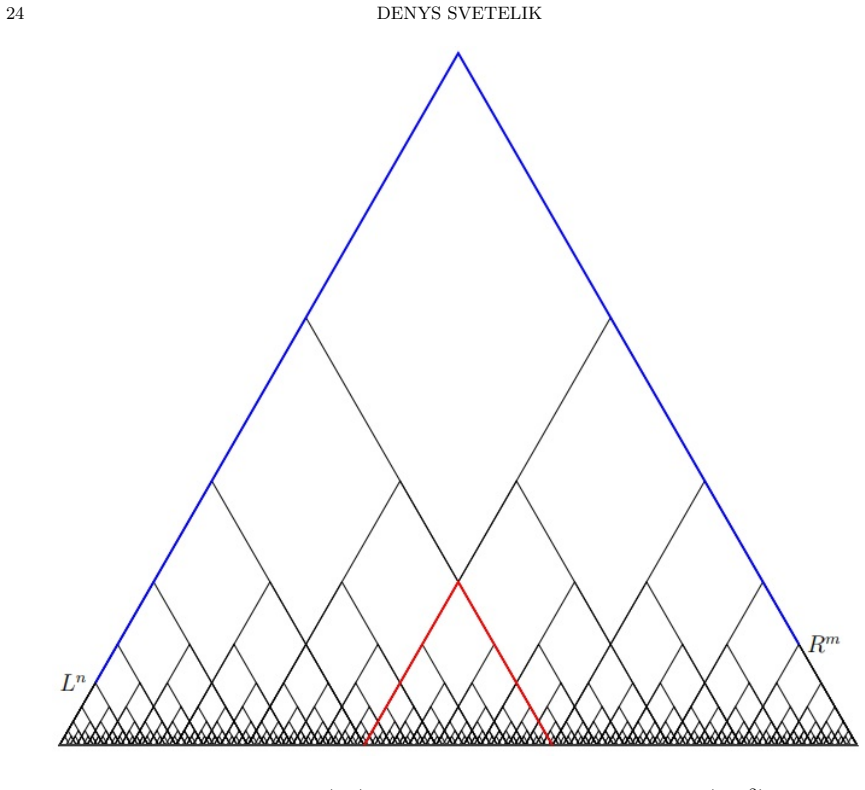
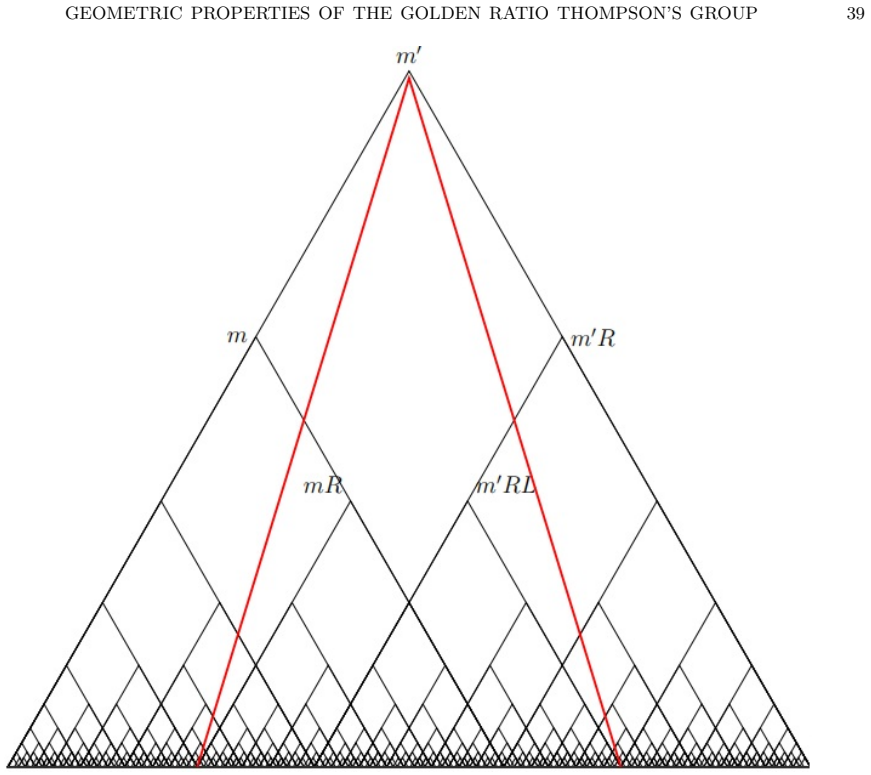
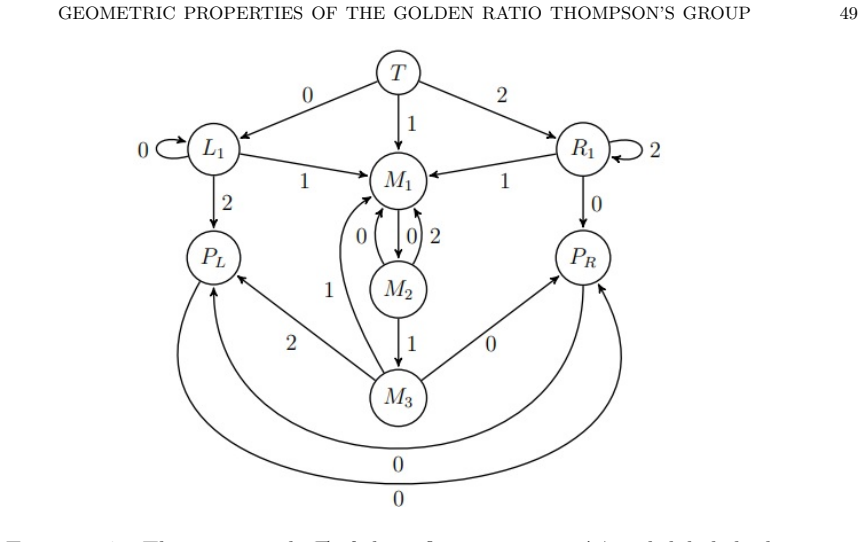
The authors establish that F_τ, T_τ and V_τ embed in the asynchronous rational group. For the monoid M = ⟨L, R : LR² = RL²⟩, whose topological full group is V_τ, they compute the distance function on its Cayley graph, prove that the graph is Gromov hyperbolic, and show that the horofunction boundary is homeomorphic to a space resembling a Cantor set with isolated points situated between each pair of breakpoints.
What carries the argument
The monoid M = ⟨L, R : LR² = RL²⟩, whose topological full group equals V_τ and whose Cayley graph carries the distance function, hyperbolicity, and horofunction boundary used to obtain the geometric conclusions.
If this is right
- The embeddings allow geometric and algorithmic properties of the asynchronous rational group to be pulled back to F_τ, T_τ and V_τ.
- Explicit distance formulas become available for words in the monoid M and therefore for elements of V_τ.
- Gromov hyperbolicity implies that geodesic triangles in the monoid graph are uniformly thin, yielding negative curvature behavior.
- The described horofunction boundary supplies a concrete topological model for the asymptotic directions of V_τ.
Where Pith is reading between the lines
- The same monoid presentation technique could be applied to other parameterized Thompson groups to test whether their associated graphs are also hyperbolic.
- The isolated points between Cantor-set breakpoints may correspond to finite-order elements or particular stabilizers in the group action on the boundary.
- Embedding into the asynchronous rational group may make word problems or conjugacy questions for these golden-ratio groups decidable via automata methods.
Load-bearing premise
The monoid M with generators L and R and the relation LR² = RL² has topological full group exactly equal to V_τ, so that geometric properties of the monoid graph transfer directly to the group.
What would settle it
An element of V_τ that lies outside the image of the monoid M under the topological full group map, or an explicit sequence of four points in the Cayley graph of M whose geodesics fail the thin-triangle condition for Gromov hyperbolicity.
Figures








read the original abstract
We show that all three golden ratio Thompson's groups $F_\tau$, $T_\tau$ and $V_\tau$ embed in the asynchronous rational group. We prove properties of the Cayley graph of the monoid $M = \langle L, R : LR^2 = RL^2 \rangle$, whose topological full group is $V_\tau$. In particular, we compute a distance function for the Cayley graph of the monoid $M$. Additionally, we prove that this Cayley graph is hyperbolic in the sense of Gromov. Our analysis reveals that the horofunction boundary of this graph is homeomorphic to a space resembling a Cantor-like set, with additional isolated points situated between each pair of breakpoints.
Editorial analysis
A structured set of objections, weighed in public.
Referee Report
Summary. The paper claims that the golden ratio Thompson groups F_τ, T_τ and V_τ all embed into the asynchronous rational group. It studies the monoid M = ⟨L, R : LR² = RL²⟩, asserts that the topological full group of M is exactly V_τ, derives an explicit distance formula on the Cayley graph of M, proves that this graph is Gromov hyperbolic, and identifies the horofunction boundary with a Cantor-like set augmented by isolated points between breakpoints.
Significance. If the monoid-to-group identification is rigorously established and the geometric arguments are correct, the results would supply a concrete hyperbolic model for V_τ together with an explicit boundary description, strengthening the geometric toolkit available for Thompson groups and their embeddings. The distance formula and hyperbolicity proof would constitute verifiable, parameter-free contributions in the style of geometric group theory.
major comments (2)
- [Abstract and introduction] The central transfer of Gromov hyperbolicity and the horofunction boundary description from the Cayley graph of M to the group V_τ rests on the claim that the topological full group of M equals V_τ. No self-contained generation argument is supplied in the abstract linking the single relation LR² = RL² to the standard piecewise-linear generators of V_τ; this identification must be proved in detail (e.g., by exhibiting explicit words in L and R that realize the usual generators of V_τ and verifying that the action on the Cantor set coincides).
- [Section on embeddings] The embeddings of F_τ and T_τ into the asynchronous rational group are stated to follow from the same monoid framework. It is unclear whether these embeddings are proved independently of the V_τ identification or whether they inherit the same gap; a separate verification that the images of F_τ and T_τ lie inside the asynchronous rational group without invoking the full V_τ claim is needed.
minor comments (2)
- [Title] The title contains the typographical error 'ration' instead of 'ratio'.
- [Boundary section] Notation for the horofunction boundary should be introduced with a precise definition before the homeomorphism statement is asserted.
Simulated Author's Rebuttal
We thank the referee for their insightful comments, which will help improve the clarity of our manuscript. We address the major comments point by point below and plan to make revisions to strengthen the presentation of our results.
read point-by-point responses
-
Referee: [Abstract and introduction] The central transfer of Gromov hyperbolicity and the horofunction boundary description from the Cayley graph of M to the group V_τ rests on the claim that the topological full group of M equals V_τ. No self-contained generation argument is supplied in the abstract linking the single relation LR² = RL² to the standard piecewise-linear generators of V_τ; this identification must be proved in detail (e.g., by exhibiting explicit words in L and R that realize the usual generators of V_τ and verifying that the action on the Cantor set coincides).
Authors: We acknowledge that the abstract is concise and does not include the full details of the identification. However, the manuscript provides the relation and asserts the topological full group is V_τ based on the action. To address this concern, we will revise the introduction to include a self-contained argument: we will exhibit explicit words in L and R corresponding to the standard generators of V_τ and verify the coincidence of the actions on the Cantor set. This will make the transfer of properties rigorous and self-contained. revision: yes
-
Referee: [Section on embeddings] The embeddings of F_τ and T_τ into the asynchronous rational group are stated to follow from the same monoid framework. It is unclear whether these embeddings are proved independently of the V_τ identification or whether they inherit the same gap; a separate verification that the images of F_τ and T_τ lie inside the asynchronous rational group without invoking the full V_τ claim is needed.
Authors: The embeddings for F_τ and T_τ are constructed directly using the monoid generators L and R without requiring the full identification with V_τ. Nevertheless, to clarify this, we will add a separate subsection verifying that the images of F_τ and T_τ are contained in the asynchronous rational group by explicit construction of the corresponding elements and their actions, independent of the V_τ claim. revision: yes
Circularity Check
No significant circularity; derivations rest on explicit monoid presentation and standard topological full group definitions.
full rationale
The paper explicitly defines the monoid M via the finite presentation ⟨L, R : LR² = RL²⟩ and derives its Cayley graph distance function, Gromov hyperbolicity, and horofunction boundary description directly from this presentation and the resulting word metric. The statement that the topological full group of M equals V_τ serves as a transfer mechanism to apply these results to the golden-ratio Thompson group, but this identification is presented as a known or separately established fact rather than a self-referential definition or fitted parameter within the geometric analysis. The embeddings of F_τ, T_τ, and V_τ into the asynchronous rational group are claimed as proven results without any exhibited reduction to prior fitted inputs or self-citation chains that would force the conclusions by construction. No equations or steps in the provided abstract or claims reduce the hyperbolicity or boundary homeomorphism to tautological inputs; the analysis remains self-contained against external benchmarks of group presentations and topological full groups.
Axiom & Free-Parameter Ledger
axioms (1)
- domain assumption The monoid M is defined by the presentation ⟨L, R : LR² = RL²⟩ and its topological full group equals V_τ.
Lean theorems connected to this paper
-
IndisputableMonolith.Constantsphi_golden_ratio echoes?
echoesECHOES: this paper passage has the same mathematical shape or conceptual pattern as the Recognition theorem, but is not a direct formal dependency.
monoid M=⟨L,R:LR²=RL²⟩ whose topological full group is V_τ … horofunction boundary … homeomorphic to a space resembling a Cantor-like set, with additional isolated points situated between each pair of breakpoints … Z[τ]∩(0,1)
-
IndisputableMonolith.Foundation.BranchSelectionbranch_selection echoes?
echoesECHOES: this paper passage has the same mathematical shape or conceptual pattern as the Recognition theorem, but is not a direct formal dependency.
every cone in Cay(M) is strongly geodesically convex … distance formula … self-similar to the whole graph itself
What do these tags mean?
- matches
- The paper's claim is directly supported by a theorem in the formal canon.
- supports
- The theorem supports part of the paper's argument, but the paper may add assumptions or extra steps.
- extends
- The paper goes beyond the formal theorem; the theorem is a base layer rather than the whole result.
- uses
- The paper appears to rely on the theorem as machinery.
- contradicts
- The paper's claim conflicts with a theorem or certificate in the canon.
- unclear
- Pith found a possible connection, but the passage is too broad, indirect, or ambiguous to say the theorem truly supports the claim.
Reference graph
Works this paper leans on
- [1]
-
[2]
Belk, J., and Bleak, C. (2017). Some undecidability results for asynchronous transducers and the Brin-Thompson group 2V. Transactions of the American Mathematical Society, 369(5), 3157-3172
work page 2017
- [3]
-
[4]
Belk, J., Bleak, C., and Matucci, F. (2021). Rational embeddings of hyperbolic groups. Journal of Combinatorial Algebra, 5(2), 123-183
work page 2021
-
[5]
Belk, J., Hyde, J., and Matucci, F. (2019). On the asynchronous rational group. Groups, Geometry, and Dynamics, 13(4), 1271-1284
work page 2019
-
[6]
Bergman, G. (1957). A number system with an irrational base. Mathematics magazine, 31(2), 98-110
work page 1957
-
[7]
Burillo, J., Nucinkis, B., and Reeves, L. (2021). An irrational-slope Thompson’s group. Publicacions matem` atiques, 65(2), 809-839
work page 2021
- [8]
-
[9]
Burillo, J., Nucinkis, B., and Reeves, L. (2022). Irrational-slope versions of thompson’s groups T and V. Proceedings of the Edinburgh Mathematical Society, 65(1), 244-262
work page 2022
-
[10]
Cannon, J. W. (1996). Introductory notes on Richard Thompson’s groups. Enseignement Mathema- tique. 42(2), 215-256. 58 DENYS SVETELIK
work page 1996
-
[11]
Cleary, S. (2000). Regular subdivision inZ[ 1+ √ 5 2 ]. Illinois Journal of Mathematics, 44(3), 453-464
work page 2000
-
[12]
Dydak, J. (1977). 1-movable continua need not be pointed 1-movable. Bulletin de l’Academie polon- aise des sciences-serie des sciences mathematiques, astronomiques, et physiques, 25(6), 559-562
work page 1977
-
[13]
Freyd, P., and Heller, A. (1993). Splitting homotopy idempotents II. Journal of pure and applied algebra, 89(1-2), 93-106
work page 1993
-
[14]
Geoghegan, R., and Brown, K. S. (1984). An infinite-dimensional torsion-freeF P ∞ group. Inven- tiones Mathematicae, 77, 367-381
work page 1984
-
[15]
Grigorchuk, R. I., Nekrashevych, V. V., and Sushchansky, V. I. (2000). Automata, dynamical sys- tems, and groups. Trudy Matematicheskogo Instituta Imeni VA Steklova, 231, 134-214
work page 2000
-
[16]
Gromov, M. (1987). Hyperbolic groups. In Essays in group theory. Mathematical Sciences Research Institute Publications 8, 75-263
work page 1987
-
[17]
Jech, T. (2003). Set theory: The third millennium edition, revised and expanded. Springer Berlin Heidelberg
work page 2003
-
[18]
Kong, S. L., Lau, K. S., and Wang, X. Y. (2021). Gromov hyperbolic graphs arising from iterations. arXiv:2006.12916
-
[19]
(2017) Geometric Group Theory, An Introduction
Loh, C. (2017) Geometric Group Theory, An Introduction. Springer International Publishing AG, Cham
work page 2017
-
[20]
McKenzie, R., and Thompson, R. J. (1973). An elementary construction of unsolvable word problems in group theory. In Studies in Logic and the Foundations of Mathematics, 71, 457-478
work page 1973
-
[21]
Mihalik, M. L. (1985). Ends of groups with the integers as quotient. Journal of Pure and Applied Algebra, 35, 305-320
work page 1985
-
[22]
Rover, C. E. (1999). Constructing finitely presented simple groups that contain Grigorchuk groups. Journal of Algebra, 220(1), 284-313
work page 1999
-
[23]
Thompson, R. J. (1980). Embeddings into finitely generated simple groups which preserve the word problem. In Studies in Logic and the Foundations of Mathematics, 95, 401-441
work page 1980
-
[24]
Webster, S. (2014). The path space of a directed graph. Proceedings of the American Mathematical Society, 142(1), 213-225
work page 2014
-
[25]
Webster, C., and Winchester, A. (2005). Boundaries of hyperbolic metric spaces. Pacific journal of mathematics, 221(1), 147-158
work page 2005
-
[26]
Willard, S. (1970). General Topology Addison-Wesley. Reading, MA. D. Svetelik, Concordia University, Department of Mathematics and Statistics, Montr´ eal, Qu´ ebec, H3G-1M8, Canada Email address:denys.svetelik@concordia.ca
work page 1970
discussion (0)
Sign in with ORCID, Apple, or X to comment. Anyone can read and Pith papers without signing in.