R²Net: 2D Deep Residual Learning with Height Embedding for 3D Radio Map Estimation
Pith reviewed 2026-05-20 00:49 UTC · model grok-4.3
The pith
Embedding height information into 2D images allows a residual network to estimate accurate 3D radio maps without 3D convolutions.
A machine-rendered reading of the paper's core claim, the machinery that carries it, and where it could break.
Core claim
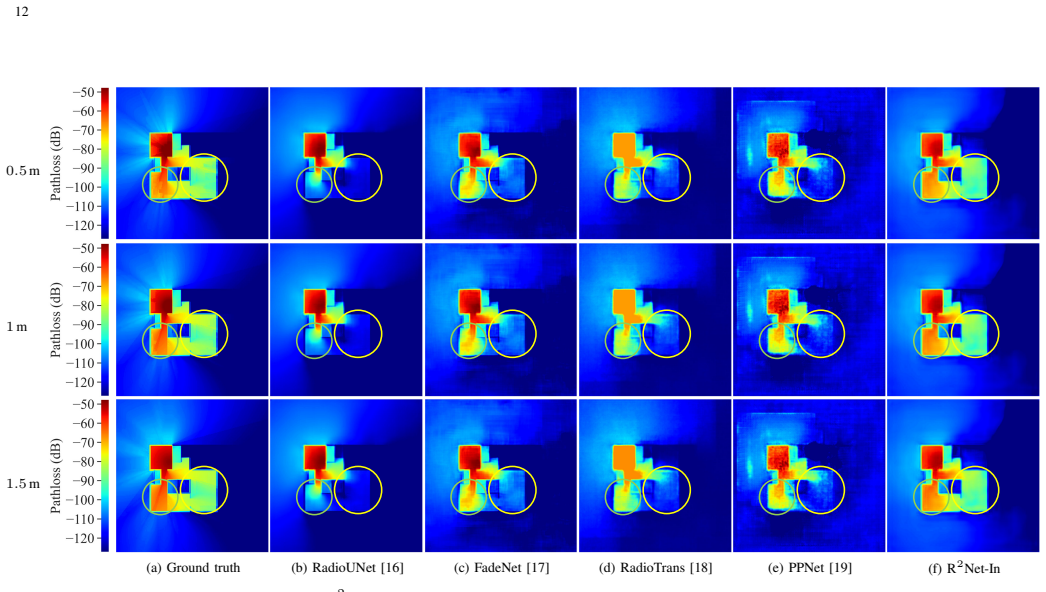
The authors first embed height information into 2D images and then apply a general 2D radio residual network called R²Net to perform 3D radio map estimation. They create R²Net-In to capture penetration loss in indoor settings and R²Net-Out to capture diffraction loss in outdoor settings. This produces radio maps that vary correctly with receiver height while delivering higher estimation accuracy, reduced computational and storage costs, and faster inference than existing methods.
What carries the argument
Height embedding into 2D images fed to the R²Net, a 2D residual network that models radio-specific loss mechanisms.
If this is right
- 3D radio maps can be generated using only 2D network architectures and lower resource demands.
- R²Net-In specifically improves modeling of indoor penetration losses while R²Net-Out improves modeling of outdoor diffraction losses.
- Estimation accuracy, computational cost, storage cost, and inference speed all improve over prior state-of-the-art approaches.
- A public 3D indoor radio map dataset supports training and benchmarking of height-aware models.
Where Pith is reading between the lines
- Similar height-embedding steps could extend to other spatial prediction tasks such as coverage mapping at multiple frequencies.
- Fast inference from the 2D design may support real-time radio map updates in environments with changing conditions.
- The method could be tested on scenarios that include moving obstacles or multi-floor buildings to check robustness beyond the current dataset.
Load-bearing premise
Embedding height information into 2D images supplies enough detail for a 2D residual network to capture full three-dimensional radio propagation effects without explicit 3D operations or geometric modeling.
What would settle it
Direct comparison of R²Net pathloss predictions against measured values at multiple distinct receiver heights in a real indoor or outdoor site would show whether the 3D estimates match observed propagation behavior.
Figures




read the original abstract
Acquiring channel knowledge is required by many applications. For instance, handover in cellular networks is mainly decided based on the knowledge of pathloss. In contrast to traditional statistical distance-determined models that might provide misleading pathloss estimates, researchers started to explore deep learning methods recently to accurately estimate the radio map that characterizes the spatial distribution of pathloss according to the specific physical wireless propagation environment. However, existing works mainly focused on 2D radio map estimation by assuming that all receivers are at the same height. In fact, radio maps could be significantly different at different receiver heights, highlighting the importance of 3D radio map estimation. In this paper, we first propose a method to embed height information into 2D images, and then propose a general 2D radio residual network (R$^{2}$Net) for 3D radio map estimation. Since pathloss exhibits different characteristics in indoor and outdoor scenarios, we specifically propose R$^{2}$Net-In for indoor scenarios and R$^{2}$Net-Out for outdoor scenarios to better capture penetration loss and diffraction loss, respectively. Extensive experimental results show that our R$^{2}$Net significantly outperforms the state-of-the-art benchmarks in terms of estimation accuracy, computational and storage costs, and inference speed. In addition, due to the lack of publicly available 3D radio map datasets, a 3D indoor radio map dataset (3DiRM3200) is created, which took more than $1,000$ labour hours. The dataset and codes will be available at https://github.com/lighttime2023/3DiRM3200.git.
Editorial analysis
A structured set of objections, weighed in public.
Referee Report
Summary. The manuscript introduces a height-embedding technique to convert 3D radio-map inputs into 2D tensors, then applies a residual network (R²Net) to estimate pathloss across multiple receiver heights. Separate variants are defined for indoor (R²Net-In, emphasizing penetration) and outdoor (R²Net-Out, emphasizing diffraction) scenarios. The authors release a new 3D indoor dataset (3DiRM3200) and report that R²Net outperforms prior benchmarks on accuracy, storage, compute, and inference speed.
Significance. If the central claims are substantiated, the work would demonstrate that a carefully designed 2D residual architecture with height embedding can deliver practical 3D radio maps at lower cost than explicit 3D models, which is relevant for network planning and handover applications. The public release of 3DiRM3200 and the associated code is a clear positive contribution that lowers the barrier for future 3D radio-map research.
major comments (2)
- [§3.2] §3.2 (Height Embedding): the formulation concatenates or tiles height scalars into 2D feature maps, yet provides no mechanism (ray-tracing prior, vertical consistency loss, or multi-height attention) that would allow subsequent 2D convolutions to enforce physically consistent diffraction or shadowing across heights; this is load-bearing for the claim that a purely 2D network suffices for full 3D estimation.
- [§4.3, Table 2] §4.3 and Table 2: the reported RMSE and inference-time gains are presented without error bars, without per-height breakdown, and without an ablation that isolates the height-embedding block; without these controls it is impossible to verify that the 2D architecture, rather than dataset-specific tuning, drives the claimed superiority over 3D baselines.
minor comments (2)
- [Abstract] The abstract states quantitative superiority but supplies no numerical values or baseline names; adding one sentence with key metrics would improve readability.
- [§3.1] Notation for the embedded height channel (e.g., H_e) is introduced without an explicit equation; a short definition in §3.1 would remove ambiguity.
Simulated Author's Rebuttal
We thank the referee for the constructive feedback on our manuscript. We address each major comment below with clarifications and indicate the revisions we will make to strengthen the paper.
read point-by-point responses
-
Referee: [§3.2] §3.2 (Height Embedding): the formulation concatenates or tiles height scalars into 2D feature maps, yet provides no mechanism (ray-tracing prior, vertical consistency loss, or multi-height attention) that would allow subsequent 2D convolutions to enforce physically consistent diffraction or shadowing across heights; this is load-bearing for the claim that a purely 2D network suffices for full 3D estimation.
Authors: We acknowledge that the current formulation does not include an explicit mechanism such as a vertical consistency loss or multi-height attention. The height embedding injects scalar height information by concatenation or tiling into the 2D feature maps, allowing the residual blocks to learn height-dependent features from the training data, which contains pathloss values across multiple receiver heights. This data-driven learning enables the network to capture effects like diffraction and shadowing implicitly. To better substantiate the claim, we will revise §3.2 to include a more detailed explanation of how the embedding facilitates vertical consistency and add qualitative visualizations of estimated radio maps at consecutive heights demonstrating physical plausibility. revision: partial
-
Referee: [§4.3, Table 2] §4.3 and Table 2: the reported RMSE and inference-time gains are presented without error bars, without per-height breakdown, and without an ablation that isolates the height-embedding block; without these controls it is impossible to verify that the 2D architecture, rather than dataset-specific tuning, drives the claimed superiority over 3D baselines.
Authors: We agree that the absence of error bars, per-height breakdowns, and an ablation isolating the height-embedding block limits the strength of the experimental claims. In the revised version, we will update §4.3 and Table 2 to include error bars (mean ± standard deviation over multiple runs), report RMSE results separately for each receiver height, and add an ablation study comparing the full model against a variant without the height-embedding module. These changes will help isolate the contribution of the proposed components. revision: yes
Circularity Check
No circularity: standard residual network training on height-embedded 2D inputs
full rationale
The paper proposes a height-embedding step into 2D images followed by application of a 2D residual network (R²Net) for 3D radio map estimation, with separate indoor/outdoor variants. No equations, derivations, or fitted parameters are shown that reduce the claimed estimation outputs to quantities defined by or fitted on the evaluation data itself. The central results rest on experimental comparisons to benchmarks using a newly created dataset, with no load-bearing self-citations or uniqueness theorems invoked to force the architecture. The approach is therefore self-contained as a standard deep-learning method applied to a new input representation.
Axiom & Free-Parameter Ledger
axioms (1)
- domain assumption Height information can be effectively embedded into 2D image representations to capture 3D radio propagation variations.
Lean theorems connected to this paper
-
IndisputableMonolith/Foundation/RealityFromDistinction.leanreality_from_one_distinction unclear?
unclearRelation between the paper passage and the cited Recognition theorem.
we first propose a method to embed height information into 2D images, and then propose a general 2D radio residual network (R²Net) for 3D radio map estimation
-
IndisputableMonolith/Cost/FunctionalEquation.leanwashburn_uniqueness_aczel unclear?
unclearRelation between the paper passage and the cited Recognition theorem.
R²Net-In … incorporating dropout layers to better capture penetration loss, while for outdoor scenarios, R²Net-Out … adopting atrous spatial pyramid pooling (ASPP) and cascaded residual blocks to extract abundant diffraction loss
What do these tags mean?
- matches
- The paper's claim is directly supported by a theorem in the formal canon.
- supports
- The theorem supports part of the paper's argument, but the paper may add assumptions or extra steps.
- extends
- The paper goes beyond the formal theorem; the theorem is a base layer rather than the whole result.
- uses
- The paper appears to rely on the theorem as machinery.
- contradicts
- The paper's claim conflicts with a theorem or certificate in the canon.
- unclear
- Pith found a possible connection, but the passage is too broad, indirect, or ambiguous to say the theorem truly supports the claim.
Reference graph
Works this paper leans on
-
[1]
A 2D deep residual learning approach f or 3D indoor radio map estimation,
H. Rao and J. Wang, “A 2D deep residual learning approach f or 3D indoor radio map estimation,” in Proc. IEEE ICC , Jun. 2024, pp. 3797– 3802
work page 2024
-
[2]
Radio map-based spectrum sharing for joint communication and sen sing,
X. Fang, W. Feng, Y . Chen, D. Y ang, N. Ge, Z. Feng, and Y . Gao, “Radio map-based spectrum sharing for joint communication and sen sing,” IEEE Open J. Commun. Soc. , vol. 5, pp. 4541–4558, Jul. 2024
work page 2024
-
[3]
Aerial base station pl acement leveraging radio tomographic maps,
D. Romero, P . Q. Viet, and G. Leus, “Aerial base station pl acement leveraging radio tomographic maps,” in Proc. IEEE ICASSP , May 2022, pp. 5358–5362
work page 2022
-
[4]
Intelligent reflecting surface enhanced indoor robot path planning: A radio map-ba sed ap- proach,
X. Mu, Y . Liu, L. Guo, J. Lin, and R. Schober, “Intelligent reflecting surface enhanced indoor robot path planning: A radio map-ba sed ap- proach,” IEEE Trans. Wireless Commun. , vol. 20, no. 7, pp. 4732–4747, Jul. 2021
work page 2021
-
[5]
C.-X. Wang, M. D. Renzo, S. Stanczak, S. Wang, and E. G. Lar sson, “Artificial intelligence enabled wireless networking for 5 G and beyond: Recent advances and future challenges,” IEEE Wireless Commun. , vol. 27, no. 1, pp. 16–23, Feb. 2020
work page 2020
-
[6]
On the road to 6G: Visio ns, requirements, key technologies, and testbeds,
C.-X. Wang, X. Y ou, X. Gao, et al., “On the road to 6G: Visio ns, requirements, key technologies, and testbeds,” IEEE Commun. Surveys Tuts., vol. 25, no. 2, pp. 905–974, Feb. 2nd Quart. 2023
work page 2023
-
[7]
A tutorial on environment-aware commu nications via channel knowledge map for 6G,
Y . Zeng, J. Chen, J. Xu, D. Wu, X. Xu, S. Jin, X. Gao, D. Gesbe rt, S. Cui, and R. Zhang, “A tutorial on environment-aware commu nications via channel knowledge map for 6G,” IEEE Commun. Surveys Tuts. , Feb. 2024. 15
work page 2024
-
[8]
Real-tim e outdoor localization using radio maps: A deep learning approach,
C ¸ . Y apar, R. Levie, G. Kutyniok, and G. Caire, “Real-tim e outdoor localization using radio maps: A deep learning approach,” IEEE Trans. Wireless Commun., vol. 22, no. 12, pp. 9703–9717, Dec. 2023
work page 2023
-
[9]
Propagation map reconstruction via i nterpolation assisted matrix completion,
H. Sun and J. Chen, “Propagation map reconstruction via i nterpolation assisted matrix completion,” IEEE Trans. Signal Process. , vol. 70, pp. 6154–6169, Dec. 2022
work page 2022
-
[10]
J. Wang, Q. Zhu, Z. Lin, J. Chen, G. Ding, Q. Wu, G. Gu, and Q. Gao, “Sparse Bayesian learning-based hierarchical cons truction for 3D radio environment maps incorporating channel shadowing ,” IEEE Trans. Wireless Commun., vol. 23, no. 10, pp. 14 560–14 574, Oct. 2024
work page 2024
-
[11]
Z. Lin, K. Liu, S. Wu, Q. Zhu, Q. Gao, W. Zhong, and Q. Wu, “N onlin- earity approximation-based spectrum map fusion with envir onmentally adaptive regularization,” IEEE Trans. Cognit. Commun. Networking , vol. 12, pp. 4032–4044, 2026
work page 2026
-
[12]
R. Hoppe, G. W¨ olfle, and U. Jakobus, “Wave propagation a nd radio network planning software WinProp added to the electromagn etic solver package FEKO,” in Proc. IEEE ACES , Mar. 2017, pp. 1–2
work page 2017
-
[13]
K-Nearest Neighbors Gaussian pro cess regres- sion for urban radio map reconstruction,
Y . Zhang and S. Wang, “K-Nearest Neighbors Gaussian pro cess regres- sion for urban radio map reconstruction,” IEEE Commun. Lett. , vol. 26, no. 12, pp. 3049–3053, Dec. 2022
work page 2022
-
[14]
Model-free radio map estimation in massive MIMO systems vi a semi- parametric gaussian regression,
N. Dal Fabbro, M. Rossi, G. Pillonetto, L. Schenato, and G. Piro, “Model-free radio map estimation in massive MIMO systems vi a semi- parametric gaussian regression,” IEEE Wireless Commun. Lett. , vol. 11, no. 3, pp. 473–477, Mar. 2022
work page 2022
-
[15]
Radio environment map construction based on gaussian process wit h positional uncertainty,
P . Zhen, B. Zhang, Y .-Q. Xu, Z. Chen, H. Wang, and D. Guo, “ Radio environment map construction based on gaussian process wit h positional uncertainty,” IEEE Wireless Commun. Lett. , vol. 11, no. 8, pp. 1639– 1643, Aug. 2022
work page 2022
-
[16]
RadioUN et: Fast radio map estimation with convolutional neural networks,
R. Levie, C ¸ . Y apar, G. Kutyniok, and G. Caire, “RadioUN et: Fast radio map estimation with convolutional neural networks,” IEEE Trans. Wireless Commun., vol. 20, no. 6, pp. 4001–4015, Jun. 2021
work page 2021
-
[17]
FadeNet: Deep learning-base d mm- wave large-scale channel fading prediction and its applica tions,
V . V . Ratnam, H. Chen, S. Pawar, B. Zhang, C. J. Zhang, Y .- J. Kim, S. Lee, M. Cho, and S.-R. Y oon, “FadeNet: Deep learning-base d mm- wave large-scale channel fading prediction and its applica tions,” IEEE Access, vol. 9, pp. 3278–3290, Dec. 2020
work page 2020
-
[18]
Transformer based radio map prediction model for dense urban environments,
Y . Tian, S. Y uan, W. Chen, and N. Liu, “Transformer based radio map prediction model for dense urban environments,” in Proc. IEEE ISAPE , Dec. 2021, pp. 1–3
work page 2021
-
[19]
Pseudo ray- tracing: Deep leaning assisted outdoor mm-wave path loss pr ediction,
K. Qiu, S. Bakirtzis, H. Song, J. Zhang, and I. Wassell, “ Pseudo ray- tracing: Deep leaning assisted outdoor mm-wave path loss pr ediction,” IEEE Wireless Commun. Lett., vol. 11, no. 8, pp. 1699–1702, Aug. 2022
work page 2022
-
[20]
Extending mac hine learning based RF coverage predictions to 3D,
M. Chen, M. Chˆ ateauvert, and J. Ethier, “Extending mac hine learning based RF coverage predictions to 3D,” in Proc. IEEE AP-S/URSI , Jul. 2022, pp. 205–206
work page 2022
-
[21]
Pano2RSSI: G eneration of RSSI maps for a room environment from a single panoramic im age,
N. Raj, D. V . V . Sai Teja, and B. S. Vineeth, “Pano2RSSI: G eneration of RSSI maps for a room environment from a single panoramic im age,” in Proc. IEEE ANTS , Dec. 2020, pp. 1–6
work page 2020
-
[22]
RadioResUNet: Wireless measurement by deep learning for indoor environments,
C.-W. Pyo, H. Sawada, and T. Matsumura, “RadioResUNet: Wireless measurement by deep learning for indoor environments,” in Proc. IEEE WPMC, Nov. 2022, pp. 104–109
work page 2022
-
[23]
N. Raj and V . B. S., “IndoorRSSINet - Deep learning based 2D RSSI map prediction for indoor environments with application to wireless localization,” in Proc. IEEE COMSNETS , Jan. 2023, pp. 609–616
work page 2023
-
[24]
Deep transfer learning based radio map estimation for indoor wir eless com- munications,
R. Jaiswal, M. Elnourani, S. Deshmukh, and B. Beferull- Lozano, “Deep transfer learning based radio map estimation for indoor wir eless com- munications,” in Proc. IEEE SPAWC, Jul. 2022, pp. 1–5
work page 2022
-
[25]
C.-X. Wang, Z. Lv, X. Gao, X. Y ou, Y . Hao, and H. Haas, “Per vasive wireless channel modeling theory and applications to 6G GBS Ms for all frequency bands and all scenarios,” IEEE Trans. V eh. Technol., vol. 71, no. 9, pp. 9159–9173, Sept. 2022
work page 2022
-
[26]
A complete study of space- time-frequency statistical properties of the 6G pervasive channel model,
C.-X. Wang, Z. Lv, Y . Chen, and H. Haas, “A complete study of space- time-frequency statistical properties of the 6G pervasive channel model,” IEEE Trans. Commun. , vol. 71, no. 12, pp. 7273–7287, Dec. 2023
work page 2023
-
[27]
Improving triplet-based channel charting on distributed massive MIMO measurements,
F. Euchner, P . Stephan, M. Gauger, S. D¨ orner, and S. Ten Brink, “Improving triplet-based channel charting on distributed massive MIMO measurements,” in Proc. IEEE SPAWC, Jul. 2022, pp. 1–5
work page 2022
-
[28]
In- door Tera-Hertz channel measurements,
China Academy of Information and Communications Techn ology, “In- door Tera-Hertz channel measurements,” [Online]. Availab le: www. mobileai-dataset.cn, accessed 25.08.2022
work page 2022
-
[29]
Dataset of pathloss and ToA radio maps with localization application,
C ¸ . Y apar, R. Levie, G. Kutyniok, and G. Caire, “Dataset of pathloss and ToA radio maps with localization application,” arXiv:2212.11777 [cs.NI], Sept. 2023
-
[30]
Cu- biCasa5K: A dataset and an improved multi-task model for floo rplan image analysis,
A. Kalervo, J. Ylioinas, M. H¨ aiki¨ o, A. Karhu, and J. Ka nnala, “Cu- biCasa5K: A dataset and an improved multi-task model for floo rplan image analysis,” in Proc. SCIA , Jun. 2019, pp. 28–40
work page 2019
-
[31]
U-Net: Convol utional net- works for biomedical image segmentation,
O. Ronneberger, P . Fischer, and T. Brox, “U-Net: Convol utional net- works for biomedical image segmentation,” in Proc. MICCAI, Oct. 2015, pp. 234–241
work page 2015
-
[32]
SegNet : A deep convolutional encoder-decoder architecture for image seg mentation,
V . Badrinarayanan, A. Kendall, and R. Cipolla, “SegNet : A deep convolutional encoder-decoder architecture for image seg mentation,” IEEE Trans. Pattern Anal. Mach. Intell. , vol. 39, no. 12, pp. 2481–2495, Dec. 2017
work page 2017
-
[33]
Deep residual learni ng for image recognition,
K. He, X. Zhang, S. Ren, and J. Sun, “Deep residual learni ng for image recognition,” in Proc. IEEE CVPR , Jun. 2016, pp. 770–778
work page 2016
-
[34]
L. Zhang, H. Sun, J. Sun, and R. Q. Hu, “WiSegRT: Dataset f or site- specific indoor radio propagation modeling with 3D segmenta tion and differentiable ray-tracing: (invited paper),” in Proc. IEEE ICNC , Feb. 2024, pp. 744–748
work page 2024
-
[35]
Dominant path prediction model for indoor scenarios,
G. W¨ olfle, R. Wahl, P . Wertz, P . Wildbolz, and F. Landstorfer, “Dominant path prediction model for indoor scenarios,” in Proc. GeMIC, 2005
work page 2005
-
[36]
A theoretical an alysis of feature pooling in visual recognition,
Y .-L. Boureau, J. Ponce, and Y . LeCun, “A theoretical an alysis of feature pooling in visual recognition,” in Proc. ICML, Jun. 2010, pp. 111–118
work page 2010
-
[37]
Rethinking Atrous Convolution for Semantic Image Segmentation
L.-C. Chen, G. Papandreou, F. Schroff, and H. Adam, “Ret hinking atrous convolution for semantic image segmentation,” arXiv:1706.05587 [cs.CV], Dec. 2017
work page internal anchor Pith review Pith/arXiv arXiv 2017
-
[38]
S. Oualline, G. Oualline, S. Oualline, and G. Oualline, “Drawing with Inkscape,” Practical Free Alternatives To Commercial Software , pp. 187–219, May 2018
work page 2018
-
[39]
Propagat ion channel modeling utilizing discrimination analysis for outdoor en vironments,
B. M. Amer, A. Ali Almahroug, and A. I. A. Omer, “Propagat ion channel modeling utilizing discrimination analysis for outdoor en vironments,” in Proc. IEEE MI-STA , May 2022, pp. 15–20
work page 2022
-
[40]
Indoor a nd outdoor 5G diffraction measurements and models at 10, 20, and 26 GHz,
S. Deng, G. R. MacCartney, and T. S. Rappaport, “Indoor a nd outdoor 5G diffraction measurements and models at 10, 20, and 26 GHz, ” in Proc. IEEE GLOBECOM , Dec. 2016, pp. 1–7
work page 2016
-
[41]
A new approac h of the beam ray tracing with double diffraction, for outdoor propa gation,
L. V albonesi, D. Monopoli, and R. E. Zich, “A new approac h of the beam ray tracing with double diffraction, for outdoor propa gation,” in Proc. IEEE WDD , Jan. 2006, pp. 1–7
work page 2006
-
[42]
Impact of wall penet ration loss on indoor wireless networks,
Z. Li, H. Hu, J. Zhang, and J. Zhang, “Impact of wall penet ration loss on indoor wireless networks,” IEEE Antennas Wirel. Propag. Lett. , vol. 20, no. 10, pp. 1888–1892, Oct. 2021
work page 2021
-
[43]
A ray-tracing metho d for mod- eling indoor wave propagation and penetration,
C.-F. Y ang, B.-C. Wu, and C.-J. Ko, “A ray-tracing metho d for mod- eling indoor wave propagation and penetration,” IEEE Trans. Antennas Propag., vol. 46, no. 6, pp. 907–919, Jun. 1998
work page 1998
-
[44]
P . Baldi and P . J. Sadowski, “Understanding dropout,” i n Proc. NIPS , vol. 26, Dec. 2013, pp. 2814–2822
work page 2013
-
[45]
Deconvolution and c heckerboard artifacts,
A. Odena, V . Dumoulin, and C. Olah, “Deconvolution and c heckerboard artifacts,” Distill, vol. 1, no. 10, p. e3, Oct. 2016
work page 2016
-
[46]
Adam: A method for stochastic opt imization,
D. P . Kingma and J. Ba, “Adam: A method for stochastic opt imization,” in Proc. ICLR , May 2015, pp. 1–15
work page 2015
-
[47]
Structural similarity index (SSIM) revisited: A data-dri ven approach,
I. Bakurov, M. Buzzelli, R. Schettini, M. Castelli, and L. V anneschi, “Structural similarity index (SSIM) revisited: A data-dri ven approach,” Expert Syst. Appl. , vol. 189, p. 116087, Mar. 2022
work page 2022
-
[48]
RSRPSet urban: Radio map in dense urban,
Y . Zheng, “RSRPSet urban: Radio map in dense urban,” Mar. 2022. [Online]. Available: https://dx.doi.org/10.21227/vmw5-c226 Huiting Rao received the B.S. and M.S. degree in communications engineering from Xiamen Univer- sity, Xiamen, China, in 2016 and 2019, respecitvely. She is currently pursuing the Ph.D. degree with the College of Electronic and Inform...
-
[49]
He has been with Southeast University, Nanjing, China , as a Professor since 2018. He worked as the Dean of the School of Information Science and Engineering, Southeast University from 2020 to 2026, an d is now a Vice President of Southeast University. He is also a Profess or with the Purple Mountain Laboratories, Nanjing. He has authored fou r books, thr...
work page 2018
discussion (0)
Sign in with ORCID, Apple, or X to comment. Anyone can read and Pith papers without signing in.