Tangent Blow-Ups for Processing Non-Manifold Geometry
Pith reviewed 2026-05-19 23:46 UTC · model grok-4.3
The pith
Tangent blow-ups lift points at singularities to separate them by tangent directions for stable geometry processing.
A machine-rendered reading of the paper's core claim, the machinery that carries it, and where it could break.
Core claim
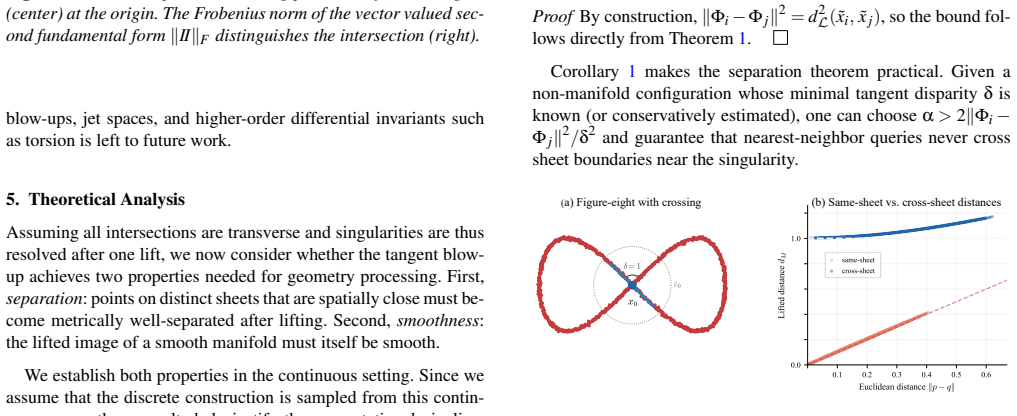
By lifting to the product of the ambient space and the Grassmannian of tangent planes, the tangent blow-up restores structure at singularities. Points that coincide in position but differ in tangent direction, curvature, or higher-order contact become well-separated after iteration. The construction is equipped with a product metric, and discretized versions of the gradient, divergence, and Laplacian are defined directly in the lifted domain for use in geometry processing pipelines.
What carries the argument
The tangent blow-up, which maps each point to a position-tangent plane pair and uses iteration to separate higher-order differences.
Load-bearing premise
Discretizing the product metric and operators on the lifted space keeps the separation intact and avoids creating new numerical artifacts near the original singularities.
What would settle it
A computation of the Laplacian on a lifted simple L-shaped polyline that shows large errors or instability localized at the corner would falsify the claim that the operators are stable.
Figures




read the original abstract
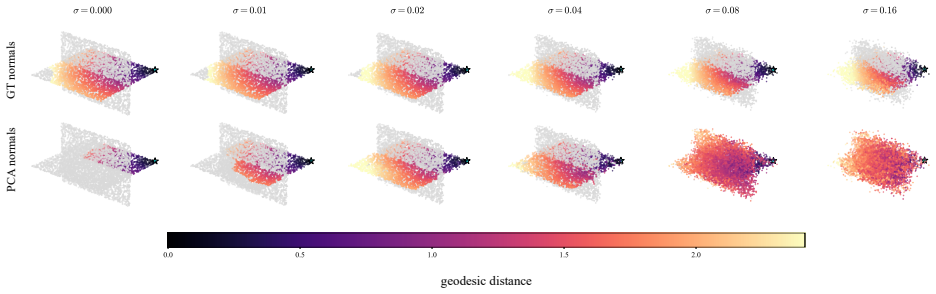
Many geometry processing pipelines implicitly assume their input data is a manifold, or is sampled from one, with a unique tangent plane at every point. Geometric data, however, routinely contains sharp features like edges, corners, self-intersections, branching junctions, and other singularities, rendering standard methods ill-defined at these points. To bring geometry processing to these and other singular spaces, we introduce the ``tangent blow-up,'' a representation inspired by algebraic geometry that restores structure at singularities by lifting to the product of the ambient space and the Grassmannian of tangent planes. After iterating this construction, points that coincide in position but differ in tangent direction, curvature, or higher-order contact become well-separated. We equip the tangent blow-up with a product metric and define discretized differential operators, such as the gradient, divergence, and Laplacian, directly in the lifted domain. We demonstrate our framework across geodesic computation, segmentation, surface parameterization, and curvature estimation.
Editorial analysis
A structured set of objections, weighed in public.
Referee Report
Summary. The manuscript introduces the tangent blow-up, a representation that lifts geometric data to the product of the ambient space and the Grassmannian of tangent planes (with iteration for higher-order contact) in order to separate points that coincide in position but differ in tangent direction at singularities. It equips the lifted space with a product metric and defines discretized differential operators (gradient, divergence, Laplacian) directly in this domain, with demonstrations on geodesic computation, segmentation, surface parameterization, and curvature estimation.
Significance. If the discretization of the product metric and operators is shown to preserve separation without reintroducing coupling at singularities, the framework would offer a principled, unified approach to geometry processing on non-manifold and singular data, reducing reliance on ad-hoc feature handling. The algebraic-geometry inspiration and explicit lifting construction are strengths that could support reproducible implementations if accompanied by clear discretization details.
major comments (1)
- [Discretization of operators (abstract and demonstration sections)] The central claim that discretized gradient, divergence, and Laplacian can be defined directly in the lifted domain (as stated in the abstract) is load-bearing for all demonstrations. The manuscript must provide the explicit discretization of the product metric on discrete inputs (meshes or point clouds) and show that lifted copies with distinct tangent planes remain separated under the chosen neighborhood or interpolation scheme; without this, standard nearest-neighbor or cotangent discretizations risk re-coupling the copies and undermining the separation property.
minor comments (1)
- [Abstract] The abstract would benefit from a single sentence clarifying the supported input representations (e.g., triangle meshes, point clouds) for which the discretization is implemented.
Simulated Author's Rebuttal
We thank the referee for the careful review and for identifying the need for greater explicitness in the discretization of the product metric and operators. We address the major comment below and will strengthen the manuscript accordingly.
read point-by-point responses
-
Referee: [Discretization of operators (abstract and demonstration sections)] The central claim that discretized gradient, divergence, and Laplacian can be defined directly in the lifted domain (as stated in the abstract) is load-bearing for all demonstrations. The manuscript must provide the explicit discretization of the product metric on discrete inputs (meshes or point clouds) and show that lifted copies with distinct tangent planes remain separated under the chosen neighborhood or interpolation scheme; without this, standard nearest-neighbor or cotangent discretizations risk re-coupling the copies and undermining the separation property.
Authors: We agree that explicit discretization details are essential to substantiate the separation property. The manuscript defines the product metric as the sum of the Euclidean distance in ambient space and the canonical metric on the Grassmannian, with operators obtained by lifting the standard cotangent or finite-element stencils to this metric. Because neighborhoods and weights are computed directly in the product space, points that coincide in position but differ in tangent plane are separated by a positive Grassmannian distance and therefore receive distinct neighbors and weights. To make this fully reproducible, we will add a dedicated subsection with pseudocode for mesh and point-cloud lifting, explicit formulas for the lifted cotangent weights, and a short numerical verification (including a simple self-intersection example) confirming that distinct tangent copies remain decoupled under the chosen scheme. revision: yes
Circularity Check
No circularity: tangent blow-up is a definitional lift with independent discretization claims
full rationale
The paper defines the tangent blow-up explicitly as a lift to the product of ambient space and Grassmannian (iterated as needed), equips it with a product metric, and states that differential operators are then defined directly on the lifted domain. This is a constructive representation rather than a fitted model or prediction that reduces to target data by construction. No equations or steps in the provided abstract or description equate the claimed operators or separation property to parameters chosen from the same data; the discretization is presented as a subsequent implementation choice whose validity is demonstrated on applications rather than assumed tautologically. No self-citation chains or uniqueness theorems imported from prior author work are invoked to force the construction. The derivation chain is therefore self-contained as a new geometric representation.
Axiom & Free-Parameter Ledger
axioms (2)
- standard math The Grassmannian of tangent planes is a well-defined manifold that can be paired with Euclidean space to form a product space with a natural metric.
- domain assumption Iterated lifting separates points that share position but differ in tangent direction or higher-order contact.
Lean theorems connected to this paper
-
IndisputableMonolith/Foundation/AlexanderDuality.leanalexander_duality_circle_linking unclear?
unclearRelation between the paper passage and the cited Recognition theorem.
We introduce the tangent blow-up, a representation inspired by algebraic geometry that restores structure at singularities by lifting to the product of the ambient space and the Grassmannian of tangent planes... We equip the tangent blow-up with a product metric and define discretized differential operators... directly in the lifted domain.
What do these tags mean?
- matches
- The paper's claim is directly supported by a theorem in the formal canon.
- supports
- The theorem supports part of the paper's argument, but the paper may add assumptions or extra steps.
- extends
- The paper goes beyond the formal theorem; the theorem is a base layer rather than the whole result.
- uses
- The paper appears to rely on the theorem as machinery.
- contradicts
- The paper's claim conflicts with a theorem or certificate in the canon.
- unclear
- Pith found a possible connection, but the passage is too broad, indirect, or ambiguous to say the theorem truly supports the claim.
Reference graph
Works this paper leans on
-
[1]
A theory of strat- ification learning
[AB24] AAMARI, EDDIEand BERENFELD, CLÉMENT. “A theory of strat- ification learning”.arXiv preprint arXiv:2405.20066(2024)
-
[2]
Polygon mesh repairing: An application perspective
[ACK13] ATTENE, MARCO, CAMPEN, MARCEL, and KOBBELT, LEIF. “Polygon mesh repairing: An application perspective”.ACM Computing Surveys (CSUR)45.2 (2013), 1–33
work page 2013
-
[3]
Anisotropic Laplace-Beltrami op- erators for shape analysis
[ARAC14] ANDREUX, MATHIEU, RODOLA, EMANUELE, AUBRY, MATHIEU, and CREMERS, DANIEL. “Anisotropic Laplace-Beltrami op- erators for shape analysis”.European conference on computer vision. Springer. 2014, 299–312
work page 2014
-
[4]
Modern differential geometry of curves and surfaces with Mathematica
[ASG17] ABBENA, ELSA, SALAMON, SIMON, and GRAY, ALFRED. Modern differential geometry of curves and surfaces with Mathematica. Chapman and Hall/CRC, 2017
work page 2017
-
[5]
Minimal submanifolds of the bi- cylinder boundary
[Ban76] BANCHOFF, THOMASF. “Minimal submanifolds of the bi- cylinder boundary”.Boletim da Sociedade Brasileira de Matemática- Bulletin/Brazilian Mathematical Society7.1 (1976), 37–57 2,
work page 1976
-
[6]
Persistent intersection ho- mology
[BH11] BENDICH, PAULand HARER, JOHN. “Persistent intersection ho- mology”.Foundations of Computational Mathematics11.3 (2011), 305– 336 2,
work page 2011
-
[7]
A varifold approach to surface approximation
[BLM17] BUET, BLANCHE, LEONARDI, GIANPAOLO, and MASNOU, SIMON. “A varifold approach to surface approximation”.Archive for Ra- tional Mechanics and Analysis226.2 (2017), 639–694
work page 2017
-
[8]
Weak and approximate curvatures of a measure: a varifold per- spective
[BLM22] BUET, BLANCHE, LEONARDI, GIANPAOLO, and MASNOU, SIMON. “Weak and approximate curvatures of a measure: a varifold per- spective”.Nonlinear Analysis222 (2022), 112983
work page 2022
- [9]
-
[10]
Stratification Learning through Homology Inference
[BMW10] BENDICH, PAUL, MUKHERJEE, SAYAN, and WANG, BEI. “Stratification Learning through Homology Inference.”AAAI Fall Sym- posium: Manifold Learning and Its Applications. 2010
work page 2010
-
[11]
Laplacian eigenmaps for dimensionality reduction and data representation
[BN03] BELKIN, MIKHAILand NIYOGI, PARTHA. “Laplacian eigenmaps for dimensionality reduction and data representation”.Neural computa- tion15.6 (2003), 1373–1396
work page 2003
-
[12]
Convergence of Laplacian eigenmaps
[BN06] BELKIN, MIKHAILand NIYOGI, PARTHA. “Convergence of Laplacian eigenmaps”.Advances in neural information processing sys- tems19 (2006) 2,
work page 2006
-
[13]
Cambridge University Press, 2023
[Bou23] BOUMAL, NICOLAS.An introduction to optimization on smooth manifolds. Cambridge University Press, 2023
work page 2023
-
[14]
Mean curvature motion of point cloud varifolds
[BR22] BUET, BLANCHEand RUMPF, MARTIN. “Mean curvature motion of point cloud varifolds”.ESAIM: Mathematical Modelling and Numer- ical Analysis56.5 (2022), 1773–1808
work page 2022
-
[15]
Vectoriza- tion of line drawings via polyvector fields
[BS19] BESSMELTSEV, MIKHAILand SOLOMON, JUSTIN. “Vectoriza- tion of line drawings via polyvector fields”.ACM Transactions on Graphics (TOG)38.1 (2019), 1–12
work page 2019
-
[16]
Construct- ing Laplace operator from point clouds in Rd
[BSW09] BELKIN, MIKHAIL, SUN, JIAN, and WANG, YUSU. “Construct- ing Laplace operator from point clouds in Rd”.Proceedings of the twentieth annual ACM-SIAM symposium on Discrete algorithms. SIAM. 2009, 1031–1040 1, 2,
work page 2009
-
[17]
Lo- cal homology transfer and stratification learning
[BWM12] BENDICH, PAUL, WANG, BEI, and MUKHERJEE, SAYAN. “Lo- cal homology transfer and stratification learning”.Proceedings of the twenty-third annual ACM-SIAM symposium on Discrete Algorithms. SIAM. 2012, 1355–1370
work page 2012
-
[18]
A Grassmann manifold handbook: Basic geometry and com- putational aspects
15 [BZA24] BENDOKAT, THOMAS, ZIMMERMANN, RALF, and ABSIL, P- A. “A Grassmann manifold handbook: Basic geometry and com- putational aspects”.Advances in Computational Mathematics50.1 (2024), 6 4, 5,
work page 2024
-
[19]
Mesh repairing using topology graphs
[CBK21] CHARTON, JEROME, BAEK, STEPHEN, and KIM, YOUNGJUN. “Mesh repairing using topology graphs”.Journal of Computational De- sign and Engineering8.1 (2021), 251–267 2,
work page 2021
-
[20]
Nash blowup fails to resolve singularities in dimensions four and higher
[CDLL26] CASTILLO, FEDERICO, DUARTE, DANIEL, LEYTON- ÁLVAREZ, MAXIMILIANO, and LIENDO, ALVARO. “Nash blowup fails to resolve singularities in dimensions four and higher”.Annals of Mathematics203.2 (2026), 677–694
work page 2026
-
[21]
Springer, 2006, 885– 895
work page 2006
-
[22]
Packing lines, planes, etc.: Packings in Grassmannian spaces
[CHS96] CONWAY, JOHNH, HARDIN, RONALDH, and SLOANE, NEIL JA. “Packing lines, planes, etc.: Packings in Grassmannian spaces”.Ex- perimental mathematics5.2 (1996), 139–159
work page 1996
-
[23]
[CL06] COIFMAN, RONALDR and LAFON, STÉPHANE. “Diffusion maps”.Applied and computational harmonic analysis21.1 (2006), 5– 30 1,
work page 2006
-
[24]
Efficient Weingarten map and curvature estimation on manifolds
[CLS*21] CAO, YUEQI, LI, DIDONG, SUN, HUAFEI, et al. “Efficient Weingarten map and curvature estimation on manifolds”.Machine Learning110.6 (2021), 1319–1344
work page 2021
-
[25]
Estimating differen- tial quantities using polynomial fitting of osculating jets
[CP05] CAZALS, FRÉDÉRICand POUGET, MARC. “Estimating differen- tial quantities using polynomial fitting of osculating jets”.Computer aided geometric design22.2 (2005), 121–146 1, 3, 12,
work page 2005
-
[26]
Geodesics in heat: A new approach to computing dis- tance based on heat flow
[CWW13] CRANE, KEENAN, WEISCHEDEL, CLARISSE, and WARDET- ZKY, MAX. “Geodesics in heat: A new approach to computing dis- tance based on heat flow”.ACM Transactions on Graphics (ToG)32.5 (2013), 1–11
work page 2013
-
[27]
Courier Dover Publica- tions, 2016 10,
[Do 16] DOCARMO, MANFREDOP.Differential geometry of curves and surfaces: revised and updated second edition. Courier Dover Publica- tions, 2016 10,
work page 2016
- [28]
-
[29]
The geometry of algorithms with orthogonality constraints
[EAS98] EDELMAN, ALAN, ARIAS, TOMÁSA, and SMITH, STEVEN T. “The geometry of algorithms with orthogonality constraints”.SIAM journal on Matrix Analysis and Applications20.2 (1998), 303–353
work page 1998
-
[30]
[FDC03] FLEISHMAN, SHACHAR, DRORI, IDDO, and COHEN-OR, DANIEL. “Bilateral mesh denoising”. (2003), 950–953
work page 2003
-
[31]
Cam- bridge University Press, 2020
work page 2020
-
[32]
[GM88] GORESKY, MARKand MACPHERSON, ROBERT. “Stratified morse theory”.Stratified Morse Theory. Springer, 1988, 3–22
work page 1988
-
[33]
Éventails en dimension 2 et transformé de Nash
[Gon77] GONZÁLEZ-SPRINBERG, GERARDO. “Éventails en dimension 2 et transformé de Nash”. 1977
work page 1977
-
[34]
[GV13] GOLUB, GENEH and VANLOAN, CHARLESF.Matrix computa- tions. JHU press, 2013
work page 2013
-
[35]
Surface reconstruction from unorganized points
[HDD*92] HOPPE, HUGUES, DEROSE, TONY, DUCHAMP, TOM, et al. “Surface reconstruction from unorganized points”.Proceedings of the 19th annual conference on computer graphics and interactive tech- niques. 1992, 71–78
work page 1992
-
[36]
Piecewise smooth surface reconstruction
[HDD*94] HOPPE, HUGUES, DEROSE, TONY, DUCHAMP, TOM, et al. “Piecewise smooth surface reconstruction”.Proceedings of the 21st annual conference on Computer graphics and interactive techniques. 1994, 295–302
work page 1994
-
[37]
[Hir83] HIRONAKA, HEISUKE. “On Nash blowing-up”.Arithmetic and Geometry: Papers Dedicated to IR Shafarevich on the Occasion of His Sixtieth Birthday. Volume II: Geometry. Springer, 1983, 103–111
work page 1983
-
[38]
Stratification learning: Detecting mixed density and dimensionality in high dimensional point clouds
[HRS06] HARO, GLORIA, RANDALL, GREGORY, and SAPIRO, GUILLERMO. “Stratification learning: Detecting mixed density and dimensionality in high dimensional point clouds”.Advances in Neural Information Processing Systems19 (2006)
work page 2006
-
[39]
Non-iterative, feature-preserving mesh smoothing
[JDD03] JONES, THOUISR, DURAND, FRÉDO, and DESBRUN, MATH- IEU. “Non-iterative, feature-preserving mesh smoothing”. (2003), 943– 949
work page 2003
-
[40]
Variational anisotropic surface meshing with V oronoi parallel linear enumeration
[Lar12] LARIC, OLIVER.Three D Scans.http : / / threedscans . com/. Accessed: 2026-04. 2012 10, 12–14. [LB13] LÉVY, BRUNOand BONNEEL, NICOLAS. “Variational anisotropic surface meshing with V oronoi parallel linear enumeration”.Proceedings of the 21st international meshing roundtable. Springer, 2013, 349–366
work page 2026
-
[41]
Lightweight curvature estimation on point clouds with randomized corrected curvature measures
[LCL*23] LACHAUD, J-O, COEURJOLLY, DAVID, LABART, CÉLINE, et al. “Lightweight curvature estimation on point clouds with randomized corrected curvature measures”. 42.5 (2023), e14910 3, 12,
work page 2023
-
[42]
[Lee03] LEE, JOHNM. “Smooth manifolds”.Introduction to smooth man- ifolds. Springer, 2003, 1–29 4,
work page 2003
-
[43]
Hades: Fast singularity detection with local measure comparison
[LON25] LIM, UZU, OBERHAUSER, HARALD, and NANDA, VIDIT. “Hades: Fast singularity detection with local measure comparison”. SIAM Journal on Mathematics of Data Science7.4 (2025), 1882–1903
work page 2025
-
[44]
[LRT22] LACHAUD, JACQUES-OLIVIER, ROMON, PASCAL, and THIB- ERT, BORIS. “Corrected curvature measures”.Discrete & Computa- tional Geometry68.2 (2022), 477–524 3,
work page 2022
-
[45]
Solving partial differential equations on point clouds
[LZ13] LIANG, JIANand ZHAO, HONGKAI. “Solving partial differential equations on point clouds”.SIAM Journal on Scientific Computing35.3 (2013), A1461–A1486
work page 2013
-
[46]
Robust feature classification and editing
[LZH*06] LAI, YU-KUN, ZHOU, QIAN-YI, HU, SHI-MIN, et al. “Robust feature classification and editing”.IEEE Transactions on Visualization and Computer Graphics13.1 (2006), 34–45
work page 2006
-
[47]
[MCO08] MARSHALL, SCOTTT, COOKE, MICHELEL, and OWEN, SU- SANE. “Effects of nonplanar fault topology and mechanical interaction on fault-slip distributions in the Ventura Basin, California”.Bulletin of the Seismological Society of America98.3 (2008), 1113–1127
work page 2008
-
[48]
Local cohomology and stratification
[Nan20] NANDA, VIDIT. “Local cohomology and stratification”.Founda- tions of Computational Mathematics20.2 (2020), 195–222 2,
work page 2020
-
[49]
Arc structure of singularities
[Nas96] NASHJR, JOHNF. “Arc structure of singularities”.Duke Math. J 81.1 (1996), 31–38
work page 1996
-
[50]
[Nea04] NEALEN, ANDREW. “An as-short-as-possible introduction to the least squares, weighted least squares and moving least squares methods for scattered data approximation and interpolation”.URL: http://www. nealen. com/projects130.150 (2004), 25
work page 2004
-
[51]
On spectral clustering: Analysis and an algorithm
[NJW01] NG, ANDREW, JORDAN, MICHAEL, and WEISS, YAIR. “On spectral clustering: Analysis and an algorithm”.Advances in neural in- formation processing systems14 (2001)
work page 2001
-
[52]
Some properties of the Nash blowing-up
[Nob75] NOBILE, AUGUSTO. “Some properties of the Nash blowing-up”. Pacific Journal of Mathematics60.1 (1975), 297–305 2,
work page 1975
-
[53]
Une représentation analy- tique de la surface de Boy
[PS81] PETIT, JEAN-PIERREand SOURIAU, J. “Une représentation analy- tique de la surface de Boy”.Compte Rendus de l’Académie des Sciences de Paris293 (1981), 5
work page 1981
-
[54]
The isophotic metric and its application to feature sensitive morphology on surfaces
[PSH*04] POTTMANN, HELMUT, STEINER, TIBOR, HOFER, MICHAEL, et al. “The isophotic metric and its application to feature sensitive morphology on surfaces”.European Conference on Computer Vision. Springer. 2004, 560–572
work page 2004
-
[55]
Desingularisation properties of the Nash blowing-up process
[Reb77] REBASSOO, VELLO. “Desingularisation properties of the Nash blowing-up process”. PhD thesis. University of Washington, 1977
work page 1977
-
[56]
[RS22] ROBBIN, JOELW and SALAMON, DIETMARA.Introduction to differential geometry. Springer Nature, 2022 1, 5,
work page 2022
- [57]
- [58]
-
[59]
Some investigations in the geometry of curve and surface elements
[Sem54] SEMPLE, J GREENLEES. “Some investigations in the geometry of curve and surface elements”.Proceedings of the London Mathematical Society3.1 (1954), 24–49
work page 1954
-
[60]
Geometric anomaly detection in data
[STHN20] STOLZ, BERNADETTEJ, TANNER, JARED, HARRINGTON, HEATHERA, and NANDA, VIDIT. “Geometric anomaly detection in data”.Proceedings of the national academy of sciences117.33 (2020), 19664–19669 2,
work page 2020
-
[61]
Bilateral filtering for gray and color images
[TM98] TOMASI, CARLOand MANDUCHI, ROBERTO. “Bilateral filtering for gray and color images”.Sixth international conference on computer vision (IEEE Cat. No. 98CH36271). IEEE. 1998, 839–846
work page 1998
- [62]
- [63]
-
[64]
Generalized principal component analysis (GPCA)
[VMS05] VIDAL, RENE, MA, YI, and SASTRY, SHANKAR. “Generalized principal component analysis (GPCA)”.IEEE transactions on pattern analysis and machine intelligence27.12 (2005), 1945–1959 3,
work page 2005
-
[65]
A tutorial on spectral clustering
[V on07] VONLUXBURG, ULRIKE. “A tutorial on spectral clustering”. Statistics and computing17.4 (2007), 395–416 9,
work page 2007
-
[66]
Topologi- cal singularity detection at multiple scales
[VR23] VONROHRSCHEIDT, JULIUSand RIECK, BASTIAN. “Topologi- cal singularity detection at multiple scales”.International Conference on Machine Learning. PMLR. 2023, 35175–35197
work page 2023
-
[67]
Deltaconv: anisotropic operators for geometric deep learning on point clouds
[WNEH22] WIERSMA, RUBEN, NASIKUN, AHMAD, EISEMANN, EL- MAR, and HILDEBRANDT, KLAUS. “Deltaconv: anisotropic operators for geometric deep learning on point clouds”.ACM Transactions on Graphics (ToG)41.4 (2022), 1–10
work page 2022
-
[68]
Mesh arrangements for solid geometry
[ZGZJ16] ZHOU, QINGNAN, GRINSPUN, EITAN, ZORIN, DENIS, and JA- COBSON, ALEC. “Mesh arrangements for solid geometry”.ACM Trans- actions on Graphics (TOG)35.4 (2016), 1–15
work page 2016
-
[69]
Thingi10K: A Dataset of 10,000 3D-Printing Models
[ZJ16] ZHOU, QINGNANand JACOBSON, ALEC. “Thingi10K: A Dataset of 10,000 3D-Printing Models”.arXiv preprint arXiv:1605.04797 (2016) 9, 10, 12,
work page internal anchor Pith review Pith/arXiv arXiv 2016
-
[70]
Self-tuning spec- tral clustering
[ZP04] ZELNIK-MANOR, LIHIand PERONA, PIETRO. “Self-tuning spec- tral clustering”.Advances in neural information processing systems17 (2004) 9,
work page 2004
discussion (0)
Sign in with ORCID, Apple, or X to comment. Anyone can read and Pith papers without signing in.