Dynamic Evolution of Pore-scale Heterogeneity and Transport Conditions Control Mineral Dissolution Regimes
Pith reviewed 2026-05-20 00:24 UTC · model grok-4.3
The pith
Initial flow heterogeneity in rocks controls reactant access and drives dynamic channeled dissolution with time-varying permeability scaling.
A machine-rendered reading of the paper's core claim, the machinery that carries it, and where it could break.
Core claim
Initial flow heterogeneity controls the accessibility of reactants to mineral surfaces, thereby setting the dissolution regime and converting what were thought to be static regimes into dynamic trajectories. Channeled dissolution appears as a joint reorganization of pore structure and flow distribution. The permeability-porosity relation that results cannot be described by one fixed power law; the effective exponent grows with the degree of heterogeneity and evolves with time, reaching maximum values of 9.8, 18.0, and 40.9 in the three rock samples examined. This causes the effective reaction rate to fall one to three orders of magnitude below the rate expected for uniform dissolution, with
What carries the argument
The coupled evolution of dissolution morphology, velocity distribution, and reaction rate tracked in three-dimensional micro-continuum simulations on micro-CT images of three heterogeneous rock samples.
If this is right
- Permeability rises with porosity according to a time-dependent power law whose exponent increases with initial flow heterogeneity.
- Effective reaction rates are suppressed by one to three orders of magnitude relative to uniform-dissolution models.
- Channeled dissolution morphology forms through simultaneous reorganization of structure and flow field.
- Mass-transfer limitations grow stronger as initial flow heterogeneity increases.
Where Pith is reading between the lines
- Reactive-transport models at larger scales may need to track evolving heterogeneity rather than rely on static Pe-Da diagrams to avoid overestimating dissolution.
- Field applications such as acidizing or carbon storage could produce slower mineral alteration than expected when initial flow variations are present.
- Laboratory tests varying starting flow distributions could check whether the reported exponent maxima scale directly with a simple heterogeneity metric.
Load-bearing premise
The simulations on the three rock images correctly capture the real pore-scale coupling of hydrodynamics, transport, and reaction kinetics without significant numerical artifacts or sample-selection bias.
What would settle it
Direct pore-scale imaging during dissolution that shows reaction rates matching uniform predictions or a permeability-porosity relationship following a single fixed power law independent of heterogeneity level would contradict the central claim.
Figures


read the original abstract
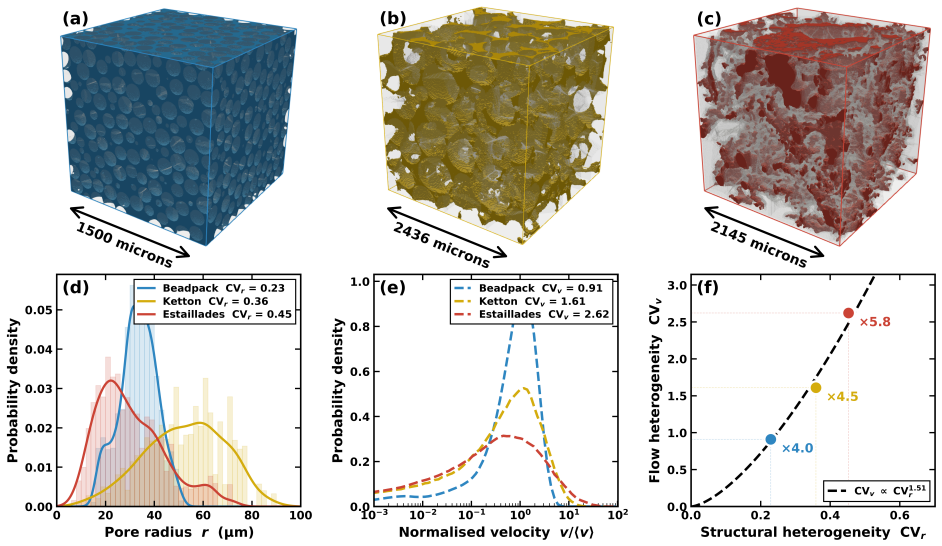
Mineral dissolution in porous media is classically partitioned into static regimes within the Pe-Da plane, but this framework fails to capture the dissolution behavior of structurally complex rocks. Using three-dimensional micro-continuum simulations on micro-CT images of three rock samples spanning a wide range of pore-space heterogeneity, we track the joint evolution of dissolution morphology, velocity distribution, and reaction rate. Our results reveal that initial flow heterogeneity controls accessibility of reactants, thereby controlling the dissolution regime,reshaping them as dynamic trajectories. Channeled dissolution emerges as a simultaneous reorganization of structure and flow, and the resulting permeability-porosity relationship cannot be captured by a single power-law. The effective power-law exponent increases with heterogeneity and changes over time, reaching a maximum of 9.8, 18.0, and 40.9 for the three samples. Consequently, the effective reaction rate falls one to three orders of magnitude below the uniform dissolution prediction, with the suppression scaling with flow heterogeneity due to mass transfer limitations in channeled dissolution.
Editorial analysis
A structured set of objections, weighed in public.
Referee Report
Summary. The manuscript reports 3D micro-continuum simulations of mineral dissolution performed on micro-CT images of three rock samples spanning a range of pore-space heterogeneity. It claims that initial flow heterogeneity governs reactant accessibility and thereby sets the dissolution regime, which then evolves dynamically rather than remaining static in the Pe-Da plane. Channeled dissolution is shown to reorganize both structure and flow simultaneously, so that the permeability-porosity relationship cannot be described by a single power law; instead the effective exponent increases with heterogeneity, varies in time, and reaches maxima of 9.8, 18.0 and 40.9 for the three samples. As a direct consequence the effective reaction rate is suppressed by one to three orders of magnitude relative to the uniform-dissolution prediction, with the degree of suppression scaling with flow heterogeneity because of mass-transfer limitations inside channels.
Significance. If the numerical results are robust, the work provides a clear mechanistic explanation for why classical static regime diagrams fail in structurally complex rocks and supplies quantitative evidence that permeability evolution must be treated as a time-dependent, heterogeneity-dependent process. The image-based approach and the reported range of effective exponents (up to 40.9) would be directly useful for upscaling dissolution in carbon-storage and acid-stimulation models. The demonstration that rate suppression scales with initial heterogeneity is a falsifiable prediction that could be tested experimentally.
major comments (3)
- §3 (Numerical Methods) and §4 (Results): the central quantitative claims—exponent maxima of 9.8/18.0/40.9 and 1–3 order-of-magnitude rate suppression—are presented as direct outputs of the micro-continuum solver, yet no mesh-sensitivity study, grid-convergence test, or comparison against a resolved sharp-interface benchmark is reported. Because the permeability-porosity scaling and the degree of channeling are known to be sensitive to artificial diffusion at the solid-fluid interface, the absence of such checks makes the reported exponents and suppression factors load-bearing but unverified.
- §3.2 (Micro-continuum formulation): the volume-fraction update and smoothed reaction term are used to represent the moving interface. If the grid spacing is comparable to or larger than the local reaction-front thickness in the smallest pores, numerical diffusion can either suppress or artificially enhance channeling. This directly affects the time evolution of the velocity distribution and the recomputed permeability values that underlie the high reported exponents; an explicit demonstration that the chosen resolution resolves the front in all three samples is required.
- §5 (Discussion): the claim that the permeability-porosity trajectory 'cannot be captured by a single power-law' rests on post-processed fits whose R² values or residual statistics are not shown. Without these diagnostics it is unclear whether the time-varying exponent description is necessary or whether a more complex but still static functional form could suffice.
minor comments (3)
- Abstract: 'regime,reshaping' is missing a space.
- Figure 4 (or equivalent permeability-porosity plot): the time-dependent exponent curves should be accompanied by the instantaneous R² of each power-law fit so readers can judge the quality of the local approximation.
- The three samples are referred to only by labels (e.g., Sample A, B, C); a brief table summarizing their initial porosity, permeability, and heterogeneity metrics (e.g., velocity variance or coordination-number distribution) would help readers assess the generality of the reported exponent range.
Simulated Author's Rebuttal
We thank the referee for the constructive and detailed comments, which have helped us improve the clarity and robustness of our numerical results. We address each major comment point by point below and have revised the manuscript to incorporate additional validation and statistical details.
read point-by-point responses
-
Referee: §3 (Numerical Methods) and §4 (Results): the central quantitative claims—exponent maxima of 9.8/18.0/40.9 and 1–3 order-of-magnitude rate suppression—are presented as direct outputs of the micro-continuum solver, yet no mesh-sensitivity study, grid-convergence test, or comparison against a resolved sharp-interface benchmark is reported. Because the permeability-porosity scaling and the degree of channeling are known to be sensitive to artificial diffusion at the solid-fluid interface, the absence of such checks makes the reported exponents and suppression factors load-bearing but unverified.
Authors: We agree that explicit mesh-sensitivity and convergence checks strengthen the quantitative claims. In the revised manuscript we have added a dedicated subsection in §3 reporting grid-convergence tests performed on representative sub-volumes of all three samples. These tests confirm that the reported maximum exponents (9.8, 18.0, 40.9) and rate-suppression factors remain within 5 % under successive refinement. While a full sharp-interface benchmark on the entire 3D micro-CT domains is computationally prohibitive, we have included validation against analytical and literature benchmark cases for simpler geometries and note that the micro-continuum formulation has been cross-checked in prior work. The new convergence data are now presented in the main text and supplementary figures. revision: yes
-
Referee: §3.2 (Micro-continuum formulation): the volume-fraction update and smoothed reaction term are used to represent the moving interface. If the grid spacing is comparable to or larger than the local reaction-front thickness in the smallest pores, numerical diffusion can either suppress or artificially enhance channeling. This directly affects the time evolution of the velocity distribution and the recomputed permeability values that underlie the high reported exponents; an explicit demonstration that the chosen resolution resolves the front in all three samples is required.
Authors: We thank the referee for highlighting the importance of front resolution. In the revised §3.2 we now provide an explicit estimate of local reaction-front thickness (derived from the local Damköhler number and pore-scale length scales) for each sample and compare it directly to the grid spacing. The analysis shows that the grid resolves the front by at least a factor of three in the dominant flow channels across all samples. We have added a supplementary figure illustrating this ratio and confirmed that the velocity-distribution evolution and permeability recomputation are insensitive to moderate changes in the smoothing length within the converged regime. revision: yes
-
Referee: §5 (Discussion): the claim that the permeability-porosity trajectory 'cannot be captured by a single power-law' rests on post-processed fits whose R² values or residual statistics are not shown. Without these diagnostics it is unclear whether the time-varying exponent description is necessary or whether a more complex but still static functional form could suffice.
Authors: We accept that fit-quality diagnostics should have been reported. In the revised §5 and supplementary material we now include R² values, root-mean-square residuals, and Akaike information criterion comparisons for both single power-law fits and the time-dependent exponent description. The single power-law fits yield R² < 0.65 for later dissolution stages with systematic residuals, whereas the dynamic-exponent model consistently achieves R² > 0.92. We also discuss why a more elaborate but static functional form cannot reproduce the observed reorganization of flow paths and the associated temporal increase in effective exponent. revision: yes
Circularity Check
No circularity: results are direct simulation outputs
full rationale
The paper reports outcomes from 3D micro-continuum simulations performed on micro-CT images of three rock samples. Claims regarding initial flow heterogeneity controlling reactant accessibility, the emergence of channeled dissolution as simultaneous structure-flow reorganization, time-varying permeability-porosity power-law exponents (maxima 9.8, 18.0, 40.9), and effective reaction rate suppression are presented as post-processed observations extracted from the simulation trajectories. No load-bearing step reduces by construction to a fitted parameter, self-citation, or ansatz; the derivation chain consists of numerical experiments whose outputs are independent of the target quantities by design.
Axiom & Free-Parameter Ledger
axioms (1)
- domain assumption Micro-continuum simulations on micro-CT images can accurately represent pore-scale flow, transport, and mineral dissolution kinetics.
Lean theorems connected to this paper
-
IndisputableMonolith/Foundation/RealityFromDistinctionreality_from_one_distinction unclear?
unclearRelation between the paper passage and the cited Recognition theorem.
Using three-dimensional micro-continuum simulations on micro-CT images of three rock samples spanning a wide range of pore-space heterogeneity, we track the joint evolution of dissolution morphology, velocity distribution, and reaction rate.
-
IndisputableMonolith/Foundation/AlexanderDualityalexander_duality_circle_linking unclear?
unclearRelation between the paper passage and the cited Recognition theorem.
The effective power-law exponent increases with heterogeneity and changes over time, reaching a maximum of 9.8, 18.0, and 40.9 for the three samples.
What do these tags mean?
- matches
- The paper's claim is directly supported by a theorem in the formal canon.
- supports
- The theorem supports part of the paper's argument, but the paper may add assumptions or extra steps.
- extends
- The paper goes beyond the formal theorem; the theorem is a base layer rather than the whole result.
- uses
- The paper appears to rely on the theorem as machinery.
- contradicts
- The paper's claim conflicts with a theorem or certificate in the canon.
- unclear
- Pith found a possible connection, but the passage is too broad, indirect, or ambiguous to say the theorem truly supports the claim.
Reference graph
Works this paper leans on
-
[1]
al2017reaction APACrefauthors Al-Khulaifi, Y. , Lin, Q. , Blunt, M J. \ Bijeljic, B. APACrefauthors \ 2017 . Reaction rates in chemically heterogeneous rock: Coupled impact of structure and flow properties studied by X-ray microtomography Reaction rates in chemically heterogeneous rock: Coupled impact of structure and flow properties studied by x-ray micr...
work page 2017
-
[2]
al2018reservoir APACrefauthors Al-Khulaifi, Y. , Lin, Q. , Blunt, M J. \ Bijeljic, B. APACrefauthors \ 2018 . Reservoir-condition pore-scale imaging of dolomite reaction with supercritical CO _2 acidified brine: Effect of pore-structure on reaction rate using velocity distribution analysis Reservoir-condition pore-scale imaging of dolomite reaction with s...
work page 2018
-
[3]
al2019pore APACrefauthors Al-Khulaifi, Y. , Lin, Q. , Blunt, M J. \ Bijeljic, B. APACrefauthors \ 2019 . Pore-scale dissolution by CO _2 saturated brine in a multimineral carbonate at reservoir conditions: Impact of physical and chemical heterogeneity Pore-scale dissolution by CO _2 saturated brine in a multimineral carbonate at reservoir conditions: Impa...
work page 2019
-
[4]
andrew2014pore APACrefauthors Andrew, M. , Bijeljic, B. \ Blunt, M J. APACrefauthors \ 2014 . Pore-scale imaging of trapped supercritical carbon dioxide in sandstones and carbonates Pore-scale imaging of trapped supercritical carbon dioxide in sandstones and carbonates . International Journal of Greenhouse Gas Control 22 1--14
work page 2014
-
[5]
bernabe2003permeability APACrefauthors Bernab \'e , Y. , Mok, U. \ Evans, B. APACrefauthors \ 2003 . Permeability-porosity relationships in rocks subjected to various evolution processes Permeability-porosity relationships in rocks subjected to various evolution processes . Pure and Applied Geophysics 160 5 937--960
work page 2003
-
[6]
bijeljic2013predictions APACrefauthors Bijeljic, B. , Raeini, A. , Mostaghimi, P. \ Blunt, M J. APACrefauthors \ 2013 . Predictions of non-Fickian solute transport in different classes of porous media using direct simulation on pore-scale images Predictions of non-fickian solute transport in different classes of porous media using direct simulation on por...
work page 2013
-
[7]
carman1997fluid APACrefauthors Carman, P C. APACrefauthors \ 1997 . Fluid flow through granular beds Fluid flow through granular beds . Chemical Engineering Research and Design 75 S32--S48
work page 1997
-
[8]
civan2001scale APACrefauthors Civan, F. APACrefauthors \ 2001 . Scale effect on porosity and permeability: Kinetics, model, and correlation Scale effect on porosity and permeability: Kinetics, model, and correlation . AIChE Journal 47 2 271--287
work page 2001
-
[9]
clemens1996combined APACrefauthors Clemens, T. , H \"u ckinghaus, D. , Sauter, M. , Liedl, R. \ Teutsch, G. APACrefauthors \ 1996 . A combined continuum and discrete network reactive transport model for the simulation of karst development A combined continuum and discrete network reactive transport model for the simulation of karst development . IAHS Publ...
work page 1996
-
[10]
deng2018pore APACrefauthors Deng, H. , Molins, S. , Trebotich, D. , Steefel, C. \ DePaolo, D. APACrefauthors \ 2018 . Pore-scale numerical investigation of the impacts of surface roughness: Upscaling of reaction rates in rough fractures Pore-scale numerical investigation of the impacts of surface roughness: Upscaling of reaction rates in rough fractures ....
work page 2018
-
[11]
detwiler2003experimental APACrefauthors Detwiler, R L. , Glass, R J. \ Bourcier, W L. APACrefauthors \ 2003 . Experimental observations of fracture dissolution: The role of Peclet number on evolving aperture variability Experimental observations of fracture dissolution: The role of peclet number on evolving aperture variability . Geophysical Research Lett...
work page 2003
-
[12]
finney1970random APACrefauthors Finney, J. APACrefauthors \ 1970 . Random packings and the structure of simple liquids. I. The geometry of random close packing Random packings and the structure of simple liquids. i. the geometry of random close packing . Proceedings of the Royal Society of London. A. Mathematical and Physical Sciences 319 1539 479--493
work page 1970
-
[13]
fredd1998influence APACrefauthors Fredd, C N. \ Fogler, H S. APACrefauthors \ 1998 . Influence of transport and reaction on wormhole formation in porous media Influence of transport and reaction on wormhole formation in porous media . AIChE Journal 44 9 1933--1949
work page 1998
-
[14]
fryar1998hydraulic APACrefauthors Fryar, A E. \ Schwartz, F W. APACrefauthors \ 1998 . Hydraulic-conductivity reduction, reaction-front propagation, and preferential flow within a model reactive barrier Hydraulic-conductivity reduction, reaction-front propagation, and preferential flow within a model reactive barrier . Journal of Contaminant Hydrology 32 ...
work page 1998
-
[15]
golfier2002ability APACrefauthors Golfier, F. , Zarcone, C. , Bazin, B. , Lenormand, R. , Lasseux, D. \ Quintard, M. APACrefauthors \ 2002 . On the ability of a Darcy-scale model to capture wormhole formation during the dissolution of a porous medium On the ability of a darcy-scale model to capture wormhole formation during the dissolution of a porous med...
work page 2002
-
[16]
harlow1972theoretical APACrefauthors Harlow, F H. \ Pracht, W E. APACrefauthors \ 1972 . A theoretical study of geothermal energy extraction A theoretical study of geothermal energy extraction . Journal of Geophysical Research 77 35 7038--7048
work page 1972
-
[17]
hoefner1988pore APACrefauthors Hoefner, M. \ Fogler, H S. APACrefauthors \ 1988 . Pore evolution and channel formation during flow and reaction in porous media Pore evolution and channel formation during flow and reaction in porous media . AIChE Journal 34 1 45--54
work page 1988
-
[18]
hommel2018porosity APACrefauthors Hommel, J. , Coltman, E. \ Class, H. APACrefauthors \ 2018 . Porosity--permeability relations for evolving pore space: A review with a focus on (bio-) geochemically altered porous media Porosity--permeability relations for evolving pore space: A review with a focus on (bio-) geochemically altered porous media . Transport ...
work page 2018
-
[19]
jung2018physical APACrefauthors Jung, H. \ Navarre-Sitchler, A. APACrefauthors \ 2018 . Physical heterogeneity control on effective mineral dissolution rates Physical heterogeneity control on effective mineral dissolution rates . Geochimica et Cosmochimica Acta 227 246--263
work page 2018
-
[20]
kanavas2025flow APACrefauthors Kanavas, Z. , Jim \'e nez-Mart \' nez, J. , Miele, F. , Nimmo, J. \ Morales, V L. APACrefauthors \ 2025 . Flow heterogeneity controls dissolution dynamics in topologically complex rocks Flow heterogeneity controls dissolution dynamics in topologically complex rocks . Geophysical Research Letters 52 8 e2024GL114369
work page 2025
-
[21]
kang2006lattice APACrefauthors Kang, Q. , Lichtner, P C. \ Zhang, D. APACrefauthors \ 2006 . Lattice Boltzmann pore-scale model for multicomponent reactive transport in porous media Lattice boltzmann pore-scale model for multicomponent reactive transport in porous media . Journal of Geophysical Research: Solid Earth 111 B5
work page 2006
-
[22]
krevor2023subsurface APACrefauthors Krevor, S. , De Coninck, H. , Gasda, S E. , Ghaleigh, N S. , de Gooyert, V. , Hajibeygi, H. Swennenhuis, F. APACrefauthors \ 2023 . Subsurface carbon dioxide and hydrogen storage for a sustainable energy future Subsurface carbon dioxide and hydrogen storage for a sustainable energy future . Nature Reviews Earth & Enviro...
work page 2023
-
[23]
lee2025effects APACrefauthors Lee, W. , Chen, M A. , Bresciani, E. , Toner, B M. \ Kang, P K. APACrefauthors \ 2025 . Effects of pore-scale three-dimensional flow and fluid inertia on mineral dissolution Effects of pore-scale three-dimensional flow and fluid inertia on mineral dissolution . Water Resources Research 61 4 e2024WR038176
work page 2025
-
[24]
li2008scale APACrefauthors Li, L. , Steefel, C I. \ Yang, L. APACrefauthors \ 2008 . Scale dependence of mineral dissolution rates within single pores and fractures Scale dependence of mineral dissolution rates within single pores and fractures . Geochimica et Cosmochimica Acta 72 2 360--377
work page 2008
-
[25]
li2022effects APACrefauthors Li, X. \ Yang, X. APACrefauthors \ 2022 . Effects of physicochemical properties and structural heterogeneity on mineral precipitation and dissolution in saturated porous media Effects of physicochemical properties and structural heterogeneity on mineral precipitation and dissolution in saturated porous media . Applied Geochemi...
work page 2022
-
[26]
liu2025thermal APACrefauthors Liu, M. , Yang, Y. , Liu, F. , Wang, J. , Song, H. , Zhang, J. Zhang, K. APACrefauthors \ 2025 . Thermal disturbance anisotropy and structural stability in deep multimineral granular systems: A discrete element method study Thermal disturbance anisotropy and structural stability in deep multimineral granular systems: A discre...
work page 2025
-
[27]
liu2017modeling APACrefauthors Liu, P. , Yao, J. , Couples, G D. , Ma, J. , Huang, Z. \ Sun, H. APACrefauthors \ 2017 . Modeling and simulation of wormhole formation during acidization of fractured carbonate rocks Modeling and simulation of wormhole formation during acidization of fractured carbonate rocks . Journal of Petroleum Science and Engineering 15...
work page 2017
-
[28]
ma2026pore APACrefauthors Ma, Q. , Chai, R. , Foroughi, S. , Wang, Y. , Blunt, M J. \ Bijeljic, B. APACrefauthors \ 2026 . Pore-scale dynamics of multiphase reactive transport in water-wet carbonates under CO _2 -acidified brine injection: Dissolution patterns and reaction rates Pore-scale dynamics of multiphase reactive transport in water-wet carbonates ...
work page 2026
-
[29]
maes2021geochemfoam APACrefauthors Maes, J. \ Menke, H P. APACrefauthors \ 2021 . GeoChemFoam: Direct modelling of multiphase reactive transport in real pore geometries with equilibrium reactions Geochemfoam: Direct modelling of multiphase reactive transport in real pore geometries with equilibrium reactions . Transport in Porous Media 139 2 271--299
work page 2021
-
[30]
maes2022improved APACrefauthors Maes, J. , Soulaine, C. \ Menke, H P. APACrefauthors \ 2022 . Improved volume-of-solid formulations for micro-continuum simulation of mineral dissolution at the pore-scale Improved volume-of-solid formulations for micro-continuum simulation of mineral dissolution at the pore-scale . Frontiers in Earth Science 10 917931
work page 2022
-
[31]
menke2016reservoir APACrefauthors Menke, H P. , Andrew, M G. , Blunt, M J. \ Bijeljic, B. APACrefauthors \ 2016 . Reservoir condition imaging of reactive transport in heterogeneous carbonates using fast synchrotron tomography—Effect of initial pore structure and flow conditions Reservoir condition imaging of reactive transport in heterogeneous carbonates ...
work page 2016
-
[32]
menke2015dynamic APACrefauthors Menke, H P. , Bijeljic, B. , Andrew, M G. \ Blunt, M J. APACrefauthors \ 2015 . Dynamic three-dimensional pore-scale imaging of reaction in a carbonate at reservoir conditions Dynamic three-dimensional pore-scale imaging of reaction in a carbonate at reservoir conditions . Environmental Science & Technology 49 7 4407--4414
work page 2015
-
[33]
menke2017dynamic APACrefauthors Menke, H P. , Bijeljic, B. \ Blunt, M J. APACrefauthors \ 2017 . Dynamic reservoir-condition microtomography of reactive transport in complex carbonates: Effect of initial pore structure and initial brine pH Dynamic reservoir-condition microtomography of reactive transport in complex carbonates: Effect of initial pore struc...
work page 2017
- [34]
-
[35]
menke20184d APACrefauthors Menke, H P. , Reynolds, C A. , Andrew, M G. , Nunes, J P. , Bijeljic, B. \ Blunt, M J. APACrefauthors \ 2018 . 4D multi-scale imaging of reactive flow in carbonates: Assessing the impact of heterogeneity on dissolution regimes using streamlines at multiple length scales 4d multi-scale imaging of reactive flow in carbonates: Asse...
work page 2018
-
[36]
molins2012investigation APACrefauthors Molins, S. , Trebotich, D. , Steefel, C I. \ Shen, C. APACrefauthors \ 2012 . An investigation of the effect of pore scale flow on average geochemical reaction rates using direct numerical simulation An investigation of the effect of pore scale flow on average geochemical reaction rates using direct numerical simulat...
work page 2012
-
[37]
noiriel2004investigation APACrefauthors Noiriel, C. , Gouze, P. \ Bernard, D. APACrefauthors \ 2004 . Investigation of porosity and permeability effects from microstructure changes during limestone dissolution Investigation of porosity and permeability effects from microstructure changes during limestone dissolution . Geophysical Research Letters 31 24 L24603
work page 2004
-
[38]
oliveira2020multispecies APACrefauthors Oliveira, T D. , Blunt, M J. \ Bijeljic, B. APACrefauthors \ 2020 . Multispecies reactive transport in a microporous rock: Impact of flow heterogeneity and reversibility of reaction Multispecies reactive transport in a microporous rock: Impact of flow heterogeneity and reversibility of reaction . Water Resources Res...
work page 2020
-
[39]
panga2005two APACrefauthors Panga, M K. , Ziauddin, M. \ Balakotaiah, V. APACrefauthors \ 2005 . Two-scale continuum model for simulation of wormholes in carbonate acidization Two-scale continuum model for simulation of wormholes in carbonate acidization . AIChE Journal 51 12 3231--3248
work page 2005
-
[40]
pereira2016pore APACrefauthors Pereira Nunes, J. , Bijeljic, B. \ Blunt, M. APACrefauthors \ 2016 . Pore-space structure and average dissolution rates: A simulation study Pore-space structure and average dissolution rates: A simulation study . Water Resources Research 52 9 7198--7212
work page 2016
-
[41]
roded2021wormholing APACrefauthors Roded, R. , Szymczak, P. \ Holtzman, R. APACrefauthors \ 2021 . Wormholing in anisotropic media: Pore-scale effect on large-scale patterns Wormholing in anisotropic media: Pore-scale effect on large-scale patterns . Geophysical Research Letters 48 11 e2021GL093659
work page 2021
-
[42]
soulaine2024micro APACrefauthors Soulaine, C. APACrefauthors \ 2024 . Micro-continuum modeling: An hybrid-scale approach for solving coupled processes in porous media Micro-continuum modeling: An hybrid-scale approach for solving coupled processes in porous media . Water Resources Research 60 2 e2023WR035908
work page 2024
-
[43]
soulaine2017mineral APACrefauthors Soulaine, C. , Roman, S. , Kovscek, A. \ Tchelepi, H A. APACrefauthors \ 2017 . Mineral dissolution and wormholing from a pore-scale perspective Mineral dissolution and wormholing from a pore-scale perspective . Journal of Fluid Mechanics 827 457--483
work page 2017
-
[44]
steefel2005reactive APACrefauthors Steefel, C I. , DePaolo, D J. \ Lichtner, P C. APACrefauthors \ 2005 . Reactive transport modeling: An essential tool and a new research approach for the Earth sciences Reactive transport modeling: An essential tool and a new research approach for the earth sciences . Earth and Planetary Science Letters 240 3-4 539--558
work page 2005
-
[45]
steefel1996approaches APACrefauthors Steefel, C I. \ McQuarrie, K. APACrefauthors \ 1996 . Approaches to modeling of reactive transport in porous media Approaches to modeling of reactive transport in porous media . Reviews in Mineralogy 83--130
work page 1996
-
[46]
steefel2013pore APACrefauthors Steefel, C I. , Molins, S. \ Trebotich, D. APACrefauthors \ 2013 . Pore scale processes associated with subsurface CO _2 injection and sequestration Pore scale processes associated with subsurface CO _2 injection and sequestration . Reviews in Mineralogy and Geochemistry 77 1 259--303
work page 2013
-
[47]
szawello2024quantifying APACrefauthors Szawe o, T. , Hyman, J D. , Kang, P K. \ Szymczak, P. APACrefauthors \ 2024 . Quantifying dissolution dynamics in porous media using a spatial flow focusing profile Quantifying dissolution dynamics in porous media using a spatial flow focusing profile . Geophysical Research Letters 51 20 e2024GL109940
work page 2024
-
[48]
szymczak2009wormhole APACrefauthors Szymczak, P. \ Ladd, A J. APACrefauthors \ 2009 . Wormhole formation in dissolving fractures Wormhole formation in dissolving fractures . Journal of Geophysical Research: Solid Earth 114 B6
work page 2009
-
[49]
wang2026data APACrefauthors Wang, J. , Yang, Y. , Blunt, M J. \ Bijeljic, B. APACrefauthors \ 2026 . Data for ``Dynamic Evolution of Pore-scale Heterogeneity and Transport Conditions Control Mineral Dissolution Regimes''. Data for ``dynamic evolution of pore-scale heterogeneity and transport conditions control mineral dissolution regimes''. Zenodo . APACr...
-
[50]
wang2025multi APACrefauthors Wang, J. , Yang, Y. , Li, Y. , Song, H. , Sun, H. , Zhang, L. Yao, J. APACrefauthors \ 2025 . Multi-mineral dissolution in 3D natural rock: Pore-scale reactive transport modeling for geological carbon storage Multi-mineral dissolution in 3d natural rock: Pore-scale reactive transport modeling for geological carbon storage . Ch...
work page 2025
-
[51]
wang2023reactive APACrefauthors Wang, T. , Hu, R. , Yang, Z. , Chen, Y F. , Li, Y. \ Zhou, C B. APACrefauthors \ 2023 . Reactive-infiltration instability in a Hele-Shaw cell influenced by initial aperture and flow rate Reactive-infiltration instability in a hele-shaw cell influenced by initial aperture and flow rate . Physical Review Fluids 8 4 043901
work page 2023
-
[52]
wang2022transitions APACrefauthors Wang, T. , Hu, R. , Yang, Z. , Zhou, C X. , Chen, Y F. \ Zhou, C B. APACrefauthors \ 2022 . Transitions of dissolution patterns in rough fractures Transitions of dissolution patterns in rough fractures . Water Resources Research 58 1 e2021WR030456
work page 2022
-
[53]
yang2020dynamic APACrefauthors Yang, Y. , Li, Y. , Yao, J. , Iglauer, S. , Luquot, L. , Zhang, K. Wang, Z. APACrefauthors \ 2020 . Dynamic pore-scale dissolution by CO _2 -saturated brine in carbonates: Impact of homogeneous versus fractured versus vuggy pore structure Dynamic pore-scale dissolution by CO _2 -saturated brine in carbonates: Impact of homog...
work page 2020
-
[54]
yang2023recent APACrefauthors Yang, Y. , Liu, F. , Zhang, Q. , Li, Y. , Wang, K. , Xu, Q. Wang, J. APACrefauthors \ 2023 . Recent advances in multiscale digital rock reconstruction, flow simulation, and experiments during shale gas production Recent advances in multiscale digital rock reconstruction, flow simulation, and experiments during shale gas produ...
work page 2023
discussion (0)
Sign in with ORCID, Apple, or X to comment. Anyone can read and Pith papers without signing in.