A Fast Robust Adaptive filter using Improved Data-Reuse Method
Pith reviewed 2026-05-19 23:58 UTC · model grok-4.3
The pith
The RTGA-IDROC algorithm merges total least squares with robust adaptation and improved data reuse to handle input noise while speeding early convergence.
A machine-rendered reading of the paper's core claim, the machinery that carries it, and where it could break.
Core claim
The RTGA-IDROC algorithm possesses the advantages of both the total least squares strategy and the robust generalized adaptive function. This algorithm not only effectively handles input noise under the errors-in-variables model but also achieves excellent performance across diverse noise environments. An improved data reuse method enables faster convergence in the early stages of iteration without compromising steady-state performance, with the added complexity controlled by an online censoring strategy.
What carries the argument
The improved data reuse method paired with online censoring, which reuses recent data samples for quicker early adaptation while selectively skipping updates to keep complexity low.
If this is right
- The algorithm handles input noise under the errors-in-variables model more effectively than standard robust filters.
- Faster early convergence occurs in diverse noise environments while steady-state error remains comparable.
- Online censoring keeps the computational cost of data reuse manageable for real-time use.
- Local stability holds and the steady-state mean-square deviation can be predicted analytically.
- Superior tracking is observed in both system identification and acoustic echo cancellation tasks.
Where Pith is reading between the lines
- The same reuse-plus-censoring pattern could be applied to other adaptive algorithms that suffer slow initial convergence.
- Adjusting the censoring threshold for real-valued signals hints at similar domain-specific tuning for complex-valued or vector cases.
- The approach may reduce the number of samples needed for acceptable performance in resource-constrained devices.
Load-bearing premise
The noise and input statistics satisfy the modeling assumptions required for the local stability analysis and the derived steady-state mean-square deviation.
What would settle it
An experiment that injects input noise whose variance or correlation structure departs markedly from the assumed model and checks whether measured convergence rate or final MSD deviates from the theoretical prediction.
Figures




read the original abstract
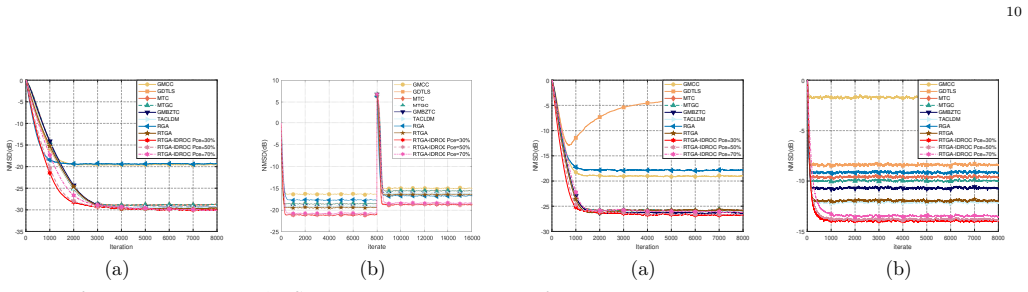
Adaptive filter in complex scenarios demands algorithms that integrate fast convergence, low complexity, and robust performance under diverse noise conditions. To address this challenge, we propose a online censoring robust total generalized adaptive filter using improved data-reused method (RTGA-IDROC) algorithm. The proposed RTGA variant possesses the advantages of both the total least squares (TLS) strategy and the robust generalized adaptive (RGA) function. This algorithm not only effectively handles input noise under the errors-in-variables (EIV) model but also achieves excellent performance across diverse noise environments. Furthermore, to meet the high demand for convergence speed in practical applications, an improved data reuse (IDR) method is introduced, enabling faster convergence in the early stages of iteration without compromising steady-state performance. The increased computational complexity brought by the IDR method is mitigated using the online censoring (OC) strategy. We also modify the OC threshold for real-valued algorithms, as the original threshold was defined for the complex domain. Beyond these algorithmic enhancements, a local stability analysis for the proposed algorithm is provided, and the theoretical steady-state mean-square deviation (MSD) is derived. Finally, simulation experiments in system identification and acoustic echo cancellation (AEC) scenarios validate the superior performance of the proposed algorithm.
Editorial analysis
A structured set of objections, weighed in public.
Referee Report
Summary. The manuscript proposes the RTGA-IDROC algorithm, a robust total generalized adaptive filter that combines total least squares (TLS) and robust generalized adaptive (RGA) strategies to handle input noise under the errors-in-variables (EIV) model. It introduces an improved data-reuse (IDR) method for faster early-stage convergence, mitigated by an online censoring (OC) strategy with a modified threshold for real-valued signals. The paper provides a local stability analysis and derives the theoretical steady-state mean-square deviation (MSD), with performance validated via simulations in system identification and acoustic echo cancellation (AEC) under diverse noise conditions including impulsive noise.
Significance. If the local stability analysis and MSD derivation hold under the tested conditions and the simulations demonstrate consistent superiority without hidden parameter tuning, the work would offer a practical advance in robust adaptive filtering by balancing convergence speed, robustness to EIV noise, and computational efficiency. The combination of theoretical MSD prediction with empirical results across noise types could inform algorithm design in real-world signal processing applications.
major comments (3)
- [§IV] §IV (Local Stability Analysis): The derivation relies on the standard independence assumption between the regressor vector and the noise process to close the expectations. For the alpha-stable and impulsive noise cases in the AEC simulations, this assumption is typically violated; the manuscript does not show that the derived stability conditions or MSD expression remain predictive when the input has heavy tails, which directly undercuts the broad robustness claim across 'diverse noise environments'.
- [§V] §V (Theoretical Steady-State MSD Derivation): The IDR and OC modifications introduce additional cross-terms in the weight-error recursion that are not explicitly bounded or averaged in the provided steps. Without showing how these terms are handled under the same moment conditions used for the base RGA/TLS analysis, it is unclear whether the closed-form MSD expression accurately matches the simulated curves for the full RTGA-IDROC algorithm.
- [Simulation Experiments] Simulation section (system identification and AEC experiments): The abstract states that simulations validate performance, yet the reported results lack error bars, explicit data-exclusion rules for the OC threshold, and direct overlays of the theoretical MSD curves versus empirical ones under impulsive noise. This prevents verification that the derived MSD supports the observed superiority without circular fitting to the simulation parameters.
minor comments (2)
- [Algorithm Description] The modification of the OC threshold for real-valued signals is mentioned but the exact formula and its derivation relative to the original complex-domain version are not shown; adding this would improve reproducibility.
- [Figures] Figure captions for convergence and MSD plots should explicitly state the noise distributions (e.g., Gaussian, alpha-stable with specific parameters) and the number of Monte Carlo runs used.
Simulated Author's Rebuttal
We thank the referee for the constructive and detailed comments. We address each major point below and indicate where the manuscript will be revised to improve clarity and rigor.
read point-by-point responses
-
Referee: [§IV] §IV (Local Stability Analysis): The derivation relies on the standard independence assumption between the regressor vector and the noise process to close the expectations. For the alpha-stable and impulsive noise cases in the AEC simulations, this assumption is typically violated; the manuscript does not show that the derived stability conditions or MSD expression remain predictive when the input has heavy tails, which directly undercuts the broad robustness claim across 'diverse noise environments'.
Authors: The independence assumption is standard in the adaptive filtering literature and is employed in the foundational analyses of both RGA and TLS algorithms. While it may not hold strictly for heavy-tailed distributions, the local stability conditions derived under this assumption still provide useful guidelines, and the extensive simulations in Section VI (including alpha-stable noise in AEC) empirically confirm stability and performance. We will revise the manuscript to explicitly state the assumption, discuss its limitations for heavy-tailed cases, and note that robustness is supported by simulation evidence rather than solely by the analysis. revision: partial
-
Referee: [§V] §V (Theoretical Steady-State MSD Derivation): The IDR and OC modifications introduce additional cross-terms in the weight-error recursion that are not explicitly bounded or averaged in the provided steps. Without showing how these terms are handled under the same moment conditions used for the base RGA/TLS analysis, it is unclear whether the closed-form MSD expression accurately matches the simulated curves for the full RTGA-IDROC algorithm.
Authors: The cross-terms introduced by IDR and OC are averaged using the same moment conditions as the base analysis, with the OC mechanism ensuring that outlier contributions remain bounded. To improve transparency, we will expand the derivation steps and add an appendix that explicitly shows the bounding and averaging of these additional terms under the stated assumptions. revision: yes
-
Referee: Simulation section (system identification and AEC experiments): The abstract states that simulations validate performance, yet the reported results lack error bars, explicit data-exclusion rules for the OC threshold, and direct overlays of the theoretical MSD curves versus empirical ones under impulsive noise. This prevents verification that the derived MSD supports the observed superiority without circular fitting to the simulation parameters.
Authors: We agree that these elements would strengthen verifiability. We will revise the simulation section to include error bars from multiple independent runs, explicitly state the data-exclusion rules and modified threshold for the real-valued OC strategy, and add overlays comparing the theoretical MSD expression against empirical curves, particularly for the impulsive and alpha-stable noise cases. revision: yes
Circularity Check
Derivation of stability analysis and MSD is self-contained under standard assumptions
full rationale
The paper presents the RTGA-IDROC algorithm as a combination of TLS and RGA strategies, augmented by IDR for convergence speed and OC for complexity control, with an explicit modification to the OC threshold for real-valued signals. The local stability analysis and theoretical steady-state MSD derivation are described as independent steps relying on typical adaptive-filtering modeling assumptions (e.g., independence between regressor and noise, bounded-moment conditions). These do not reduce by construction to fitted parameters, self-citations, or ansatzes imported from the authors' prior work. No equations are shown that equate a 'prediction' directly to a fit or that invoke a uniqueness theorem whose only support is a self-citation chain. Simulations in system identification and AEC provide separate empirical checks. The derivation chain therefore remains non-circular.
Axiom & Free-Parameter Ledger
Lean theorems connected to this paper
-
IndisputableMonolith/Cost/FunctionalEquation.leanwashburn_uniqueness_aczel unclear?
unclearRelation between the paper passage and the cited Recognition theorem.
cost function J(i) with parameters a,b,c and limits to TLMP/LTLS/MTGC (Eq. 7–11); local stability and MSD under A1–A3 (independence, GGD, positive-definite R)
What do these tags mean?
- matches
- The paper's claim is directly supported by a theorem in the formal canon.
- supports
- The theorem supports part of the paper's argument, but the paper may add assumptions or extra steps.
- extends
- The paper goes beyond the formal theorem; the theorem is a base layer rather than the whole result.
- uses
- The paper appears to rely on the theorem as machinery.
- contradicts
- The paper's claim conflicts with a theorem or certificate in the canon.
- unclear
- Pith found a possible connection, but the passage is too broad, indirect, or ambiguous to say the theorem truly supports the claim.
Reference graph
Works this paper leans on
-
[1]
S. S. Haykin, Adaptive filter theory. Pearson Education India, 2002
work page 2002
-
[2]
S. Lv, H. Zhao, and W. Xu, “Robust widely linear affine projection m-estimate adaptive algorithm: Performance analysis and application,” IEEE Transactions on Signal Processing, vol. 71, pp. 3623–3636, 2023
work page 2023
-
[3]
Proportionate total adaptive filtering algorithms for sparse system identification,
J. Ni, Y. Xing, Z. Zhu, and J. Chen, “Proportionate total adaptive filtering algorithms for sparse system identification,” IEEE Transactions on Systems, Man, and Cybernetics: Systems, vol. 54, no. 3, pp. 1840–1852, 2023
work page 2023
-
[4]
Robust minimum disturbance diffusion lms for distributed estimation,
H. Zayyani, “Robust minimum disturbance diffusion lms for distributed estimation,” IEEE Transactions on Circuits and Systems II: Express Briefs, vol. 68, no. 1, pp. 521–525, 2020
work page 2020
-
[5]
Q. Zhang, Z. Li, H. Jin, and X. Chen, “An augmented complex- valued gradient-descent total least-squares algorithm for noncir- cular signals,” Signal Processing, vol. 228, p. 109740, 2025
work page 2025
-
[6]
H. Zhao, S. Gao, Z. He, X. Zeng, W. Jin, and T. Li, “Iden- tification of nonlinear dynamic system using a novel recurrent wavelet neural network based on the pipelined architecture,” IEEE Transactions on Industrial Electronics, vol. 61, no. 8, pp. 4171–4182, 2013
work page 2013
-
[7]
Low-complexity nonlinear adaptive filter based on a pipelined bilinear recurrent neural network,
H. Zhao, X. Zeng, and Z. He, “Low-complexity nonlinear adaptive filter based on a pipelined bilinear recurrent neural network,” IEEE Transactions on Neural Networks, vol. 22, no. 9, pp. 1494–1507, 2011
work page 2011
-
[8]
Memory proportionate apa with individual activation factors for acoustic echo cancellation,
H. Zhao, Y. Yu, S. Gao, X. Zeng, and Z. He, “Memory proportionate apa with individual activation factors for acoustic echo cancellation,” IEEE/ACM transactions on audio, speech, and language processing, vol. 22, no. 6, pp. 1047–1055, 2014
work page 2014
-
[9]
H. Zhao and B. Tian, “Robust power system forecasting- aided state estimation with generalized maximum mixture correntropy unscented kalman filter,” IEEE Transactions on Instrumentation and Measurement, vol. 71, pp. 1–10, 2022
work page 2022
-
[10]
Robust stable iterated un- scented kalman filter based on maximum correntropy criterion,
H. Zhao, B. Tian, and B. Chen, “Robust stable iterated un- scented kalman filter based on maximum correntropy criterion,” Automatica, vol. 142, p. 110410, 2022
work page 2022
-
[11]
H. Zhao and J. Zhang, “Functional link neural network cascaded with chebyshev orthogonal polynomial for nonlinear channel equalization,” Signal processing, vol. 88, no. 8, pp. 1946–1957, 2008
work page 1946
-
[12]
Adaptive reduced feedback flnn filter for active control of nonlinear noise processes,
H. Zhao, X. Zeng, and J. Zhang, “Adaptive reduced feedback flnn filter for active control of nonlinear noise processes,” Signal Processing, vol. 90, no. 3, pp. 834–847, 2010
work page 2010
-
[13]
H. Zhao and J. Zhang, “Adaptively combined fir and functional link artificial neural network equalizer for nonlinear communica- tion channel,” IEEE Transactions on Neural Networks, vol. 20, no. 4, pp. 665–674, 2009
work page 2009
-
[14]
J. Ye, H. Zhao, S. Lv, and Y. Zhou, “Fractional-order subband p-norm adaptive filter via transformation nearest kronecker product decomposition for active noise control,” Mechanical Systems and Signal Processing, vol. 249, p. 114073, 2026
work page 2026
-
[15]
Nearest kronecker product decomposition based subband adaptive filter: Algorithms and applications,
J. Ye and H. Zhao, “Nearest kronecker product decomposition based subband adaptive filter: Algorithms and applications,” IEEE Transactions on Audio, Speech and Language Processing, 2025
work page 2025
-
[16]
Errors-in-variables methods in system identi- fication,
T. Söderström, “Errors-in-variables methods in system identi- fication,” Automatica, vol. 43, no. 6, pp. 939–958, 2007
work page 2007
-
[17]
Analysis of the gradient-descent total least-squares adaptive filtering algo- rithm,
R. Arablouei, S. Werner, and K. Doğançay, “Analysis of the gradient-descent total least-squares adaptive filtering algo- rithm,” IEEE Transactions on Signal Processing, vol. 62, no. 5, pp. 1256–1264, 2014
work page 2014
-
[18]
A robust total least mean M-estimate adaptive algorithm for impulsive noise suppression,
L. Li and H. Zhao, “A robust total least mean M-estimate adaptive algorithm for impulsive noise suppression,” IEEE Transactions on Circuits and Systems II: Express Briefs, vol. 67, no. 4, pp. 800–804, 2019
work page 2019
-
[19]
Complex total maximum verso- ria criterion algorithm for doa estimation,
H. Zhao, Y. Peng, and W. Xu, “Complex total maximum verso- ria criterion algorithm for doa estimation,” IEEE Transactions on Circuits and Systems II: Express Briefs, vol. 71, no. 4, pp. 2489–2493, 2023
work page 2023
-
[20]
Maximum total cor- rentropy adaptive filtering against heavy-tailed noises,
F. Wang, Y. He, S. Wang, and B. Chen, “Maximum total cor- rentropy adaptive filtering against heavy-tailed noises,” Signal Processing, vol. 141, pp. 84–95, 2017
work page 2017
-
[21]
Maximum total complex correntropy for adaptive filter,
G. Qian, S. Wang, and H. H. Iu, “Maximum total complex correntropy for adaptive filter,” IEEE Transactions on Signal Processing, vol. 68, pp. 978–989, 2020
work page 2020
-
[22]
H. Zhao and Z. Cao, “Robust normalized subband adaptive filter algorithm based on logarithmic and total least squares for cor- related input signals and impulsive noise,” IEEE Transactions on Circuits and Systems II: Express Briefs, vol. 70, no. 11, pp. 4276–4280, 2023
work page 2023
-
[23]
Maximum total generalized correntropy adaptive filtering for parameter estimation,
J. He, G. Wang, X. Zhang, H. Wang, and B. Peng, “Maximum total generalized correntropy adaptive filtering for parameter estimation,” Signal Processing, vol. 203, p. 108787, 2023
work page 2023
-
[24]
Generalized correntropy for robust adaptive filtering,
B. Chen, L. Xing, H. Zhao, N. Zheng, and J. C. Principe, “Generalized correntropy for robust adaptive filtering,” IEEE Transactions on Signal Processing, vol. 64, no. 13, pp. 3376– 3387, 2016
work page 2016
-
[25]
H. Zhao and Z. Cao, “Robust generalized maximum blake– zisserman total correntropy adaptive filter for generalized gaus- sian noise and noisy input,” IEEE Transactions on Systems, Man, and Cybernetics: Systems, vol. 53, no. 11, pp. 6757–6765, 2023
work page 2023
-
[26]
H. Zhao, Y. Peng, and Z. Cao, “An improved robust total logistic distance metrics algorithm for generalized gaussian noise and noisy input,” IEEE Transactions on Audio, Speech and Language Processing, vol. 33, pp. 3320–3331, 2025
work page 2025
-
[27]
A general and adaptive robust loss function,
J. T. Barron, “A general and adaptive robust loss function,” in Proceedings of the IEEE/CVF conference on computer vision and pattern recognition, 2019, pp. 4331–4339
work page 2019
-
[28]
A family of robust generalized adaptive filters and application for time-series prediction,
Y. Peng, H. Zhao, and J. Hu, “A family of robust generalized adaptive filters and application for time-series prediction,” IEEE Transactions on Circuits and Systems I: Regular Papers, vol. 72, no. 12, pp. 7902–7914, 2025
work page 2025
-
[29]
Data-reuse recur- sive least-squares algorithms,
C. Paleologu, J. Benesty, and S. Ciochină, “Data-reuse recur- sive least-squares algorithms,” IEEE Signal Processing Letters, vol. 29, pp. 752–756, 2022
work page 2022
-
[30]
Data-reuse adaptive algorithms for graph signal estimation over sensor network,
H. Zhao, C. Li, and W. Xiang, “Data-reuse adaptive algorithms for graph signal estimation over sensor network,” IEEE Sensors Journal, vol. 24, no. 4, pp. 5086–5096, 2024
work page 2024
-
[31]
R.-A. Otopeleanu, C. Paleologu, J. Benesty, L.-M. Dogariu, C.- L. Stanciu, and S. Ciochină, “Robust data-reuse regularized recursive least-squares algorithms for system identification ap- plications,” Sensors, vol. 25, no. 16, p. 5017, 2025
work page 2025
-
[32]
Theoretical analysis of the performance of the data-reuse RLS algorithm,
W. Gao, J. Chen, and C. Richard, “Theoretical analysis of the performance of the data-reuse RLS algorithm,” IEEE Transac- tions on Circuits and Systems II: Express Briefs, vol. 71, no. 1, pp. 490–494, 2023
work page 2023
-
[33]
Analysis of the data-reusing lms algorithm,
S. Roy and J. J. Shynk, “Analysis of the data-reusing lms algorithm,” in Proceedings of the 32nd Midwest Symposium on Circuits and Systems,. IEEE, 1989, pp. 1127–1130. 13
work page 1989
-
[34]
Mean square deviation analysis of lms and nlms algorithms with white reference inputs,
S. Zhang, J. Zhang, and H. C. So, “Mean square deviation analysis of lms and nlms algorithms with white reference inputs,” Signal Processing, vol. 131, pp. 20–26, 2017
work page 2017
-
[35]
Online censor- ing for large-scale regressions with application to streaming big data,
D. Berberidis, V. Kekatos, and G. B. Giannakis, “Online censor- ing for large-scale regressions with application to streaming big data,” IEEE Transactions on Signal Processing, vol. 64, no. 15, pp. 3854–3867, 2016
work page 2016
-
[36]
Online censoring based complex-valued adaptive filters,
E. C. Mengüç, M. Xiang, and D. P. Mandic, “Online censoring based complex-valued adaptive filters,” Signal Processing, vol. 200, p. 108638, 2022
work page 2022
-
[37]
A novel family of online cen- soring based complex-valued least mean kurtosis algorithms,
B. Ç. Güvenç and E. C. Mengüç, “A novel family of online cen- soring based complex-valued least mean kurtosis algorithms,” Signal Processing, vol. 216, p. 109302, 2024
work page 2024
-
[38]
Online censoring-based learning algorithms for fully complex-valued neural networks,
E. C. Mengüç and D. P. Mandic, “Online censoring-based learning algorithms for fully complex-valued neural networks,” Neurocomputing, vol. 623, p. 129412, 2025
work page 2025
-
[39]
A class of online cen- soring based quaternion-valued least mean square algorithms,
E. C. Mengüç, N. Acır, and D. P. Mandic, “A class of online cen- soring based quaternion-valued least mean square algorithms,” IEEE Signal Processing Letters, vol. 30, pp. 244–248, 2023
work page 2023
-
[40]
Comparison of lms, alpha lms, and data reusing lms algorithms,
S. Shaffer and C. Williams, “Comparison of lms, alpha lms, and data reusing lms algorithms,” in Conference Record of the Seventeenth Asilomar Conference on Circuits, Systems and Computers, 1983, pp. 260–264
work page 1983
-
[41]
A practical online multichannel dereverberation approach with data-reuse technique,
W. Huang, C. Xue, J. Feng, and W. B. Kleijn, “A practical online multichannel dereverberation approach with data-reuse technique,” in ICASSP 2024-2024 IEEE International Confer- ence on Acoustics, Speech and Signal Processing (ICASSP). IEEE, 2024, pp. 501–505
work page 2024
-
[42]
Low-complexity data reusing methods in adaptive filtering,
R. A. Soni, K. A. Gallivan, and W. K. Jenkins, “Low-complexity data reusing methods in adaptive filtering,” IEEE Transactions on signal processing, vol. 52, no. 2, pp. 394–405, 2004
work page 2004
-
[43]
Error reused filtered-x least mean square algorithm for active noise control,
Q. Zhang, D. Lin, Y. Xiao, Y. Zheng, and S. Wang, “Error reused filtered-x least mean square algorithm for active noise control,” IEEE/ACM Transactions on Audio, Speech, and Lan- guage Processing, vol. 32, pp. 397–412, 2023
work page 2023
-
[44]
B. A. Schnaufer, Practical techniques for rapid and reliable real-time adaptive filtering. University of Illinois at Urbana- Champaign, 1995
work page 1995
-
[45]
Online censoring complex- valued nsaf algorithms: Design, analysis, and applications,
D. Liu, H. Zhao, Y. Zhou, and S. Lv, “Online censoring complex- valued nsaf algorithms: Design, analysis, and applications,” Signal Processing, p. 110221, 2025
work page 2025
-
[46]
J. Yang, Q. Zhang, Y. Luo, and S. Yan, “A fractional-order gradient-descent total least mean p-norm adaptive filtering algorithm in impulsive noise environments,” IEEE Transactions on Circuits and Systems II: Express Briefs, vol. 70, no. 3, pp. 1204–1208, 2022
work page 2022
-
[47]
Efficient recursive total least mean fourth algorithm,
K. N. Aliyu, M. H. Mohamed, A. Lawal, A. Muqaibel, M. Moin- uddin, and A. Zerguine, “Efficient recursive total least mean fourth algorithm,” in 2023 20th International Multi-Conference on Systems, Signals & Devices (SSD). IEEE, 2023, pp. 784–787
work page 2023
-
[48]
Robust adaptive filter with lncosh cost,
C. Liu and M. Jiang, “Robust adaptive filter with lncosh cost,” Signal Processing, vol. 168, p. 107348, 2020
work page 2020
-
[49]
C. T. Kelley, Iterative methods for optimization. SIAM, 1999
work page 1999
-
[50]
K. M. Abadir and J. R. Magnus, Matrix algebra. Cambridge University Press, 2005, vol. 1
work page 2005
discussion (0)
Sign in with ORCID, Apple, or X to comment. Anyone can read and Pith papers without signing in.