Iron line diagnostics of the stellar wind in X1908+075
Pith reviewed 2026-05-20 09:21 UTC · model grok-4.3
The pith
Modeling NH variability in X1908+075 constrains inclination to 46 degrees and donor mass-loss rate to 9.1 × 10^{-7} M⊙ yr^{-1}.
A machine-rendered reading of the paper's core claim, the machinery that carries it, and where it could break.
Core claim
The orbital modulation of the neutral hydrogen column density NH is modeled through particle swarm optimization to constrain the inclination to 46 ± 3 degrees and the donor mass-loss rate to (9.1 ± 1.6) × 10^{-7} M⊙ yr^{-1}. Fe Kα emission is detected in all observations with flux that correlates to the continuum and equivalent width that anticorrelates with NH and orbital phase. Line broadening reaches velocities of ~3000 km s^{-1}. No highly ionized Fe XXV or Fe XXVI lines are confirmed. These findings classify X1908+075 as a classical wind-fed SgXB in the direct accretion regime with complex density and ionization structure in the stellar wind.
What carries the argument
Particle swarm optimization modeling of the orbital modulation of neutral hydrogen column density NH to derive inclination and donor wind mass-loss rate.
If this is right
- The neutron star accretes directly from the donor stellar wind without forming a persistent disk.
- The stellar wind possesses a complex density and ionization structure that produces the observed continuum and line variability.
- The Fe Kα line originates in dense reprocessing material and its broadening indicates velocity dispersions up to 3000 km s^{-1}.
- The absence of highly ionized iron lines shows limited ionization in the wind near the compact object.
Where Pith is reading between the lines
- The same NH variability modeling approach could be applied to other wind-fed supergiant X-ray binaries to obtain independent inclination and wind strength estimates.
- The measured mass-loss rate provides a benchmark for predicting the expected accretion luminosity that can be tested against multiwavelength data.
- Future high-resolution X-ray spectra at additional orbital phases could map ionization gradients within the wind.
Load-bearing premise
The orbital modulation of neutral hydrogen column density is dominated by the smooth geometry of the stellar wind and can be reliably recovered by particle swarm optimization.
What would settle it
An independent measurement of orbital inclination from optical photometry or donor radial velocities that deviates significantly from 46 degrees would falsify the derived parameters.
Figures
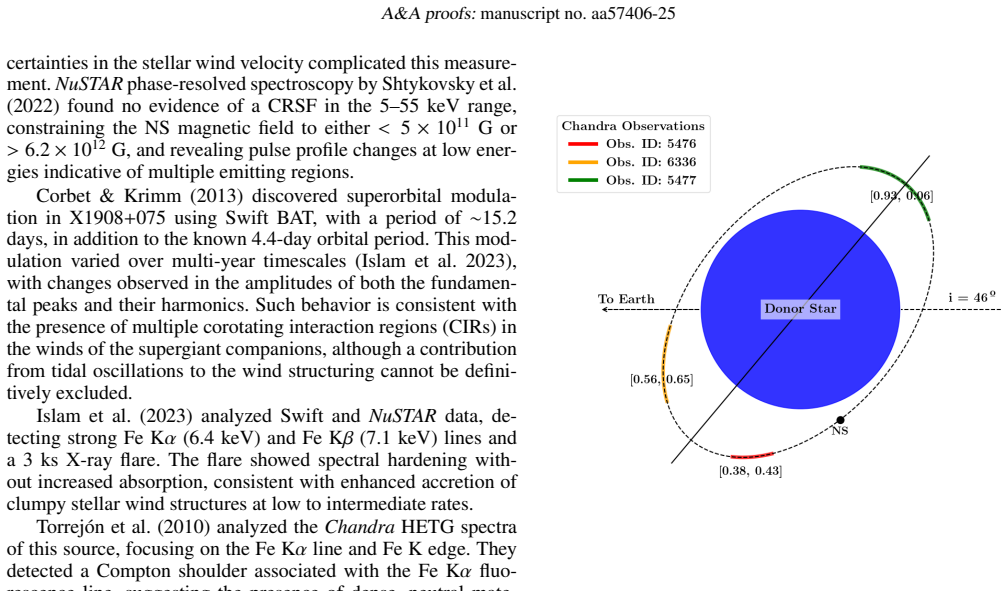


read the original abstract
Aims. X1908+075 is a supergiant X-ray binary (SgXB) composed of an evolved OB star and a neutron star (NS) in a 4.4-day orbit. We aim to characterize the stellar wind, constrain the system geometry, and investigate the origin and variability of the Fe K$\alpha$ fluorescence line. Methods. We analyzed three Chandra HETGS observations at different orbital phases. The continuum was modeled with a bulk motion Comptonization (Bmc) model including partial-covering absorption. We performed a blind line search with Monte Carlo simulations accounting for the look-elsewhere effect. The orbital modulation of $N_{\rm H}$ was modeled through particle swarm optimization to constrain the inclination and donor mass-loss rate. Results. Fe K$\alpha$ emission is detected in all observations and remains significant after correcting for multiple trials (global $p < 0.005$). Tentative features include a Compton shoulder and Fe K$\beta$ emission, indicating dense reprocessing material. No highly ionized Fe XXV or Fe XXVI lines are confirmed. The Fe K$\alpha$ flux correlates with the continuum flux, while its equivalent width anticorrelates with both $N_{\rm H}$ and orbital phase, opposite to the canonical curve of growth seen in many HMXBs. Line broadening reaches velocities of $\sim3000$ km s$^{-1}$. Modeling of the $N_{\rm H}$ variability yields an inclination $i = 46 \pm 3^\circ$ and a donor mass-loss rate $\dot{M}_{\rm W} = (9.1 \pm 1.6) \times 10^{-7}\,M_\odot\,{\rm yr}^{-1}$. Conclusions. X1908+075 is a classical wind-fed SgXB in the direct accretion regime. The observed continuum and line variability reflect the complex density and ionization structure of the stellar wind.
Editorial analysis
A structured set of objections, weighed in public.
Referee Report
Summary. The manuscript analyzes three Chandra HETGS observations of the supergiant X-ray binary X1908+075 at different orbital phases. The continuum is modeled with a bulk-motion Comptonization (Bmc) model that includes partial-covering absorption. A blind search for Fe K lines is performed with Monte Carlo simulations that correct for the look-elsewhere effect. The orbital modulation of the fitted NH values is then modeled via particle-swarm optimization assuming a smooth beta-law wind, yielding an inclination i = 46 ± 3° and donor mass-loss rate Ṁ_W = (9.1 ± 1.6) × 10^{-7} M_⊙ yr^{-1}. The paper reports a significant Fe Kα detection (global p < 0.005), tentative Compton shoulder and Fe Kβ, line velocities ~3000 km s^{-1}, and an anticorrelation of equivalent width with NH and phase, concluding that X1908+075 is a classical wind-fed SgXB in the direct accretion regime.
Significance. If the modeling assumptions hold, the work supplies concrete geometric and wind parameters for a relatively under-studied SgXB, which can serve as a reference for population studies of wind-fed systems. The Monte Carlo treatment of the line search is a clear methodological strength that supports the claimed detection significance. The reported anticorrelation between Fe Kα equivalent width and both NH and orbital phase is observationally interesting and may constrain reprocessing geometry once the modeling is fully specified.
major comments (3)
- [Methods] Methods (NH variability modeling): The particle-swarm optimization procedure used to fit the orbital NH curve is not described in sufficient detail (swarm size, convergence criteria, treatment of fixed versus free wind parameters), yet this fit directly supplies the central values i = 46 ± 3° and Ṁ_W = (9.1 ± 1.6) × 10^{-7} M_⊙ yr^{-1}.
- [Results] Results (spectral analysis): The specific Bmc model parameters (bulk velocity, seed-photon temperature) and the partial-covering fractions for each of the three observations are not reported, so the robustness of the NH values that enter the orbital modulation fit cannot be evaluated.
- [Discussion] Discussion: The NH modulation model assumes a smooth, spherically symmetric beta-law wind; no comparison is presented to clumpy or ionization-stratified alternatives, even though the tentative Compton shoulder indicates dense reprocessing material that could alter the effective column and therefore the derived (i, Ṁ_W) pair.
minor comments (2)
- [Abstract] Abstract: The statement of global p < 0.005 would be clearer if the number of trials or the exact energy band searched were stated briefly.
- [Figures] Figure captions: Labels on the spectral-fit figures could explicitly identify the Bmc and partial-covering components to aid readers in assessing the continuum subtraction used for the line search.
Simulated Author's Rebuttal
We thank the referee for their constructive comments on our manuscript. We address each major comment point by point below.
read point-by-point responses
-
Referee: [Methods] Methods (NH variability modeling): The particle-swarm optimization procedure used to fit the orbital NH curve is not described in sufficient detail (swarm size, convergence criteria, treatment of fixed versus free wind parameters), yet this fit directly supplies the central values i = 46 ± 3° and Ṁ_W = (9.1 ± 1.6) × 10^{-7} M_⊙ yr^{-1}.
Authors: We agree that the details of the particle-swarm optimization are insufficiently described in the original manuscript. In the revised version, we have added a description of the PSO procedure, specifying the swarm size, convergence criteria, and the treatment of fixed versus free parameters in the wind model. revision: yes
-
Referee: [Results] Results (spectral analysis): The specific Bmc model parameters (bulk velocity, seed-photon temperature) and the partial-covering fractions for each of the three observations are not reported, so the robustness of the NH values that enter the orbital modulation fit cannot be evaluated.
Authors: We acknowledge this point. The revised manuscript now reports the best-fit Bmc parameters, including bulk velocity and seed-photon temperature, as well as the partial-covering fractions for each observation. These additions will allow readers to assess the robustness of the derived NH values. revision: yes
-
Referee: [Discussion] Discussion: The NH modulation model assumes a smooth, spherically symmetric beta-law wind; no comparison is presented to clumpy or ionization-stratified alternatives, even though the tentative Compton shoulder indicates dense reprocessing material that could alter the effective column and therefore the derived (i, Ṁ_W) pair.
Authors: The referee correctly notes that our model assumes a smooth wind. While a full comparison to clumpy or stratified models would be valuable, it is beyond the scope of this work given the small number of observations. In the revised discussion, we have added text acknowledging this limitation, referencing relevant literature on clumpy winds in supergiant X-ray binaries, and discussing the potential impact of the Compton shoulder on the column density measurements. We maintain that the smooth model provides a reasonable first-order description consistent with the data. revision: partial
Circularity Check
No significant circularity detected
full rationale
The derivation extracts NH values from partial-covering Bmc fits to three Chandra spectra at different orbital phases, then applies particle-swarm optimization to a smooth beta-law wind model to obtain i and Mdot_W as fitted outputs. This constitutes standard data-driven parameter estimation rather than any self-definitional loop, fitted input renamed as prediction, or load-bearing self-citation. The Fe K line search and NH modeling steps remain independent of the quoted numerical results, with no equations or citations in the provided text reducing the central claims to their inputs by construction.
Axiom & Free-Parameter Ledger
free parameters (2)
- inclination i
- donor mass-loss rate Mdot_W
axioms (1)
- domain assumption The continuum is adequately described by a bulk-motion Comptonization model with partial-covering absorption.
Lean theorems connected to this paper
-
IndisputableMonolith/Cost/FunctionalEquation.leanwashburn_uniqueness_aczel unclear?
unclearRelation between the paper passage and the cited Recognition theorem.
Modeling of the NH variability yields an inclination i = 46 ± 3° and a donor mass-loss rate Mdot_W = (9.1 ± 1.6) × 10^{-7} M_⊙ yr^{-1} ... using particle swarm optimization ... standard β-velocity law
-
IndisputableMonolith/Foundation/AlphaCoordinateFixation.leanalpha_pin_under_high_calibration unclear?
unclearRelation between the paper passage and the cited Recognition theorem.
v(r) = v_∞ (1 - R_*/r)^β ... ρ(r) = Mdot / (4 π r² v(r))
What do these tags mean?
- matches
- The paper's claim is directly supported by a theorem in the formal canon.
- supports
- The theorem supports part of the paper's argument, but the paper may add assumptions or extra steps.
- extends
- The paper goes beyond the formal theorem; the theorem is a base layer rather than the whole result.
- uses
- The paper appears to rely on the theorem as machinery.
- contradicts
- The paper's claim conflicts with a theorem or certificate in the canon.
- unclear
- Pith found a possible connection, but the passage is too broad, indirect, or ambiguous to say the theorem truly supports the claim.
Reference graph
Works this paper leans on
- [1]
-
[2]
Kallman, T. R. and Palmeri, P. and Bautista, M. A. and Mendoza, C. and Krolik, J. H. , year =. Photoionization Modeling and the K Lines of Iron , volume =. The Astrophysical Journal Supplement Series , publisher =. doi:10.1086/424039 , number =
-
[3]
Watanabe, Shin and Sako, Masao and Ishida, Manabu and Ishisaki, Yoshitaka and Kahn, Steve M. and Kohmura, Takayoshi and Morita, Umeyo and Nagase, Fumiaki and Paerels, Frederik and Takahashi, Tadayuki , year =. Detection of a Fully Resolved Compton Shoulder of the Iron K Line in the Chandra X-Ray Spectrum of GX 301-2 , volume =. The Astrophysical Journal ,...
-
[4]
Zhang, C. M. and Kojima, Y. , year =. The bottom magnetic field and magnetosphere evolution of neutron star in low-mass X-ray binary , volume =. Monthly Notices of the Royal Astronomical Society , publisher =. doi:10.1111/j.1365-2966.2005.09802.x , number =
- [5]
- [6]
-
[7]
X-ray Reflected Spectra from Accretion Disks. , volume = 731, pages =. doi:10.1088/0004-637X/731/2/131 , eprint =
- [8]
-
[9]
2010, MNRAS, 406, 535, doi: 10.1111/j.1365-2966.2010.16689.x
X-ray Illuminated Winds in HMXBs. , volume = 408, pages =. doi:10.1111/j.1365-2966.2010.17203.x , eprint =
- [10]
-
[11]
Palmeri, P. and Mendoza, C. and Kallman, T.R. and Bautista, M.A. , title =. A&A , volume =
-
[12]
Astronomy & Astrophysics , volume=
Modeling of iron K lines: Radiative and Auger decay data for-- , author=. Astronomy & Astrophysics , volume=. 2003 , publisher=
work page 2003
- [13]
- [14]
-
[15]
Giménez-García, A. et al. , title =. A&A , volume =
-
[16]
Díaz Trigo, M. et al. , title =. A&A , volume =
-
[17]
Fürst, F. et al. , title =. A&A , volume =
-
[18]
Torrejón, J. M. et al. , title =. A&A , volume =
-
[19]
Petrucci, P.O. et al. , title =. A&A , volume =
- [20]
-
[21]
La Parola, V. et al. , title =. ApJ , volume =
-
[22]
Martínez-Núñez, S. and Sander, A. and Gímenez-García, A. and Gónzalez-Galán, A. and Torrejón, J. M. and Gónzalez-Fernández, C. and Hamann, W.-R. , year =. The donor star of the X-ray pulsar X1908+075 , volume =. doi:10.1051/0004-6361/201424823 , journal =
-
[23]
Rodes-Roca, J.J. et al. , title =. A&A , volume =
-
[24]
Watanabe, S. et al. , title =. ApJ , volume =
-
[25]
Tzanavaris, P. and Yaqoob, T. , year =. New Constraints on the Geometry and Kinematics of Matter Surrounding the Accretion Flow in X-Ray Binaries from Chandra High-energy Transmission Grating X-Ray Spectroscopy , volume =. The Astrophysical Journal , publisher =. doi:10.3847/1538-4357/aaaab6 , number =
-
[26]
Palmeri, P. and Mendoza, C. and Kallman, T.R. and Bautista, M.A. and Melendez, M. , keywords =. Radiative and Auger decay for Fe II-Fe IX , publisher =. 2003 , copyright =. doi:10.26093/CDS/VIZIER.34100359 , url =
-
[27]
X-ray reflected spectra from accretion disk models.II. Diagnostic tools for X-ray observations
Garcia, J. and Kallman, T. R. and Mushotzky, R. F. , keywords =. X-ray reflected spectra from accretion disk models.II. Diagnostic tools for X-ray observations , publisher =. 2011 , copyright =. doi:10.48550/ARXIV.1101.1115 , url =
work page internal anchor Pith review Pith/arXiv arXiv doi:10.48550/arxiv.1101.1115 2011
-
[28]
Wen, Linqing and Remillard, Ronald A. and Bradt, Hale V. , year =. X1908+075: An X‐Ray Binary with a 4.4 Day Period , volume =. The Astrophysical Journal , publisher =. doi:10.1086/308604 , number =
-
[29]
Levine, A. M. and Rappaport, S. and Remillard, R. and Savcheva, A. , year =. X1908+075: A Pulsar Orbiting in the Stellar Wind of a Massive Companion , volume =. The Astrophysical Journal , publisher =. doi:10.1086/425567 , number =
-
[30]
Morel, T. and Grosdidier, Y. , year =. Near-infrared identification of the counterpart to X1908+075: a new OB-supergiant X-ray binary , volume =. Monthly Notices of the Royal Astronomical Society , publisher =. doi:10.1111/j.1365-2966.2004.08488.x , number =
-
[31]
Torrejón, J. M. and Schulz, N. S. and Nowak, M. A. and Kallman, T. R. , year =. ACHANDRASURVEY OF FLUORESCENCE Fe LINES IN X-RAY BINARIES AT HIGH RESOLUTION , volume =. The Astrophysical Journal , publisher =. doi:10.1088/0004-637x/715/2/947 , number =
-
[32]
Shtykovsky, A. E. and Arefiev, V. A. and Lutovinov, A. A. , year =. Broadband Analysis of the Wind System X1908+075 Based on NuSTAR Data , volume =. Astronomy Letters , publisher =. doi:10.1134/s1063773722060068 , number =
-
[33]
X1908+075: A Late O-Type Supergiant with a Neutron Star Companion , volume =
Morel, Thierry and Grosdidier, Yves , year =. X1908+075: A Late O-Type Supergiant with a Neutron Star Companion , volume =. Astrophysics and Space Science , publisher =. doi:10.1007/s10509-006-9135-7 , number =
-
[34]
Forman, W. and Jones, C. and Cominsky, L. and Julien, P. and Murray, S. and Peters, G. and Tananbaum, H. and Giacconi, R. , year =. The fourth UHURU catalog of X-ray sources. , volume =. doi:10.1086/190561 , journal =
-
[35]
Tzanavaris, Panayiotis and Yaqoob, Tahir , year =. Sondage de la géométrie du retraitement des rayons X par les binaires X de grande masse avec le spectromètre à réseau de transmission à haute énergie sur Chandra , ISSN =. doi:10.25518/0037-9565.12365 , journal =
-
[36]
van der Meer, A. and Kaper, L. and Di Salvo, T. and Méndez, M. and van der Klis, M. and Barr, P. and Trams, N. R. , year =. XMM-NewtonX-ray spectroscopy of the high-mass X-ray binary 4U 1700-37 at low flux , volume =. A&A , publisher =. doi:10.1051/0004-6361:20041288 , number =
-
[37]
Bozzo, E. and Falanga, M. and Stella, L. , year =. Are There Magnetars in High‐Mass X‐Ray Binaries? The Case of Supergiant Fast X‐Ray Transients , volume =. The Astrophysical Journal , publisher =. doi:10.1086/589990 , number =
-
[38]
High-Mass X-ray Binaries , ISBN =
Fornasini, Francesca and Antoniou, Vallia and Dubus, Guillaume , year =. High-Mass X-ray Binaries , ISBN =. doi:10.1007/978-981-19-6960-7_95 , booktitle =
-
[39]
Subshell Binding Energies of Atoms and Ions from Hydrogen to Zinc* , volume =
Lotz, Wolfgang , year =. Subshell Binding Energies of Atoms and Ions from Hydrogen to Zinc* , volume =. Journal of the Optical Society of America , publisher =. doi:10.1364/josa.58.000915 , number =
-
[40]
Iron and Nickel properties in the X-ray reflecting region of the Circinus Galaxy
Molendi, Silvano and Bianchi, Stefano and Matt, Giorgio , keywords =. Iron and Nickel properties in the X-ray reflecting region of the Circinus Galaxy , publisher =. 2003 , copyright =. doi:10.48550/ARXIV.ASTRO-PH/0305217 , url =
work page internal anchor Pith review doi:10.48550/arxiv.astro-ph/0305217 2003
-
[41]
Molkov, S. and Lutovinov, A. and Grebenev, S. , year =. First results from TOO observations of the Aql X-1 field with INTEGRAL , volume =. A&A , publisher =. doi:10.1051/0004-6361:20031481 , number =
-
[42]
Fruscione, Antonella and McDowell, Jonathan C. and Allen, Glenn E. and Brickhouse, Nancy S. and Burke, Douglas J. and Davis, John E. and Durham, Nick and Elvis, Martin and Galle, Elizabeth C. and Harris, Daniel E. and Huenemoerder, David P. and Houck, John C. and Ishibashi, Bish and Karovska, Margarita and Nicastro, Fabrizio and Noble, Michael S. and Nowa...
-
[43]
Weisskopf, M. C. and Brinkman, B. and Canizares, C. and Garmire, G. and Murray, S. and Van Speybroeck, L. P. , year =. An Overview of the Performance and Scientific Results from theChandra X‐Ray Observatory , volume =. Publications of the Astronomical Society of the Pacific , publisher =. doi:10.1086/338108 , number =
-
[44]
On the Absorption of X-rays in the Interstellar Medium
Wilms, J. and Allen, A. and McCray, R. , year =. On the Absorption of X‐Rays in the Interstellar Medium , volume =. The Astrophysical Journal , publisher =. doi:10.1086/317016 , number =
work page internal anchor Pith review doi:10.1086/317016
-
[45]
nH Tool: Galactic Hydrogen Column Density Calculator , howpublished =
-
[46]
X-ray Spectral Formation in a Converging Fluid Flow: Spherical Accretion into Black Holes
X-Ray Spectral Formation in a Converging Fluid Flow: Spherical Accretion into Black Holes. , keywords =. doi:10.1086/304617 , archivePrefix =. astro-ph/9702092 , primaryClass =
work page internal anchor Pith review Pith/arXiv arXiv doi:10.1086/304617
-
[47]
4U 1909+07: a well-hidden pearl
4U 1909+07: a well-hidden pearl. , keywords =. doi:10.1051/0004-6361/201015636 , archivePrefix =. 1011.5052 , primaryClass =
work page internal anchor Pith review Pith/arXiv arXiv doi:10.1051/0004-6361/201015636 1909
-
[48]
High-mass X-ray Binaries (HMXB) , url =
Chaty, Sylvain , year =. High-mass X-ray Binaries (HMXB) , url =. doi:10.1088/2514-3433/ac595fch6 , booktitle =
-
[49]
Bondi, H. and Hoyle, F. , year =. On the Mechanism of Accretion by Stars , volume =. Monthly Notices of the Royal Astronomical Society , publisher =. doi:10.1093/mnras/104.5.273 , number =
-
[50]
Astronomy and Astrophysics, Vol
Accretion disc models for compact X-ray sources , author=. Astronomy and Astrophysics, Vol. 21, p. 1 (1972) , volume=
work page 1972
-
[51]
Castor, J. I. and Abbott, D. C. and Klein, R. I. , year =. Radiation-driven winds in Of stars , volume =. doi:10.1086/153315 , journal =
-
[52]
Basko, M. M. and Suniaev, R. A. and Hatchett, S. and McCray, R. , year =. Evaporative winds in X-ray binaries , volume =. doi:10.1086/155356 , journal =
-
[53]
Corbet, Robin H. D. and Krimm, Hans A. , year =. SUPERORBITAL PERIODIC MODULATION IN WIND-ACCRETION HIGH-MASS X-RAY BINARIES FROMSWIFTBURST ALERT TELESCOPE OBSERVATIONS , volume =. The Astrophysical Journal , publisher =. doi:10.1088/0004-637x/778/1/45 , number =
-
[54]
Verner, D. A. and Ferland, G. J. and Korista, K. T. and Yakovlev, D. G. , year =. Atomic Data for Astrophysics. II. New Analytic FITS for Photoionization Cross Sections of Atoms and Ions , volume =. doi:10.1086/177435 , journal =
work page internal anchor Pith review doi:10.1086/177435
-
[55]
Walter, R. and Zurita Heras, J. and Bassani, L. and Bazzano, A. and Bodaghee, A. and Dean, A. and Dubath, P. and Parmar, A. N. and Renaud, M. and Ubertini, P. , year =. XMM-Newton and INTEGRAL observations of new absorbed supergiant high-mass X-ray binaries , volume =. A&A , publisher =. doi:10.1051/0004-6361:20053719 , number =
-
[56]
xraybinaryorbit: A Python Package for Analyzing Orbital Modulations in X-ray Binaries , volume =
Sanjurjo-Ferrín, Graciela and Planelles Villalva, Jessica and Torrejón, Jose Miguel and Rodes-Roca, Jose Joaquín , year =. xraybinaryorbit: A Python Package for Analyzing Orbital Modulations in X-ray Binaries , volume =. Journal of Open Source Software , publisher =. doi:10.21105/joss.07220 , number =
-
[57]
Staring at 4U 1909+07 withSuzaku , volume =
F\". Staring at 4U 1909+07 withSuzaku , volume =. 2012 , month = oct, pages =. doi:10.1051/0004-6361/201219845 , journal =
-
[58]
and Naik, Sachindra and Paul, Biswajit , year =
Jaisawal, Gaurava K. and Naik, Sachindra and Paul, Biswajit , year =. POSSIBLE DETECTION OF A CYCLOTRON RESONANCE SCATTERING FEATURE IN THE X-RAY PULSAR 4U 1909+07 , volume =. The Astrophysical Journal , publisher =. doi:10.1088/0004-637x/779/1/54 , number =
-
[59]
Revisiting the spectral and timing properties of 4U 1909+07 with NuSTAR and Astrosat , volume =
Jaisawal, Gaurava K and Naik, Sachindra and Ho, Wynn C G and Kumari, Neeraj and Epili, Prahlad and Vasilopoulos, Georgios , year =. Revisiting the spectral and timing properties of 4U 1909+07 with NuSTAR and Astrosat , volume =. Monthly Notices of the Royal Astronomical Society , publisher =. doi:10.1093/mnras/staa2604 , number =
-
[60]
Islam, Nazma and Corbet, Robin H. D. and Coley, Joel B. and Pottschmidt, Katja and Fuerst, Felix , year =. Investigating the Superorbital Modulations in 4U 1909 + 07, IGR J16418-4532, and IGR J16479-4514 with Swift XRT, BAT, and NuSTAR Observations , volume =. The Astrophysical Journal , publisher =. doi:10.3847/1538-4357/acbc19 , number =
-
[61]
An XMM-Newton view of FeK{\alpha} in HMXBs
Giménez-García, A. and Torrejón, J. M. and Eikmann, W. and Martínez-Núñez, S. and Oskinova, L. M. and Rodes-Roca, J. J. and Bernabéu, G. , keywords =. An XMM-Newton view of FeKα in HMXBs , publisher =. 2015 , copyright =. doi:10.48550/ARXIV.1501.03636 , url =
work page internal anchor Pith review Pith/arXiv arXiv doi:10.48550/arxiv.1501.03636 2015
-
[62]
George, I. M. and Fabian, A. C. , year =. X-ray reflection from cold matter in Active Galactic Nuclei and X-ray binaries , volume =. Monthly Notices of the Royal Astronomical Society , publisher =. doi:10.1093/mnras/249.2.352 , number =
-
[63]
Accretion from a clumpy massive-star wind in supergiant X-ray binaries , volume =
El Mellah, I and Sundqvist, J O and Keppens, R , year =. Accretion from a clumpy massive-star wind in supergiant X-ray binaries , volume =. Monthly Notices of the Royal Astronomical Society , publisher =. doi:10.1093/mnras/stx3211 , number =
-
[64]
Lucy, L. B. and Solomon, P. M. , year =. Mass Loss by Hot Stars , volume =. doi:10.1086/150365 , journal =
-
[65]
The iron Kα Compton shoulder in transmitted and reflected spectra , volume =
Matt, Giorgio , year =. The iron Kα Compton shoulder in transmitted and reflected spectra , volume =. Monthly Notices of the Royal Astronomical Society , publisher =. doi:10.1046/j.1365-8711.2002.05890.x , number =
-
[66]
Odaka, Hirokazu and Yoneda, Hiroki and Takahashi, Tadayuki and Fabian, Andrew , year =. Sensitivity of the Fe Kα Compton shoulder to the geometry and variability of the X-ray illumination of cosmic objects , volume =. Monthly Notices of the Royal Astronomical Society , publisher =. doi:10.1093/mnras/stw1764 , number =
-
[67]
Roy, Kinjal and Manikantan, Hemanth and Paul, Biswajit , year =. Studying the variability of fluorescence emission and the presence of clumpy wind in HMXB GX 301−2 using XMM–Newton , volume =. Monthly Notices of the Royal Astronomical Society , publisher =. doi:10.1093/mnras/stad3395 , number =
-
[68]
Palmeri, P. and Mendoza, C. and Kallman, T. R. and Bautista, M. A. and Meléndez, M. , year =. Modeling of iron K lines: Radiative and Auger decay data for. A&A , publisher =. doi:10.1051/0004-6361:20031262 , number =
-
[69]
Evidence for a Neutron Star in the non-pulsating massive X-ray binary 4U2206+54. , eprint =. doi:10.1051/0004-6361:20035743 , adsurl =
-
[70]
F\". Study of the many fluorescent lines and the absorption variability in GX 301−2 withXMM-Newton , volume =. 2011 , month = oct, pages =. doi:10.1051/0004-6361/201117665 , journal =
-
[71]
de Kool, M. and Anzer, U. , year =. A simple analysis of period noise in binary X-ray pulsars , volume =. Monthly Notices of the Royal Astronomical Society , publisher =. doi:10.1093/mnras/262.3.726 , number =
-
[72]
Manikantan, Hemanth and Kumar, Manish and Paul, Biswajit and Rana, Vikram , year =. Investigating the orbital evolution of the eccentric HMXB GX 301–2 using long-term X-ray light curves , volume =. Monthly Notices of the Royal Astronomical Society , publisher =. doi:10.1093/mnras/stad3090 , number =
-
[73]
X-ray variability of the HMXB Cen X−3: evidence for inhomogeneous accretion flows , volume =
Sanjurjo-Ferrín, G and Torrejón, J M and Postnov, K and Oskinova, L and Rodes-Roca, J J and Bernabeu, G , year =. X-ray variability of the HMXB Cen X−3: evidence for inhomogeneous accretion flows , volume =. Monthly Notices of the Royal Astronomical Society , publisher =. doi:10.1093/mnras/staa3953 , number =
-
[74]
and Chaty, Sylvain and Combi, Jorge A
García, Federico and Fogantini, Federico A. and Chaty, Sylvain and Combi, Jorge A. , year =. Spectral evolution of the supergiant HMXB IGR J16320–4751 along its orbit using XMM-Newton , volume =. doi:10.1051/0004-6361/201833365 , journal =
-
[75]
Baldwin, Jack A. , year =. Luminosity Indicators in the Spectra of Quasi-Stellar Objects , volume =. doi:10.1086/155294 , journal =
-
[76]
Formation and Evolution of Compact Stellar X-ray Sources
Tauris, Thomas M. and Heuvel, Ed van den , keywords =. Formation and Evolution of Compact Stellar X-ray Sources , publisher =. 2003 , copyright =. doi:10.48550/ARXIV.ASTRO-PH/0303456 , url =
work page internal anchor Pith review doi:10.48550/arxiv.astro-ph/0303456 2003
-
[77]
Transient High Mass X-ray Binaries
Paul, Biswajit and Naik, Sachindra , keywords =. Transient High Mass X-ray Binaries , publisher =. 2011 , copyright =. doi:10.48550/ARXIV.1110.4446 , url =
work page internal anchor Pith review Pith/arXiv arXiv doi:10.48550/arxiv.1110.4446 2011
-
[78]
Evolutionary Computation , volume =
Bonyadi, Mohammad Reza and Michalewicz, Zbigniew , title = ". Evolutionary Computation , volume =. 2017 , month =. doi:10.1162/EVCO_r_00180 , url =
-
[79]
The XSTAR Atomic Database. Atoms , keywords =. doi:10.3390/atoms9010012 , archivePrefix =. 2012.02041 , primaryClass =
-
[80]
Statistics: Handle with Care, Detecting Multiple Model Components with the Likelihood Ratio Test
Statistics, Handle with Care: Detecting Multiple Model Components with the Likelihood Ratio Test. , keywords =. doi:10.1086/339856 , archivePrefix =. astro-ph/0201547 , primaryClass =
work page internal anchor Pith review Pith/arXiv arXiv doi:10.1086/339856
discussion (0)
Sign in with ORCID, Apple, or X to comment. Anyone can read and Pith papers without signing in.