Alternative Lattice Design for the STCF Collider Rings
Pith reviewed 2026-05-19 23:22 UTC · model grok-4.3
pith:Y6XZVJVR Add to your LaTeX paper
What is a Pith Number?\usepackage{pith}
\pithnumber{Y6XZVJVR}
Prints a linked pith:Y6XZVJVR badge after your title and writes the identifier into PDF metadata. Compiles on arXiv with no extra files. Learn more
The pith
An alternative one-fold lattice for the STCF collider reaches 1×10^{35} cm^{-2}s^{-1} luminosity at 2 GeV with a 600-second Touschek lifetime.
A machine-rendered reading of the paper's core claim, the machinery that carries it, and where it could break.
Core claim
The optimized lattice achieves the more ambitious luminosity of 1×10^{35} cm^{-2}s^{-1} while maintaining a Touschek lifetime of about 600 s at 2 GeV, with sufficient dynamic aperture and momentum acceptance for stable operation. This performance is obtained through a systematic optimization framework that proceeds in three stages: lattice-agnostic global parameter optimization incorporating luminosity, beam-beam limits, and collective effects; optics design based on a compact interaction region with local chromatic correction and crab-waist sextupoles; and global nonlinear optimization that combines analysis-driven methods with tracking-based refinement.
What carries the argument
Three-stage optimization framework consisting of global parameter tuning, local chromatic correction plus crab-waist sextupoles in the interaction region, and combined analysis-plus-tracking nonlinear refinement.
If this is right
- The lattice supports stable operation at the target luminosity without excessive beam loss from Touschek scattering.
- Local nonlinear control in the interaction region is essential to preserve dynamic aperture under crab-waist collisions.
- The same optimization strategy supplies a reusable methodology for other high-luminosity low-energy colliders.
- Sufficient momentum acceptance keeps the beam stable when operating near beam-beam limits.
- Global nonlinear optimization converges to solutions that simultaneously satisfy luminosity and lifetime requirements.
Where Pith is reading between the lines
- The one-fold layout may simplify construction and alignment compared with more segmented ring designs.
- Testing the lattice at currents slightly above design would reveal whether unforeseen collective instabilities appear.
- The approach could be adapted to explore trade-offs between luminosity and energy range in future tau-charm proposals.
- Higher luminosity enabled by this lattice would increase event rates for precision measurements of charm and tau decays.
Load-bearing premise
The design assumes that the crab-waist scheme combined with local chromatic correction will suppress beam-beam instabilities sufficiently for the nonlinear optimization to converge without collective effects dominating at the target currents.
What would settle it
A detailed beam-tracking simulation or experimental measurement at design current that yields a Touschek lifetime well below 600 s or dynamic aperture too small for injection would show the lattice does not meet the claimed performance.
Figures





read the original abstract
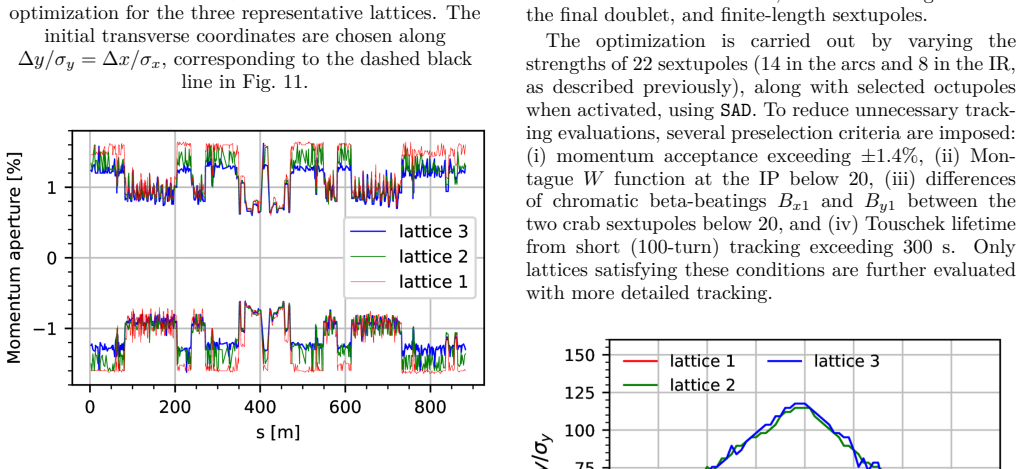
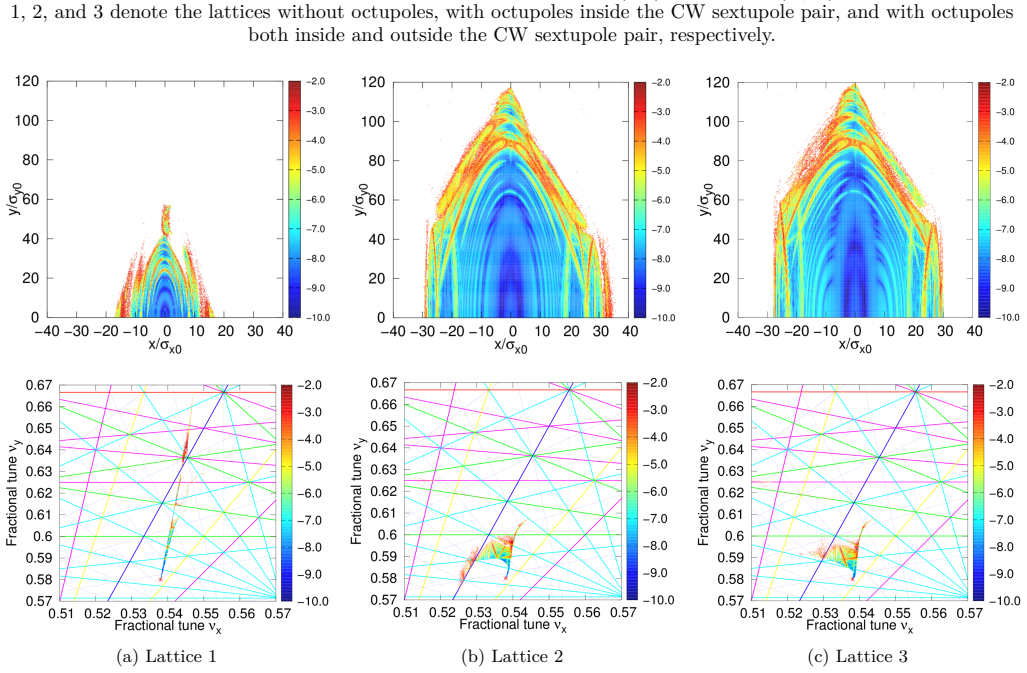
The Super Tau-Charm Facility (STCF) is a proposed high-luminosity electron-positron collider operating in the beam energy range of 1-3.5 GeV, targeting a peak luminosity larger than $0.5\times10^{35}\ \mathrm{cm^{-2}s^{-1}}$ at 2 GeV. In this regime, the combination of beam-beam interaction in the crab-waist scheme and low beam energy imposes stringent constraints on dynamic aperture, momentum acceptance, and Touschek lifetime. In this paper, we present an alternative one-fold lattice design for the STCF collider rings, developed within a systematic optimization framework. The approach consists of three stages: (i) lattice-agnostic global parameter optimization using a parameter optimization model that consistently incorporates luminosity performance, beam-beam limits, and collective effects; (ii) optics design based on a compact interaction region with local chromatic correction and crab-waist sextupoles; and (iii) global nonlinear optimization combining analysis-driven methods and tracking-based refinement. The optimized lattice achieves the more ambitious luminosity of $1\times10^{35}\ \mathrm{cm^{-2}s^{-1}}$ while maintaining a Touschek lifetime of about 600 s at 2 GeV, with sufficient dynamic aperture and momentum acceptance for stable operation. The results highlight the critical role of local nonlinear control in the interaction region and demonstrate that the proposed optimization strategy provides an effective and general methodology for the design of high-luminosity low-energy colliders.
Editorial analysis
A structured set of objections, weighed in public.
Referee Report
Summary. The manuscript presents an alternative one-fold lattice design for the STCF collider rings developed via a three-stage optimization framework: (i) lattice-agnostic global parameter optimization incorporating luminosity, beam-beam limits, and collective effects; (ii) compact IR optics with local chromatic correction and crab-waist sextupoles; and (iii) global nonlinear optimization combining analysis-driven methods with tracking-based refinement. The optimized lattice is reported to reach a luminosity of 1×10^{35} cm^{-2}s^{-1} at 2 GeV while delivering a Touschek lifetime of ~600 s and adequate dynamic aperture and momentum acceptance for stable operation.
Significance. If the performance claims are substantiated, the work supplies a concrete, systematically optimized lattice option for the STCF project that exceeds the nominal luminosity target while respecting lifetime and acceptance constraints at low beam energy. The emphasis on local nonlinear control in the interaction region offers a reusable methodology for other high-luminosity, low-energy e^{+}e^{-} colliders.
major comments (1)
- [Results / global nonlinear optimization] Results section (performance metrics following the three-stage description): The central claim that the lattice supports stable operation at the design luminosity of 1×10^{35} cm^{-2}s^{-1} with 600 s Touschek lifetime rests on the assumption that beam-beam driven instabilities remain under control. However, the reported tracking is single-particle; no multi-particle simulations that include beam-beam kicks at full design bunch population are presented to verify that collective effects do not prevent convergence to the quoted performance.
minor comments (2)
- [Abstract] Abstract: the luminosity target is written as 0.5×10^{35}; consistent use of scientific notation (e.g., 5×10^{34}) throughout the text and figures would improve readability.
- [Methods] Methods: the description of the tracking-based refinement does not state the number of particles, number of turns, or synchrotron-radiation damping inclusion; adding these parameters would strengthen reproducibility.
Simulated Author's Rebuttal
We thank the referee for the positive evaluation of our work and the constructive comment on verification of beam-beam stability. We address the point below.
read point-by-point responses
-
Referee: The central claim that the lattice supports stable operation at the design luminosity of 1×10^{35} cm^{-2}s^{-1} with 600 s Touschek lifetime rests on the assumption that beam-beam driven instabilities remain under control. However, the reported tracking is single-particle; no multi-particle simulations that include beam-beam kicks at full design bunch population are presented to verify that collective effects do not prevent convergence to the quoted performance.
Authors: We thank the referee for this observation. In the three-stage framework, stage (i) performs lattice-agnostic global parameter optimization that explicitly folds in beam-beam limits together with luminosity and collective effects to identify a feasible working point. Stages (ii) and (iii) then design the IR optics and refine nonlinear dynamics via single-particle tracking to guarantee adequate dynamic aperture and momentum acceptance, which directly enter the Touschek lifetime estimate. We agree that dedicated multi-particle beam-beam simulations at full bunch population would supply additional evidence of stability; such studies lie outside the scope of the present lattice-design manuscript and are planned for subsequent work. In the revision we will add a clarifying paragraph that distinguishes the role of the parameter-level beam-beam constraints from the single-particle lattice validation. revision: partial
Circularity Check
No circularity detected in the three-stage lattice optimization chain
full rationale
The paper describes a systematic three-stage optimization (global parameter model incorporating luminosity and collective effects, IR optics with local correction, and global nonlinear tracking refinement) whose outputs are the achieved luminosity, Touschek lifetime, DA, and MA. These performance numbers are presented as results of applying the framework to the STCF parameters rather than being redefined or fitted back into the same quantities by construction. No equations, self-citations, or ansatzes are quoted that reduce the central claims to tautological inputs; the derivation remains self-contained against standard accelerator-physics benchmarks such as single-particle tracking and lifetime calculations.
Axiom & Free-Parameter Ledger
free parameters (1)
- sextupole strengths and IR optics parameters
axioms (1)
- domain assumption Crab-waist scheme plus local chromatic correction sufficiently mitigates beam-beam and chromatic effects at the target currents
Reference graph
Works this paper leans on
-
[1]
4, two damping wigglers are installed in each of the inner and outer half-rings
Damping Wiggler Section To provide flexibility in controlling radiation damping time, emittance, and beam parameters at different oper- ating energies, as shown in Fig. 4, two damping wigglers are installed in each of the inner and outer half-rings. The lattice and linear optics of the damping-wiggler sec- tions are shown in Fig. 9. The wigglers are place...
-
[2]
Siberian Snake Section Siberian Snake sections are introduced to achieve lon- gitudinal polarization of the electron beam at the IP. The snakes are distributed around the ring, with equal azimuthal spacing of 120° between neighboring sections. Figure 10 shows the lattice configuration together with the corresponding linear optics functions of a representa...
work page 2000
-
[3]
P. Raimondi, 2nd SuperB Workshop, INFN-LNF, Fras- cati, http://www.lnf.infn.it/conference/superb06/ (2006). 15
work page 2006
-
[4]
Beam-Beam Issues for Colliding Schemes with Large Piwinski Angle and Crabbed Waist
P. Raimondi, D. N. Shatilov, and M. Zobov, Beam-beam issues for colliding schemes with large piwinski angle and crabbed waist, arXiv preprint physics/0702033 (2007)
work page internal anchor Pith review Pith/arXiv arXiv 2007
-
[5]
P. Raimondi, D. Shatilov, and M. Zobov, Suppression of beam-beam resonances in crab waist collisions, in Proc. 11th European Particle Accelerator Conference (EPAC
- [6]
-
[7]
M. Zobov, D. Alesini, M. E. Biagini, et al. , Test of “crab- waist” collisions at the da Φne Φ factory, Physical Review Letters 104, 174801 (2010)
work page 2010
-
[8]
Y. Ohnishi, T. Abe, K. Akai, Y. Arimoto, K. Egawa, S. Enomoto, H. Fukuma, Y. Funakoshi, K. Furukawa, N. Iida, et al. , SuperKEKB operation using crab waist collision scheme, The European Physical Journal Plus 136, 1023 (2021)
work page 2021
-
[9]
A. Abada, M. Abbrescia, S. S. AbdusSalam, I. Ab- dyukhanov, J. Abelleira Fernandez, A. Abramov, M. Aburaia, A. O. Acar, P. R. Adzic, P. Agrawal, et al. , FCC-ee: the lepton collider: future circular collider con- ceptual design report volume 2, European Physical Jour- nal Special Topics 228, 261 (2019)
work page 2019
-
[10]
CEPC Study Group, CEPC conceptual design report: Volume 1-accelerator, arXiv preprint arXiv:1809.00285 (2018)
work page internal anchor Pith review Pith/arXiv arXiv 2018
-
[11]
H. Peng, Y.-H. Zheng, and X.-R. Zhou, Super tau-charm facility of china, Physics 49, 513 (2020)
work page 2020
- [12]
-
[13]
Tau/Charm Factory Accelerator Report
M. Biagini, R. Boni, M. Boscolo, A. Chiarucci, R. Cimino, A. Clozza, A. Drago, S. Guiducci, C. Ligi, G. Mazzitelli, et al. , Tau/Charm factory accelerator re- port, arXiv preprint arXiv:1310.6944 (2013)
work page internal anchor Pith review Pith/arXiv arXiv 2013
-
[14]
Anashin et al., Super Charm-Tau Factory: Conceptual Design Report, Tech
V. Anashin et al., Super Charm-Tau Factory: Conceptual Design Report, Tech. Rep. (Technical Report, Budker In- stitute of Nuclear Physics, Novosibirsk Russia, 2018)
work page 2018
-
[15]
A. Y. Barnyakov et al. , The project of the super charm- tau factory in novosibirsk, in Journal of Physics: Confer- ence Series, Vol. 1561 (IOP Publishing, 2020) p. 012004
work page 2020
-
[16]
SuperB Collaboration, SuperB progress reports – accel- erator (2011), arXiv:1009.6178 [physics]
work page internal anchor Pith review Pith/arXiv arXiv 2011
-
[17]
SuperKEKB design report, https://kds.kek.jp/ event/15914/
-
[18]
Q. Luo, W. Gao, J. Lan, W. Li, D. Xu, et al. , Progress of Conceptual Study for the Accelerators of a 2-7GeV Super Tau Charm Facility at China, in 10th Int. Particle Accelerator Conf.(IPAC’19), Melbourne, Australia, 19- 24 May 2019 (JACOW Publishing, Geneva, Switzerland,
work page 2019
-
[19]
J. Lan, Q. Luo, C. Zhang, W. Gao, Y. Xu, and Y. Bai, Design of beam optics for a super tau-charm factory, Journal of Instrumentation 16 (7), T07001
-
[20]
T. Liu, C. Zhang, L. Wang, and Q. Luo, Design of a hybrid seven-bend-achromat-based lattice for a super tau charm facility, in Proc. of Ipac2023, Venice, Italy, 07-12 May 2023 , 14 (JACoW Publishing, Venice, Italy, 2023) pp. 768–771
work page 2023
-
[21]
T. Liu, L. Zhang, S. Li, L. Wang, and Q. Luo, Recent progress and future plan for STCF collider ring lattice design, Modern Physics Letters A , 2440005 (2024)
work page 2024
-
[22]
T. Liu, L. Wang, and Q. Luo, Study of chromaticity cor- rection methods for a hybrid multi-bend-achromat lat- tice, Journal of Physics: Conference Series 2709, 12001 (2024)
work page 2024
-
[23]
Y. Zou, L. Zhang, T. Liu, P. Yang, W. Li, T. He, D. Zhou, K. Ohmi, S. Li, Z. Yu, et al. , Optics design of the super tau-charm facility collider rings, Nuclear Instruments and Methods in Physics Research Section A: Accelerators, Spectrometers, Detectors and Associated Equipment , 171191 (2025)
work page 2025
-
[24]
N. Dikansky and D. Pestrikov, Effect of the crab waist and of the micro-beta on the beam–beam instability, Nu- clear Instruments and Methods in Physics Research Sec- tion A: Accelerators, Spectrometers, Detectors and As- sociated Equipment 600, 538 (2009)
work page 2009
-
[25]
D. Zhou, Formulae of luminosity and beam-beam tune shifts for flat-beam asymmetric colliders, arXiv preprint arXiv:2212.12706 (2022)
-
[26]
P. Raimondi and M. Zobov, New generation electron- positron factories, Technical note G-58 (DA ΦNE, 2003)
work page 2003
-
[27]
K. Ohmi, N. Kuroo, K. Oide, D. Zhou, and F. Zimmer- mann, Coherent Beam-Beam instability in collisions with a large crossing angle, Physical review letters 119, 134801 (2017)
work page 2017
- [28]
-
[29]
P. Raimondi, S. M. Liuzzo, L. Farvacque, S. White, and M. Hofer, Local chromatic correction optics for future circular collider e+ e-, Physical Review Accelerators and Beams 28, 021002 (2025)
work page 2025
-
[30]
K. Oide, M. Aiba, S. Aumon, M. Benedikt, A. Blon- del, A. Bogomyagkov, M. Boscolo, H. Burkhardt, Y. Cai, A. Doblhammer, et al. , Design of beam optics for the future circular collider e + e - collider rings, Physical Review Accelerators and Beams 19, 111005 (2016)
work page 2016
- [31]
-
[32]
A. Bogomyagkov, E. Levichev, and P. Piminov, Final focus designs for crab waist colliders, Physical Review Accelerators and Beams 19, 121005 (2016)
work page 2016
-
[33]
K. L. Brown and R. V. Servranckx, First- and second- order charged particle optics, in AIP Conference Pro- ceedings, Vol. 127 (AIP, 1985) pp. 62–138
work page 1985
-
[34]
J. Bengtsson, The sextupole scheme for the swiss light source (sls): an analytic approach, SLS-Note 9, 97 (1997)
work page 1997
-
[35]
A. Bogomyagkov, Chromaticity correction of the inter- action region, The first IHEP-BINP CEPC Accelerator Collaboration Workshop, Beijing12-13 January (2016)
work page 2016
-
[36]
B. W. S. L. Montague, Linear optics for improved chro- maticity correction, Tech. Rep. (SCAN-0009131, 1979)
work page 1979
-
[37]
Y. Cai, Y. Nosochkov, J. S. Berg, J. Kewisch, Y. Li, D. Marx, C. Montag, S. Tepikian, F. Willeke, G. Hoff- staetter, and J. Unger, Optimization of chromatic op- tics in the electron storage ring of the electron-ion col- lider, Physical Review Accelerators and Beams 25, 71001 (2022)
work page 2022
- [38]
-
[39]
A. Bogomyagkov, E. Levichev, and S. Sinyatkin, Tou- schek lifetime and luminosity optimization for russian 16 super charm tau factory, Journal of Instrumentation 19 (2), P02018
-
[40]
B. Wei, Z. Bai, J. Tan, L. Wang, and G. Feng, Minimizing the fluctuation of resonance driving terms in dynamic aperture optimization, Physical Review Accelerators and Beams 26, 84001 (2023)
work page 2023
-
[41]
Liu, Pamkit-particle accelerator modeling kit, https: //pypi.org/project/PAMKIT (2025)
T. Liu, Pamkit-particle accelerator modeling kit, https: //pypi.org/project/PAMKIT (2025)
work page 2025
-
[42]
K. Deb, A. Pratap, S. Agarwal, and T. Meyarivan, A fast and elitist multiobjective genetic algorithm: Nsga-ii, IEEE Transactions on Evolutionary Computation 6, 182 (2002)
work page 2002
-
[43]
SAD Home Page, https://acc-physics.kek.jp/SAD
-
[44]
B. Riemann, M. Aiba, J. Kallestrup, and A. Streun, Efficient algorithms for dynamic aperture and momen- tum acceptance calculation in synchrotron light sources, Physical Review Accelerators and Beams 27, 94002 (2024)
work page 2024
discussion (0)
Sign in with ORCID, Apple, or X to comment. Anyone can read and Pith papers without signing in.