Comment on "Angle insensitive filters based on Fabry-Perot resonance structures" [J. Appl. Phys. 136, 193102 (2024)]
Pith reviewed 2026-05-20 23:32 UTC · model grok-4.3
The pith
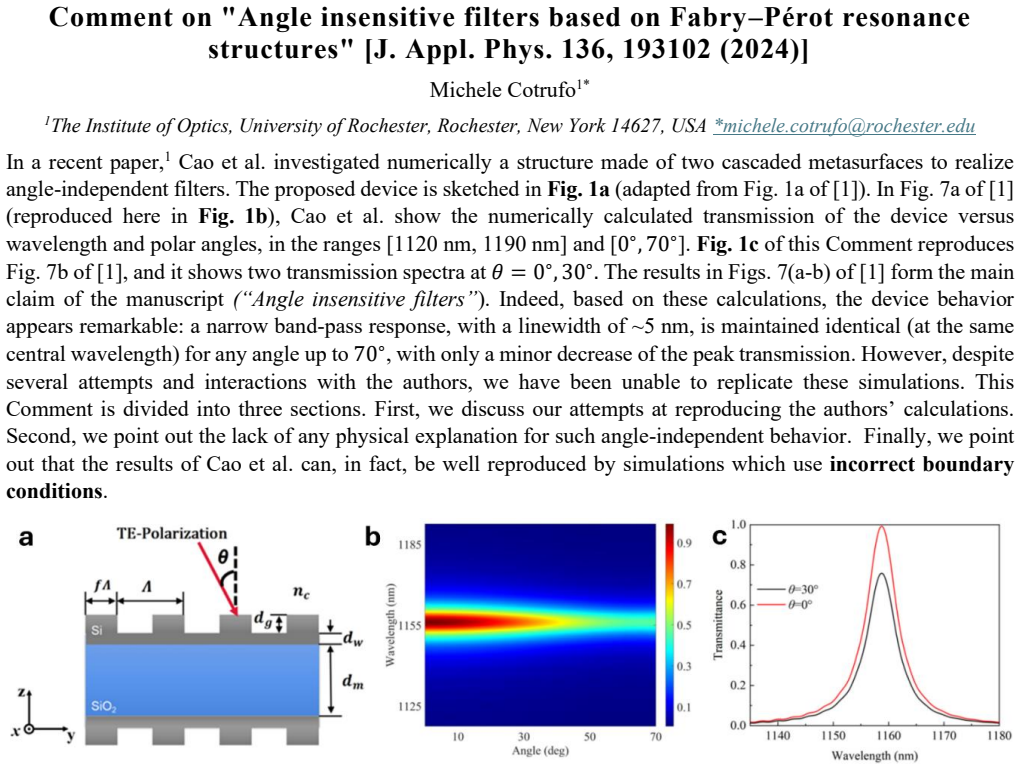
Simulations claiming perfect angle-independent filters up to 70 degrees can be reproduced only by using incorrect boundary conditions.
A machine-rendered reading of the paper's core claim, the machinery that carries it, and where it could break.
Core claim
The calculations presented by Cao et al. showing remarkable angle-independent filtering can be reproduced accurately when incorrect boundary conditions are used in the electromagnetic simulations, while correct periodic or absorbing boundary conditions fail to show the same effect despite multiple attempts to match the setup.
What carries the argument
Boundary conditions applied in electromagnetic simulations of the cascaded metasurface structure, where incorrect settings artificially remove the angle dependence expected for oblique incidence on Fabry-Perot resonances.
If this is right
- The claimed perfect angle independence up to 70 degrees does not appear under standard simulation conditions.
- Metasurface designs based on cascaded Fabry-Perot elements may still function but will exhibit the usual angle dependence at oblique incidence.
- Careful verification of boundary condition choices is required to avoid artifacts when modeling periodic or open photonic structures.
- Any future claims of extreme angle independence in similar geometries would need both correct simulations and a supporting physical model.
Where Pith is reading between the lines
- Detailed reporting of all simulation parameters, including exact boundary condition implementations, would reduce replication failures in nanophotonics.
- Other published claims of near-perfect angle-independent metasurface performance may benefit from re-examination for possible boundary condition artifacts.
- Fabrication and optical testing of the proposed cascaded metasurface structure would provide direct evidence beyond simulation results.
Load-bearing premise
That the replication attempts accurately matched the original simulation setup in all respects except for the boundary conditions used.
What would settle it
A side-by-side comparison of simulation files showing that only the boundary condition settings differ between the replication and the original work, or an experimental measurement of transmission through the fabricated structure at large angles.
Figures
read the original abstract
In a recent paper, Cao et al. investigated numerically a structure made of two cascaded metasurfaces to realize angle-independent filters. Their calculations show a remarkable performance, with a perfect angle-independent response up to 70 degrees. However, despite several attempts and interactions with the authors, we have been unable to replicate these simulations. This Comment discuss (1) our failed attempts at reproducing the authors' calculations, (2) the lack of any physical explanation for such angle-independent behavior, (3) the fact that the results of Cao et al. can, in fact, be well reproduced by simulations which use incorrect boundary conditions.
Editorial analysis
A structured set of objections, weighed in public.
Referee Report
Summary. This comment manuscript reports unsuccessful attempts to replicate the angle-independent filter performance (perfect transmission up to 70°) claimed by Cao et al. in J. Appl. Phys. 136, 193102 (2024) for a cascaded metasurface structure based on Fabry-Perot resonances. The authors state that they could not reproduce the results with standard (correct) boundary conditions despite interactions with the original team, but that the claimed response is recovered when incorrect boundary conditions are deliberately used in the simulations. They further note the absence of a physical mechanism that would explain true angle insensitivity.
Significance. If the replication claim is substantiated, the work would usefully flag a possible source of numerical artifacts in metasurface filter simulations and reinforce the need for explicit verification of boundary-condition choices in periodic electromagnetic modeling. The observation that no physical explanation exists for the reported angle independence is also a constructive point. However, the current manuscript supplies no quantitative simulation parameters, mesh-convergence data, or side-by-side setup comparisons, which limits its immediate utility for correcting the literature.
major comments (2)
- Abstract and main text: the central assertion that 'the results of Cao et al. can, in fact, be well reproduced by simulations which use incorrect boundary conditions' is load-bearing for the comment's conclusion, yet no tabulated parameter list, PML thickness, material dispersion model, periodicity enforcement details, or mesh-density values are provided to demonstrate that the only controlled difference between the 'correct' and 'incorrect' runs is the boundary-condition choice itself.
- Abstract: the statement that replication attempts were performed 'despite several attempts and interactions with the authors' is presented without any explicit confirmation that all other aspects of the original setup (excitation, post-processing of transmission spectra, unit-cell geometry, etc.) were held identical; this omission prevents the reader from isolating the boundary-condition effect as the sole explanatory factor.
minor comments (2)
- Abstract: grammatical error 'This Comment discuss' should read 'This Comment discusses'.
- The manuscript would benefit from at least one figure or table that directly overlays the transmission spectra obtained with correct versus incorrect boundary conditions against the curves reported by Cao et al.
Simulated Author's Rebuttal
We thank the referee for their careful and constructive review of our manuscript. We have addressed each of the major comments below and will revise the manuscript accordingly to improve its clarity and evidentiary value.
read point-by-point responses
-
Referee: Abstract and main text: the central assertion that 'the results of Cao et al. can, in fact, be well reproduced by simulations which use incorrect boundary conditions' is load-bearing for the comment's conclusion, yet no tabulated parameter list, PML thickness, material dispersion model, periodicity enforcement details, or mesh-density values are provided to demonstrate that the only controlled difference between the 'correct' and 'incorrect' runs is the boundary-condition choice itself.
Authors: We agree that the manuscript would benefit from explicit documentation of the simulation settings. In the revised version we will add a dedicated table (and accompanying text) that lists all relevant parameters for both the correct and incorrect boundary-condition cases, including PML thickness and termination, material dispersion models, periodicity enforcement, mesh density, and convergence checks. Side-by-side geometry and post-processing details will also be provided so that the sole controlled variable is indeed the boundary-condition implementation. revision: yes
-
Referee: Abstract: the statement that replication attempts were performed 'despite several attempts and interactions with the authors' is presented without any explicit confirmation that all other aspects of the original setup (excitation, post-processing of transmission spectra, unit-cell geometry, etc.) were held identical; this omission prevents the reader from isolating the boundary-condition effect as the sole explanatory factor.
Authors: We acknowledge the need for greater clarity on this point. The revised manuscript will include an explicit statement confirming that, in all replication attempts, the unit-cell geometry, material properties, excitation conditions, frequency sampling, and post-processing of the transmission spectra were matched exactly to the original work, with the only deliberate difference being the choice of boundary conditions. revision: yes
Circularity Check
No circularity: empirical replication critique with no derivations or self-referential claims
full rationale
This comment paper reports failed replication attempts of prior numerical simulations and notes that results can be reproduced using incorrect boundary conditions. It contains no equations, derivations, fitted parameters, predictions, or ansatzes. All claims rest on described simulation outcomes and author interactions rather than any mathematical chain that reduces to its own inputs. The analysis is therefore self-contained with no load-bearing self-citations or definitional loops.
Axiom & Free-Parameter Ledger
Lean theorems connected to this paper
-
IndisputableMonolith/Foundation/RealityFromDistinction.leanreality_from_one_distinction unclear?
unclearRelation between the paper passage and the cited Recognition theorem.
using incorrect boundary conditions (periodicity instead of Bloch/Floquet)
What do these tags mean?
- matches
- The paper's claim is directly supported by a theorem in the formal canon.
- supports
- The theorem supports part of the paper's argument, but the paper may add assumptions or extra steps.
- extends
- The paper goes beyond the formal theorem; the theorem is a base layer rather than the whole result.
- uses
- The paper appears to rely on the theorem as machinery.
- contradicts
- The paper's claim conflicts with a theorem or certificate in the canon.
- unclear
- Pith found a possible connection, but the passage is too broad, indirect, or ambiguous to say the theorem truly supports the claim.
Reference graph
Works this paper leans on
-
[1]
Cao, S., Chen, N. & Jiang, Y. Angle insensitive filters based on Fabry–Pérot resonance structures. Journal of Applied Physics 136, (2024)
work page 2024
-
[2]
Private Communication from Authors via the Editorial Office, received by us on July 3, 2025
work page 2025
-
[3]
Private Communication from Authors via the Editorial Office, received by us on July 7, 2025
work page 2025
- [4]
-
[5]
Markowitz, M. et al. Tailored resonant waveguide gratings for augmented reality. Optics Express 30, 20469–20481 (2022)
work page 2022
-
[6]
Private Communication from Authors via the Editorial Office, received by us on October 17, 2025
work page 2025
-
[7]
Angle insensitive filters based on Fabry–Pérot resonance structures
Cotrufo, M. Code and models to reproduce the calculations in ‘Comment on “Angle insensitive filters based on Fabry–Pérot resonance structures” [J. Appl. Phys. 136, 193102 (2024)]’. https://doi.org/10.5281/zenodo.17488428
discussion (0)
Sign in with ORCID, Apple, or X to comment. Anyone can read and Pith papers without signing in.