The Agentic Economy: Humans, AI Agents, Robots, and the Measurable Transition toward Distributed Economic Action
Pith reviewed 2026-05-20 01:41 UTC · model grok-4.3
The pith
Economic action is distributing across AI agents, robots, and protocols, making classical categories of labor, capital, and firm incomplete.
A machine-rendered reading of the paper's core claim, the machinery that carries it, and where it could break.
Core claim
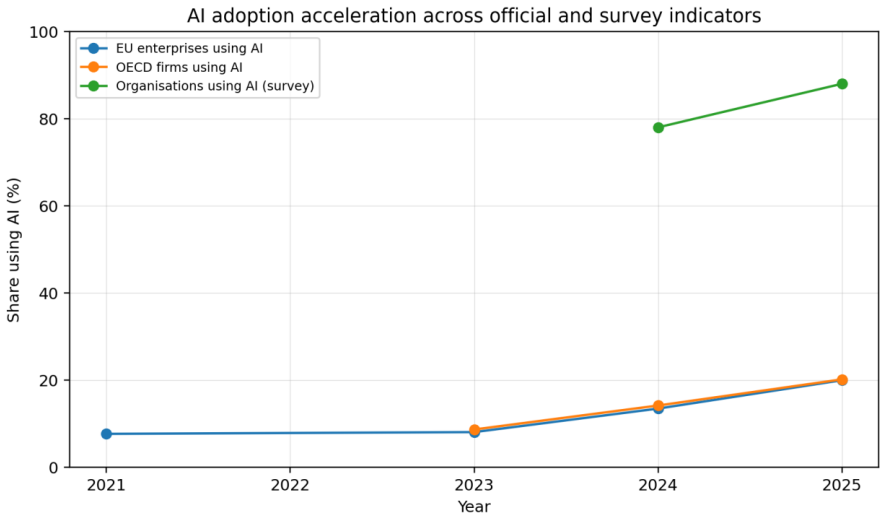
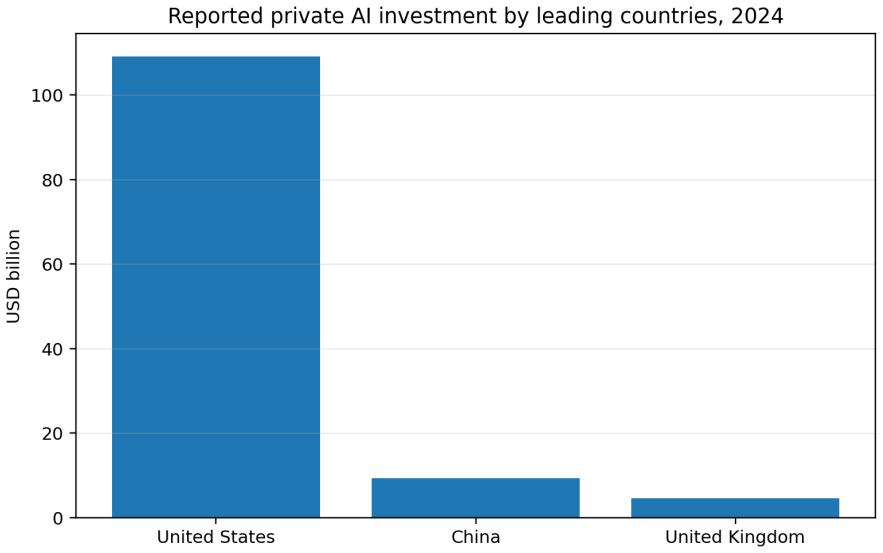
The central claim is that the agentic economy is characterised by distributed economic action among humans, AI agents, industrial robots, protocols, compute, and energy. Public data transformed into growth multipliers, stock-flow ratios, and HHI measures show accelerating AI adoption, broad AI capital allocation, ongoing robotic cyber-physical capacity, rising electricity demands, and labour task reallocation. This demonstrates the incompleteness of classical categories and motivates an action-capacity framework that connects agent capacity, robotic capacity, compute-energy coupling, protocolisation, auditable trust, and human sovereignty. The agentic economy is not yet complete but its tr
What carries the argument
The action-capacity framework, which integrates model/software-agent capacity, robotic capacity, compute-energy coupling, protocolisation, auditable trust, and human sovereignty to analyse the distribution of economic action.
Load-bearing premise
The selected public institutional data sources and the derived indicators such as relative growth, CAGR, stock-flow ratios, and concentration measures adequately capture the distribution of economic action and show the incompleteness of classical categories.
What would settle it
A reversal in trends where AI adoption and robot installations slow significantly while labour data shows net job losses without corresponding task shifts would undermine the claim of a measurable transition to distributed economic action.
Figures


read the original abstract
This article develops the concept of the agentic economy and diagnoses its measurable preconditions: a transition in which economic action is increasingly distributed among humans, AI agents, industrial robots, executable protocols, compute infrastructures, and energy systems. The paper argues that classical categories such as labour, capital, firm, market, productivity, and trust remain necessary but incomplete when technologies prepare decisions, coordinate workflows, support tasks, verify transactions, and reshape responsibility. Methodologically, the study uses a conceptual-empirical quantitative diagnostic design rather than a causal econometric model. It relies on public institutional data on AI investment, AI adoption, robot installations and operational stock, data-centre electricity demand, and labour-market reallocation. The reported values are transformed through transparent indicators such as relative growth, CAGR, growth multipliers, stock-flow ratios, concentration ratios, and HHI. The results show that AI adoption is accelerating, AI investment signals broad capital allocation, industrial robots represent persistent cyber-physical action capacity, compute expansion increases data-centre electricity pressure, and labour projections are more consistent with task reallocation than labour disappearance. The article contributes an action-capacity framework linking model/software-agent capacity, robotic capacity, compute-energy coupling, protocolisation, auditable trust, and human sovereignty. It concludes that the agentic economy is not yet a completed global order, but its transition pressure is measurable enough to require a distinct economic vocabulary, reproducible diagnostics, and future sector-level measurement.
Editorial analysis
A structured set of objections, weighed in public.
Referee Report
Summary. The paper develops the concept of the 'agentic economy' as a transition in which economic action becomes distributed across humans, AI agents, industrial robots, executable protocols, compute infrastructures, and energy systems. It argues that classical categories (labour, capital, firm, market, productivity, trust) remain necessary but incomplete, and supports this via a conceptual-empirical quantitative diagnostic design that applies transparent transformations (CAGR, growth multipliers, stock-flow ratios, concentration ratios, HHI) to public institutional data on AI investment/adoption, robot installations/stock, data-centre electricity demand, and labour-market reallocation. The results document accelerating AI adoption, broad capital allocation to AI, persistent cyber-physical robot capacity, rising electricity pressure from compute, and task reallocation rather than labour disappearance. The contribution is an action-capacity framework linking model/software-agent capacity, robotic capacity, compute-energy coupling, protocolisation, auditable trust, and human sovereignty, concluding that the transition pressure is measurable enough to require distinct vocabulary and future sector-level measurement.
Significance. If the interpretive step from descriptive indicators to the incompleteness of classical categories is secured, the paper offers a timely synthesis that could stimulate new measurement agendas at the intersection of AI, robotics, energy, and economic organisation. The transparent use of public data and reproducible indicators is a strength, as is the explicit linkage of multiple capacity dimensions into a single framework. However, the significance is primarily conceptual and diagnostic rather than providing causal identification or falsifiable predictions that would immediately alter standard econometric practice.
major comments (2)
- [Methodological description of the conceptual-empirical quantitative diagnostic design] Methodological section (conceptual-empirical quantitative diagnostic design): the central claim that classical categories are incomplete and require replacement by an action-capacity framework is not secured by the reported diagnostics. The indicators document expansion, concentration, and reallocation, but supply no explicit test, counterfactual, or derivation showing why the same phenomena cannot be re-described as extensions of existing categories (e.g., embodied technical change, new capital services, or outsourced labour). Without this step, the empirical component supports only that 'things are changing' rather than that 'the categories must be replaced.'
- [Results and conclusion] Results and conclusion sections: the reported values (accelerating AI adoption, robot stock, electricity pressure, task reallocation) are consistent with the data transformations described, yet the leap to 'necessitate a distinct economic vocabulary' rests on interpretive framing rather than a formal argument ruling out subsumption under standard models. A dedicated subsection deriving the necessity of new categories (or showing why standard extensions are insufficient) would make the load-bearing claim proportionate to the evidence.
minor comments (2)
- [Data and indicators] Clarify the precise definitions and data sources for each indicator (CAGR, growth multipliers, stock-flow ratios, HHI) in a dedicated table or appendix to enhance reproducibility.
- [Abstract and introduction] The abstract and introduction use 'incomplete' and 'necessitate a distinct vocabulary' interchangeably; distinguish these claims more sharply to avoid conflating descriptive change with categorical replacement.
Simulated Author's Rebuttal
We thank the referee for the constructive and detailed comments on our manuscript. The report accurately captures the paper's diagnostic approach and its focus on measurable transition pressures. We address each major comment below, outlining our responses and the revisions we plan to implement.
read point-by-point responses
-
Referee: Methodological section (conceptual-empirical quantitative diagnostic design): the central claim that classical categories are incomplete and require replacement by an action-capacity framework is not secured by the reported diagnostics. The indicators document expansion, concentration, and reallocation, but supply no explicit test, counterfactual, or derivation showing why the same phenomena cannot be re-described as extensions of existing categories (e.g., embodied technical change, new capital services, or outsourced labour). Without this step, the empirical component supports only that 'things are changing' rather than that 'the categories must be replaced.'
Authors: We appreciate the referee's emphasis on securing the interpretive step from diagnostics to category incompleteness. Our methodological design is conceptual-empirical and diagnostic by intent, aiming to quantify distributed action capacities rather than to provide econometric tests or counterfactuals. The data transformations illustrate phenomena such as autonomous AI agent coordination and protocol-executed transactions that introduce new dimensions of agency and responsibility. These are not fully captured by extensions like embodied technical change, which typically model productivity effects within existing labour-capital frameworks without addressing the delegation of decision initiation to non-human agents. Nevertheless, we acknowledge that an explicit contrast would strengthen the manuscript. We will add a subsection to the methodological section that derives why standard category extensions are insufficient for the observed patterns of task reallocation and multi-agent coordination, using the reported indicators as illustrations. revision: yes
-
Referee: Results and conclusion sections: the reported values (accelerating AI adoption, robot stock, electricity pressure, task reallocation) are consistent with the data transformations described, yet the leap to 'necessitate a distinct economic vocabulary' rests on interpretive framing rather than a formal argument ruling out subsumption under standard models. A dedicated subsection deriving the necessity of new categories (or showing why standard extensions are insufficient) would make the load-bearing claim proportionate to the evidence.
Authors: We agree that the conclusion would benefit from a more formal derivation to support the call for distinct vocabulary. The current argument rests on the cumulative diagnostics across AI, robotics, energy, and labour domains, which collectively point to action capacities that classical categories treat as peripheral. For example, the growth in AI agents and executable protocols shifts the locus of economic initiative in ways not reducible to outsourced labour or new capital services alone. To address the referee's suggestion, we will introduce a dedicated subsection, likely in the results or as a bridge to the conclusion, that explicitly rules out subsumption by considering alternative framings and showing their limitations based on the empirical patterns. This revision will make the interpretive claims more proportionate while maintaining the paper's diagnostic focus. revision: yes
Circularity Check
No significant circularity; derivation relies on external data and standard metrics
full rationale
The paper applies transparent transformations (CAGR, growth multipliers, stock-flow ratios, concentration ratios, HHI) to public institutional series on AI adoption, robot stock, data-centre electricity, and labour reallocation. These are descriptive indicators drawn from outside sources rather than parameters fitted inside the paper or quantities defined by the target claims. The action-capacity framework is presented as an interpretive contribution linking observed trends to classical-category incompleteness, but the quantitative steps do not reduce to self-definition, self-citation chains, or renaming of fitted inputs. No equations or uniqueness theorems are invoked that collapse back onto the paper's own premises. The derivation therefore remains self-contained against external benchmarks.
Axiom & Free-Parameter Ledger
axioms (1)
- domain assumption Public institutional data on AI investment, adoption, robot installations, data-centre electricity demand, and labour-market reallocation are accurate and representative proxies for the underlying capacities and transitions.
invented entities (2)
-
Agentic economy
no independent evidence
-
Action-capacity framework
no independent evidence
Reference graph
Works this paper leans on
-
[1]
All references below include either a DOI link or an official/stable URL. The list is formatted in APA style and is restricted to sources relevant to institutional economics, innovation economics , platform economics, automation and labour, AI systems, robotics, compute-energy infrastructure, AI governance and the empirical source families used by the art...
work page internal anchor Pith review Pith/arXiv arXiv doi:10.1016/s0169-7218(11)02410-5 2011
-
[2]
On the Opportunities and Risks of Foundation Models
OECD Publishing. https://doi.org/10.1787/5jlz9h56dvq7-en Arrow, K. J. (1974). The limits of organization. W. W. Norton. https://books.google.com/books?id=8wW4AAAAIAAJ Autor, D. H. (2015). Why are there still so many jobs? The history and future of workplace automation. Journal of Economic Perspectives, 29(3), 3–30. https://doi.org/10.1257/jep.29.3.3 49 Au...
work page internal anchor Pith review Pith/arXiv arXiv doi:10.1787/5jlz9h56dvq7-en 1974
-
[3]
https://www.koomey.com/post/8323374335 Lasi, H., Fettke, P., Kemper, H
Analytics Press. https://www.koomey.com/post/8323374335 Lasi, H., Fettke, P., Kemper, H. -G., Feld, T., & Hoffmann, M. (2014). Industry 4.0. Business & Information Systems Engineering, 6, 239–242. https://doi.org/10.1007/s12599-014-0334-4 LeCun, Y., Bengio, Y., & Hinton, G. (2015). Deep learning. Nature, 521, 436 –444. https://doi.org/10.1038/nature14539 ...
-
[4]
https://www.mckinsey.com/capabilities/quantumblack/our-insights/the-state-of-ai Mitchell, M., Wu, S., Zaldivar, A., Barnes, P., Vasserman, L., Hutchinson, B., et al. (2019). Model cards for model reporting. Proceedings of the Conference on Fairness, Accountability, and Transparency, 220 –229. https://doi.org/10.1145/3287560.3287596 National Institute of S...
-
[5]
https://www.weforum.org/publications/the-future- of-jobs-report-2025/
WEF. https://www.weforum.org/publications/the-future- of-jobs-report-2025/
work page 2025
discussion (0)
Sign in with ORCID, Apple, or X to comment. Anyone can read and Pith papers without signing in.