Laser-driven Ion and Neutron Sources from Medium Repetition Ultrashort PW Laser
Pith reviewed 2026-05-20 08:00 UTC · model grok-4.3
The pith
Ion maximum energies from thin plastic targets scale with q squared over mass under 4PW laser irradiation, indicating ponderomotive acceleration.
A machine-rendered reading of the paper's core claim, the machinery that carries it, and where it could break.
Core claim
The authors establish that the highest observed energy of each ion species scales as q squared over mass, aligning more with ponderomotive acceleration than TNSA. Maximum ion energies increase with target thickness in the 30 to 160 nm range. Using deuterated targets, they produced a fast neutron source with an exponential spectrum up to 15 MeV and a yield of 2x10^7 n/J via deuteron breakup on copper.
What carries the argument
The q squared over mass scaling of peak ion energies, which distinguishes the dominant acceleration process as ponderomotive in this thin-target, ultrashort-pulse regime.
If this is right
- Maximum ion energies increase linearly with laser intensity for all species tested.
- Ion energies continue to rise as target thickness increases from 30 nm to 160 nm.
- Neutron yields reach 2x10^7 n/J from thicker targets, comparable to TNSA-regime sources.
- The neutron spectrum is exponential and extends to 15 MeV from deuteron breakup reactions.
Where Pith is reading between the lines
- If the q²/m scaling persists at higher powers, it may allow selection of ion species by tuning target composition for specific applications.
- Medium repetition rate operation at 0.1 Hz could make laser-driven neutron sources viable for time-resolved experiments or imaging.
- Extending to other converter materials might further optimize neutron yield or spectrum shape for different uses.
Load-bearing premise
The wedge-shaped filters correctly identify and measure energies of carbon 6+ ions separately from deuterons without errors that would invalidate the q squared over mass scaling.
What would settle it
An independent measurement of ion energies and species using a different method such as a Thomson parabola spectrometer that fails to reproduce the q²/m scaling for maximum energies.
Figures

read the original abstract
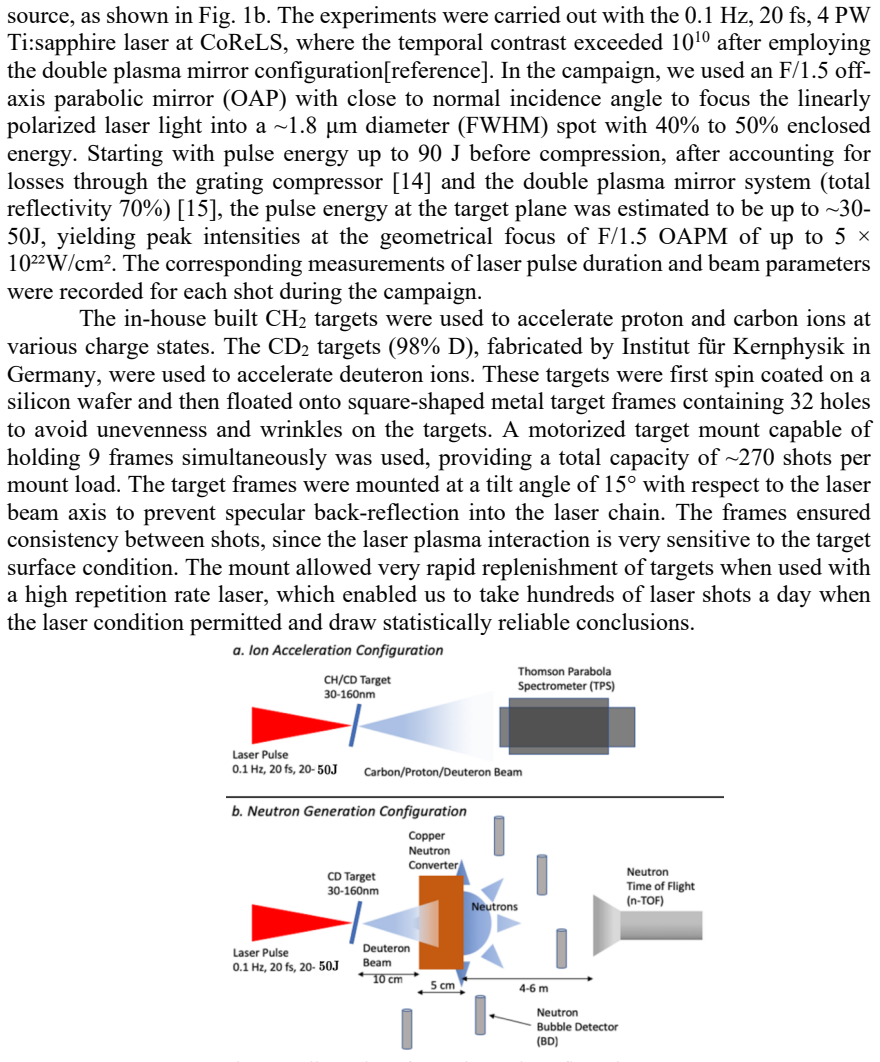
We report the first experiment investigating ion acceleration and neutron generation irradiating thin plastic targets (CH2) and deuterated plastic targets (CD2) of thickness ranging from 30nm to 160nm using the 4PW (0.1 Hz) laser at CoReLS in South Korea. Thin wedge-shaped filters exploiting differing stopping ranges were designed to distinguish carbon 6+ ions from deuterons in shots with CD2 targets. The maximum energies of all ion species from both CH2 and CD2 targets were found to increase linearly with the laser intensity. The highest observed energy of each ion species scales as q (charge)^2/mass, which is more similar to the scaling expected for ponderomotive acceleration than to the scaling expected for TNSA. The maximum ion energies were also found to increase with target thickness. Utilizing the secondary interactions of the deuteron beam, we created a fast neutron source via deuteron breakup reactions on a copper converter. The neutron spectrum follows an exponential distribution with energy up to 15MeV. A neutron yield of 2x10^7n/J was observed from thicker targets, comparable to TNSA-regime laser-driven neutron sources and within one order of magnitude of the highest yields reported using Break-out-afterburner (BOA) acceleration with beryllium converters.
Editorial analysis
A structured set of objections, weighed in public.
Referee Report
Summary. The manuscript reports the first experimental investigation of ion acceleration and neutron generation using a 4 PW (0.1 Hz) ultrashort laser at CoReLS on thin CH2 and CD2 plastic targets (30–160 nm thickness). Wedge-shaped filters exploiting stopping-range differences are used to separate carbon 6+ ions from deuterons in CD2 shots. Maximum ion energies for all species are reported to increase linearly with laser intensity and with target thickness; the highest observed energy per species is stated to scale as q²/mass, interpreted as more consistent with ponderomotive acceleration than TNSA. Secondary deuteron interactions on a copper converter produce neutrons with an exponential spectrum up to 15 MeV and a yield of 2×10^7 n/J from thicker targets.
Significance. If the species discrimination and scaling are robustly supported, the work provides new data on acceleration mechanisms in the ultrashort PW regime at medium repetition rates and demonstrates a practical route to laser-driven neutron sources with yields comparable to established TNSA and BOA approaches. The thickness and intensity trends, together with the q²/m observation, could help discriminate between competing ion-acceleration models when placed on firmer quantitative footing.
major comments (2)
- [Ion species separation method (wedge filters)] The central claim that the highest ion energies scale as q²/mass (more ponderomotive-like than TNSA) rests on correct assignment of maximum energies to C6+ versus deuterons in the CD2 shots. The thin wedge-shaped filters are described as exploiting differing stopping ranges, yet the manuscript supplies no quantitative stopping-power curves, calculated transmission windows, energy-resolution estimates, or calibration data showing non-overlapping ranges for the two species. Any overlap would misassign the reported per-species maxima and directly undermine the scaling comparison.
- [Results and discussion] The results section asserts linear scaling of maximum energies with laser intensity and with target thickness, plus the q²/m relation, without reported error bars, shot-to-shot statistics, or uncertainty quantification on the extracted maxima. This absence makes it impossible to evaluate the statistical significance of the claimed trends or the robustness of the mechanism interpretation.
minor comments (1)
- [Figures and methods] Figure captions and the methods section would benefit from explicit statements of the number of shots per condition and the criteria used to define 'maximum energy' for each species.
Simulated Author's Rebuttal
We thank the referee for the careful and constructive review of our manuscript. We address each major comment in detail below and outline the revisions that will be incorporated to strengthen the presentation of our results.
read point-by-point responses
-
Referee: The central claim that the highest ion energies scale as q²/mass (more ponderomotive-like than TNSA) rests on correct assignment of maximum energies to C6+ versus deuterons in the CD2 shots. The thin wedge-shaped filters are described as exploiting differing stopping ranges, yet the manuscript supplies no quantitative stopping-power curves, calculated transmission windows, energy-resolution estimates, or calibration data showing non-overlapping ranges for the two species. Any overlap would misassign the reported per-species maxima and directly undermine the scaling comparison.
Authors: We agree that quantitative validation of the wedge-filter separation is essential to support the species assignment and the resulting q²/m scaling claim. The manuscript describes the design principle based on stopping-range differences, but we acknowledge the absence of explicit curves and resolution estimates. In the revised manuscript we will add SRIM-based stopping-power calculations for C⁶⁺ and deuterons through the wedge material, explicit transmission windows as a function of energy, energy-resolution estimates, and supporting simulation or calibration results demonstrating that the detected maxima fall in non-overlapping ranges for the two species. These additions will directly address the concern and reinforce the robustness of the scaling interpretation. revision: yes
-
Referee: The results section asserts linear scaling of maximum energies with laser intensity and with target thickness, plus the q²/m relation, without reported error bars, shot-to-shot statistics, or uncertainty quantification on the extracted maxima. This absence makes it impossible to evaluate the statistical significance of the claimed trends or the robustness of the mechanism interpretation.
Authors: We accept that the lack of error bars and statistical quantification limits the ability to assess the significance of the reported trends. In the revised version we will include error bars on all maximum-energy data points, derived from the observed shot-to-shot variation for shots taken under nominally identical conditions. We will also add a quantitative discussion of the number of shots per data point, the uncertainty in the extracted maxima, and a statistical evaluation (e.g., linear-regression confidence intervals) of the intensity, thickness, and q²/m scalings to allow readers to judge the robustness of the mechanism interpretation. revision: yes
Circularity Check
No circularity: pure experimental report with direct observations
full rationale
The paper reports experimental measurements of ion energies from CH2 and CD2 targets and neutron yields from deuteron breakup. Maximum energies are stated to increase linearly with intensity and to scale as q²/mass, presented as observed data compared to known expectations for ponderomotive acceleration versus TNSA. No derivations, equations, fitted models, or ansatzes appear in the provided text. Scaling statements are empirical comparisons, not reductions to inputs or self-citations. The work is self-contained against external benchmarks as an experimental report; the wedge-filter method is a measurement technique whose validity is separate from circularity analysis.
Axiom & Free-Parameter Ledger
axioms (1)
- domain assumption Standard models of TNSA and ponderomotive ion acceleration apply to nm-scale targets under these laser conditions
Reference graph
Works this paper leans on
-
[1]
Wilks, S. C., Kruer, W. L., Tabak, M., Langdon, A. B., Absorption of ultra-intense laser pulses, Phys. Rev. Lett. 69, 1383 (1992)
work page 1992
-
[2]
Snavely, R. A. and Key, M. H. and Hatchett, S. P. and Cowan, T. E. and Roth, M. and Phillips, T. W. and Stoyer, M. A. and Henry, E. A. and Sangster, T. C. and Singh, M. S. and Wilks, S. C. and MacKinnon, A. and Offenberger, A. and Pennington, D. M. and Yasuike, K. and Langdon, A. B. and Lasinski, B. F. and Johnson, J. and Perry, M. D. and Campbell, E. M.,...
work page 2000
-
[3]
Macchi, Andrea and Borghesi, Marco and Passoni, Matteo, Ion acceleration by superintense laser-plasma interaction, Rev. Mod. Phys. 85, 751 (2013)
work page 2013
-
[4]
Esirkepov, T. and Borghesi, M. and Bulanov, S. V. and Mourou, G. and Tajima, T., Highly Efficient Relativistic-Ion Generation in the Laser-Piston Regime, Phys. Rev. Lett. 92, 175003 (2004)
work page 2004
-
[5]
Henig, A. and Steinke, S. and Schnurer, M. and Sokollik, T. and H\"orlein, R. and Kiefer, D. and Jung, D. and Schreiber, J. and Hegelich, B. M. and Yan, X. Q. and Meyer-ter-Vehn, J. and Tajima, T. and Nickles, P. V. and Sandner, W. and Habs, D., Radiation-Pressure Acceleration of Ion Beams Driven by Circularly Polarized Laser Pulses, Phys. Rev. Lett. 103,...
work page 2009
-
[6]
Robinson, A P L and Gibbon, P and Zepf, M and Kar, S and Evans, R G and Bellei, C, Relativistically correct hole-boring and ion acceleration by circularly polarized laser pulses, 2009 Plasma Phys. Control. Fusion 51 024004
work page 2009
-
[7]
Yin L, Albright B. J., Hegelich B. M., Fernandez J. C. GeV laser ion acceleration from ultrathin targets: The laser break-out afterburner. Laser and Particle Beams 24, 291 (2006)
work page 2006
-
[8]
B. M. Hegelich, I. Pomerantz, L. Yin, B. J. Albright, D. Jung, S. A. Gaillard, J. M. Letzring, S. Palaniyappan, R. C. Shah, K. Flippo, T. Shimada, R. P. Johnson, J. Willeke, 13 and J. C. Fernández., Laser-Driven Ion Acceleration from Relativistically Transparent Nanotargets, New Journal of physics 15.8 (2013): 085015
work page 2013
-
[9]
Roth, M., et al., Bright laser-driven neutron source based on the relativistic transparency of solids, Physical Review Letters 110.4, 044802 (2013)
work page 2013
-
[10]
Kleinschmidt, A., et al., Intense, directed neutron beams from a laser-driven neutron source at PHELIX, Physics of Plasmas 25, 053101 (2018). DOI: 10.1063/1.5006613
-
[11]
Higginson, D. P. and Vassura, L. and Gugiu, M. M. and Antici, P. and Borghesi, M. and Brauckmann, S. and Diouf, C. and Green, A. and Palumbo, L. and Petrascu, H. and Sofia, S. and Stardubtsev, M. and Willi, O. and Kar, S. and Negoita, F. and Fuchs, J., Temporal Narrowing of Neutrons Produced by High-Intensity Short-Pulse Lasers, Phys. Rev. Lett. 115, 0548...
work page 2015
-
[12]
Zimmer, L., et al., "Non-destructive and isotope-sensitive material analysis using a laser-driven epi-thermal neutron source," Nature Communications 13, 1173 (2022)
work page 2022
-
[13]
Laser Generated Neutron Source for Neutron Resonance Spectroscopy,
Higginson, D.P., J.M. McNaney, D.C. Swift, T. Bartal, D.S. Hey, R. Kodama, S. Le Pape, et al., "Laser Generated Neutron Source for Neutron Resonance Spectroscopy," Physics of Plasmas 17, 100701 (2010)
work page 2010
-
[14]
4.2 PW, 20 fs Ti:sapphire laser at 0.1 Hz,
Jae Hee Sung, Hwang Woon Lee, Je Yoon Yoo, Jin Woo Yoon, Chang Won Lee, Jeong Moon Yang, Yeon Joo Son, Yong Ha Jang, Seong Ku Lee, and Chang Hee Nam, "4.2 PW, 20 fs Ti:sapphire laser at 0.1 Hz," Opt. Lett. 42, 2058-2061 (2017) Choi et al., Opt. Lett. 45, 6342 (2020)
work page 2058
-
[15]
Highly efficient double plasma mirror producing ultrahigh-contrast multi-petawatt laser pulses,
Il Woo Choi, Cheonha Jeon, Seong Geun Lee, Seung Yeon Kim, Tae Yun Kim, I Jong Kim, Hwang Woon Lee, Jin Woo Yoon, Jae Hee Sung, Seong Ku Lee, and Chang Hee Nam, "Highly efficient double plasma mirror producing ultrahigh-contrast multi-petawatt laser pulses," Opt. Lett. 45, 6342-6345 (2020)
work page 2020
-
[16]
On the theory of the passage of fast corpuscular rays through matter
Bethe, H.A. (1930) On the Theory of the Passage of Fast Corpuscular Rays through Matter. Annalen der Physik, 397, 325-400. https://doi.org/10.1002/andp.19303970303
-
[17]
Performance of the n_TOF facility at CERN,
Guerrero, C., et al., "Performance of the n_TOF facility at CERN," Eur. Phys. J. A 49, 27 (2013)
work page 2013
-
[18]
H Ing, R.A Noulty, T.D McLean, Bubble detectors --A maturing technology, Radiation Measurements, Volume 27, Issue 1, 1997, Pages 1-11, ISSN 1350-4487, https://doi.org/10.1016/S1350-4487(96)00156-4
-
[19]
Fuchs, J., Antici, P., d’Humières, E. et al. Laser-driven proton scaling laws and new paths towards energy increase. Nature Phys 2, 48–54 (2006). https://doi.org/10.1038/nphys199
-
[20]
Scaling of proton acceleration driven by petawatt-laser–plasma interactions
Robson, Lynne, et al. "Scaling of proton acceleration driven by petawatt-laser–plasma interactions." Nature physics 3.1 (2007): 58-62
work page 2007
-
[21]
S. C. Wilks, A. B. Langdon, T. E. Cowan, M. Roth, M. Singh, S. Hatchett, M. H. Key, D. Pennington, A. MacKinnon, R. A. Snavely; Energetic proton generation in ultra-intense laser–solid interactions. Phys. Plasmas 1 February 2001; 8 (2): 542–549. https://doi.org/10.1063/1.1333697
-
[22]
Vallières et al., High average-flux laser-driven neutron source, Nat. Commun. 16, 11498 (2025)
work page 2025
discussion (0)
Sign in with ORCID, Apple, or X to comment. Anyone can read and Pith papers without signing in.