Spin asymmetry for the elastic scattering of polarized electrons from Zn, Cd, and Hg
Pith reviewed 2026-05-20 03:00 UTC · model grok-4.3
The pith
The calculation method for electron spin asymmetry extends directly to zinc, cadmium, and mercury.
A machine-rendered reading of the paper's core claim, the machinery that carries it, and where it could break.
Core claim
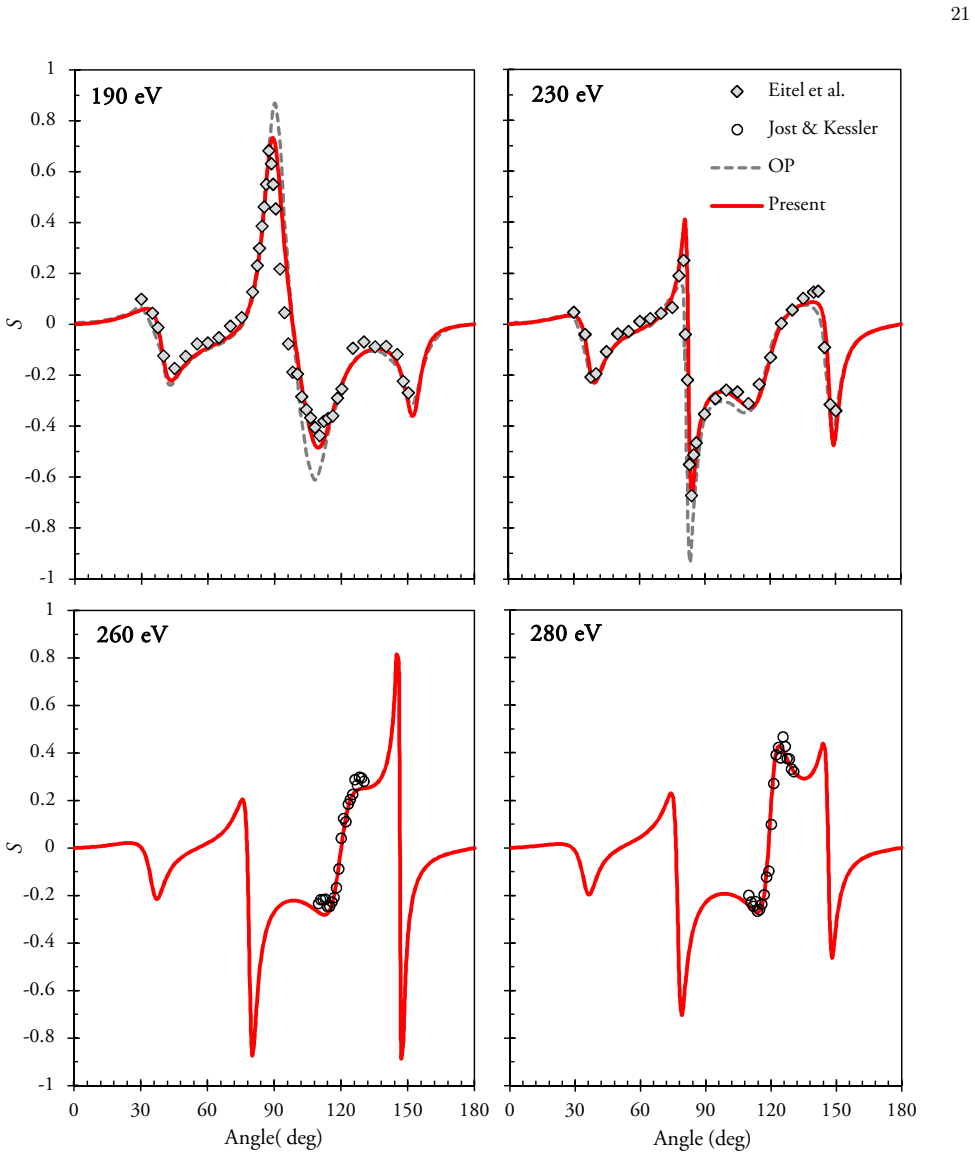
We present an extensive set of theoretical results for spin asymmetry in the form of Sherman functions for the elastic scattering of electrons by zinc, cadmium, and mercury. This study extends the application of our earlier method of calculations, which we previously employed for stable inert gases and alkaline-earth-metals to these three atoms. Our predictions are in adequate agreement with experimental values and precise theoretical results.
What carries the argument
The Sherman function, which describes the degree of spin asymmetry arising from the scattering process.
If this is right
- The method proves applicable to these atoms without significant modifications.
- The computed Sherman functions can serve as benchmarks for future experiments.
- Agreement with data supports the reliability of the approach for these heavier atoms.
Where Pith is reading between the lines
- Similar extensions might work for other atoms with comparable electronic structures.
- These results could inform the design of experiments using spin-polarized electrons.
Load-bearing premise
The prior calculation method for inert gases and alkaline-earth metals transfers accurately to zinc, cadmium, and mercury without needing major adjustments or losing precision.
What would settle it
An experimental measurement of the Sherman function for electron scattering from mercury at a fixed energy and scattering angle that differs substantially from the predicted value.
Figures




read the original abstract
We present an extensive set of theoretical results for spin asymmetry in the form of Sherman functions for the elastic scattering of electrons by zinc, cadmium, and mercury. This study extends the application of our earlier method of calculations, which we previously employed for stable inert gases and alkaline-earth-metals to these three atoms. Our predictions are in adequate agreement with experimental values and precise theoretical results.
Editorial analysis
A structured set of objections, weighed in public.
Referee Report
Summary. The paper extends the authors' prior method for computing Sherman functions (spin asymmetries) in elastic scattering of polarized electrons, previously applied to inert gases and alkaline-earth atoms, to the targets Zn, Cd, and Hg. It reports an extensive set of theoretical predictions that are stated to be in adequate agreement with experimental values and other precise theoretical results.
Significance. If the central claim holds, the work supplies useful benchmark predictions for spin-dependent scattering from these heavy atoms with filled d-shells, extending the authors' earlier calculations to a new class of targets. No machine-checked proofs, reproducible code, or parameter-free derivations are described.
major comments (2)
- [Introduction / Method description] The central claim that the prior method applies directly and accurately to Zn, Cd, and Hg rests on the untested assumption that filled 3d/4d/5d shells do not require major adjustments to the scattering potential, correlation terms, or relativistic corrections. No explicit validation (e.g., comparison of results with and without d-shell contributions or tests against known d-shell effects in related systems) is provided to support transferability.
- [Abstract and Results] The abstract asserts 'adequate agreement' with experiment and precise theory, but without quantitative metrics (e.g., mean absolute deviations, chi-squared values, or tabulated comparisons in the results section) it is not possible to assess whether the agreement is sufficient to validate the extended calculations.
minor comments (1)
- [Figures and notation] Notation for the Sherman function and any energy-dependent plots should be clarified with explicit definitions and axis labels for reproducibility.
Simulated Author's Rebuttal
We thank the referee for the careful reading of our manuscript and the constructive comments. We address each major comment below and outline the revisions we will make to strengthen the presentation.
read point-by-point responses
-
Referee: [Introduction / Method description] The central claim that the prior method applies directly and accurately to Zn, Cd, and Hg rests on the untested assumption that filled 3d/4d/5d shells do not require major adjustments to the scattering potential, correlation terms, or relativistic corrections. No explicit validation (e.g., comparison of results with and without d-shell contributions or tests against known d-shell effects in related systems) is provided to support transferability.
Authors: The referee is correct that the manuscript does not contain an explicit side-by-side comparison isolating d-shell contributions. Our relativistic optical-potential framework, detailed in the method section and in our earlier papers on inert gases and alkaline-earth atoms, constructs the scattering potential from the full Dirac-Fock electron density of the target; the filled d shells of Zn, Cd, and Hg are therefore already included in the static and exchange potentials as well as in the correlation and absorption terms. Because the same code and parameter choices were used without modification, the transferability is implicit. Nevertheless, to make this reasoning explicit we will insert a short paragraph in the introduction that recalls how the d-shell electrons enter the potential and notes that independent calculations for these atoms (cited in the paper) employ comparable treatments of the d shells. This addition will directly address the concern about untested assumptions. revision: yes
-
Referee: [Abstract and Results] The abstract asserts 'adequate agreement' with experiment and precise theory, but without quantitative metrics (e.g., mean absolute deviations, chi-squared values, or tabulated comparisons in the results section) it is not possible to assess whether the agreement is sufficient to validate the extended calculations.
Authors: We agree that the phrase 'adequate agreement' in the abstract is qualitative and that the results section would be improved by quantitative measures. Although the manuscript already presents graphical comparisons with experiment and with other theories, we will add a new table (or subsection) that reports mean absolute deviations and, where the data permit, root-mean-square deviations between our Sherman-function values and the experimental points as well as selected benchmark calculations. These numbers will be referenced from the abstract and discussed briefly in the text. The revision will allow readers to judge the level of agreement more objectively. revision: yes
Circularity Check
Minor self-citation for prior method; new results for Zn/Cd/Hg are independent applications
specific steps
-
self citation load bearing
[Abstract]
"This study extends the application of our earlier method of calculations, which we previously employed for stable inert gases and alkaline-earth-metals to these three atoms."
The applicability of the framework to atoms with filled d shells is justified by reference to the authors' own prior publications rather than by new verification steps internal to this manuscript.
full rationale
The paper extends a previously published computational method to three new atomic targets. The abstract explicitly frames the work as an application to Zn, Cd, and Hg, with new predictions checked against external experimental data and other theoretical results. No equations or steps are shown to reduce by construction to fitted parameters or prior outputs. The self-reference to the authors' earlier work on inert gases and alkaline-earth atoms is present but does not carry the central claim; the new Sherman-function values constitute independent content validated externally.
Axiom & Free-Parameter Ledger
Reference graph
Works this paper leans on
-
[1]
M. Bartsch, H. Geesmann, G. F. Hanne, and J. Kessler, Journal of Physics B: Atomic, Molecular and Optical Physics25, 1511 (1992), URLhttps://dx.doi.org/10.1088/0953-4075/25/7/021
-
[2]
R. P. McEachran and A. D. Stauffer, Journal of Physics B: Atomic, Molecular and Optical Physics25, 1527 (1992), URL https://dx.doi.org/10.1088/0953-4075/25/7/022
-
[3]
P. Kumar, A. K. Jain, A. N. Tripathi, and S. N. Nahar, Phys. Rev. A49, 899 (1994), URLhttps://link.aps.org/doi/ 10.1103/PhysRevA.49.899
-
[4]
R. Szmytkowski and J. E. Sienkiewicz, Journal of Physics B: Atomic, Molecular and Optical Physics27, 555 (1994), URL https://dx.doi.org/10.1088/0953-4075/27/3/019
-
[5]
C. J. Bostock, D. V. Fursa, and I. Bray, Phys. Rev. A85, 062707 (2012), URLhttps://link.aps.org/doi/10.1103/ PhysRevA.85.062707
work page 2012
-
[6]
S. N. Nahar, Phys. Rev. A43, 2223 (1991), URLhttps://link.aps.org/doi/10.1103/PhysRevA.43.2223
-
[7]
M. J. Berrington, C. J. Bostock, D. V. Fursa, I. Bray, R. P. McEachran, and A. D. Stauffer, Phys. Rev. A85, 042708 (2012), URLhttps://link.aps.org/doi/10.1103/PhysRevA.85.042708
-
[8]
M. M. Haque, A. K. Haque, M. A. Uddin, M. Maaza, M. A. R. Patoary, A. K. Basak, and B. C. Saha (Academic Press, 2021), vol. 84 ofAdvances in Quantum Chemistry, pp. 1–72, URLhttps://www.sciencedirect.com/science/article/ pii/S0065327620300046
work page 2021
-
[9]
Deichsel, Zeitschrift f¨ ur Physik164, 156 (1961)
H. Deichsel, Zeitschrift f¨ ur Physik164, 156 (1961)
work page 1961
- [10]
-
[11]
H. Deichsel, E. Reichert, and H. Steidl, Zeitschrift f¨ ur Physik189, 212 (1966)
work page 1966
-
[12]
W. Eitel, K. Jost, and J. Kessler, Phys. Rev.159, 47 (1967), URLhttps://link.aps.org/doi/10.1103/PhysRev.159.47
-
[13]
W. Eitel and J. Kessler, Zeitschrift f¨ ur Physik A Hadrons and nuclei241, 355 (1971)
work page 1971
- [14]
-
[15]
M. D¨ uweke, N. Kirchner, E. Reichert, and S. Sch¨ on, Journal of Physics B: Atomic and Molecular Physics9, 1915 (1976), URLhttps://dx.doi.org/10.1088/0022-3700/9/11/017
-
[16]
K. Albert, C. Christian, T. Heindorff, E. Reichert, and S. Sch¨ on, Journal of Physics B: Atomic and Molecular Physics10, 3733 (1977), URLhttps://doi.org/10.1088/0022-3700/10/18/029
-
[17]
G. F. Hanne, K. J. Kollath, and W. Wubker, Journal of Physics B: Atomic and Molecular Physics13, L395 (1980), URL https://dx.doi.org/10.1088/0022-3700/13/12/009
-
[18]
O. Berger, J. Kessler, K. J. Kollath, R. M¨ ollenkamp, and W. W¨ ubker, Phys. Rev. Lett.46, 768 (1981), URLhttps: //link.aps.org/doi/10.1103/PhysRevLett.46.768
-
[19]
R. M¨ ollenkamp, W. W¨ ubker, O. Berger, K. Jost, and J. Kessler, Journal of Physics B: Atomic and Molecular Physics17, 1107 (1984), URLhttps://doi.org/10.1088/0022-3700/17/6/022
-
[20]
O. Berger and J. Kessler, Journal of Physics B: Atomic and Molecular Physics19, 3539 (1986), URLhttps://dx.doi. org/10.1088/0022-3700/19/21/018
-
[21]
F. Kaussen, H. Geesmann, G. F. Hanne, and J. Kessler, Journal of Physics B: Atomic and Molecular Physics20, 151 (1987), URLhttps://dx.doi.org/10.1088/0022-3700/20/1/018
-
[22]
M. D¨ ummler, M. Bartsch, H. Geesmann, G. F. Hanne, and J. Kessler, Journal of Physics B: Atomic, Molecular and Optical Physics25, 4281 (1992), URLhttps://dx.doi.org/10.1088/0953-4075/25/20/022
-
[23]
P. J. Bunyan, Proceedings of the Physical Society81, 816 (1963), URLhttps://doi.org/10.1088/0370-1328/81/5/304
-
[24]
P. J. Bunyan and J. L. Schonfelder, Proceedings of the Physical Society85, 455 (1965), URLhttps://doi.org/10.1088/ 0370-1328/85/3/306
work page 1965
-
[25]
M. Fink and A. C. Yates, Atomic Data and Nuclear Data Tables1, 385 (1969), ISSN 0092-640X, URLhttps://www. sciencedirect.com/science/article/pii/S0092640X6980029X. 6
work page 1969
-
[26]
K. Bartschat, K. Blum, P. G. Burke, G. F. Hanne, and N. S. Scott, Journal of Physics B: Atomic and Molecular Physics 17, 3797 (1984), URLhttps://doi.org/10.1088/0022-3700/17/18/016
-
[27]
R. Haberland and L. Fritsche, Journal of Physics B: Atomic and Molecular Physics20, 121 (1987), URLhttps://dx.doi. org/10.1088/0022-3700/20/1/016
-
[28]
R. P. McEachran and A. D. Stauffer, Journal of Physics B: Atomic and Molecular Physics20, 5517 (1987), URLhttps: //dx.doi.org/10.1088/0022-3700/20/20/027
-
[29]
J. E. Sienkiewicz, Journal of Physics B: Atomic, Molecular and Optical Physics23, 1869 (1990), URLhttps://dx.doi. org/10.1088/0953-4075/23/11/020
-
[30]
L. Fritsche, C. Kroner, and T. Reinert, Journal of Physics B: Atomic, Molecular and Optical Physics25, 4287 (1992), URLhttps://dx.doi.org/10.1088/0953-4075/25/20/023
-
[31]
V. I. Kelemen and E. Y. Remeta, Journal of Physics B: Atomic, Molecular and Optical Physics45, 185202 (2012), URL https://dx.doi.org/10.1088/0953-4075/45/18/185202
-
[32]
A. K. F. Haque, M. M. Haque, P. P. Bhattacharjee, M. A. Uddin, M. A. R. Patoary, M. I. Hossain, A. K. Basak, M. S. Mahbub, M. Maaza, and B. C. Saha, Journal of Physics Communications1, 035014 (2017), URLhttps://doi.org/10. 1088/2399-6528/aa8bf8
work page 2017
-
[33]
M. Adibzadeh and C. E. Theodosiou, Atomic Data and Nuclear Data Tables91, 8 (2005), ISSN 0092-640X, URLhttps: //www.sciencedirect.com/science/article/pii/S0092640X05000343
work page 2005
-
[34]
M. Adibzadeh and C. E. Theodosiou, Phys. Rev. A70, 052704 (2004), URLhttps://link.aps.org/doi/10.1103/ PhysRevA.70.052704
work page 2004
-
[35]
M. Adibzadeh, C. E. Theodosiou, and N. J. Harmon, Atoms12(2024), ISSN 2218-2004, URLhttps://www.mdpi.com/ 2218-2004/12/6/33
work page 2024
-
[36]
J. B. Furness and I. E. McCarthy, Journal of Physics B: Atomic and Molecular Physics6, 2280 (1973), URLhttps: //dx.doi.org/10.1088/0022-3700/6/11/021
-
[37]
D. Kolb, W. R. Johnson, and P. Shorer, Phys. Rev. A26, 19 (1982), URLhttps://link.aps.org/doi/10.1103/PhysRevA. 26.19
-
[38]
N. Sherman, Phys. Rev.103, 1601 (1956), URLhttps://link.aps.org/doi/10.1103/PhysRev.103.1601
-
[39]
J. Kessler, Rev. Mod. Phys.41, 3 (1969), URLhttps://link.aps.org/doi/10.1103/RevModPhys.41.3
- [40]
-
[41]
C. J. Bostock, M. J. Berrington, D. V. Fursa, and I. Bray, Phys. Rev. Lett.107, 093202 (2011), URLhttps://link.aps. org/doi/10.1103/PhysRevLett.107.093202. 7 -0.2 -0.1 0 0.1 0.2 3 eV Bartsch et al. RDW 1 RDW 2 RCCC Present -0.6 -0.5 -0.4 -0.3 -0.2 -0.1 0 0.1 0.2 0.3 0 30 60 90 120 150 180 Angle (deg) 5 eV -0.3 -0.2 -0.1 0 0.1 0.2 0.3S 2 eV -0.4 -0.3 -0.2 ...
discussion (0)
Sign in with ORCID, Apple, or X to comment. Anyone can read and Pith papers without signing in.