Higher-order Weyl nodes driven by helical magnetic order in EuAgAs
Pith reviewed 2026-05-20 04:46 UTC · model grok-4.3
The pith
Helical magnetic order in EuAgAs folds electronic bands to create effective higher-order Weyl nodes.
A machine-rendered reading of the paper's core claim, the machinery that carries it, and where it could break.
Core claim
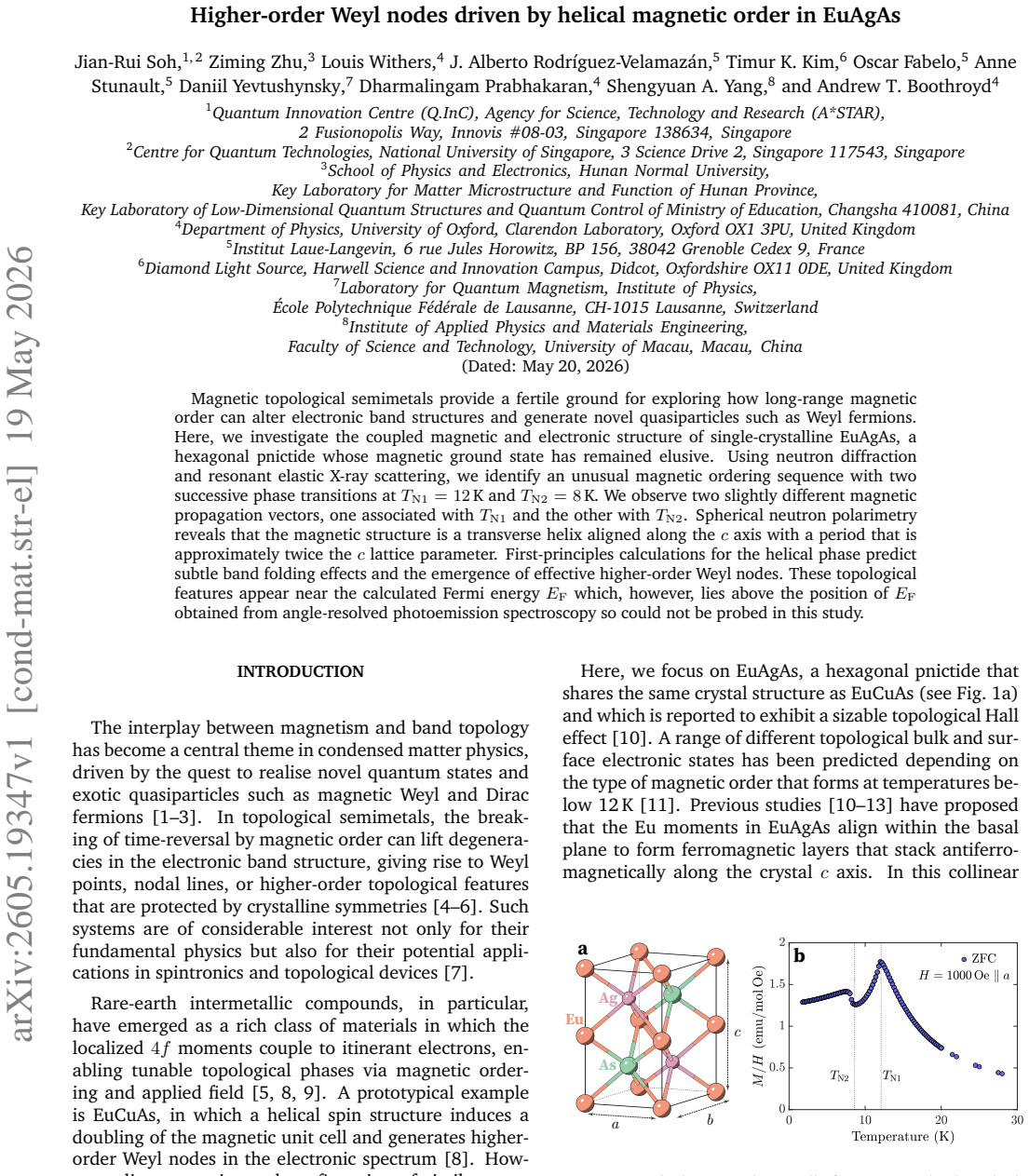
Neutron diffraction, resonant x-ray scattering, and spherical neutron polarimetry establish that EuAgAs undergoes two magnetic transitions at 12 K and 8 K into a transverse helical structure aligned along the c axis with a period roughly twice the lattice constant. When this helical configuration is supplied to density-functional calculations, the electronic bands undergo folding that produces effective higher-order Weyl nodes close to the calculated Fermi energy.
What carries the argument
The experimentally fixed transverse helical magnetic order, which supplies the periodic potential that folds the bands and generates the higher-order Weyl nodes in the first-principles electronic-structure calculation.
If this is right
- The helical order with its two slightly different propagation vectors folds the bands and produces effective higher-order Weyl nodes.
- These nodes appear near the Fermi energy obtained from the calculations performed on the helical phase.
- The magnetic transitions at 12 K and 8 K each correspond to one of the two propagation vectors in the helical structure.
- Because the calculated Fermi energy lies above the ARPES value, the nodes remain inaccessible to direct spectroscopic probe in the present study.
Where Pith is reading between the lines
- Shifting the Fermi level by doping or gating could bring the predicted nodes into the experimentally accessible energy window.
- The same helical-order mechanism might be tested in chemically related hexagonal pnictides that share the same crystal structure.
- Calculations performed on the paramagnetic or other non-helical phases would isolate whether the magnetic periodicity is strictly required for the nodes to appear.
Load-bearing premise
The transverse helical magnetic structure measured by scattering is the correct periodic potential that must be used in the calculations to obtain the higher-order Weyl nodes.
What would settle it
Angle-resolved photoemission spectra taken at the calculated Fermi energy in the helical phase either show or fail to show the predicted band crossings that define the higher-order Weyl nodes.
Figures


read the original abstract
Magnetic topological semimetals provide a fertile ground for exploring how long-range magnetic order can alter electronic band structures and generate novel quasiparticles such as Weyl fermions. Here, we investigate the coupled magnetic and electronic structure of single-crystalline EuAgAs, a hexagonal pnictide whose magnetic ground state has remained elusive. Using neutron diffraction and resonant elastic X-ray scattering, we identify an unusual magnetic ordering sequence with two successive phase transitions at $T_\mathrm{N1} = 12$ K and $T_\mathrm{N2} = 8$ K. We observe two slightly different magnetic propagation vectors, one associated with $T_\mathrm{N1}$ and the other with $T_\mathrm{N2}$. Spherical neutron polarimetry reveals that the magnetic structure is a transverse helix aligned along the $c$ axis with a period that is approximately twice the $c$ lattice parameter. First-principles calculations for the helical phase predict subtle band folding effects and the emergence of effective higher-order Weyl nodes. These topological features appear near the calculated Fermi energy $E_{\mathrm{F}}$ which, however, lies above the position of $E_{\mathrm{F}}$ obtained from angle-resolved photoemission spectroscopy so could not be probed in this study.
Editorial analysis
A structured set of objections, weighed in public.
Referee Report
Summary. The manuscript experimentally identifies a transverse helical magnetic structure in EuAgAs with successive transitions at TN1 = 12 K and TN2 = 8 K, using neutron diffraction, resonant elastic X-ray scattering, and spherical neutron polarimetry to determine two slightly different propagation vectors and a period approximately twice the c lattice parameter. First-principles calculations for this helical phase predict subtle band folding and the emergence of effective higher-order Weyl nodes near the calculated Fermi energy, although this EF lies above the position determined by ARPES.
Significance. If the predicted higher-order Weyl nodes prove robust, the work would advance understanding of how helical magnetic order induces novel topological quasiparticles in pnictide semimetals. The experimental magnetic structure determination is clearly presented and serves as direct input to the calculations, which are free of additional fitted parameters. However, the topological claim's relevance is limited by the EF mismatch with experiment.
major comments (2)
- [First-principles calculations] First-principles calculations section: The helical order is modeled via a commensurate supercell with period approximately twice the c-axis. Given the propagation vectors are described as 'slightly different' and the period as 'approximately', this minimal supercell imposes artificial periodicity that can produce spurious Brillouin-zone folding and higher-order Weyl nodes absent in a truly incommensurate helix.
- [ARPES and calculations comparison] ARPES comparison: The calculated EF lies above the ARPES-determined EF, so the predicted nodes lie outside the experimentally probed region. It is unclear whether these nodes remain or become gapped when the chemical potential is shifted to match the experimental EF.
minor comments (1)
- [Abstract] Abstract: The term 'effective higher-order Weyl nodes' is used without a brief definition or reference; adding one sentence clarifying the meaning in this context would aid accessibility.
Simulated Author's Rebuttal
We thank the referee for their thorough review and valuable comments on our manuscript. We address the two major comments below regarding the first-principles calculations and the comparison with ARPES measurements. We have made revisions to clarify these aspects.
read point-by-point responses
-
Referee: First-principles calculations section: The helical order is modeled via a commensurate supercell with period approximately twice the c-axis. Given the propagation vectors are described as 'slightly different' and the period as 'approximately', this minimal supercell imposes artificial periodicity that can produce spurious Brillouin-zone folding and higher-order Weyl nodes absent in a truly incommensurate helix.
Authors: We appreciate the referee's concern about the use of a commensurate supercell for modeling the helical magnetic order. The experimental propagation vectors are slightly different, leading to an approximate doubling of the c-axis period. The minimal supercell was chosen to enable computationally tractable first-principles calculations while capturing the primary effects of the magnetic ordering on the electronic structure. This is a standard approach for systems with long-period magnetic structures. The emergence of effective higher-order Weyl nodes results from the band folding due to the broken translational symmetry imposed by the helix. Although a fully incommensurate helix would not have a simple periodic supercell, the topological features associated with the approximate periodicity are expected to be robust. In the revised manuscript, we have included an additional discussion on the limitations of the commensurate approximation and why we believe the predicted nodes are not spurious. revision: partial
-
Referee: ARPES comparison: The calculated EF lies above the ARPES-determined EF, so the predicted nodes lie outside the experimentally probed region. It is unclear whether these nodes remain or become gapped when the chemical potential is shifted to match the experimental EF.
Authors: We acknowledge the discrepancy between the calculated and experimental Fermi levels, which is already stated in the abstract and main text. The higher-order Weyl nodes are predicted near the calculated EF in the helical phase. Since these nodes originate from the specific band folding induced by the helical magnetic order, they are topologically protected features of the electronic structure. Shifting the chemical potential to the experimental value (e.g., via rigid band approximation) would reposition the Fermi level but would not gap out the nodes, as their existence is determined by the symmetries of the magnetic structure rather than the exact position of EF. We have revised the manuscript to elaborate on this point and to clarify that while the nodes are not at the experimental EF, their prediction highlights the potential of helical order to generate such quasiparticles. revision: yes
Circularity Check
No circularity: experimental magnetic structure drives independent first-principles prediction
full rationale
The paper first determines the transverse helical magnetic structure and propagation vectors experimentally using neutron diffraction, resonant elastic X-ray scattering, and spherical neutron polarimetry. These measured quantities are then supplied as fixed input to first-principles calculations that compute the electronic band structure, band folding, and effective higher-order Weyl nodes. This workflow is a standard separation of experimental characterization from theoretical computation; the predicted topological features are not obtained by fitting parameters to the target observables, by self-definition, or by any self-citation chain that would render the result tautological. No load-bearing step reduces the output to the input by construction.
Axiom & Free-Parameter Ledger
axioms (1)
- standard math Standard assumptions in density functional theory calculations for electronic bands in the presence of magnetic order.
Lean theorems connected to this paper
-
IndisputableMonolith/Foundation/AbsoluteFloorClosure.leanreality_from_one_distinction unclear?
unclearRelation between the paper passage and the cited Recognition theorem.
First-principles calculations for the helical phase predict subtle band folding effects and the emergence of effective higher-order Weyl nodes.
What do these tags mean?
- matches
- The paper's claim is directly supported by a theorem in the formal canon.
- supports
- The theorem supports part of the paper's argument, but the paper may add assumptions or extra steps.
- extends
- The paper goes beyond the formal theorem; the theorem is a base layer rather than the whole result.
- uses
- The paper appears to rely on the theorem as machinery.
- contradicts
- The paper's claim conflicts with a theorem or certificate in the canon.
- unclear
- Pith found a possible connection, but the passage is too broad, indirect, or ambiguous to say the theorem truly supports the claim.
Forward citations
Cited by 1 Pith paper
-
Orbital Selective Dirac-like States in EuAgAs Revealed by Polarization Dependent ARPES and DFT
Polarization-dependent ARPES combined with DFT reveals orbital-selective Dirac-like states in EuAgAs that show little change between 9 K and 30 K.
Reference graph
Works this paper leans on
-
[1]
N. P. Armitage, Mele E. J., and A. Vishwanath. Weyl and Dirac semimetals in three-dimensional solids.Rev. Mod. Phys., 90:015001, 2018
work page 2018
-
[2]
A. A. Burkov. Topological semimetals.Nature Materials, 15(11):1145–1148, November 2016
work page 2016
-
[3]
A. T. Boothroyd. Topological electronic bands in crys- talline solids.Contemporary Physics, 63(4):305–327, 2022
work page 2022
-
[4]
Turner, Ashvin Vishwanath, and Sergey Y
Xiangang Wan, Ari M. Turner, Ashvin Vishwanath, and Sergey Y. Savrasov. Topological semimetal and fermi-arc surface states in the electronic structure of pyrochlore iri- dates.Phys. Rev. B, 83:205101, May 2011
work page 2011
-
[5]
Rahn, Dharmalingam Prabhakaran, Sonia Francoual, Henrik M
Jian-Rui Soh, Alessandro Bombardi, Fr ´ed´eric Mila, Marein C. Rahn, Dharmalingam Prabhakaran, Sonia Francoual, Henrik M. Rønnow, and Andrew T. Boothroyd. Understanding unconventional magnetic order in a candi- date axion insulator by resonant elastic x-ray scattering. Nature Communications, 14(1):3387, June 2023
work page 2023
-
[6]
Enke Liu, Yan Sun, Nitesh Kumar, Lukas Muechler, Aili Sun, Lin Jiao, Shuo-Ying Yang, Defa Liu, Aiji Liang, Qi- unan Xu, Johannes Kroder, Vicky S ¨uß, Horst Borrmann, Chandra Shekhar, Zhaosheng Wang, Chuanying Xi, Wen- hong Wang, Walter Schnelle, Steffen Wirth, Yulin Chen, 7 Sebastian T. B. Goennenwein, and Claudia Felser. Giant anomalous Hall effect in a ...
work page 2018
-
[7]
Mengyuan Zhong, Nam Thanh Trung Vu, Wenhao Zhai, Jian Rui Soh, Yuanda Liu, Jing Wu, Ady Suwardi, Huajun Liu, Guoqing Chang, Kian Ping Loh, Weibo Gao, Cheng- Wei Qiu, Joel K. W. Yang, and Zhaogang Dong. Weyl semimetals: From principles, materials to applications. Advanced Materials, page 2506236, 2025
work page 2025
-
[8]
Jian-Rui Soh, Iri ´an S ´anchez-Ram´ırez, Xupeng Yang, Jinzhao Sun, Ivica Zivkovic, J. Alberto Rodr ´ıguez- Velamaz´an, Oscar Fabelo, Anne Stunault, Alessandro Bombardi, Christian Balz, Manh Duc Le, Helen C. Walker, J. Hugo Dil, Dharmalingam Prabhakaran, Henrik M. Rønnow, Fernando de Juan, Maia G. Vergniory , and An- drew T. Boothroyd. Weyl metallic state...
work page 2024
-
[9]
Vergniory , Vladimir Strocov, Chandra Shekhar, and Claudia Felser
Subhajit Roychowdhury , Kartik Samanta, Premakumar Yanda, Bernard Malaman, Mengyu Yao, Walter Schnelle, Emmanuel Guilmeau, Procopios Constantinou, Sushmita Chandra, Horst Borrmann, Maia G. Vergniory , Vladimir Strocov, Chandra Shekhar, and Claudia Felser. Inter- play between Magnetism and Topology: Large Topolog- ical Hall Effect in an Antiferromagnetic T...
work page 2023
- [10]
-
[11]
Yahui Jin, Xu-Tao Zeng, Xiaolong Feng, Xin Du, Weikang Wu, Xian-Lei Sheng, Zhi-Ming Yu, Ziming Zhu, and Shengyuan A. Yang. Multiple magnetism-controlled topo- logical states in EuAgAs.Phys. Rev. B, 104:165424, 2021
work page 2021
-
[12]
Zhuyi Zhang, Xuliang Chen, Chao An, Shuyang Wang, Lili Zhang, Yonghui Zhou, Min Zhang, Jian Zhou, and Zhaorong Yang. Coupled magnetic and structural tran- sition in topological antiferromagnet EuAgAs under high pressure.Materials T oday Physics, 38:101228, 2023
work page 2023
-
[13]
Hao Liu, Chen Zhang, Qi-Yi Wu, Yahui Jin, Ziming Zhu, Jiao-Jiao Song, Sheng-Tao Cui, Zhe Sun, Honghong Wang, Bo Chen, Jun He, Hai-Yun Liu, Yu-Xia Duan, Pe- ter M. Oppeneer, and Jian-Qiao Meng. Ultrafast pho- toinduced phase transition in the antiferromagnetic Dirac semimetal EuAgAs.Phys. Rev. B, 111:L121113, 2025
work page 2025
-
[14]
A. T. Boothroyd.Principles of Neutron Scattering from Con- densed Matter. Oxford University Press, Oxford, UK, 2020
work page 2020
-
[15]
Mohamed El Gazzah, Daniel Kaplan, Zachary Morgan, Abhijeet Nayak Resham Regmi, Sk Jamaluddin, Huibo Cao, Igor I. Mazin, and Nirmal J. Ghimire. Near- degenerate competing magnetic orders in euagas: a tun- able route to altermagnetism, 2026
work page 2026
- [16]
-
[17]
F. Tasset, P.J. Brown, E. Leli´evre-Berna, T. Roberts, S. Pu- jol, J. Allibon, and E. Bourgeat-Lami. Spherical neutron polarimetry with Cryopad-II.Physica B, 267–268:69–74, 1999
work page 1999
-
[18]
E. Leli ´evre-Berna, E. Bourgeat-Lami, P. Fouilloux, B. Gef- fray , Y. Gibert, K. Kakurai, N. Kernavanois, B. Longuet, F. Mantegezza, M. Nakamura, S. Pujol, L.-P. Regnault, F. Tasset, M. Takeda, M. Thomas, and X. Tonon. Advances in spherical neutron polarimetry with Cryopad.Physica B, 356:131–135, 2005
work page 2005
-
[19]
G. Kresse and J. Furthm ¨uller. Efficient iterative schemes for ab initio total-energy calculations using a plane-wave basis set.Phys. Rev. B, 54:11169–11186, Oct 1996
work page 1996
-
[20]
G. Kresse and J. Furthm ¨uller. Efficiency of ab-initio total energy calculations for metals and semiconductors using a plane-wave basis set.Computational Materials Science, 6(1):15–50, 1996
work page 1996
-
[21]
Perdew, Kieron Burke, and Matthias Ernzerhof
John P. Perdew, Kieron Burke, and Matthias Ernzerhof. Generalized gradient approximation made simple.Phys. Rev. Lett., 77:3865–3868, Oct 1996
work page 1996
-
[22]
H. J. Monkhorst and J. D. Pack. Special points for Brillouin-zone integrations.Phys. Rev. B, 13:5188–5192, 1976
work page 1976
-
[23]
Kim, Pavel Dudin, Hongchang Wang, S
Moritz Hoesch, Timur K. Kim, Pavel Dudin, Hongchang Wang, S. Scott, P. Harris, S. Patel, M. Matthews, D. Hawkins, Simon G. Alcock, Thomas Richter, J. J. Mudd, M. Basham, L. Pratt, P. Leicester, E. C. Longhi, Anna Tamai, and Felix Baumberger. A facility for the analy- sis of the electronic structures of solids and their surfaces by synchrotron radiation ph...
work page 2017
-
[24]
A.T. Boothroyd, D. Prabhakaran, J. A. Rodriguez- Velamazan, and J.-R. Soh. Magnetic order and magnetically-induced topological states in EuAgAs, 2024. 10.5291/ILL-DATA.5-41-1261
-
[25]
A.T. Boothroyd, J. A. Rodriguez-Velamazan, J.-R. Soh, and A. Stunault. Magnetic controlled topological states in EuAgAs, 2023. 10.5291/ILL-DATA.DIR-295. ACKNOWLEDGMENTS The authors wish to thank Yang Xupeng for extensive help with the experiments. The proposal numbers for the data presented in this manuscript are 5-41-1261 (D9, ILL [24]) and DIR-295 (D3, ...
discussion (0)
Sign in with ORCID, Apple, or X to comment. Anyone can read and Pith papers without signing in.