Optimal airfoils in the intermediate Reynolds number range
Pith reviewed 2026-05-20 03:05 UTC · model grok-4.3
The pith
Zero-thickness cambered airfoils are globally optimal for glide ratio and endurance factor across Reynolds numbers 1 to 3000.
A machine-rendered reading of the paper's core claim, the machinery that carries it, and where it could break.
Core claim
The authors establish that zero-thickness cambered airfoils are globally optimal across the entire Reynolds-number range considered. The optimal angle of attack decreases monotonically with Re, whereas the optimal camber varies non-monotonically, reaching a pronounced maximum near Re ≈ 50-60 before declining at higher Re. At low Reynolds numbers (Re ≲ 100), a broad family of cambered shapes performs within a few per cent of the optimum, indicating weak sensitivity to geometrical parameters. In contrast, for Re ≳ 1000, the performance landscape becomes sharply localized around a single preferred design, for which geometric refinement is critical.
What carries the argument
Joukowski airfoil family optimized by hybrid stochastic search plus direct parameter sweep inside a conformal-mapping, second-order finite-difference steady laminar Navier-Stokes solver.
If this is right
- Designs for miniature vehicles can safely adopt thin cambered plates instead of thicker profiles.
- At Re below 100 many cambered shapes deliver nearly identical performance, relaxing manufacturing precision.
- Above Re of 1000 small geometric changes produce large performance gains, so refinement becomes essential.
- The non-monotonic peak in optimal camber near Re 50-60 marks a shift in the dominant flow physics.
Where Pith is reading between the lines
- The prevalence of thin cambered wings in small insects may reflect aerodynamic optimality rather than manufacturing constraint alone.
- Relaxing the Joukowski restriction or allowing unsteady flow could reveal whether even higher performance is possible outside the present family.
- The reported trends supply candidate scaling rules for endurance in flapping-wing micro air vehicles at these Reynolds numbers.
Load-bearing premise
The true optimum must lie inside the two-parameter Joukowski family and the flow must remain steady and laminar.
What would settle it
An experiment or simulation at any Re between 1 and 3000 in which a thick airfoil or a non-Joukowski shape achieves a higher glide ratio than the best zero-thickness cambered Joukowski profile would falsify the global optimality claim.
Figures


read the original abstract
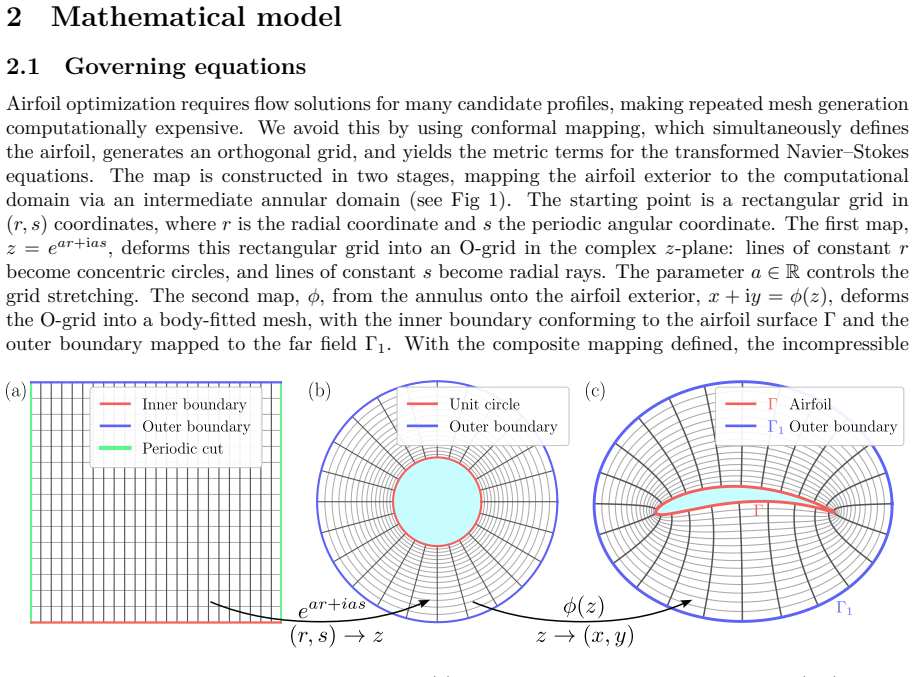
We revisit a classical airfoil design problem: the search for shapes that maximize aerodynamic performance metrics, targeting the underexplored intermediate Reynolds-number regime between 1 and 3000, relevant to small animals and miniature vehicles. The problem is formally stated as the glide ratio or the endurance factor maximization for Joukowski airfoil profiles under steady inflow. It is solved numerically by a hybrid approach combining stochastic search and direct parameter sweep, and using a steady laminar Navier--Stokes solver based on conformal mapping and second-order finite-difference discretization. Zero-thickness cambered airfoils are found to be globally optimal across the entire Reynolds-number range considered. The optimal angle of attack decreases monotonically with $Re$, whereas the optimal camber varies non-monotonically, reaching a pronounced maximum near $Re \approx 50-60$ before declining at higher $Re$. At low Reynolds numbers ($Re \lesssim 100$), a broad family of cambered shapes performs within a few per cent of the optimum, indicating weak sensitivity to geometrical parameters. In contrast, for $Re \gtrsim 1000$, the performance landscape becomes sharply localized around a single preferred design, for which geometric refinement is critical.
Editorial analysis
A structured set of objections, weighed in public.
Referee Report
Summary. The manuscript optimizes Joukowski airfoils to maximize glide ratio or endurance factor over Re = 1–3000 using a hybrid stochastic search plus direct sweep inside a steady laminar Navier–Stokes solver on a conformally mapped domain. It reports that zero-thickness cambered shapes are globally optimal within the family, with optimal angle of attack decreasing monotonically with Re and optimal camber reaching a maximum near Re ≈ 50–60 before declining; the performance landscape is broad at low Re and sharply peaked at Re ≳ 1000.
Significance. If substantiated, the work supplies concrete numerical guidance on shape selection for intermediate-Re aerodynamics relevant to micro air vehicles and small-animal flight. The reported transition from weak to strong geometric sensitivity with increasing Re is a useful qualitative result for design practice.
major comments (1)
- [Abstract] Abstract: the assertion that zero-thickness cambered airfoils are 'globally optimal' is not qualified by the fact that the search is performed exclusively inside the two-parameter Joukowski family. Because the problem is formally restricted to this parametrization and no argument is supplied that the family is dense in the space of all possible shapes, the claim should be restated as optimality within the Joukowski class, especially given the sharp performance peak reported for Re ≳ 1000.
minor comments (2)
- The manuscript should report grid-convergence checks and at least one validation benchmark for the conformal-mapping Navier–Stokes solver to support the quantitative performance values used in the optimization.
- Clarify whether 'glide ratio' and 'endurance factor' are optimized separately or jointly and how the two metrics are defined in the steady laminar setting.
Simulated Author's Rebuttal
We thank the referee for the careful reading and constructive comment on the abstract. We address the major comment below.
read point-by-point responses
-
Referee: [Abstract] Abstract: the assertion that zero-thickness cambered airfoils are 'globally optimal' is not qualified by the fact that the search is performed exclusively inside the two-parameter Joukowski family. Because the problem is formally restricted to this parametrization and no argument is supplied that the family is dense in the space of all possible shapes, the claim should be restated as optimality within the Joukowski class, especially given the sharp performance peak reported for Re ≳ 1000.
Authors: We agree that the optimality statement in the abstract requires qualification. The manuscript already states that the problem is the maximization of glide ratio or endurance factor for Joukowski airfoil profiles under steady inflow, solved via a Navier-Stokes solver that exploits the conformal mapping specific to this family. We did not intend a claim of optimality over all possible shapes. In the revised manuscript we will update the abstract to read that zero-thickness cambered airfoils are globally optimal within the Joukowski class. This qualification is especially warranted given the sharp performance peaks observed for Re ≳ 1000. revision: yes
Circularity Check
No circularity: direct numerical optimization within explicitly stated Joukowski family
full rationale
The paper states the problem as glide-ratio/endurance-factor maximization strictly for Joukowski profiles under steady laminar inflow and solves it by hybrid stochastic search plus direct sweep inside a conformal-mapping Navier-Stokes solver. The reported optimality of zero-thickness cambered shapes is the direct output of that computation, not a quantity defined in terms of itself or recovered by fitting a parameter that is then relabeled as a prediction. No load-bearing self-citation, uniqueness theorem, or ansatz imported from prior work appears in the derivation chain. The restriction to the two-parameter Joukowski family is declared up front, so the result does not reduce to its inputs by construction and remains a self-contained numerical finding within the chosen parametrization.
Axiom & Free-Parameter Ledger
axioms (2)
- domain assumption Joukowski profiles are representative of globally optimal airfoils
- domain assumption Steady laminar Navier-Stokes equations capture the relevant physics
Lean theorems connected to this paper
-
IndisputableMonolith/Cost/FunctionalEquation.lean (J-cost uniqueness)washburn_uniqueness_aczel unclear?
unclearRelation between the paper passage and the cited Recognition theorem.
Zero-thickness cambered airfoils are found to be globally optimal across the entire Reynolds-number range considered.
What do these tags mean?
- matches
- The paper's claim is directly supported by a theorem in the formal canon.
- supports
- The theorem supports part of the paper's argument, but the paper may add assumptions or extra steps.
- extends
- The paper goes beyond the formal theorem; the theorem is a base layer rather than the whole result.
- uses
- The paper appears to rely on the theorem as machinery.
- contradicts
- The paper's claim conflicts with a theorem or certificate in the canon.
- unclear
- Pith found a possible connection, but the passage is too broad, indirect, or ambiguous to say the theorem truly supports the claim.
Reference graph
Works this paper leans on
-
[1]
Sunada, S. and Sakaguchi, A. and Kawachi, K. , year =. Airfoil section characteristics at a low. J. Fluids Engng , volume =
-
[2]
In, K.M. and Choi, D.H. and Kim, M.-U. , year =. Two-dimensional viscous flow past a flat plate , journal =
- [3]
-
[4]
Srinath, D.N. and Mittal, S. , year =. Optimal airfoil shapes for low. Intl J. Numer. Meth. Fluids , volume =
-
[5]
Dennis, S.C.R. and Chang, G.Z. , year =. Numerical solutions for steady flow past a circular cylinder at. J. Fluid Mech. , volume =
-
[6]
Nieuwstadt, F. and Keller, H.B. , year =. Viscous flow past circular cylinders , journal =
- [7]
- [8]
discussion (0)
Sign in with ORCID, Apple, or X to comment. Anyone can read and Pith papers without signing in.