Building Acoustics 01: Finite Element Model of an Building Acoustics Test Facility to Predict the Sound Transmission Loss Based on DIN EN ISO 10140
Pith reviewed 2026-05-20 02:10 UTC · model grok-4.3
pith:VE5IGVOO Add to your LaTeX paper
What is a Pith Number?\usepackage{pith}
\pithnumber{VE5IGVOO}
Prints a linked pith:VE5IGVOO badge after your title and writes the identifier into PDF metadata. Compiles on arXiv with no extra files. Learn more
The pith
A finite element model of a building acoustics test facility predicts sound transmission loss and matches theory for insulated double-leaf walls.
A machine-rendered reading of the paper's core claim, the machinery that carries it, and where it could break.
Core claim
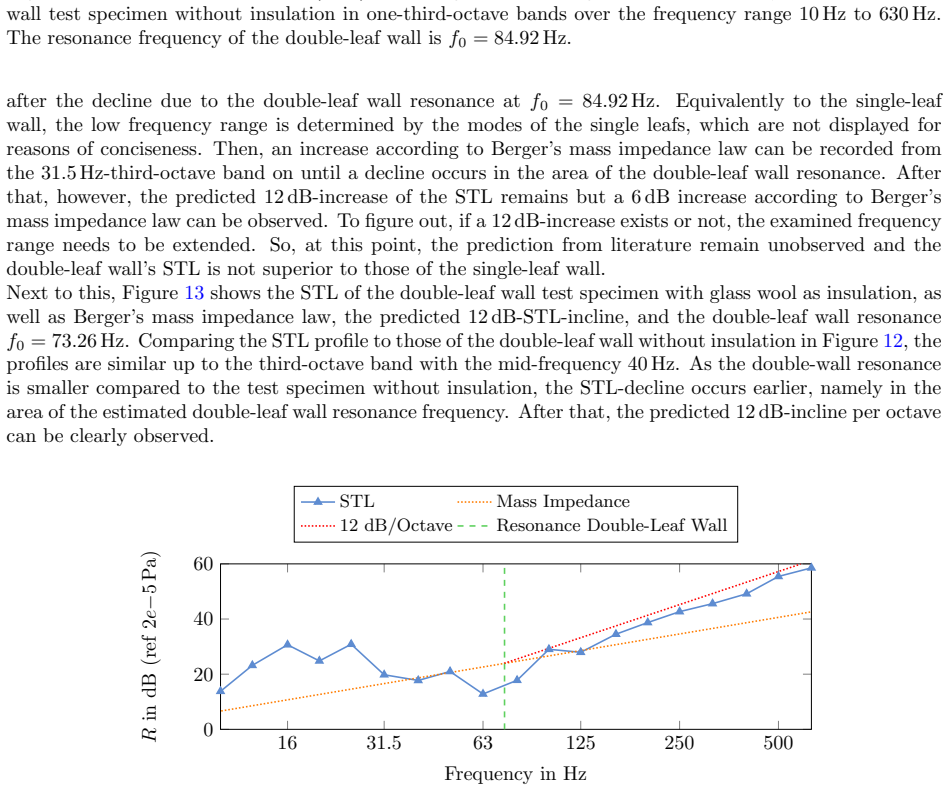
The authors built a large-scale finite element model of the building acoustics test facility following DIN EN ISO 10140. Using a frequency- and domain-specific discretisation approach, they calculated sound transmission loss in one-third-octave bands from 8 Hz to 630 Hz for single- and double-leaf walls with and without insulation. The double-leaf wall with insulation produced results that aligned well with the theoretical sound transmission loss profile reported in the literature.
What carries the argument
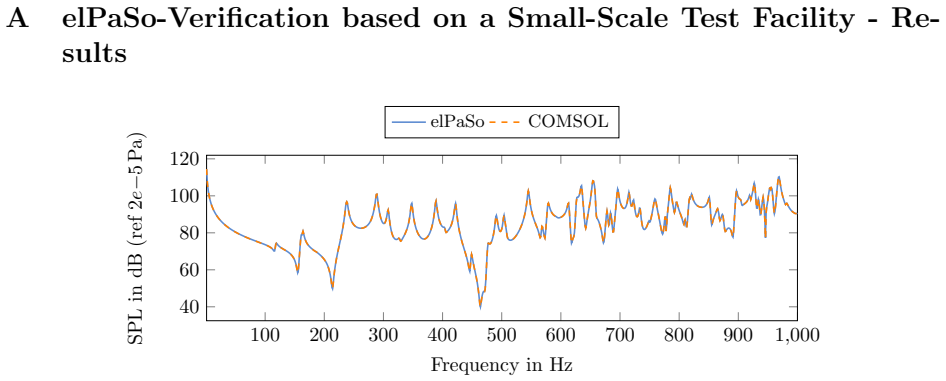
Large-scale finite element model of the test facility with frequency- and domain-specific discretisation, after small-scale verification against COMSOL.
If this is right
- Designers can estimate sound transmission loss for different material and geometry choices without building physical prototypes.
- The model supplies predictions for both single-leaf and double-leaf walls in standardized frequency bands.
- Insulation effects on transmission loss become quantifiable through virtual testing.
- Early-stage acoustic design decisions can incorporate these estimates directly.
Where Pith is reading between the lines
- Such a model could shorten the cycle of testing new wall configurations by replacing some physical measurements with simulations.
- Linking the approach to real measurement data from compliant facilities would allow calibration for wider use.
- The same framework might extend to other standardized acoustic tests beyond transmission loss.
Load-bearing premise
The frequency- and domain-specific discretisation approach used for the large-scale model accurately represents the physical sound transmission without significant numerical artifacts or missing boundary effects.
What would settle it
Measuring sound transmission loss for the double-leaf wall with insulation in a physical test facility built exactly to DIN EN ISO 10140 and checking whether the one-third-octave band values from 8 Hz to 630 Hz match the simulation results.
Figures




read the original abstract
In the context of building acoustics, sound transmission loss estimations are crucial to quantify the noise pollution in buildings. When developing building prototypes in the sense of an acoustic-oriented design process, it is desirable to have an virtual prototype, especially in early development stages, to estimate, for instance, the influence of different material or geometry configurations on to the sound transmission loss. This contribution aims to present a simple virtual prototype of an building acoustics test facility in accordance with DIN EN ISO 10140 for the measurement of the sound transmission loss of single- and double-leaf walls with and without insulation. Here, the finite element method is used as the numerical modelling method of choice. In the course of this, geometry and mesh creation was done using SALOME 9.14 whereas the institute's in-house research code elPaSo was utilised for the matrix assembly and solving procedure. At first, elPaSo was verified by the commercial software COMSOL 6.3 considering a small-scale test facility. Afterwards, the large-scale test facility finite element model was created using a frequency- and domain-specific discretisation approach. The sound transmission loss of three different test specimens was estimated in one-third-octave bands from 8 Hz to 630 Hz, where the double-leaf wall with insulation exhibited good agreement to the theoretical sound transmission loss profile from literature.
Editorial analysis
A structured set of objections, weighed in public.
Referee Report
Summary. The manuscript presents a finite element model of a building acoustics test facility compliant with DIN EN ISO 10140, constructed with SALOME for geometry and meshing and the in-house code elPaSo for assembly and solution. The solver is first verified on a small-scale facility against COMSOL 6.3; a frequency- and domain-specific discretization is then applied to the large-scale facility to compute sound transmission loss in one-third-octave bands from 8 Hz to 630 Hz for three wall specimens (single-leaf, double-leaf, and insulated double-leaf), with the claim that the insulated double-leaf case shows good agreement with literature theory.
Significance. If the large-scale results prove numerically reliable, the work supplies a virtual-prototyping capability for early-stage acoustic design of building elements and demonstrates the use of an in-house acoustic FEM code with a commercial-software cross-check. The small-scale verification step is a constructive element that supports credibility in computational building acoustics.
major comments (2)
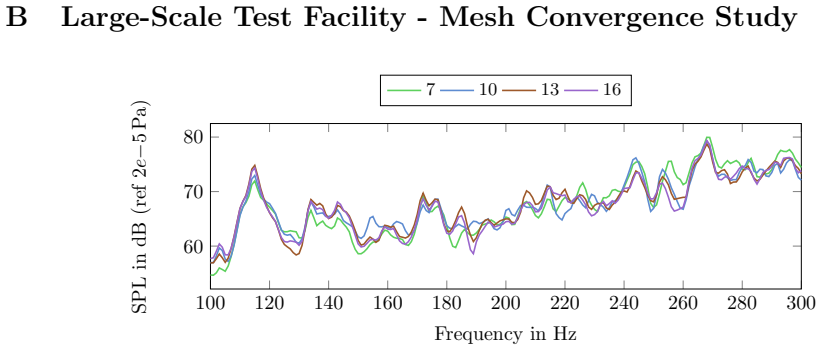
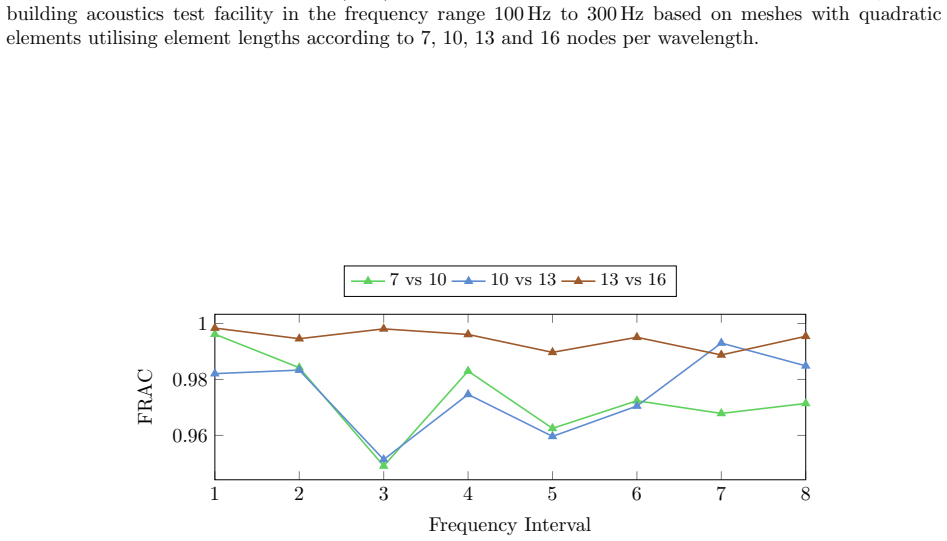
- [Large-scale test facility finite element model] Large-scale test facility finite element model: the frequency- and domain-specific discretization strategy is applied to the full facility (up to 630 Hz) without any reported mesh-convergence study, dispersion-error estimate, or boundary-condition sensitivity analysis. Because the headline agreement with literature theory for the insulated double-leaf wall rests entirely on these large-scale predictions, the absence of such checks leaves open the possibility that the observed match is influenced by under-resolved elements or incomplete absorption at the facility boundaries.
- [Results] Results for the three test specimens: no quantitative error bars, uncertainty quantification, or sensitivity analysis on material parameters or boundary absorption coefficients are supplied for the large-scale transmission-loss curves. This omission weakens the ability to judge whether the reported agreement for the insulated double-leaf wall is robust or partly an artifact of the chosen discretization.
minor comments (3)
- [Title] The title contains a grammatical error ('an Building' should read 'a Building').
- [Abstract] Abstract: the phrase 'influence of different material or geometry configurations on to the sound transmission loss' contains a redundant preposition; 'on' suffices.
- [Large-scale test facility finite element model] The manuscript would benefit from an explicit statement of the element-size rule (e.g., elements per wavelength) used in each frequency band for the large-scale mesh.
Simulated Author's Rebuttal
We thank the referee for the constructive feedback on our manuscript describing the finite element model of a DIN EN ISO 10140 test facility. We address the major comments point by point below and commit to revisions that strengthen the numerical validation and presentation of results without altering the core findings.
read point-by-point responses
-
Referee: Large-scale test facility finite element model: the frequency- and domain-specific discretization strategy is applied to the full facility (up to 630 Hz) without any reported mesh-convergence study, dispersion-error estimate, or boundary-condition sensitivity analysis. Because the headline agreement with literature theory for the insulated double-leaf wall rests entirely on these large-scale predictions, the absence of such checks leaves open the possibility that the observed match is influenced by under-resolved elements or incomplete absorption at the facility boundaries.
Authors: We agree that explicit documentation of mesh convergence for the large-scale facility would increase confidence in the results. The discretization in the original work followed standard acoustic FEM guidelines (minimum 10 linear elements per wavelength at 630 Hz in fluid domains, with domain-specific adjustments for solids based on shear and longitudinal wave speeds). The small-scale verification against COMSOL 6.3 already demonstrated solver fidelity for comparable geometries and frequencies. In the revised manuscript we will add a dedicated subsection presenting mesh-convergence results at three representative one-third-octave bands (100 Hz, 315 Hz, 630 Hz) together with a short dispersion-error estimate derived from the linear-element rule of thumb. We will also include a brief boundary-absorption sensitivity check using literature ranges for the facility wall coefficients. revision: yes
-
Referee: Results for the three test specimens: no quantitative error bars, uncertainty quantification, or sensitivity analysis on material parameters or boundary absorption coefficients are supplied for the large-scale transmission-loss curves. This omission weakens the ability to judge whether the reported agreement for the insulated double-leaf wall is robust or partly an artifact of the chosen discretization.
Authors: The manuscript’s primary objective was to demonstrate the practical use of the in-house elPaSo code for virtual prototyping of building elements rather than to deliver a full probabilistic uncertainty study. The reported agreement for the insulated double-leaf case is with established analytical theory, which itself rests on simplifying assumptions. To address the referee’s concern we will augment the results section with a sensitivity analysis on the two most influential parameters (boundary absorption coefficient and wall material density). The outcomes will be shown as shaded bands around the nominal transmission-loss curves, providing quantitative indication of robustness. This addition remains within the scope of a major revision and does not require new experimental data. revision: yes
Circularity Check
Forward FEM simulation of test facility is self-contained with external verification
full rationale
The paper describes a standard finite-element workflow: geometry/mesh generation in SALOME, matrix assembly and solve in the institute code elPaSo, small-scale verification against the independent commercial solver COMSOL, followed by application of a frequency- and domain-specific discretization to the large-scale facility. Sound-transmission-loss values are then computed directly from the resulting fields and compared to independent literature profiles. No parameter is fitted to the target STL data, no output is defined in terms of itself, and no load-bearing premise rests on an unverified self-citation. The modeling steps therefore remain independent of the final comparison result.
Axiom & Free-Parameter Ledger
free parameters (1)
- mesh element size per frequency band
axioms (1)
- domain assumption Linear acoustics and time-harmonic assumptions hold for the modeled sound fields
Lean theorems connected to this paper
-
IndisputableMonolith/Cost/FunctionalEquation.leanwashburn_uniqueness_aczel unclear?
unclearRelation between the paper passage and the cited Recognition theorem.
the finite element method is used... Helmholtz equation... Mindlin plate theory... Johnson-Champoux-Allard (JCA) model... Nitsche-type coupling
-
IndisputableMonolith/Foundation/AlexanderDuality.leanalexander_duality_circle_linking unclear?
unclearRelation between the paper passage and the cited Recognition theorem.
sound transmission loss... one-third-octave bands from 8 Hz to 630 Hz... double-leaf wall with insulation exhibited good agreement to the theoretical sound transmission loss profile from literature
What do these tags mean?
- matches
- The paper's claim is directly supported by a theorem in the formal canon.
- supports
- The theorem supports part of the paper's argument, but the paper may add assumptions or extra steps.
- extends
- The paper goes beyond the formal theorem; the theorem is a base layer rather than the whole result.
- uses
- The paper appears to rely on the theorem as machinery.
- contradicts
- The paper's claim conflicts with a theorem or certificate in the canon.
- unclear
- Pith found a possible connection, but the passage is too broad, indirect, or ambiguous to say the theorem truly supports the claim.
Reference graph
Works this paper leans on
-
[1]
Ackermann: Simulation der Schalltransmission durch W¨ ande
L. Ackermann: Simulation der Schalltransmission durch W¨ ande. PhD thesis, TU Braunschweig, 2002. https://doi.org/10.24355/dbbs.084-200511080100-673
-
[2]
J. F. Allard, N. Atalla: Propagation of Sound in Porous Media: Modelling Sound Absorbing Materials. John Wiley & Sons, 2009. https://doi.org/10.1002/9780470747339
-
[3]
H. Altenbach, J. Altenbach, N. Konstantin: Ebene Fl¨ achentragwerke, Grundlagen der Modellierung und Berechnung von Scheiben und Platten. Berlin, Heidelberg, Springer Vieweg, 2023. https://doi.org/10. 1007/978-3-662-68391-0 23
work page 2023
-
[4]
A. Arjunan, C. J. Wang, K. Yahiaoui, D. J. Mynors, T. Morgan, V. B. Nguyen, M. English: Development of a 3D finite element acoustic model to predict the sound reduction index of stud based double-leaf walls. JSV 333(23) (2014) 6140-6155. https://doi.org/10.1016/j.jsv.2014.06.032
-
[5]
N. Atalla, R. Panneton, P. Debergue: A mixed displacement-pressure formulation for poroelastic mate- rials. J. Acoust. Soc. Am. 104(3) (1998) 1444-1452. https://doi.org/10.1121/1.424355
- [6]
-
[7]
H. D. Baehr, K. Stephan: W¨ arme- und Stoff¨ ubertragung. Berlin, Heidelberg, Springer Vieweg, 2016. https://doi.org/10.1007/978-3-662-49677-0
-
[8]
H. E. Bass, L. C. Sutherland, A. J. Zuckerwar: Atmospheric absorption of sound: Update. J. Acoust. Soc. Am. 88(4) (1990) 2019–2021. https://doi.org/10.1121/1.400176
-
[9]
H. E. Bass, L. C. Sutherland, A. J. Zuckerwar, D. T. Blackstock, D. M. Hester: Atmospheric absorption of sound: Further developments. J. Acoust. Soc. Am. 97(1) (1995) 680–683. https://doi.org/10.1121/1. 412989
work page doi:10.1121/1 1995
- [10]
- [11]
-
[12]
C. Blech, H. K. Sreekumar, Y. H¨ upel, S. C. Langer: Efficient Solution Strategies for Cabin Noise Assessment of Wave-Resolving Aircraft Fuselage Models. J. Theor. Comp. Acout. 32(4) (2024) 2450018. https://doi.org/10.1142/S259172852450018X
-
[13]
K. U. Bletzinger, M. Bischoff, E. Ramm: A unified approach for shear-locking-free triangular and rectangular shell finite elements. Computers & Structures 75(3) (2000) 321-334. https://doi.org/10.1016/ S0045-7949(99)00140-6
work page 2000
-
[14]
J. S. Bolton, Y. J. Kang: Elastic porous materials for sound absorption and transmission control. SAE Technical Paper 971878 (1997). https://doi.org/10.4271/971878
-
[15]
D. Clasen: Numerische Untersuchung der akustischen Eigenschaften von trennenden und flankierenden Bauteilen. PhD thesis, TU Braunschweig, 2008. https://doi.org/10.24355/dbbs.084-200806100200-2
- [16]
-
[17]
Dietz: Aerodynamik des Fliegens, Von den Grundlagen bis zur Flugzeugauslegung
M. Dietz: Aerodynamik des Fliegens, Von den Grundlagen bis zur Flugzeugauslegung. Berlin, Heidel- berg, Springer Vieweg, 2024. https://doi.org/10.1007/978-3-662-68234-0
-
[18]
V.: DIN EN ISO 4109-1:2018-01 Schallschutz im Hochbau - Teil 1: Mindestanforderungen, 2018
Deutsches Institut f¨ ur Normung e. V.: DIN EN ISO 4109-1:2018-01 Schallschutz im Hochbau - Teil 1: Mindestanforderungen, 2018
work page 2018
-
[19]
Deutsches Institut f¨ ur Normung e. V.: DIN EN ISO 10140-2:2021-09 Akustik – Messung der Schalld¨ ammung von Bauteilen im Pr¨ ufstand – Teil 2: Messung der Luftschalld¨ ammung, 2021
work page 2021
-
[20]
Deutsches Institut f¨ ur Normung e. V.: DIN EN ISO 10140-4:2021-09 Akustik – Messung der Schalld¨ ammung von Bauteilen im Pr¨ ufstand – Teil 4: Messverfahren und Anforderungen, 2021
work page 2021
-
[21]
Deutsches Institut f¨ ur Normung e. V.: DIN EN ISO 10140-5:2021-09 Akustik - Messung der Schalld¨ ammung von Bauteilen im Pr¨ ufstand - Teil 5: Anforderungen an Pr¨ ufst¨ ande und Pr¨ ufeinrichtungen, 2021. 24
work page 2021
-
[22]
Deutsches Institut f¨ ur Normung e. V.: DIN EN 61260-1:2014-10 Elektroakustik – Bandfilter f¨ ur Oktaven und Bruchteile von Oktaven – Teil 1: Anforderungen, 2014
work page 2014
-
[23]
EAA Computational Acoustics. Zenodo. https://zenodo.org/communities/eaa-computationalacoustics
-
[24]
Fahy: Foundations of Engineering Acoustics
F. Fahy: Foundations of Engineering Acoustics. Academic Press, 2003. https://doi.org/10.1016/ B978-0-12-247665-5.X5000-0
work page 2003
-
[25]
International Organization for Standardization: ISO 9613-1:1993-06 Acoustics - Attenuation of sound during propagation outdoors, Part 1: calculation of the absorption of sound by the atmosphere, 1993
work page 1993
-
[26]
Kaltenbacher: Numerical Simulation of Mechatronic Sensors and Actuators
M. Kaltenbacher: Numerical Simulation of Mechatronic Sensors and Actuators. Berlin, Heidelberg, Springer, 2015. https://doi.org/10.1007/978-3-642-40170-1
-
[27]
Kling: Investigations into damping in building acoustics by use of downscaled models
C. Kling: Investigations into damping in building acoustics by use of downscaled models. PhD thesis, RWTH Aachen, 2008
work page 2008
-
[28]
S. C. Langer, H. Antes: Analyses of sound transmission through windows by coupled finite and boundary element methods, Acta Acustica united with Acustica, 89(1) (2003) 78-85
work page 2003
-
[29]
S. C. Langer: Paving the Path for Acoustics-Oriented Design, 31st International Congress on Sound and Vibration, Incheon, Korea, 2025
work page 2025
-
[30]
A. W. Leissa: Vibration of plates, Scientific and Technical Information Division. National Aeronautics and Space Administration, 1969
work page 1969
-
[31]
R. H. Lyon, R. G. DeJong: Theory and Application of Statistical Energy Analysis, Second Edition. Boston, Butterworth-Heinemann, 1994. https://doi.org/10.1016/C2009-0-26747-X
-
[32]
S. P. S. Maluski, B. M. Gibbs: Application of a finite-element model to low-frequency sound insulation in dwellings. J. Acoust. Soc. Am. 108(4) (2000) 1741–1751. https://doi.org/10.1121/1.1310355
- [33]
-
[34]
M. M¨ oser, W. Kropp: K¨ orperschall - Physikalische Grundlagen und technische Anwendungen. Berlin, Heidelberg, Springer, 2010. https://doi.org/10.1007/978-3-540-49048-7
-
[35]
Panneton: Comments on the limp frame equivalent fluid model for porous media
R. Panneton: Comments on the limp frame equivalent fluid model for porous media. J. Acoust. Soc. Am. 122(6) (2007) EL217–EL222. https://doi.org/10.1121/1.2800895
-
[36]
U. R¨ omer, M. Bollh¨ ofer, H. K. Sreekumar, C. Blech, S. C. Langer: An adaptive sparse grid rational Arnoldi method for uncertainty quantification of dynamical systems in the frequency domain. Int. J. Numer. Methods Eng. 122(20) (2021) 5487–5511. https://doi.org/10.1002/nme.6761
-
[37]
A. G. Prinn: A Review of Finite Element Methods for Room Acoustics. Acoustics 5(2) (2023) 367-395. https://doi.org/10.3390/acoustics5020022
-
[38]
S. Schmidt, S. C. Langer: Building Acoustics 01: Finite Element Model of an Building Acoustics Test Facility to Predict the Sound Transmission Loss Based on DIN EN ISO 10140 (Version 01) [Data set]. Zenodo, https://doi.org/10.5281/zenodo.18669593, February 2025
-
[39]
A. Schmitz, A. Meier, G. Raabe: Inter-Laboratory Test of Sound Insulation Measurements on Heavy Walls: Part I — Preliminary Test. Building Acoustics 6(3) (1999) 159-169. https://doi.org/10.1260/ 1351010991501383
work page 1999
-
[40]
G. R. Sinambari, S. Sentpali: Ingenieurakustik, Physikalische Grundlagen, Anwendungsbeispiele und ¨Ubungen. Wiesbaden, Springer Vieweg, 2020. https://doi.org/10.1007/978-3-658-27289-0 25
-
[41]
H. K. Sreekumar, R. Ullmann, S. Sicklinger, S. C. Langer: Efficient Krylov Subspace Techniques for Model Order Reduction of Automotive Structures in Vibroacoustic Applications, in Model Reduction of Complex Dynamical Systems, ISNM, vol. 171. P. Benner, T. Breiten, H. Faßbender, M. Hinze, T. Stykel, R. Zimmermann, Editors, Cham, Birkh¨ auser, 2021. https:/...
-
[42]
H. K. Sreekumar, C. Blech, S. C. Langer: Large-scale vibroacoustic simulations using parallel direct solvers for high-performance clusters. 47. Jahrestagung f¨ ur Akustik, Wien, Austria, 2021. https://doi. org/10.24355/dbbs.084-202212141330-0
-
[43]
H. K. Sreekumar, S. C. Langer: elPaSo Core - Elementary parallel solver core module for high perfor- mance vibroacoustic simulations. 2023. https://doi.org/10.24355/dbbs.084-202301301305-0
-
[44]
T. E. Vigran: Building Acoustics. London, Taylor & Francis Ltd, 2008. https://doi.org/10.1201/ 9781482266016
work page 2008
-
[45]
W. M. Willems, A. Wagner, D. Stricker: Schallschutz: Bauakustik, Grundlagen – Luftschallschutz – Trittschallschutz. Wiesbaden, Springer Vieweg, 2020. https://doi.org/10.1007/978-3-658-28454-1
-
[46]
M. Wulkau, S. C. Langer: Virtual test facilities for building acoustic predictions using FEM. Proc. Appl. Math. Mech. 11(1) (2011) 643-644. https://doi.org/10.1002/pamm.201110311
-
[47]
O. C. Zienkiewicz, R. L. Taylor, J. Z. Zhu: The Finite Element Method Set, Its Basis and Fundamentals. Elsevier, 2005. 26 A elPaSo-Verification based on a Small-Scale Test Facility - Re- sults 100 200 300 400 500 600 700 800 900 1,000 40 60 80 100 120 Frequency in Hz SPL in dB (ref 2e−5 Pa) elPaSo COMSOL Figure 14: Single-leaf wall configuration (SLW2): s...
work page 2005
discussion (0)
Sign in with ORCID, Apple, or X to comment. Anyone can read and Pith papers without signing in.