Towards inertial-mode helioseismology: Direct sensing of solar rotation at 75 deg latitude and 0.8 Rsun
Pith reviewed 2026-05-20 02:40 UTC · model grok-4.3
The pith
The m=1 inertial mode frequency implies solar rotation at 75 deg latitude and 0.8 solar radii is 365.3 nHz, exceeding p-mode estimates by 8.1 nHz.
A machine-rendered reading of the paper's core claim, the machinery that carries it, and where it could break.
Core claim
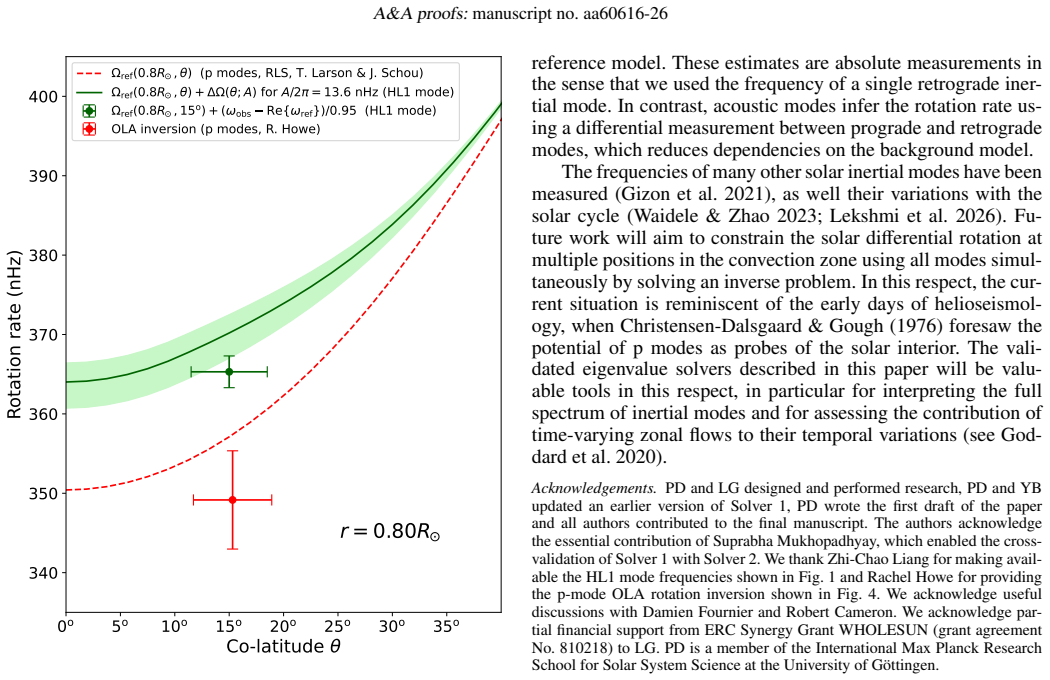
Using a validated eigenvalue solver, the linear sensitivity kernel of the m=1 high-latitude inertial mode is shown to peak at 75 deg latitude and 0.8 R_sun. From the observed frequency in the Carrington frame of -87.9 ± 1.9 nHz, the solar rotation rate at that location is inferred to be 365.3 ± 2.0 nHz, which exceeds the reference p-mode estimate by 8.1 nHz. This constitutes the first example of spatially resolved inertial-mode helioseismology for the bulk of the convection zone.
What carries the argument
The linear sensitivity kernel of the m=1 high-latitude inertial mode, computed from perturbations to the reference p-mode rotation profile and peaking at 75 deg latitude and 0.8 R_sun with widths of 7 deg and 0.13 R_sun.
If this is right
- Individual inertial modes supply direct constraints on rotation throughout the bulk of the solar convection zone.
- A latitudinally smooth, radially independent modification to the high-latitude rotation rate accounts for the observations outside the small-perturbation regime.
- Inertial-mode helioseismology enables spatially resolved diagnostics of solar differential rotation at high latitudes.
Where Pith is reading between the lines
- The method could be applied to other inertial modes to construct a fuller map of rotation across different depths and latitudes.
- The discrepancy with p-mode estimates may motivate inclusion of magnetic effects when modeling mode frequencies at high latitudes.
- Repeated measurements of this mode over multiple solar cycles could test whether the inferred rotation varies with time.
Load-bearing premise
The frequency perturbation of the m=1 mode is accurately captured by a linear sensitivity kernel from the reference p-mode rotation profile, without significant contributions from magnetic fields, nonlinear effects, or other unmodeled physics.
What would settle it
An independent measurement of the rotation rate at 75 deg latitude and 0.8 R_sun, for instance from additional helioseismic techniques or long-term mode-frequency monitoring, that matches the p-mode reference instead of the 8.1 nHz higher value would falsify the central inference.
Figures


read the original abstract
Solar internal rotation at high latitudes is poorly constrained by acoustic-mode helioseismology. Global inertial modes observed on the Sun are highly sensitive to solar differential rotation and may provide new diagnostics of rotation in these regions. We aim to constrain solar rotation with the measured frequency of the $m=1$ high-latitude inertial mode, starting from the HMI/SDO reference rotation profile given by p-mode helioseismology for 2010-2024. Using a validated and accurate eigenvalue solver, we compute the perturbation to the mode frequency resulting from localised changes in the differential rotation rate throughout the solar interior. We find that the linear sensitivity kernel of the $m=1$ high-latitude mode peaks at latitude 75 deg and radius $0.8 R_\odot$, with full widths of 7 deg and $0.13 R_\odot$. From the observed mode frequency in the Carrington frame, $-87.9 \pm 1.9$ nHz (retrograde, averaged over 2010-2024), we infer that the solar rotation rate near this location is $365.3\pm 2.0$ nHz, which exceeds the reference p-mode estimate by $8.1$ nHz. Additionally, we propose a latitudinally smooth, radially independent modification to the rotation rate at high latitudes beyond the linear (small-perturbation) regime. This work demonstrates that individual inertial modes can provide direct constraints on rotation in the bulk of the solar convection zone, well below the surface, representing the first example of spatially resolved inertial-mode helioseismology.
Editorial analysis
A structured set of objections, weighed in public.
Referee Report
Summary. The paper develops inertial-mode helioseismology to constrain solar differential rotation at high latitudes. Using a reference rotation profile from p-mode helioseismology (2010-2024), the authors compute a linear sensitivity kernel for the m=1 high-latitude inertial mode via an eigenvalue solver. The kernel peaks at 75° latitude and 0.8 R_⊙. From the observed retrograde frequency of −87.9 ± 1.9 nHz in the Carrington frame, they infer a local rotation rate of 365.3 ± 2.0 nHz (8.1 nHz above the p-mode reference) and additionally propose a latitudinally smooth, radially independent modification to the rotation profile beyond the linear regime.
Significance. If the linear kernel and its error budget are validated, the work would provide the first spatially resolved inertial-mode constraint on rotation deep in the convection zone at high latitudes, where acoustic-mode sensitivity is weak. The explicit location of the kernel peak (75° , 0.8 R_⊙) and the quantitative frequency-to-rotation mapping constitute concrete, falsifiable outputs that could be tested with future observations or forward modeling.
major comments (2)
- [Abstract / Methods] The central inference of a 365.3 ± 2.0 nHz rotation rate (8.1 nHz excess) rests on the linear sensitivity kernel computed from the reference p-mode profile. The manuscript provides no quantitative validation metrics, synthetic-data recovery tests, or error budget for this kernel (abstract and associated methods description). Without these, it is unclear whether the reported offset can be attributed solely to a localized rotation perturbation rather than unmodeled contributions.
- [Abstract / Results] The linear-kernel assumption—that the entire observed frequency shift arises from a small, localized change in the differential-rotation profile—requires explicit justification at 0.8 R_⊙ and 75°. The abstract notes a separate latitudinally smooth modification proposed beyond the linear regime, yet the quoted numerical result and uncertainty are derived from the linear kernel alone. A concrete test (e.g., forward modeling with added magnetic or nonlinear terms) is needed to bound possible systematic contributions.
minor comments (2)
- [Abstract] Clarify the precise definition of the Carrington-frame frequency and how the ±1.9 nHz uncertainty is propagated into the final rotation-rate uncertainty.
- [Abstract] The phrase 'validated and accurate eigenvalue solver' should be accompanied by at least one quantitative accuracy metric or comparison to an independent code.
Simulated Author's Rebuttal
We thank the referee for the constructive and detailed report. We address the two major comments point by point below, indicating the changes we will make to strengthen the manuscript.
read point-by-point responses
-
Referee: [Abstract / Methods] The central inference of a 365.3 ± 2.0 nHz rotation rate (8.1 nHz excess) rests on the linear sensitivity kernel computed from the reference p-mode profile. The manuscript provides no quantitative validation metrics, synthetic-data recovery tests, or error budget for this kernel (abstract and associated methods description). Without these, it is unclear whether the reported offset can be attributed solely to a localized rotation perturbation rather than unmodeled contributions.
Authors: We agree that the current version lacks explicit synthetic recovery tests and a fuller error-budget discussion for the kernel. The eigenvalue solver itself was validated in our prior work on inertial modes against analytic limits and independent codes, but we did not repeat those tests for the specific high-latitude m=1 kernel here. In the revised manuscript we will add a dedicated Methods subsection that (i) summarizes the solver validation, (ii) presents synthetic recovery experiments in which known localized rotation perturbations are injected into the reference profile and recovered via the kernel, and (iii) details the linear propagation of the observed frequency uncertainty (1.9 nHz) through the kernel to obtain the quoted ±2.0 nHz. We will also note the dominant remaining systematic (uncertainty in the reference p-mode profile itself) and quantify its contribution at the kernel peak. revision: yes
-
Referee: [Abstract / Results] The linear-kernel assumption—that the entire observed frequency shift arises from a small, localized change in the differential-rotation profile—requires explicit justification at 0.8 R_⊙ and 75°. The abstract notes a separate latitudinally smooth modification proposed beyond the linear regime, yet the quoted numerical result and uncertainty are derived from the linear kernel alone. A concrete test (e.g., forward modeling with added magnetic or nonlinear terms) is needed to bound possible systematic contributions.
Authors: The 8.1 nHz perturbation is only ~2 % of the local rotation rate, which lies well inside the regime where the linear eigenvalue perturbation is expected to be accurate. We will insert a short paragraph in the Results section that justifies this scale and cites the fractional perturbation size. The latitudinally smooth, radially independent modification is presented as an exploratory extension, not as the primary result; the quoted 365.3 ± 2.0 nHz value remains the linear-kernel inference. To provide the requested concrete test, the revised manuscript will include a forward-modeling check: we solve the full eigenvalue problem with the proposed smooth high-latitude modification added to the reference profile and confirm that the resulting mode frequency lies within the linear prediction plus the observational uncertainty. This exercise bounds the size of nonlinear corrections for the observed shift. revision: yes
Circularity Check
Derivation uses independent inertial-mode datum and external p-mode reference without reduction by construction
full rationale
The paper computes a linear sensitivity kernel for the m=1 inertial mode by applying an eigenvalue solver to localized perturbations around the external HMI/SDO p-mode reference rotation profile. It then maps the independently measured observed frequency (−87.9 ± 1.9 nHz) through this kernel to infer a local rotation rate of 365.3 ± 2.0 nHz at the kernel peak (75° latitude, 0.8 R⊙). This inference is not equivalent to the reference profile by construction; the observed frequency supplies new information, and the reported 8.1 nHz excess is the direct result of matching that datum under the linear approximation. No self-definitional steps, fitted inputs relabeled as predictions, or load-bearing self-citations appear in the provided derivation chain. The central claim remains self-contained against the external reference and the new observational input.
Axiom & Free-Parameter Ledger
free parameters (1)
- observed inertial-mode frequency
axioms (1)
- domain assumption Frequency perturbation is linear in differential-rotation changes
Lean theorems connected to this paper
-
IndisputableMonolith/Foundation/AbsoluteFloorClosure.leanreality_from_one_distinction unclear?
unclearRelation between the paper passage and the cited Recognition theorem.
The linear sensitivity of the mode frequency to a spatial change in rotation is specified through the integral equation δω = ∫ K(r, θ) δΩ(r, θ) r dr dθ
-
IndisputableMonolith/Cost/FunctionalEquation.leanwashburn_uniqueness_aczel unclear?
unclearRelation between the paper passage and the cited Recognition theorem.
Using a validated and accurate eigenvalue solver, we compute the perturbation to the mode frequency resulting from localised changes in the differential rotation rate
What do these tags mean?
- matches
- The paper's claim is directly supported by a theorem in the formal canon.
- supports
- The theorem supports part of the paper's argument, but the paper may add assumptions or extra steps.
- extends
- The paper goes beyond the formal theorem; the theorem is a base layer rather than the whole result.
- uses
- The paper appears to rely on the theorem as machinery.
- contradicts
- The paper's claim conflicts with a theorem or certificate in the canon.
- unclear
- Pith found a possible connection, but the passage is too broad, indirect, or ambiguous to say the theorem truly supports the claim.
Reference graph
Works this paper leans on
-
[1]
Faster formulations of the optimally localized averages method for helioseismic inversions. , keywords =
- [2]
-
[3]
Inertial waves in a differentially rotating spherical shell. J. Fluid. Mech. , keywords =. doi:10.1017/jfm.2012.605 , archivePrefix =. 1203.4347 , primaryClass =
work page internal anchor Pith review Pith/arXiv arXiv doi:10.1017/jfm.2012.605 2012
-
[4]
Science , year = 1996, month = may, volume =
Differential Rotation and Dynamics of the Solar Interior. Science , year = 1996, month = may, volume =. doi:10.1126/science.272.5266.1300 , adsurl =
-
[5]
The Sun’s differential rotation is controlled by high-latitude baroclinically unstable inertial modes , journal =. 2024 , doi =. doi:10.1126/sciadv.adk5643 , author =. https://www.science.org/doi/pdf/10.1126/sciadv.adk5643 , abstract =
-
[6]
Mecheri, R and Meftah, M , title =. , volume =. 2021 , month =. doi:10.1093/mnras/stab1827 , url =
-
[7]
Flux-Transport Dynamos with Lorentz Force Feedback on Differential Rotation and Meridional Flow: Saturation Mechanism and Torsional Oscillations. , keywords =. doi:10.1086/505170 , archivePrefix =. astro-ph/0604446 , primaryClass =
work page internal anchor Pith review Pith/arXiv arXiv doi:10.1086/505170
-
[8]
Pavlov, Dmitry and Dolgakov, Ivan , TITLE =. Universe , VOLUME =. 2024 , NUMBER =
work page 2024
- [9]
-
[10]
The Sun’s Large-Scale Flows I: Measurements of Differential Rotation & Torsional Oscillation , author=. , year=
-
[11]
Global-Mode Analysis of Full-Disk Data from the Michelson Doppler Imager and the Helioseismic and Magnetic Imager. , keywords =. doi:10.1007/s11207-017-1201-5 , adsurl =
-
[12]
Double-Cell Type Solar Meridional Circulation Based on Mean-Field Hydrodynamic Model
Double-cell-type Solar Meridional Circulation Based on a Mean-field Hydrodynamic Model. , keywords =. doi:10.3847/1538-4357/835/1/9 , archivePrefix =. 1612.00174 , primaryClass =
work page internal anchor Pith review Pith/arXiv arXiv doi:10.3847/1538-4357/835/1/9
-
[13]
Die Wasserstoffkonvektionszone der Sonne. Mit 11 Textabbildungen. ZA , year = 1953, volume = 32, pages =
work page 1953
-
[14]
U ber die Wasserstoffkonvektionszone in Sternen verschiedener Effektivtemperaturen und Leuchtkr \
\"U ber die Wasserstoffkonvektionszone in Sternen verschiedener Effektivtemperaturen und Leuchtkr \"a fte. Mit 5 Textabbildungen. ZA , year = 1958, volume = 46, pages =
work page 1958
-
[15]
Science , year = 1996, month = may, volume = 272, pages =
The Current State of Solar Modeling. Science , year = 1996, month = may, volume = 272, pages =. doi:10.1126/science.272.5266.1286 , adsurl =
-
[16]
Magnetic Quenching of Turbulent Diffusivity: Reconciling Mixing-length Theory Estimates with Kinematic Dynamo Models of the Solar Cycle. , keywords =. doi:10.1088/2041-8205/727/1/L23 , archivePrefix =. 1007.1262 , primaryClass =
work page internal anchor Pith review Pith/arXiv arXiv doi:10.1088/2041-8205/727/1/l23 2041
-
[17]
Magnetic field generation in electrically conducting fluids
-
[18]
The solar dynamo. , keywords =. doi:10.1007/s00159-003-0019-3 , adsurl =
-
[19]
Differential Rotation in Magnetized and Non-magnetized Stars
Differential Rotation in Magnetized and Non-magnetized Stars. , keywords =. doi:10.1088/0004-637X/806/1/10 , archivePrefix =. 1504.01129 , primaryClass =
work page internal anchor Pith review Pith/arXiv arXiv doi:10.1088/0004-637x/806/1/10
-
[20]
Generation of Solar-like Differential Rotation. , keywords =. doi:10.3847/1538-4357/ac7395 , archivePrefix =. 2202.04183 , primaryClass =
-
[21]
Convective Velocity Suppression via the Enhancement of the Subadiabatic Layer: Role of the Effective Prandtl Number. , keywords =. doi:10.3847/1538-4357/aa9b7f , archivePrefix =. 1711.05960 , primaryClass =
work page internal anchor Pith review Pith/arXiv arXiv doi:10.3847/1538-4357/aa9b7f
-
[22]
Global-scale equatorial Rossby waves as an essential component of solar internal dynamics , journal=
L. Global-scale equatorial Rossby waves as an essential component of solar internal dynamics , journal=. 2018 , month=. doi:10.1038/s41550-018-0460-x , url=
-
[23]
Detection of Rossby Waves in the Sun using Normal-mode Coupling. , keywords =. doi:10.3847/2041-8213/aaff60 , adsurl =
-
[24]
Time-distance helioseismology of solar Rossby waves
Time-distance helioseismology of solar Rossby waves. , keywords =. doi:10.1051/0004-6361/201834849 , archivePrefix =. 1812.07413 , primaryClass =
work page internal anchor Pith review Pith/arXiv arXiv doi:10.1051/0004-6361/201834849
-
[25]
Exploring the latitude and depth dependence of solar Rossby waves using ring-diagram analysis. , keywords =. doi:10.1051/0004-6361/201937007 , archivePrefix =. 1912.02056 , primaryClass =
-
[26]
Solar Rossby waves observed in GONG++ ring-diagram flow maps. , keywords =. doi:10.1051/0004-6361/201937321 , archivePrefix =. 2002.01194 , primaryClass =
-
[27]
Convection in a rotating cylindrical annulus - Thermal Rossby waves. J. Fluid. Mech. , keywords =. doi:10.1017/S0022112086000095 , adsurl =
-
[28]
Geophysical and Astrophysical Fluid Dynamics , keywords =
Differential rotation driven by convection in a rapidly rotating annulus. Geophysical and Astrophysical Fluid Dynamics , keywords =. doi:10.1080/03091928208209005 , adsurl =
-
[29]
Asymptotic theory of convection in a rotating, cylindrical annulus. J. Fluid. Mech. , keywords =. doi:10.1017/S002211208600126X , adsurl =
-
[30]
Anomalous sideband instabilities of thermal Rossby waves at low Prandtl numbers. Phys. Fluids , year = 1995, month = feb, volume =. doi:10.1063/1.868764 , adsurl =
-
[31]
Guervilly, Céline and Cardin, Philippe , year=. Subcritical convection of liquid metals in a rotating sphere using a quasi-geostrophic model , volume=. doi:10.1017/jfm.2016.631 , journal=
-
[32]
Hanson, Chris S. and Hanasoge, Shravan and Sreenivasan, Katepalli R. , title=. Nat. Astron. , year=. doi:10.1038/s41550-022-01632-z , url=
-
[33]
and Gizon, Laurent , month = mar, year =
Mushtaq, Muneeb and Fournier, Damien and Ayoub, Rama and Schmid, Peter J. and Gizon, Laurent , month = mar, year =. Nonlinear evolution of unstable solar inertial modes:. doi:10.48550/arXiv.2603.08528 , urldate =
-
[34]
Theory of solar oscillations in the inertial frequency range: Linear modes of the convection zone. , keywords =. doi:10.1051/0004-6361/202243164 , archivePrefix =. 2203.04442 , primaryClass =
-
[35]
Assessing the validity of the anelastic and Boussinesq approximations to model solar inertial modes. , keywords =. doi:10.1051/0004-6361/202453634 , archivePrefix =. 2501.16797 , primaryClass =
-
[36]
Dibyendu Nandy and Arnab Rai Choudhuri , title =. Science , volume =. 2002 , doi =. https://www.science.org/doi/pdf/10.1126/science.1070955 , abstract =
-
[37]
Theory of solar oscillations in the inertial frequency range: Amplitudes of equatorial modes from a nonlinear rotating convection simulation. , keywords =. doi:10.1051/0004-6361/202244150 , archivePrefix =. 2208.11081 , primaryClass =
-
[38]
Separation of large-scale photospheric Doppler patterns. , keywords =. doi:10.1007/BF00154804 , adsurl =
-
[39]
Disentangling the independently controllable factors of variation by interacting with the world
The Internal Rotation of the Sun. , year = 2003, month = jan, volume =. doi:10.1146/annurev.astro.41.011802.094848 , adsurl =
work page internal anchor Pith review Pith/arXiv arXiv doi:10.1146/annurev.astro.41.011802.094848 2003
-
[40]
Inertial Waves in a Nonlinear Simulation of the Sun's Convection Zone and Radiative Interior. , keywords =. doi:10.3847/1538-4357/ad27d1 , archivePrefix =. 2312.14270 , primaryClass =
-
[41]
Radial Trapping of Thermal Rossby Waves within the Convection Zones of Low-mass Stars. , keywords =. doi:10.3847/1538-4357/ac6d64 , archivePrefix =. 2205.02346 , primaryClass =
-
[42]
Dedalus: A flexible framework for numerical simulations with spectral methods , author =. Phys. Rev. Res. , volume =. 2020 , month =. doi:10.1103/PhysRevResearch.2.023068 , url =
-
[43]
Plaut, E. and Lebranchu, Y. and Simitev, R. and Busse, F. H. , year=. Reynolds stresses and mean fields generated by pure waves: applications to shear flows and convection in a rotating shell , volume=. doi:10.1017/S0022112008000840 , journal=
-
[44]
K. Hori and R.J. Teed and C.A. Jones , keywords =. The dynamics of magnetic Rossby waves in spherical dynamo simulations: A signature of strong-field dynamos? , journal =. 2018 , issn =. doi:https://doi.org/10.1016/j.pepi.2017.07.008 , url =
-
[45]
Thermal Rossby waves in a rotating annulus. Their stability. , keywords =. doi:10.1103/PhysRevE.63.056312 , adsurl =
-
[46]
Geochemistry, Geophysics, Geosystems , keywords =
Quasigeostrophic models of convection in rotating spherical shells. Geochemistry, Geophysics, Geosystems , keywords =. doi:10.1029/2002GC000456 , adsurl =
-
[47]
The onset of thermal convection in rotating spherical shells. J. Fluid. Mech. , year = 2004, month = feb, volume =. doi:10.1017/S0022112003007316 , adsurl =
-
[48]
and Noir, Jérôme and Eldredge, Jeff D
Calkins, Michael A. and Noir, Jérôme and Eldredge, Jeff D. and Aurnou, Jonathan M. , title = ". Geophys. J. Int. , volume =. 2012 , month =
work page 2012
-
[49]
Chaos , year = 1994, month = jun, volume =
Convection driven zonal flows and vortices in the major planets. Chaos , year = 1994, month = jun, volume =. doi:10.1063/1.165999 , adsurl =
-
[50]
S. Towards a Better Understanding of Rotating Turbulent Convection in Geo- and Astrophysical Systems , volume =. 2016 , month =
work page 2016
-
[51]
Journal of Atmospheric Sciences , keywords =
The Compressional Beta Effect: Analytical Solution, Numerical Benchmark, and Data Analysis. Journal of Atmospheric Sciences , keywords =. doi:10.1175/JAS-D-20-0124.1 , archivePrefix =. 2004.15017 , primaryClass =
-
[52]
, year = 2005, month = nov, volume =
Simulation of equatorial and high-latitude jets on Jupiter in a deep convection model. , year = 2005, month = nov, volume =. doi:10.1038/nature04208 , adsurl =
-
[53]
Australian Journal of Physics , keywords =
Deep convection in the interior of major planets: a review. Australian Journal of Physics , keywords =. doi:10.1071/P97079 , adsurl =
-
[54]
M. A. Azouni and E. W. Bolton and F. H. Busse , title =. Geophys. Astrophys. Fluid Dyn. , volume =. 1985 , publisher =. doi:10.1080/03091928508245448 , URL =
-
[55]
Quasi-geostrophic approximation of anelastic convection. J. Fluid. Mech. , keywords =. doi:10.1017/jfm.2014.293 , archivePrefix =. 1403.2258 , primaryClass =
work page internal anchor Pith review Pith/arXiv arXiv doi:10.1017/jfm.2014.293 2014
-
[56]
Properties of Solar Rossby Waves from Normal Mode Coupling and Characterizing Its Systematics. , keywords =. doi:10.3847/1538-4357/ab7227 , archivePrefix =. 1908.05890 , primaryClass =
-
[57]
Rossby modes in slowly rotating stars: depth dependence in distorted polytropes with uniform rotation. , keywords =. doi:10.1051/0004-6361/201936251 , archivePrefix =. 2003.05276 , primaryClass =
-
[58]
Effect of latitudinal differential rotation on solar Rossby waves: Critical layers, eigenfunctions, and momentum fluxes in the equatorial plane. , keywords =. doi:10.1051/0004-6361/202038525 , archivePrefix =. 2008.02185 , primaryClass =
-
[59]
Predicting frequency changes of global-scale solar Rossby modes due to solar cycle changes in internal rotation. , keywords =. doi:10.1051/0004-6361/202038539 , archivePrefix =. 2007.14387 , primaryClass =
-
[60]
Hydrodynamic Properties of the Sun's Giant Cellular Flows. , keywords =. doi:10.3847/1538-4357/abcbfa , archivePrefix =. 2006.06084 , primaryClass =
-
[61]
Helioseismology challenges models of solar convection
Helioseismology challenges models of solar convection. PNAS , keywords =. doi:10.1073/pnas.1208875109 , archivePrefix =. 1208.6154 , primaryClass =
work page internal anchor Pith review Pith/arXiv arXiv doi:10.1073/pnas.1208875109
-
[62]
and Julien, Keith and Featherstone, Nicholas A
Vasil, Geoffrey M. and Julien, Keith and Featherstone, Nicholas A. , title =. 2021 , doi =
work page 2021
-
[63]
Anomalously Weak Solar Convection
Anomalously weak solar convection. Proceedings of the National Academy of Science , keywords =. doi:10.1073/pnas.1206570109 , archivePrefix =. 1206.3173 , primaryClass =
work page internal anchor Pith review Pith/arXiv arXiv doi:10.1073/pnas.1206570109
-
[64]
Velocity amplitudes in global convection simulations: The role of the Prandtl number and near-surface driving. Advances in Space Research , keywords =. doi:10.1016/j.asr.2016.03.038 , archivePrefix =. 1603.06107 , primaryClass =
work page internal anchor Pith review Pith/arXiv arXiv doi:10.1016/j.asr.2016.03.038 2016
-
[65]
Seismic Sounding of Convection in the Sun
Seismic Sounding of Convection in the Sun. Annual Review of Fluid Mechanics , keywords =. doi:10.1146/annurev-fluid-122414-034534 , archivePrefix =. 1503.07961 , primaryClass =
work page internal anchor Pith review Pith/arXiv arXiv doi:10.1146/annurev-fluid-122414-034534
-
[66]
Consequences of high effective Prandtl number on solar differential rotation and convective velocity. Phys. Fluids , keywords =. doi:10.1063/1.5022034 , archivePrefix =. 1801.00560 , primaryClass =
work page internal anchor Pith review Pith/arXiv arXiv doi:10.1063/1.5022034
-
[67]
The Role of Subsurface Flows in Solar Surface Convection: Modeling the Spectrum of Supergranular and Larger Scale Flows. , keywords =. doi:10.1088/0004-637X/793/1/24 , archivePrefix =. 1407.2209 , primaryClass =
work page internal anchor Pith review Pith/arXiv arXiv doi:10.1088/0004-637x/793/1/24
-
[68]
Stellar mixing length theory with entropy rain
Stellar Mixing Length Theory with Entropy Rain. , keywords =. doi:10.3847/0004-637X/832/1/6 , archivePrefix =. 1504.03189 , primaryClass =
work page internal anchor Pith review Pith/arXiv arXiv doi:10.3847/0004-637x/832/1/6
-
[69]
Geophysical and Astrophysical Fluid Dynamics , keywords =
Sensitivity to luminosity, centrifugal force, and boundary conditions in spherical shell convection. Geophysical and Astrophysical Fluid Dynamics , keywords =. doi:10.1080/03091929.2019.1571586 , adsurl =
-
[70]
Driving Solar Giant Cells through the Self-Organization of Near-Surface Plumes
Driving Solar Giant Cells through the Self-organization of Near-surface Plumes. , keywords =. doi:10.3847/1538-4357/aabc07 , archivePrefix =. 1804.01166 , primaryClass =
work page internal anchor Pith review Pith/arXiv arXiv doi:10.3847/1538-4357/aabc07
-
[71]
Science Advances , year = 2020, month = jul, volume =
Turbulence in the Sun is suppressed on large scales and confined to equatorial regions. Science Advances , year = 2020, month = jul, volume =. doi:10.1126/sciadv.aba9639 , adsurl =
-
[72]
Giant Convection Cells Found on the Sun. Science , keywords =. doi:10.1126/science.1244682 , adsurl =
-
[73]
Relation between variations in the intensity of the zonal circulation of the atmosphere and the displacement of the semi-permanent centers of action. J. Marine Res. , year = 1939, volume =
work page 1939
-
[74]
Planetary flow patterns in the atmosphere. Q. J. Roy. Meteo. Soc. , year = 1940, volume =
work page 1940
-
[75]
Vallis, G. K. , title =
-
[76]
doi:10.1088/0034-4885/68/8/r06 , url =
Ashwin R Vasavada and Adam P Showman , title =. doi:10.1088/0034-4885/68/8/r06 , url =
-
[77]
Vallis, Geoffrey K. and Maltrud, Matthew E. , title = ". Journal of Physical Oceanography , volume =. 1993 , month =. doi:10.1175/1520-0485(1993)023<1346:GOMFAJ>2.0.CO;2 , url =
-
[78]
Journal of Fluid Mechanics , year = 1975, month = jan, volume =
Waves and turbulence on a beta-plane. Journal of Fluid Mechanics , year = 1975, month = jan, volume =. doi:10.1017/S0022112075001504 , adsurl =
-
[79]
Numerical simulations of stellar convective dynamos. I. The model andmethod. Journal of Computational Physics , keywords =. doi:10.1016/0021-9991(84)90033-0 , adsurl =
-
[80]
R-mode oscillations in uniformly rotating stars. , keywords =. doi:10.1086/159945 , adsurl =
discussion (0)
Sign in with ORCID, Apple, or X to comment. Anyone can read and Pith papers without signing in.