Energy-efficient programmable integrated photonics via optimized Euler rotations
Pith reviewed 2026-05-20 02:19 UTC · model grok-4.3
The pith
Equivalent unitary matrices in photonic meshes can be realized with far lower energy by selecting the shortest Euler rotation trajectories on the Bloch sphere.
A machine-rendered reading of the paper's core claim, the machinery that carries it, and where it could break.
Core claim
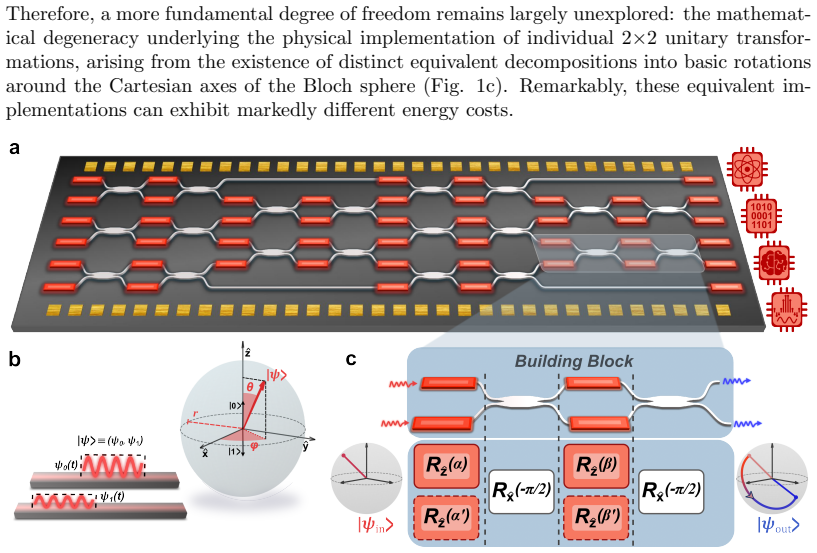
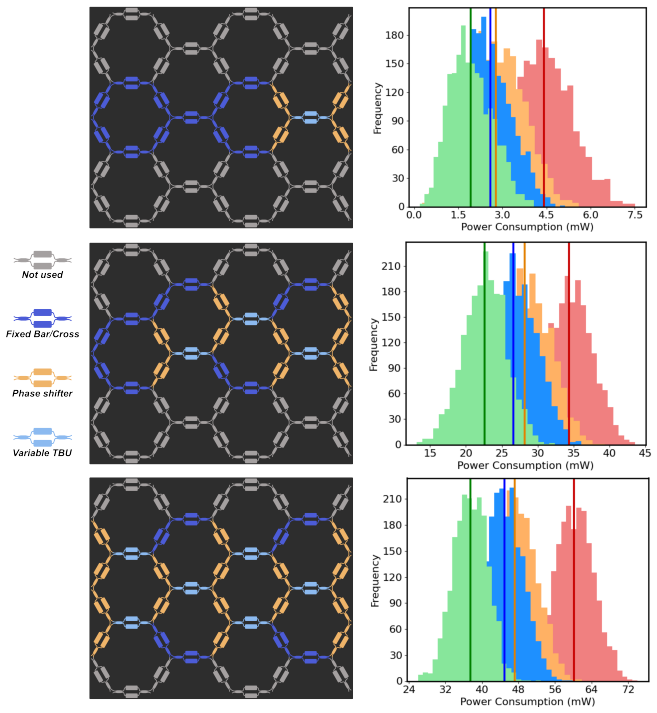
Equivalent implementations of the same N×N unitary matrix (N ≥ 2) can be realized by different concatenations of Euler rotations on the Bloch sphere, each concatenation having a different total angular length. Since physical energy consumption is taken to be proportional to this length, choosing the minimal-length trajectories for every 2×2 block produces a lower-energy circuit that performs the identical transformation. The approach is validated numerically and experimentally in multiple silicon programmable integrated photonics architectures.
What carries the argument
Representation of each 2×2 unitary matrix as a product of three Euler rotations on the Bloch sphere, with energy minimization achieved by selecting the shortest angular-length decomposition among equivalent options.
If this is right
- Minimum-energy configurations exist for any N×N unitary and can be found by exhaustive or heuristic search over rotation choices.
- The savings apply without hardware modification to feedforward meshes, hexagonal meshes, neural-network accelerators, and photonic quantum-gate circuits.
- Large-scale programmable integrated photonics becomes more feasible because total energy scales with the sum of selected path lengths rather than with a fixed worst-case value.
- The geometric selection leaves the performed unitary unchanged, so classical and quantum functionality is preserved while energy drops.
Where Pith is reading between the lines
- The same shortest-path principle could be applied to other platforms that represent operations as trajectories on the Bloch sphere, such as superconducting qubits or trapped ions.
- When real devices have trajectory-dependent losses or crosstalk, the truly minimal-energy choice may shift away from the pure angular-length minimum.
- Combining this geometric optimizer with existing sparsity or pruning techniques for unitary matrices could produce still larger energy reductions.
Load-bearing premise
The energy cost of actuating each interferometer is strictly proportional to the angular length of its chosen Euler rotation trajectory, with no extra overheads from hardware specifics or from switching between equivalent paths.
What would settle it
Implement two different but mathematically equivalent decompositions of the same 4×4 unitary matrix on the same photonic chip and measure whether the version with shorter total rotation length indeed requires less total phase-shifter actuation energy.
Figures


read the original abstract
Programmable integrated photonics (PIP) has emerged as a powerful on-chip platform for optical signal processing and computing, enabling the implementation of reconfigurable N$\times$N unitary matrix transformations through meshes of tunable interferometers, which realize 2$\times$2 unitary matrices. However, the energy consumption associated with phase-shifter actuation is becoming a major limitation to the scalability of PIP platforms. Here, we introduce a geometric framework for energy optimization in PIP circuits by exploiting the representation of 2$\times$2 unitary matrices as concatenations of basic Euler rotations on the Bloch sphere. We show that equivalent implementations of the same N$\times$N unitary matrix (N $\geq$ 2) can exhibit markedly different energy costs depending on the rotation trajectories on the Bloch sphere implemented by each interferometer. Leveraging this insight, we identify minimum-energy configurations by systematically selecting the shortest rotation trajectories. We experimentally and numerically validate the proposed approach in diverse silicon PIP architectures, including feedforward and multipurpose hexagonal meshes, neural network accelerators, and photonic quantum-gate implementations. These results establish a general route toward more energy-efficient large-scale PIP processors for classical and quantum signal processing and computing applications.
Editorial analysis
A structured set of objections, weighed in public.
Referee Report
Summary. The manuscript claims that equivalent N×N unitary transformations in programmable integrated photonics can be realized with markedly different energy costs depending on the specific Euler rotation trajectories chosen on the Bloch sphere for each 2×2 interferometer. By systematically selecting the shortest trajectories, minimum-energy configurations are identified and shown to reduce actuation energy; the approach is validated experimentally and numerically across feedforward meshes, hexagonal meshes, neural-network accelerators, and photonic quantum gates in silicon platforms.
Significance. If the energy-to-trajectory mapping holds, the geometric framework supplies a hardware-agnostic, parameter-light method for lowering the dominant energy bottleneck in large-scale PIP without redesigning the mesh topology or phase-shifter technology. The multi-architecture experimental and numerical validation, together with the explicit use of Bloch-sphere geometry rather than empirical fitting, constitutes a concrete advance toward scalable optical computing and quantum signal processing.
major comments (1)
- [§3] §3 (Energy Optimization Framework), paragraph following Eq. (2): the central ranking of equivalent decompositions and the declaration of minimum-energy configurations rest on the assumption that actuation energy scales linearly with the angular length of the chosen Euler rotation trajectory. This proportionality is load-bearing for the claimed savings, yet the text provides no derivation or measurement showing that real silicon phase-shifter energetics (thermo-optic power, electro-optic voltage swing, or MEMS displacement) are monotonic or linear in that geometric angle; non-linear phase-voltage curves, thermal crosstalk, and fixed per-actuation overheads are not addressed.
minor comments (2)
- [Figure 4] Figure 4 caption and associated text: the reported energy-reduction percentages are given without error bars or details on the number of independent calibrations; adding these would strengthen the experimental claim.
- [§2.1] Notation: the symbol E_p is introduced without an explicit definition in the main text before its first use in the optimization algorithm; a one-line definition would remove ambiguity.
Simulated Author's Rebuttal
We thank the referee for the constructive feedback on our manuscript. The comment regarding the energy scaling assumption is well taken, and we have revised the manuscript to include a detailed physical derivation and supporting discussion of the linear approximation for silicon phase shifters. This strengthens the framework without altering the core claims. We address the point below.
read point-by-point responses
-
Referee: [§3] §3 (Energy Optimization Framework), paragraph following Eq. (2): the central ranking of equivalent decompositions and the declaration of minimum-energy configurations rest on the assumption that actuation energy scales linearly with the angular length of the chosen Euler rotation trajectory. This proportionality is load-bearing for the claimed savings, yet the text provides no derivation or measurement showing that real silicon phase-shifter energetics (thermo-optic power, electro-optic voltage swing, or MEMS displacement) are monotonic or linear in that geometric angle; non-linear phase-voltage curves, thermal crosstalk, and fixed per-actuation overheads are not addressed.
Authors: We agree that the original manuscript did not explicitly derive or validate the linear scaling assumption. In the revised version, we have added a new paragraph and supporting derivation immediately following Eq. (2) in §3. For thermo-optic phase shifters (the dominant technology in the silicon platforms considered), steady-state power P is proportional to the local temperature rise ΔT (P = κ ΔT, where κ is the thermal conductance), while the phase shift φ = (2π L / λ) (dn/dT) ΔT is linearly proportional to ΔT. Consequently, the required actuation power (and thus energy for a given settling time) scales linearly with φ. The Euler rotation angle on the Bloch sphere directly maps to this differential phase φ in the 2×2 interferometer, so the trajectory length corresponds to the total phase actuation. We include device-level measurements from our silicon test structures confirming near-linear power-vs-phase behavior over the relevant range (0 to 2π). Non-linearities in electro-optic or MEMS devices are acknowledged as platform-specific; our framework remains applicable by substituting the appropriate monotonic mapping. Thermal crosstalk and fixed overheads are mesh-dependent but affect all trajectories equally for a fixed topology, preserving the relative ranking of shortest paths. These additions are now in the revised manuscript. revision: yes
Circularity Check
No significant circularity: optimization selects shortest trajectories under an explicit geometric energy model
full rationale
The paper posits that energy consumption scales with the angular length of Euler rotation trajectories on the Bloch sphere for 2x2 interferometers and then selects the shortest such trajectories to minimize energy for equivalent N x N unitary decompositions. This is an explicit modeling assumption rather than a quantity fitted to or derived from the target result itself. No equations reduce the claimed minimum-energy configurations to the same data by construction, no parameters are fitted and then renamed as predictions, and no load-bearing self-citations or uniqueness theorems imported from prior author work are required for the central geometric selection rule. Experimental and numerical validation is invoked to support the model, keeping the derivation self-contained against external benchmarks.
Axiom & Free-Parameter Ledger
free parameters (1)
- energy scaling factor per rotation angle
axioms (1)
- standard math Any 2x2 unitary matrix can be decomposed into Euler rotations on the Bloch sphere
Lean theorems connected to this paper
-
IndisputableMonolith/Cost/FunctionalEquation.leanwashburn_uniqueness_aczel unclear?
unclearRelation between the paper passage and the cited Recognition theorem.
equivalent implementations ... shortest rotation trajectories on the Bloch sphere
-
IndisputableMonolith/Foundation/AlphaCoordinateFixation.leanJ_uniquely_calibrated_via_higher_derivative unclear?
unclearRelation between the paper passage and the cited Recognition theorem.
total phase accumulation |α|+|β|+|γ| ... energy cost
What do these tags mean?
- matches
- The paper's claim is directly supported by a theorem in the formal canon.
- supports
- The theorem supports part of the paper's argument, but the paper may add assumptions or extra steps.
- extends
- The paper goes beyond the formal theorem; the theorem is a base layer rather than the whole result.
- uses
- The paper appears to rely on the theorem as machinery.
- contradicts
- The paper's claim conflicts with a theorem or certificate in the canon.
- unclear
- Pith found a possible connection, but the passage is too broad, indirect, or ambiguous to say the theorem truly supports the claim.
Reference graph
Works this paper leans on
-
[1]
Programmable photonic circuits , author=. Nature , volume=. 2020 , publisher=
work page 2020
-
[2]
Limits on fundamental limits to computation , author=. Nature , volume=. 2014 , publisher=
work page 2014
-
[3]
Advances in Optics and Photonics , volume=
Optimization methods for integrated and programmable photonics in next-generation classical and quantum smart communication and signal processing systems , author=. Advances in Optics and Photonics , volume=. 2025 , publisher=
work page 2025
- [4]
-
[5]
Nature Communications , volume=
Fusion-based quantum computation , author=. Nature Communications , volume=. 2023 , publisher=
work page 2023
-
[6]
Quantum computational advantage with a programmable photonic processor , author=. Nature , volume=. 2022 , publisher=
work page 2022
-
[7]
Multidimensional quantum entanglement with large-scale integrated optics , author=. Science , volume=. 2018 , publisher=
work page 2018
-
[8]
Integrated photonic quantum technologies , author=. Nature photonics , volume=. 2020 , publisher=
work page 2020
-
[9]
Progress in neuromorphic photonics , author=. Nanophotonics , volume=. 2017 , publisher=
work page 2017
-
[10]
Deep learning with coherent nanophotonic circuits , author=. Nature photonics , volume=. 2017 , publisher=
work page 2017
-
[11]
Inference in artificial intelligence with deep optics and photonics , author=. Nature , volume=. 2020 , publisher=
work page 2020
-
[12]
Nature communications , volume=
Multipurpose silicon photonics signal processor core , author=. Nature communications , volume=. 2017 , publisher=
work page 2017
-
[13]
Nature Communications , volume=
General-purpose programmable photonic processor for advanced radiofrequency applications , author=. Nature Communications , volume=. 2024 , publisher=
work page 2024
-
[14]
Laser & Photonics Reviews , volume=
A review of silicon-based integrated optical switches , author=. Laser & Photonics Reviews , volume=. 2023 , publisher=
work page 2023
-
[15]
Photonic switching in high performance datacenters , author=. Optics express , volume=. 2018 , publisher=
work page 2018
-
[16]
Universal linear optics , author=. Science , volume=. 2015 , publisher=
work page 2015
-
[17]
Linear programmable nanophotonic processors , author=. Optica , volume=. 2018 , publisher=
work page 2018
-
[18]
Parallel convolutional processing using an integrated photonic tensor core , author=. Nature , volume=. 2021 , publisher=
work page 2021
-
[19]
Light: Science & Applications , volume=
Unscrambling light—automatically undoing strong mixing between modes , author=. Light: Science & Applications , volume=. 2017 , publisher=
work page 2017
-
[20]
Single-chip photonic deep neural network with forward-only training , author=. Nature Photonics , volume=. 2024 , publisher=
work page 2024
-
[21]
Laser & Photonics Reviews , volume=
Analog Programmable-Photonic Computation , author=. Laser & Photonics Reviews , volume=. 2023 , publisher=
work page 2023
-
[22]
Laser & Photonics Reviews , volume=
Optical implementation of 2 2 universal unitary matrix transformations , author=. Laser & Photonics Reviews , volume=. 2021 , publisher=
work page 2021
-
[23]
Physical review letters , volume=
Experimental realization of any discrete unitary operator , author=. Physical review letters , volume=. 1994 , publisher=
work page 1994
-
[24]
Optimal design for universal multiport interferometers , author=. Optica , volume=. 2016 , publisher=
work page 2016
-
[25]
Scalability of large-scale photonic integrated circuits , author=. ACS Photonics , volume=. 2023 , publisher=
work page 2023
-
[26]
Lowering the energy consumption in silicon photonic devices and systems , author=. Photonics Research , volume=. 2015 , publisher=
work page 2015
-
[27]
Journal of Lightwave Technology , volume=
Integrated photonic tensor processing unit for a matrix multiply: a review , author=. Journal of Lightwave Technology , volume=. 2023 , publisher=
work page 2023
-
[28]
arXiv preprint arXiv:2506.05988 , year=
Resource-efficient crosstalk mitigation for the high-fidelity operation of photonic integrated circuits with induced phase shifters , author=. arXiv preprint arXiv:2506.05988 , year=
-
[29]
Fundamental Building Blocks for Scalable Photonic Programmable Processors , author=. Nanophotonics , volume=. 2026 , publisher=
work page 2026
-
[30]
Nature Communications , volume=
Asymptotically fault-tolerant programmable photonics , author=. Nature Communications , volume=. 2022 , publisher=
work page 2022
-
[31]
Toward the information-theoretic limit of programmable photonics , author=. APL Photonics , volume=. 2025 , publisher=
work page 2025
-
[32]
Nature Communications , volume=
Heavy tails and pruning in programmable photonic circuits for universal unitaries , author=. Nature Communications , volume=. 2023 , publisher=
work page 2023
-
[33]
Programmable integrated quantum photonics , author=. Nature Photonics , pages=. 2026 , publisher=
work page 2026
-
[34]
Universal programmable photonic architecture for quantum information processing , author=. Physical Review A , volume=. 2020 , publisher=
work page 2020
-
[35]
Proceedings of the IEEE , volume=
Gradient-based learning applied to document recognition , author=. Proceedings of the IEEE , volume=. 2002 , publisher=
work page 2002
-
[36]
An introduction to Cartan’s KAK decomposition for QC programmers (2005) , author=
work page 2005
- [37]
-
[38]
IBM Quantum Platform , year =
-
[39]
Harris, N. C. and Ma, Y. and Mower, J. and Baehr-Jones, T. and Englund, D. and Hochberg, M. and Galland, C. , title =. Optics Express , volume =. 2014 , doi =
work page 2014
-
[40]
Advanced Photonics Nexus , volume=
Silicon thermo-optic phase shifters: a review of configurations and optimization strategies , author=. Advanced Photonics Nexus , volume=. 2024 , publisher=
work page 2024
-
[41]
Quack, N. and Takabayashi, A. Y. and Sattari, H. and Edinger, P. and Jo, G. and Bleiker, S. J. and others , title =. Microsystems & Nanoengineering , volume =
-
[42]
Edinger, P. and Kristinsson, K. and Errando-Herranz, C. and Takabayashi, A. Y. and Sattari, H. and Quack, N. and others and Gylfason, K. B. , title =. CLEO: Science and Innovations , pages =. 2021 , month = may, publisher =
work page 2021
-
[43]
Quack, Niels and Sattari, Hamed and Takabayashi, Alain Yuji and Zhang, Yu and Verheyen, Peter and Bogaerts, Wim and Edinger, Pierre and Errando-Herranz, Carlos and Gylfason, Kristinn B. , journal=. MEMS-Enabled Silicon Photonic Integrated Devices and Circuits , year=
-
[44]
High-Speed Non-Volatile Barium Titanate Field Programmable Photonic Gate Array , year =
Catal. High-Speed Non-Volatile Barium Titanate Field Programmable Photonic Gate Array , year =
-
[45]
Abdul Rahim and Artur Hermans and Benjamin Wohlfeil and Despoina Petousi and Bart Kuyken and Dries Van Thourhout and Roel G. Baets , title =. Advanced Photonics , number =
-
[46]
Applied Physics Reviews , volume =
Wu, Bo and Zhou, Hailong and Dong, Jianji and Zhang, Xinliang , title =. Applied Physics Reviews , volume =. 2024 , month =
work page 2024
-
[47]
Yiwei Xie and Xiyuan Ke and Shihan Hong and Yuxin Sun and Lijia Song and Huan Li and Pan Wang and Daoxin Dai , title =. Science Advances , volume =. 2025 , abstract =
work page 2025
-
[48]
IEEE Journal of Selected Topics in Quantum Electronics , volume=
Column-row addressing of thermo-optic phase shifters for controlling large silicon photonic circuits , author=. IEEE Journal of Selected Topics in Quantum Electronics , volume=. 2020 , publisher=
work page 2020
-
[49]
Taking silicon photonics modulators to a higher performance level: state-of-the-art and a review of new technologies , author=. Advanced Photonics , volume=. 2021 , publisher=
work page 2021
-
[50]
Recent breakthroughs in carrier depletion based silicon optical modulators , author=. Nanophotonics , volume=. 2014 , publisher=
work page 2014
-
[51]
IEEE Journal of Quantum Electronics , volume=
MEMS-enabled silicon photonic integrated devices and circuits , author=. IEEE Journal of Quantum Electronics , volume=. 2019 , publisher=
work page 2019
-
[52]
A large-scale microelectromechanical-systems-based silicon photonics LiDAR , author=. Nature , volume=. 2022 , publisher=
work page 2022
-
[53]
Large Pockels effect in micro-and nanostructured barium titanate integrated on silicon , author=. Nature materials , volume=. 2019 , publisher=
work page 2019
-
[54]
A ferroelectric multilevel non-volatile photonic phase shifter , author=. Nature Photonics , volume=. 2022 , publisher=
work page 2022
-
[55]
Programming universal unitary transformations on a general-purpose silicon photonic platform , author=. APL Photonics , volume=. 2025 , publisher=
work page 2025
discussion (0)
Sign in with ORCID, Apple, or X to comment. Anyone can read and Pith papers without signing in.