Using Longitudinal Strong Focusing Principle to Lower Particle Beam Energy Spread Locally in a Storage Ring
Pith reviewed 2026-05-20 01:56 UTC · model grok-4.3
The pith
Longitudinal strong focusing can locally lower particle beam energy spread in a storage ring.
A machine-rendered reading of the paper's core claim, the machinery that carries it, and where it could break.
Core claim
The authors claim that the longitudinal strong focusing principle can be used to lower particle beam energy spread locally in a storage ring. They give an example application in reversible Echo SSMB for high-power EUV radiation generation and state that strong focusing in the longitudinal dimension has wide application potential.
What carries the argument
Longitudinal strong focusing principle: the application of strong focusing techniques along the longitudinal (time/energy) dimension to achieve local control of beam energy spread.
If this is right
- Local energy spread reduction improves beam quality at specific positions without global ring adjustments.
- The approach supports high-power EUV radiation generation in reversible Echo SSMB setups.
- Strong focusing in the longitudinal dimension extends to other storage ring designs and beam control tasks.
Where Pith is reading between the lines
- This local control method could be combined with existing transverse focusing to optimize overall beam performance in future machines.
- Experimental tests in current storage rings could quantify the energy spread reduction and check side effects on beam lifetime.
- Wider adoption might simplify designs for compact high-brightness light sources used in industry and research.
Load-bearing premise
Longitudinal strong focusing can be realized in a storage ring without introducing unacceptable increases in other beam parameters or instabilities.
What would settle it
A direct measurement in a storage ring showing whether applying longitudinal strong focusing elements reduces local energy spread by the expected amount without causing excessive emittance growth or beam instability.
Figures
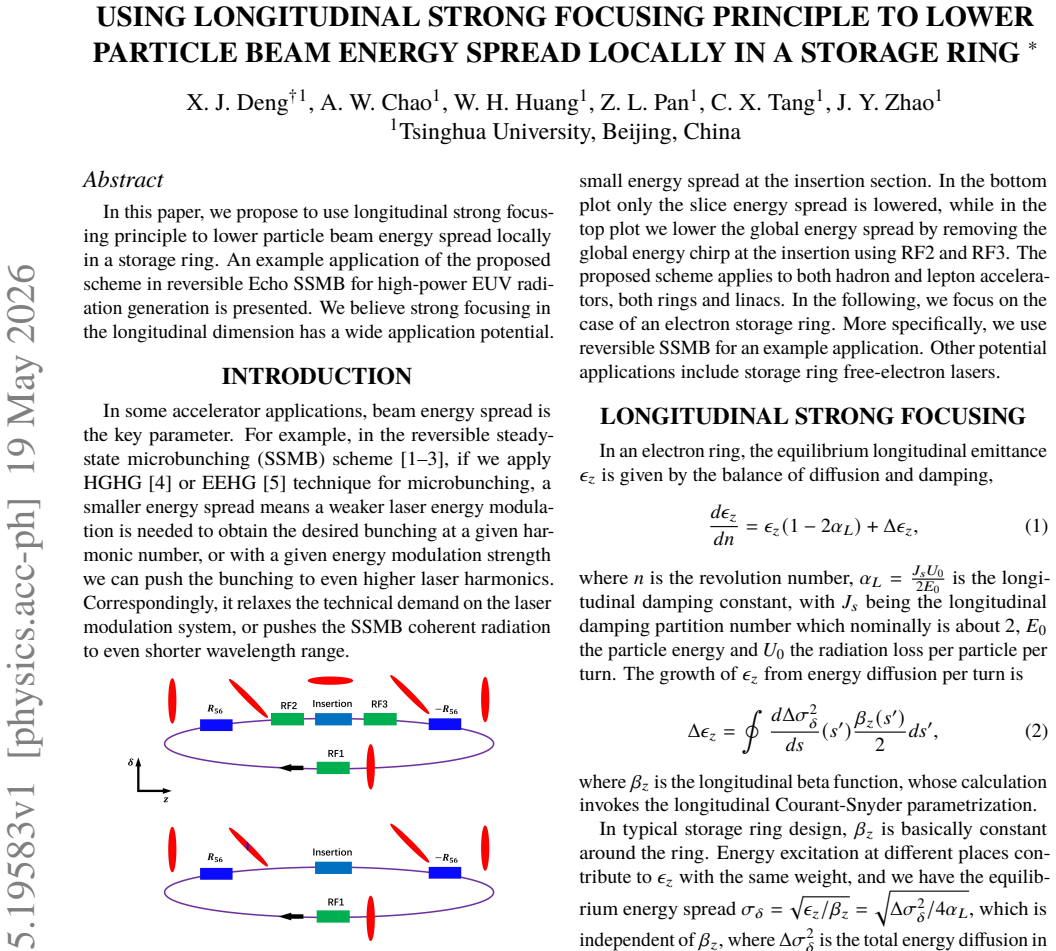
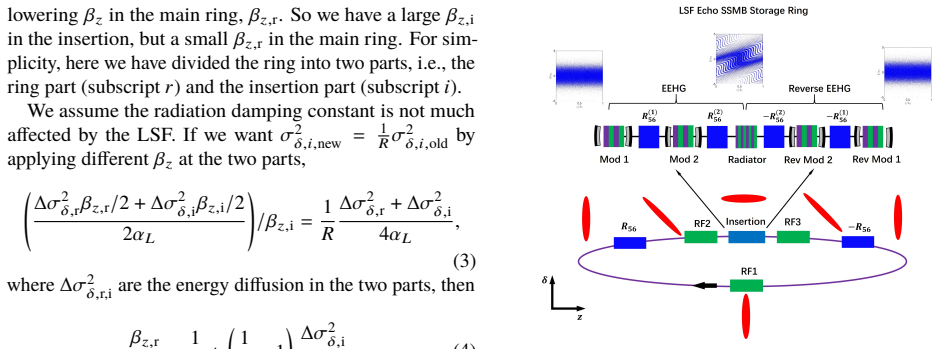

read the original abstract
In this paper, we propose to use longitudinal strong focusing principle to lower particle beam energy spread locally in a storage ring. An example application of the proposed scheme in reversible Echo SSMB for high-power EUV radiation generation is presented. We believe strong focusing in the longitudinal dimension has a wide application potential.
Editorial analysis
A structured set of objections, weighed in public.
Referee Report
Summary. The manuscript proposes applying the longitudinal strong focusing principle to locally reduce particle beam energy spread in a storage ring. It outlines a conceptual scheme and presents an example application to reversible Echo SSMB for high-power EUV radiation generation, concluding that the approach has wide potential in accelerator physics.
Significance. If demonstrated to be feasible, the idea could enable improved local control of energy spread in storage rings without global lattice redesign, which would be valuable for coherent radiation sources such as SSMB. The proposal itself is a novel conceptual contribution, but the manuscript supplies neither an explicit longitudinal transfer-matrix derivation nor any tracking or stability analysis to establish that the claimed local reduction can be achieved while preserving closed orbits and acceptable beam parameters.
major comments (2)
- [Abstract and proposal description] The central claim requires that a longitudinal strong-focusing insertion can be placed in a periodic storage ring while maintaining closed-orbit conditions, transverse stability, and acceptable collective effects. No transfer-matrix analysis or lattice integration study is provided to support this assumption.
- [Echo SSMB example] In the reversible Echo SSMB application, the manuscript asserts that local energy-spread reduction is achievable but supplies no quantitative estimates of emittance growth, tune shifts, or instability thresholds under the required focusing strength.
minor comments (1)
- [Introduction] The term 'longitudinal strong focusing' should be defined more precisely with reference to existing literature on longitudinal focusing techniques in rings.
Simulated Author's Rebuttal
We thank the referee for the careful and constructive review of our manuscript on applying longitudinal strong focusing to locally reduce beam energy spread in storage rings. We address the major comments point by point below, indicating revisions where the manuscript will be updated.
read point-by-point responses
-
Referee: [Abstract and proposal description] The central claim requires that a longitudinal strong-focusing insertion can be placed in a periodic storage ring while maintaining closed-orbit conditions, transverse stability, and acceptable collective effects. No transfer-matrix analysis or lattice integration study is provided to support this assumption.
Authors: We agree that an explicit longitudinal transfer-matrix derivation is needed to support the central claim. In the revised manuscript we add a dedicated section deriving the longitudinal transfer matrix for the proposed insertion and showing the conditions under which closed orbits are preserved. Transverse stability and collective-effect considerations are discussed at a general level; a full lattice-integration study with tracking would require a specific ring design and is beyond the scope of this conceptual proposal. revision: partial
-
Referee: [Echo SSMB example] In the reversible Echo SSMB application, the manuscript asserts that local energy-spread reduction is achievable but supplies no quantitative estimates of emittance growth, tune shifts, or instability thresholds under the required focusing strength.
Authors: The referee is correct that the original manuscript lacks quantitative estimates. We have added order-of-magnitude estimates for emittance growth and tune shifts arising from the required focusing strength in the revised Echo SSMB section. A detailed instability-threshold analysis would need ring-specific simulations and beam parameters not provided here; we note this limitation and indicate it as a direction for future work. revision: partial
Circularity Check
No circularity: conceptual proposal with no self-referential derivations or fitted predictions
full rationale
The paper proposes applying the longitudinal strong focusing principle to locally reduce beam energy spread in a storage ring and illustrates it with a reversible Echo SSMB example. No equations, transfer matrices, or parameter fits appear that would reduce any claimed prediction or result to the input assumptions by construction. The central claim remains a forward-looking application idea rather than a closed mathematical derivation; external lattice integration and stability questions are acknowledged as open but not resolved via self-citation chains or ansatz smuggling. The derivation chain is therefore self-contained as a conceptual suggestion.
Axiom & Free-Parameter Ledger
Reference graph
Works this paper leans on
-
[1]
Steady-state microbunching in a storage ring for generating coherent radiation,
D. F. Ratner and A. W. Chao, “Steady-state microbunching in a storage ring for generating coherent radiation,”Phys. Rev. Lett., vol. 105, no. 15, p. 154801, Oct. 2010. doi:10.1103/PhysRevLett.105.154801
-
[2]
Reversible seeding in storage rings,
D. Ratner and A. Chao, “Reversible seeding in storage rings,” inProc. FEL’11, Shanghai, China, Aug. 2011
work page 2011
-
[3]
Reversible steady-state microbunching in an electron storage ring,
X. J. Deng, Z. L. Pan, J. Y. Zhao, A. W. Chao, and C. X. Tang, “Reversible steady-state microbunching in an electron storage ring,” submitted toPhys. Rev. Accel. Beams, Apr. 2025
work page 2025
-
[4]
Generation of intense uv radiation by subharmon- ically seeded single-pass free-electron lasers,
L. H. Yu, “Generation of intense uv radiation by subharmon- ically seeded single-pass free-electron lasers,”Phys. Rev. A, vol. 44, no. 8, pp. 5178–5193, Oct. 1991. doi:10.1103/PhysRevA.44.5178
-
[5]
Using the beam-echo effect for generation of short-wavelength radiation,
G. Stupakov, “Using the beam-echo effect for generation of short-wavelength radiation,”Phys. Rev. Lett., vol. 102, no. 7, p. 074801, Feb. 2009. doi:10.1103/PhysRevLett.102.074801
-
[6]
Courant-Snyder formalism of longitudinal dynamics,
X. J. Denget al., “Courant-Snyder formalism of longitudinal dynamics,”Phys. Rev. Accel. Beams, vol. 24, no. 9, p. 094001, Sep. 2021. doi:10.1103/PhysRevAccelBeams.24.094001
-
[7]
Ultralowlongitudinalemittancestoragerings,
Y.Zhanget al.,“Ultralowlongitudinalemittancestoragerings,” Phys. Rev. Accel. Beams, vol. 24, no. 9, p. 090701, Sep. 2021. doi:10.1103/PhysRevAccelBeams.24.090701
-
[8]
Steady-state microbunching based on transverse-longitudinal coupling,
X. J. Denget al., “Steady-state microbunching based on transverse-longitudinal coupling,”Nucl. Sci. Tech., vol. 37, no. 2, Dec. 2025.doi:10.1007/s41365-025-01855-5
-
[9]
710 kW stable average power in a 45,000 finesse two-mirror optical cavity,
X. Y. Luet al., “710 kW stable average power in a 45,000 finesse two-mirror optical cavity,”Opt. Lett., vol. 49, no. 23, pp. 6884–6887, Dec. 2024.doi:10.1364/OL.543388
-
[10]
Z. L. Panet al., “Isochronous lattice design with time-of- flight fluctuation reaching subattoseconds based on high-order achromat,”Phys. Rev. Accel. Beams,vol.28,no.12,p.124001, Dec. 2025.doi:10.1103/3v8n-84fr
-
[11]
J. Y. Zhaoet al., “Lattice design to achieve reversible mi- crobunching in a steady-state microbunching (SSMB) storage ring,” inProc. IPAC’26, Geneva, Switzerland, THP5611, this conference
-
[12]
C. Tang, Z. Pan, X. Deng, J. Zhao, and A. Chao, Physics of Steady-State Microbunching, Springer, 2026
work page 2026
-
[13]
Deng, Theoretical and Experimental Studies on Steady- State Microbunching, Springer Nature, 2024
X. Deng, Theoretical and Experimental Studies on Steady- State Microbunching, Springer Nature, 2024
work page 2024
-
[14]
J. H. Bianet al., “Threshold studies of coherent synchrotron radiation induced microwave instability beyond adiabatic ap- proximation,”Phys. Rev. Accel. Beams, vol. 28, no. 7, p. 074401, Jul. 2025.doi:10.1103/jp4b-1mhy
-
[15]
The effect of transverse-longitudinal cou- plingonlongitudinalmicrowaveinstability,
J. H. Bianet al., “The effect of transverse-longitudinal cou- plingonlongitudinalmicrowaveinstability,”inProc. IPAC’26, Geneva, Switzerland, THP5653, this conference
-
[16]
Intrabeam scattering study for longitudinal strong focusing storage rings and lattice optimization,
Z. L. Panet al., “Intrabeam scattering study for longitudinal strong focusing storage rings and lattice optimization,”Phys. Rev. Accel. Beams, vol. 28, no. 11, p. 114201, Nov. 2025. doi:10.1103/ysdm-mzv3
-
[17]
Z. H. Zhaoet al., “Method for calculating the longitudinal space-charge tune shift suitable for arbitrary bunch lengths,” Phys. Rev. Accel. Beams, vol. 28, no. 10, p. 104201, Oct. 2025. doi:10.1103/kxbb-n27x
-
[19]
C. Y. Tsai, “Theoretical formulation of multiturn collective dynamicsinalasercavitymodulatorwithcomparisontoRobin- son and high-gain free-electron laser instability,”Phys. Rev. Accel. Beams, vol. 25, no. 6, p. 064401, Jun. 2022. doi:10.1103/kwxj-4bff
-
[20]
Longitudinal beam instability driven by coherent radiation in an SSMB laser modulator
Y. J. Daiet al., “Longitudinal beam instability driven by co- herent radiation in an SSMB laser modulator,”arXiv preprint arXiv:2604.27036, 2026. doi:10.48550/arXiv.2604.27036
work page internal anchor Pith review Pith/arXiv arXiv doi:10.48550/arxiv.2604.27036 2026
-
[21]
V.A.Shkarubaet al.,“Statusofdevelopmentofsuperconduct- inginsertiondevicesforgenerationofsynchrotronradiationat Budker INP,” inProc. RuPAC’18, Protvino, Russia, Oct. 2018, JACoW Publishing, Geneva, Switzerland. doi:10.5072/JACoW-RuPAC2018-THPSC04
discussion (0)
Sign in with ORCID, Apple, or X to comment. Anyone can read and Pith papers without signing in.