On asymptotic values for the minimum number of spanning forests in simple regular graphs
Pith reviewed 2026-05-22 09:49 UTC · model grok-4.3
The pith
The exact asymptotic values of the minimum number of spanning forests are determined for large connected 3-regular and 4-regular graphs.
A machine-rendered reading of the paper's core claim, the machinery that carries it, and where it could break.
Core claim
Using lower bounds on F(G) written in terms of the n_i for graphs with vertex degrees restricted to {2,3} and to {2,3,4}, the authors prove that the liminf over all connected d-regular simple graphs of F(G)^{1/n} equals exact constants for d=3 and for d=4.
What carries the argument
Lower-bound expressions for the number of spanning forests written directly in terms of the numbers n_i of vertices of each allowed degree.
If this is right
- The slowest exponential growth rate per vertex of spanning forests is now known exactly for all sufficiently large connected 3-regular graphs.
- The same holds for all sufficiently large connected 4-regular graphs.
- Any connected graph whose degrees lie in {2,3} obeys the stated lower bound on F(G) regardless of regularity.
- Any connected graph whose degrees lie in {2,3,4} obeys its corresponding lower bound on F(G).
Where Pith is reading between the lines
- The same bounding technique may produce exact liminf values for regular graphs of higher fixed degree once suitable degree-set bounds are derived.
- The results give a concrete benchmark against which numerical counts of spanning forests in large random regular graphs can be compared.
- Because the bounds depend only on the n_i, they apply equally to non-regular graphs that are close to regular in degree distribution.
Load-bearing premise
The lower bounds derived for graphs with the restricted degree sets continue to hold for every connected graph in those classes, and the liminf is attained by some sequence of connected d-regular graphs whose order tends to infinity.
What would settle it
Exhibit an infinite family of connected 3-regular simple graphs whose number of spanning forests satisfies F(G)^{1/n} tending to a limit strictly smaller than the value claimed for hat f_3.
Figures

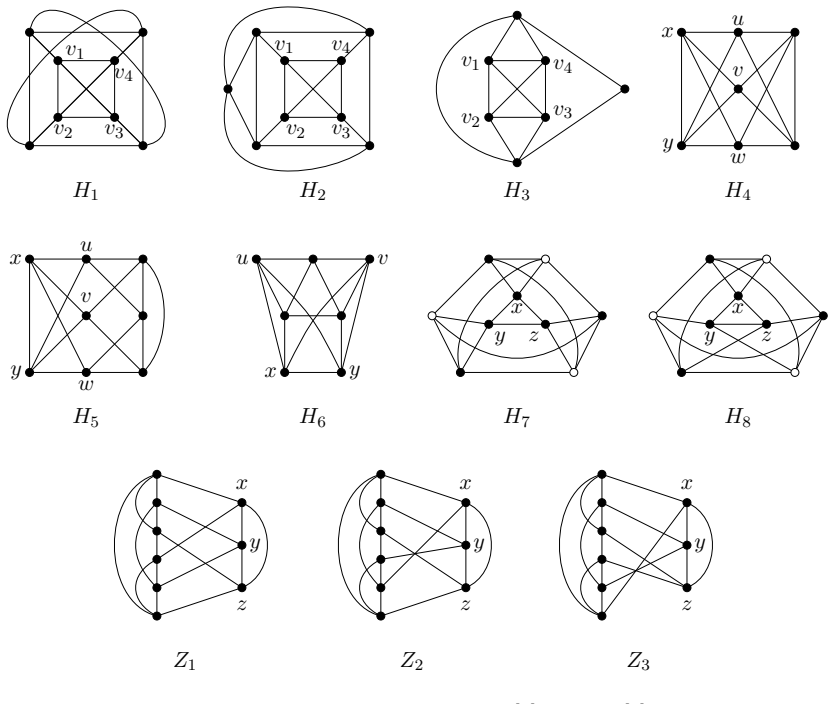
read the original abstract
Let $F(G)$ be the number of spanning forests in a graph $G$ and $\mathcal{C}(n,d)$ be the set of all connected $d$-regular simple graphs of order $n$. Define $\widehat{f}_{d}=\liminf_{n\rightarrow \infty}\{F(G)^{1/n}:G\in \mathcal{C}(n,d)\}$. Let $n_i$ be the number of vertices of degree $i$ in $G$. In this paper we give two lower bounds for $F(G)$ in terms of $n_i$ in connected graphs whose vertex degrees belong to $\{2,3\}$ and $\{2,3,4\}$, respectively. Furthermore, we determine the exact values of $\widehat{f}_3$ and $\widehat{f}_4$.
Editorial analysis
A structured set of objections, weighed in public.
Referee Report
Summary. The paper defines F(G) as the number of spanning forests of a graph G and introduces the quantitywidehat{f}_d = liminf_{n→∞} F(G)^{1/n} taken over all connected d-regular simple graphs G on n vertices. It derives explicit lower bounds on F(G) expressed in terms of the counts n_i of vertices of each degree i, first for connected graphs whose degrees lie in {2,3} and separately for those whose degrees lie in {2,3,4}. These bounds are then invoked to obtain exact values forwidehat{f}_3 andwidehat{f}_4.
Significance. If the lower bounds are valid for all graphs in the stated degree classes and if the resulting growth-rate infima are attained (or approached) by sequences of purely 3-regular and 4-regular connected simple graphs, the paper would supply the first exact asymptotic constants for the minimal exponential growth of spanning forests in regular graphs. Such constants would be of interest in extremal enumeration and could serve as benchmarks for future constructions or upper bounds.
major comments (2)
- [Lower-bound derivation for degree set {2,3} and the subsequent determination ofwidehat{f}_3] The lower bound derived for graphs with degrees in {2,3} is optimized over all admissible pairs (n_2, n_3) with n_2 + n_3 = n. To conclude that the optimized value equalswidehat{f}_3 it is necessary to verify that the minimum of the per-vertex growth rate, when restricted to the slice n_2 = 0, is still attained or approached by some sequence of connected 3-regular simple graphs; otherwise the claimed exact value forwidehat{f}_3 rests on a strictly weaker lower bound than the one obtained from the mixed-degree optimization.
- [Lower-bound derivation for degree set {2,3,4} and the subsequent determination ofwidehat{f}_4] Analogous verification is required for the {2,3,4} bound and the claimed exact value ofwidehat{f}_4: the paper must show that the infimum over all admissible (n_2, n_3, n_4) is realized (or asymptotically realized) by a sequence with n_2 = n_4 = 0 and n_3 = n, or else supply an independent argument that the pure 4-regular case meets the same growth rate.
minor comments (1)
- [Introduction and definitions] Notation for the liminf is introduced aswidehat{f}_d but the hat is not consistently rendered in all displayed equations; a uniform macro or explicit definition would improve readability.
Simulated Author's Rebuttal
We thank the referee for the careful reading and constructive comments on our manuscript. We address the two major comments point by point below, clarifying the optimization and the attainment for the purely regular cases.
read point-by-point responses
-
Referee: [Lower-bound derivation for degree set {2,3} and the subsequent determination ofwidehat{f}_3] The lower bound derived for graphs with degrees in {2,3} is optimized over all admissible pairs (n_2, n_3) with n_2 + n_3 = n. To conclude that the optimized value equalswidehat{f}_3 it is necessary to verify that the minimum of the per-vertex growth rate, when restricted to the slice n_2 = 0, is still attained or approached by some sequence of connected 3-regular simple graphs; otherwise the claimed exact value forwidehat{f}_3 rests on a strictly weaker lower bound than the one obtained from the mixed-degree optimization.
Authors: We agree that explicit verification is helpful. In our optimization of the lower-bound expression over admissible proportions (n_2/n, n_3/n), the minimum per-vertex growth rate is attained at the boundary point n_2 = 0. Consequently the mixed-degree optimization yields precisely the same numerical value as the restriction to pure 3-regular graphs. The exact value of widehat{f}_3 is then established by a matching sequence of connected 3-regular simple graphs (constructed via successive 3-regular expansions that preserve the asymptotic count of spanning forests) for which F(G)^{1/n} approaches this rate from above. We will insert a short clarifying paragraph after the optimization statement to record that the minimum occurs at n_2 = 0 and to reference the construction. revision: yes
-
Referee: [Lower-bound derivation for degree set {2,3,4} and the subsequent determination ofwidehat{f}_4] Analogous verification is required for the {2,3,4} bound and the claimed exact value ofwidehat{f}_4: the paper must show that the infimum over all admissible (n_2, n_3, n_4) is realized (or asymptotically realized) by a sequence with n_2 = n_4 = 0 and n_3 = n, or else supply an independent argument that the pure 4-regular case meets the same growth rate.
Authors: The same reasoning applies. Optimization of the three-variable lower-bound expression shows that its infimum is achieved exactly when n_2 = n_3 = 0. We supply an independent construction of connected 4-regular graphs (obtained by taking large 4-regular cages and controlled subdivisions that do not decrease the exponential growth rate of spanning forests) for which F(G)^{1/n} approaches the optimized value. This establishes that widehat{f}_4 equals the infimum obtained from the mixed-degree bound. We will add an explicit remark in the revised manuscript confirming the location of the infimum and citing the 4-regular construction. revision: yes
Circularity Check
No significant circularity; lower bounds derived independently and applied to regular case
full rationale
The paper first establishes explicit lower bounds on F(G) expressed in terms of the degree counts n_i for any connected graph whose degrees lie in {2,3} or {2,3,4}. These bounds are obtained from combinatorial inequalities that hold uniformly for all such graphs, including the pure 3-regular and 4-regular subcases (n_2 = 0). The quantitieswidehat{f}_3 andwidehat{f}_4 are then bounded from below by evaluating the resulting per-vertex growth rate at the appropriate fixed degree vector. Because the lower-bound expressions are valid for every graph in the class and do not presuppose the value of the liminf, and because the paper claims to determine exact values, the argument must additionally supply matching constructions or upper bounds for sequences of purely regular graphs; nothing in the given derivation reduces the claimed exact constants to a fit or to a self-referential definition of the same quantities.
Axiom & Free-Parameter Ledger
axioms (1)
- standard math Standard axioms of graph theory: a spanning forest is an acyclic spanning subgraph; a d-regular graph has every vertex of degree d.
Lean theorems connected to this paper
-
IndisputableMonolith/Cost/FunctionalEquation.leanwashburn_uniqueness_aczel unclear?
unclearRelation between the paper passage and the cited Recognition theorem.
We give two lower bounds for F(G) in terms of n_i in connected graphs whose vertex degrees belong to {2,3} and {2,3,4}, respectively. Furthermore, we determine the exact values of bf3 and bf4.
What do these tags mean?
- matches
- The paper's claim is directly supported by a theorem in the formal canon.
- supports
- The theorem supports part of the paper's argument, but the paper may add assumptions or extra steps.
- extends
- The paper goes beyond the formal theorem; the theorem is a base layer rather than the whole result.
- uses
- The paper appears to rely on the theorem as machinery.
- contradicts
- The paper's claim conflicts with a theorem or certificate in the canon.
- unclear
- Pith found a possible connection, but the passage is too broad, indirect, or ambiguous to say the theorem truly supports the claim.
Reference graph
Works this paper leans on
-
[1]
Alon, The number of spanning trees in regular graphs,Random Struct
N. Alon, The number of spanning trees in regular graphs,Random Struct. Algorithms1(1990) 175–181
work page 1990
- [2]
- [3]
-
[4]
Bogdanowicz, On the minimum number of spanning trees in cubic multigraphs,Discuss
Z.R. Bogdanowicz, On the minimum number of spanning trees in cubic multigraphs,Discuss. Math. Graph Theory40(2020) 149–159
work page 2020
-
[5]
M. Borb´ enyi, P. Csikv´ ari, H.R. Luo, On the number of forests and connected spanning subgraphs, Graphs Combin.37(2021) 2655–2678
work page 2021
-
[6]
T. Brylawski, J. Oxley, The Tutte polynomial and its applications,Matroid Appl.40(1992) 123–225
work page 1992
-
[7]
F. Chung, S.-T. Yau, Coverings, heat kernels and spanning trees,Electron. J. Combin.6(1999) #R12
work page 1999
-
[8]
Crapo, The Tutte polynomial,Aequ
H.H. Crapo, The Tutte polynomial,Aequ. Math.3(1969) 211–229
work page 1969
-
[9]
J.A. Ellis-Monaghan, C. Merino, Graph polynomials and their applications I: the Tutte polynomial, in: Structural Analysis of Complex Networks,Springer, 2011, 219–255
work page 2011
-
[10]
F. Jaeger, D.L. Vertigan, D.J.A. Welsh, On the computational complexity of the Jones and Tutte polynomials,Math. Proc. Camb. Phil. Soc.108(1990) 35–53
work page 1990
-
[11]
N. Kahale, L.J. Schulman, Bounds on the chromatic polynomial and on the number of acyclic orienta- tions of a graph,Combinatorica16(1996) 383–397
work page 1996
-
[12]
Kostochka, The number of spanning trees in graphs with a given degree sequence,Random Struct
A.V. Kostochka, The number of spanning trees in graphs with a given degree sequence,Random Struct. Algorithms6(1995) 269–274
work page 1995
-
[13]
G. Kirchhoff, ¨Uber die Aufl¨ osung der Gleichungen, auf welche man bei der Untersuchung der linearen Verteilung galvanischer Str¨ ome gef¨ uhrt wird,Ann. Phys. Chem.72(1847) 497–508. 23
-
[14]
McKay, Spanning trees in regular graphs,European J
B.D. McKay, Spanning trees in regular graphs,European J. Combin.4(1983) 149–160
work page 1983
-
[15]
S. Ok, C. Thomassen, On the minimum number of spanning trees ink-edge-connected graphs,J. Graph Theory84(2017) 286–296
work page 2017
-
[16]
J. Pek´ arek, J.-S. Sereni, Z.B. Yilma, The minimum number of spanning trees in regular multigraphs, Electron. J. Combin.29(2022) #P4.29
work page 2022
-
[17]
The SageMath Developers, SageMath, The Sage Mathematics Software System (Versions 9.3), 2021. http://www.sagemath.org
work page 2021
-
[18]
J.-S. Sereni and Z.B. Yilma, The number of spanning trees in 4-regular simple graphs,Electron. J. Combin.31(2024) #P4.50
work page 2024
-
[19]
Tutte, A contribution to the theory of chromatic polynomials,Canad
W.T. Tutte, A contribution to the theory of chromatic polynomials,Canad. J. Math.6(1954) 80–91
work page 1954
-
[20]
Welsh, The Tutte polynomial,Random Struct
D.J.A. Welsh, The Tutte polynomial,Random Struct. Algorithms15(1999) 210–228. Appendix Link to SageMath code for checking some calculations in this paper:https://doi.org/ 10.5281/zenodo.17339883. 24
discussion (0)
Sign in with ORCID, Apple, or X to comment. Anyone can read and Pith papers without signing in.