Component over Composite: Mitigating Type I Error Inflation when Imputing "Days Alive and at Home"
Pith reviewed 2026-05-21 07:18 UTC · model grok-4.3
The pith
Imputing the separate components of Days Alive and at Home controls type I error better than imputing the composite directly.
A machine-rendered reading of the paper's core claim, the machinery that carries it, and where it could break.
Core claim
Through a simulation study motivated by the NOTACS trial, we compare several methods of handling missing data, including complete case analysis, MI of the composite, and MI of the components when the primary analysis is a Mann-Whitney-Wilcoxon test. MI on the component level has good properties in terms of type I error control and power. We caution against the use of MI on the composite level with Predictive Mean Matching, which can lead to type I error inflation.
What carries the argument
Multiple imputation applied to the individual components of the DAH outcome before they are combined, which respects each component's distinct distribution and missing-data mechanism.
If this is right
- Component-level multiple imputation keeps type I error rates at the nominal level for the Mann-Whitney-Wilcoxon test on DAH.
- Direct imputation of the composite DAH value with predictive mean matching risks inflating type I error.
- Complete-case analysis discards incomplete records and can reduce power compared with component imputation.
- Future imputation methods should be developed to match more complex definitions of the DAH outcome.
Where Pith is reading between the lines
- The component-imputation approach may extend usefully to other composite endpoints that combine continuous lengths of stay with binary mortality indicators.
- Trial protocols that adopt DAH should pre-specify component-level imputation and include sensitivity analyses for the missing-at-random assumption.
- Repeating the simulation across additional trial datasets would clarify how sensitive the recommendation is to the specific missingness structure.
Load-bearing premise
The missing-data patterns and correlations among components observed in the NOTACS trial are representative of those in other trials that will use the DAH outcome.
What would settle it
A new simulation that draws missingness rates, mechanisms, and component correlations from a different real trial dataset using DAH, then checks whether component-level imputation still controls type I error while composite-level imputation with predictive mean matching inflates it.
Figures


read the original abstract
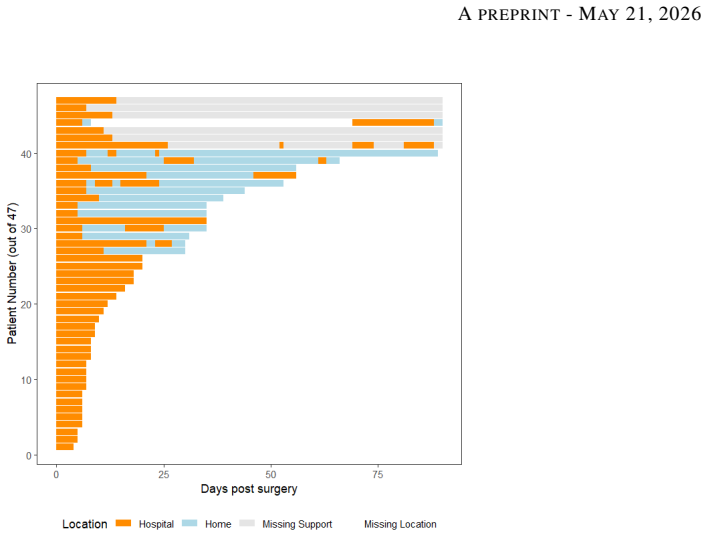
Background: Days Alive and at Home (DAH) over a pre-defined follow-up period is a novel post-intervention composite outcome that combines data from at least three components: (i) initial length of hospital stay, (ii) length of total readmissions or other post-discharge care and (iii) mortality. Missing values bring unique challenges to the analysis of trials with the DAH outcome as the three components may have different rates of missingness caused by distinct missing data mechanisms. Current approaches define DAH as missing if any of the components are missing, and proceed with complete cases or Multiple Imputation (MI) of the composite. Methods: Through a simulation study motivated by the NOTACS trial, we compare several methods of handling missing data, including complete case analysis, MI of the composite, and MI of the components when the primary analysis is a Mann-Whitney-Wilcoxon test. Results: MI on the component level has good properties in terms of type I error control and power. We caution against the use of MI on the composite level with Predictive Mean Matching, which can lead to type I error inflation. Conclusions: Given the complex distributional characteristics of DAH, naive approaches such as defining missingness on the composite level and directly imputing the composite with Predictive Mean Matching, can lead to type I error inflation. Imputing on the component level is recommended, suggested future work included imputation approaches that are compatible with more complex definitions of DAH, as well as recommendations for sensitivity analyses to the Missing at Random assumption.
Editorial analysis
A structured set of objections, weighed in public.
Referee Report
Summary. The manuscript reports a simulation study motivated by the NOTACS trial comparing methods for handling missing data when analyzing the Days Alive and at Home (DAH) composite outcome. The authors evaluate complete-case analysis, multiple imputation applied directly to the composite DAH, and multiple imputation applied separately to the three components (initial length of stay, readmission/post-discharge days, and mortality) before constructing DAH, with the primary analysis being a Mann-Whitney-Wilcoxon test. The central finding is that component-level imputation maintains nominal type I error control and reasonable power, whereas composite-level imputation using predictive mean matching produces type I error inflation under the simulated conditions.
Significance. If the operating characteristics hold, this work supplies practical, actionable guidance for trialists using DAH endpoints, which are increasingly adopted in perioperative and critical-care studies. The simulation design is a clear strength: it is explicitly motivated by an existing trial, compares relevant methods, reports both type I error and power, and avoids post-hoc data exclusions. The explicit caution against composite-level PMM is a concrete contribution that can directly inform analysis plans. The authors also flag the need for future work on more complex DAH definitions and sensitivity analyses to the MAR assumption, which appropriately tempers the scope of the recommendations.
minor comments (2)
- [Results] Results section (tables reporting type I error): Monte Carlo standard errors should be reported alongside the empirical type I error rates so readers can judge the simulation precision directly.
- [Discussion] Discussion: The interaction between imputation method and the observed correlation structure among DAH components could be discussed in greater detail to help readers anticipate performance in trials with different dependence patterns.
Simulated Author's Rebuttal
We thank the referee for their positive review and recommendation to accept the manuscript. We appreciate the recognition of the simulation study's motivation from the NOTACS trial, its clear design, and the practical implications for handling missing data in DAH endpoints.
Circularity Check
No circularity: empirical simulation study with independent Monte Carlo results
full rationale
This is an empirical simulation study whose type I error and power conclusions are generated directly from Monte Carlo replications under missingness mechanisms and correlations calibrated to the NOTACS trial. No algebraic identity, fitted parameter, or self-citation is reused as a prediction; the central comparison (component-level MI versus composite-level PMM) is evaluated by direct simulation output rather than by construction or by a load-bearing self-reference. The work is therefore self-contained against external benchmarks and receives the default non-circularity finding.
Axiom & Free-Parameter Ledger
axioms (1)
- domain assumption Missing at random (MAR) mechanism governs the missingness in the three DAH components
Reference graph
Works this paper leans on
-
[1]
URLhttps://doi.org/10.1080/02664763.2024.2418473
doi: 10.1080/02664763.2024.2418473. URLhttps://doi.org/10.1080/02664763.2024.2418473. Max Bell, Lars I. Eriksson, Tobias Svensson, Linn Hallqvist, Fredrik Granath, Jennifer Reilly, and Paul S. Myles. Days at home after surgery: An integrated and efficient outcome measure for clinical trials and quality assurance. EClinicalMedicine, 11:18–26,
-
[2]
doi: 10.1016/j.eclinm.2019.04.011. Mabel Chung, Zaid I. Almarzooq, Archana Tale, Yang Song, Issa J. Dahabreh, Dhruv S. Kazi, Suzanne J. Baron, and Robert W. Yeh. Days at home after transcatheter mitral valve repair versus medical therapy alone in heart failure. Journal of the American Heart Association, 14, 1
-
[3]
ISSN 20479980. doi: 10.1161/JAHA.124.038401. S. N. Dawson, Y . D. Chiu, A. A. Klein, et al. Effect of high-flow nasal therapy on patient-centred outcomes in patients at high risk of postoperative pulmonary complications after cardiac surgery: a statistical analysis plan for notacs, a multicentre adaptive randomised controlled trial.Trials, 23(1):699,
-
[4]
URL https://doi.org/10.1186/s13063-022-06607-z
doi: 10.1186/s13063-022-06607-z. URL https://doi.org/10.1186/s13063-022-06607-z. Sarah N Dawson, Yi-Da Chiu, Andrew A Klein, Melissa Earwaker, Sofia S Villar, and NOTACS study team. Effect of high-flow nasal therapy on patient-centred outcomes in patients at high risk of postoperative pulmonary complications after cardiac surgery: update to the statistica...
-
[5]
doi: 10.1080/02664763.2021.1895087. e-Collection
-
[6]
URL https: //bmjopen.bmj.com/content/7/8/e015828
doi: 10.1136/bmjopen-2017-015828. URL https: //bmjopen.bmj.com/content/7/8/e015828. Paul S. Myles, Jan M. Dieleman, Andrew Forbes, Stephane Heritier, and Julian A. Smith. Dexamethasone for cardiac surgery trial (decs-ii): Rationale and a novel, practice preference-randomized consent design.American Heart Journal, 204:52–57,
-
[7]
doi: https://doi.org/10.1016/j.ahj.2018.06.008
ISSN 0002-8703. doi: https://doi.org/10.1016/j.ahj.2018.06.008. URL https: //www.sciencedirect.com/science/article/pii/S000287031830190X. Aidan G. O’Keeffe, Daniel M. Farewell, Brian D. M. Tom, and Vernon T. Farewell. Multiple imputation of missing com- posite outcomes in longitudinal data.Statistical Biosciences, 8(2):310–332,
-
[8]
URLhttps://doi.org/10.1007/s12561-016-9146-z
doi: 10.1007/s12561-016-9146-z. URLhttps://doi.org/10.1007/s12561-016-9146-z. Tra My Pham, Ian R. White, Brennan C. Kahan, Tim P. Morris, Simon J. Stanworth, and Gordon Forbes. A comparison of methods for analyzing a binary composite endpoint with partially observed components in randomized controlled trials.Statistics in Medicine, 40:6634–6650, 12
-
[9]
ISSN 10970258. doi: 10.1002/sim.9203. Donald B. Rubin.Multiple Imputation for Nonresponse in Surveys. John Wiley & Sons, New York,
-
[10]
ISSN 1471-2288. doi: 10.1186/1471-2288-12-46. URL https://doi.org/10.1186/1471-2288-12-46 . Ralph Shackleton, Sarah V ollam, Stephen Gerry, Akshay Shah, and David M. Griffith. Reporting of hospital-free days as an outcome measure in critical care trials: A systematic review.Critical Care Medicine, 53(12):e2686–e2697, December
-
[11]
doi: 10.1097/CCM.0000000000006858. S. Shetty, M. Duckworth, R. Norman, J. Affandi, S. Dawson, J. Fox-Rushby, NOTACS investigators, NOTACS Trial Steering Committee, and NOTACS DMEC Committee. The international trial of nasal oxygen therapy after cardiac surgery (notacs) in patients at high risk of postoperative pulmonary complications: Economic evaluation ...
-
[12]
URL https://doi.org/10.1371/journal.pone.0311861
doi: 10.1371/journal.pone.0311861. URL https://doi.org/10.1371/journal.pone.0311861. Thomas R Sullivan, Ian R White, Amy B Salter, Philip Ryan, and Katherine J Lee. Should multiple imputation be the method of choice for handling missing data in randomized trials?Statistical Methods in Medical Research, 27: 2610–2626, 9
-
[13]
ISSN 0962-2802. doi: 10.1177/0962280216683570. Paul T. von Hippel. How to impute interactions, squares, and other transformed variables.Sociological Methodology, 39:265–291,
-
[14]
doi: 10.1111/j.1467-9531.2009.01245.x. Ian R. White, Patrick Royston, and Angela M. Wood. Multiple imputation using chained equations: Issues and guidance for practice.Statistics in Medicine, 30:377–399, 2
-
[15]
ISSN 0277-6715. doi: 10.1002/sim.4067. Letao Yuan, Sofía S. Villar, and Dominique-Laurent Couturier. Beyond the composite: Enhancing trial analysis through a divide & conquer approach to “Days Alive and at Home": Insights from the NOTACS trial,
-
[16]
URL https://arxiv.org/abs/2605.16606. 12
work page internal anchor Pith review Pith/arXiv arXiv
discussion (0)
Sign in with ORCID, Apple, or X to comment. Anyone can read and Pith papers without signing in.