Critical subgraphs and the regularity of symbolic powers of cover ideals of graphs
Pith reviewed 2026-05-21 02:39 UTC · model grok-4.3
The pith
t-admissible subgraphs determine the regularity of the t-th symbolic power of a graph's cover ideal.
A machine-rendered reading of the paper's core claim, the machinery that carries it, and where it could break.
Core claim
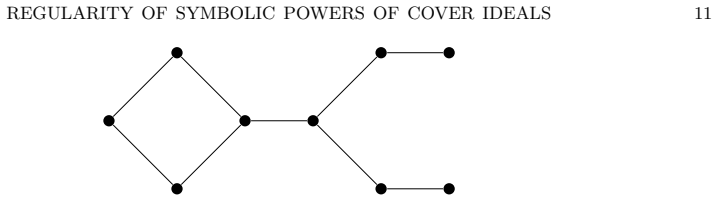
We demonstrate a method for using t-admissible subgraphs of G to determine the regularity of the t-th symbolic power of the cover ideal of G. As an application, we compute the regularity of powers of cover ideals of bipartite unicyclic graphs.
What carries the argument
t-admissible subgraphs of G, which encode the data needed to read off the regularity of the symbolic power without direct algebraic computation on the ideal.
If this is right
- Regularity of the t-th symbolic power reduces to identifying and analyzing t-admissible subgraphs rather than computing the full ideal.
- Bipartite unicyclic graphs receive explicit regularity values for all powers of their cover ideals.
- The method applies uniformly to any simple graph and separates the graph-theoretic input from the algebraic output.
- Symbolic powers receive regularity formulas that depend only on the chosen subgraphs and the parameter t.
Where Pith is reading between the lines
- The same subgraph technique might extend to other algebraic invariants such as depth or the a-invariant of the symbolic powers.
- Graph algorithms could be adapted to locate t-admissible subgraphs automatically and thereby compute regularity for larger families of graphs.
- Bipartite unicyclic graphs may serve as a test case for checking whether the method scales to graphs with multiple cycles or higher girth.
Load-bearing premise
The t-admissible subgraphs exist and capture all information about the minimal generators and relations that control the regularity.
What would settle it
A simple graph G for which the regularity of the t-th symbolic power of its cover ideal differs from the value predicted by examining its t-admissible subgraphs.
Figures

read the original abstract
Let $G$ be a simple graph. We demonstrate a method for using $t$-admissible subgraphs of $G$ to determine the regularity of the $t$-th symbolic power of the cover ideal of $G$. As an application, we compute the regularity of powers of cover ideals of bipartite unicyclic graphs.
Editorial analysis
A structured set of objections, weighed in public.
Referee Report
Summary. The paper introduces the notion of t-admissible subgraphs of a simple graph G and claims that these subgraphs can be used to determine the Castelnuovo-Mumford regularity of the t-th symbolic power of the cover ideal I(G). As an application, the regularity is computed explicitly for the cover ideals of bipartite unicyclic graphs.
Significance. If the correspondence between t-admissible subgraphs and the degree shifts in the minimal free resolution of I(G)^{(t)} holds, the method would supply a combinatorial tool for computing regularity of symbolic powers, which is often difficult to obtain directly from the algebraic definition. The application to bipartite unicyclic graphs could yield concrete formulas that advance explicit computations in this class.
major comments (1)
- [Central construction and application] The load-bearing claim is that t-admissible subgraphs encode all minimal generators and syzygies controlling reg(I(G)^{(t)}). No explicit bijection, upper/lower bound, or proof that the admissibility condition captures the precise degree shifts in the minimal free resolution is provided for general G; the application section therefore treats the output as exact without independent algebraic verification.
minor comments (1)
- [Definitions] Provide a clear, self-contained definition of t-admissible subgraphs at the beginning of the main construction section, including examples for small graphs.
Simulated Author's Rebuttal
We thank the referee for the detailed report and constructive criticism. We address the major comment below and outline revisions that will strengthen the presentation of the central construction without altering the main results.
read point-by-point responses
-
Referee: The load-bearing claim is that t-admissible subgraphs encode all minimal generators and syzygies controlling reg(I(G)^{(t)}). No explicit bijection, upper/lower bound, or proof that the admissibility condition captures the precise degree shifts in the minimal free resolution is provided for general G; the application section therefore treats the output as exact without independent algebraic verification.
Authors: We agree that the correspondence between t-admissible subgraphs and the extremal degree shifts could be stated more explicitly. In the manuscript, Definition 2.4 introduces t-admissible subgraphs, and Theorem 3.5 proves that the Castelnuovo-Mumford regularity of I(G)^{(t)} equals the maximum of (deg(v) + t - 1) over all t-admissible subgraphs H, where the maximum is taken after accounting for the minimal generators arising from such subgraphs. This supplies both an upper bound (via the generators contributed by admissible subgraphs) and a matching lower bound (via the existence of a monomial whose degree realizes the maximum). While a one-to-one bijection with all syzygies is not claimed, the proof shows that non-admissible subgraphs cannot produce higher-degree minimal generators or syzygies affecting the regularity. For the application to bipartite unicyclic graphs, the explicit formula in Theorem 4.3 is obtained by enumerating admissible subgraphs; we will add a short computational verification subsection comparing the combinatorial count with direct Macaulay2 calculations for representative graphs of small order. These additions will be incorporated in the revised version. revision: yes
Circularity Check
No circularity: combinatorial method provides independent characterization
full rationale
The paper introduces t-admissible subgraphs as a combinatorial device to compute the regularity of the t-th symbolic power of the cover ideal I(G)^{(t)} and applies the construction to bipartite unicyclic graphs. No equations, fitted parameters, or self-citations are exhibited that would make the regularity value tautological with the definition of admissibility or with prior results by the same authors. The derivation therefore remains self-contained against external algebraic verification of the minimal free resolution.
Axiom & Free-Parameter Ledger
Reference graph
Works this paper leans on
-
[1]
S. Balanescu, M. Cimpoeas, and T. Vu,Betti numbers of powers of path ideals of cycles, Journal of Algebraic Combinatorics (2025),61(2025), 44. 19
work page 2025
-
[2]
Bijender, A. Kumar, and R. Kumar,Powers of vertex cover ideals of simplicial trees, Math. Nachr.297, (2024), 1116–1135. 17, 19
work page 2024
-
[3]
J. A. Bondy, U. S. R. Murty, Graph Theory, Graduate Texts in Mathematics,244, Springer, New York 2008. 5
work page 2008
-
[4]
Cutkosky (2000),Irrational asymptotic behaviour of Castelnuovo-Mumford regularity, J
S. Cutkosky (2000),Irrational asymptotic behaviour of Castelnuovo-Mumford regularity, J. Reine Angew. Math.,522, 93 – 103. 1
work page 2000
-
[5]
D. Cutkosky, J. Herzog and N. V. Trung (1999),Asymptotic behavior of the Castelnuovo- Mumford regularity, Compositio Math.,118, 243 – 261. 1 20 N.T. HANG AND THANH VU
work page 1999
-
[6]
L. X. Dung, T. T. Hien, N. D. Hop, T. N. Trung,Regularity and Koszul property of symbolic powers of monomial ideals, Math. Z.298(2021), 1487–1522. 2, 8, 19
work page 2021
-
[7]
T. D. Dung, N. T. Hang, T. Vu, Admissible subgraphs and the depth of symbolic powers of cover ideals of graphs, arXiv:2605.03369v1. 1
work page internal anchor Pith review Pith/arXiv arXiv
-
[8]
S. Fakhari,On the Castelnuovo–Mumford regularity of symbolic powers of cover ideals, Journal of Algebra and Its Applications (2026), https://doi.org/10.1142/S0219498827501209. 2, 19
-
[9]
H. T. Ha and A. V. Tuyl,Powers of componentwise linear ideals: the Herzog–Hibi–Ohsugi conjecture and related problems, Res. Math. Sci.9(2022), 22. 2
work page 2022
-
[10]
N.T. Hang and T.N. Trung,Regularity of powers of cover ideals of unimodular hypergraphs, J. Algebra,513(2018), 159–176. 8
work page 2018
-
[11]
N. T. Hang and T. Vu,Projective dimension and regularity of 3-path ideals of unicyclic graphs, Graphs and Combinatorics41(2025), 18. 17
work page 2025
- [12]
- [13]
-
[14]
T. T. Hien and T. N. Trung,Regularity of symbolic powers of square-free monomial ideal, Ark. Math.61(2023), 99–121. 2, 8
work page 2023
-
[15]
D. T. Hoang and T. Vu,Depth and regularity of tableau ideals, Advances in Applied Mathematics 169(2025), 102913. 7
work page 2025
-
[16]
Hochster, Cohen - Macaulay rings, combinatorics, and simlpicial complexes, inB
M. Hochster, Cohen - Macaulay rings, combinatorics, and simlpicial complexes, inB. R. Mc- Donald and R. A. Morris (eds), Ring theory II, Lect. Notes in Pure and Appl. Math. 26, M. Dekker, 1977, 171–223. 1
work page 1977
-
[17]
Jacques,Betti numbers of graph ideals, Ph.D
S. Jacques,Betti numbers of graph ideals, Ph.D. Thesis, University of Sheffield, 2004. 16
work page 2004
-
[18]
Kodiyalam,Asymptotic behaviour of Castelnuovo-Mumford regularity, Proc
V. Kodiyalam,Asymptotic behaviour of Castelnuovo-Mumford regularity, Proc. Amer. Math. Soc.128(2000), 407 – 411. 1
work page 2000
-
[19]
Kozlov,Complexes of Directed Trees, Journal of Combinatorial Theory, Series A88(1999), 112–122
D. Kozlov,Complexes of Directed Trees, Journal of Combinatorial Theory, Series A88(1999), 112–122. 9
work page 1999
- [20]
-
[21]
N. C. Minh and T. Vu,Survey on Regularity of symbolic powers of an edge ideal, In: Peeva, I. (eds) Commutative Algebra. Springer, Cham. (2021), 569–588. 2
work page 2021
-
[22]
N. C. Minh and T. Vu,Regularity of powers of Stanley-Reisner ideals of one-dimensional sim- plicial complexes, Mathematische Nachrichten296(2023), 3539–3558. 2
work page 2023
-
[23]
N. C. Minh and T. Vu,A characterization of Graphs whose small powers of their edge ideals have a linear free resolution, Combinatorica44(2024), 337–353. 6, 8
work page 2024
-
[24]
N. C. Minh, L. D. Nam, T. D. Phong, P. T. Thuy, and T. Vu,Comparison between regularity of small powers of symbolic powers and ordinary powers of an edge ideal,J. Combin. Theory Ser. A190(2022), 105621. 2, 4
work page 2022
-
[25]
M. H. Pham and T. Vu,Contractible independence complexes of trees, arXiv:2604.10269v2. 3, 10
work page internal anchor Pith review Pith/arXiv arXiv
-
[26]
N. Terai,Alexander duality theorem and Stanley-Reisner rings, Surikaisekikenkyusho Kokyuroku 1078, 174–184, Free resolutions of coordinate rings of projective varieties and related topics (Kyoto, 1998). 17
work page 1998
-
[27]
Woodroofe,Vertex decomposable graphs and obstructions to shellability, Proc
R. Woodroofe,Vertex decomposable graphs and obstructions to shellability, Proc. Amer. Math. Soc.137(2009), 3235–3246. 16, 17 REGULARITY OF SYMBOLIC POWERS OF COVER IDEALS 21 Thai Nguyen University of Sciences, Phan Dinh phung W ard, Thai Nguyen, Vietnam Email address:hangnt@tnus.edu.vn Institute of Mathematics, V AST, 18 Hoang Quoc Viet, Hanoi, Vietnam Em...
work page 2009
discussion (0)
Sign in with ORCID, Apple, or X to comment. Anyone can read and Pith papers without signing in.