Eliminating Premature Termination in Multihop Rendezvous for Cognitive Radio-based Emergency Response Network
Pith reviewed 2026-05-22 02:20 UTC · model grok-4.3
The pith
MR-DMCA eliminates premature termination to guarantee complete neighbor and topology discovery in cognitive radio emergency networks.
A machine-rendered reading of the paper's core claim, the machinery that carries it, and where it could break.
Core claim
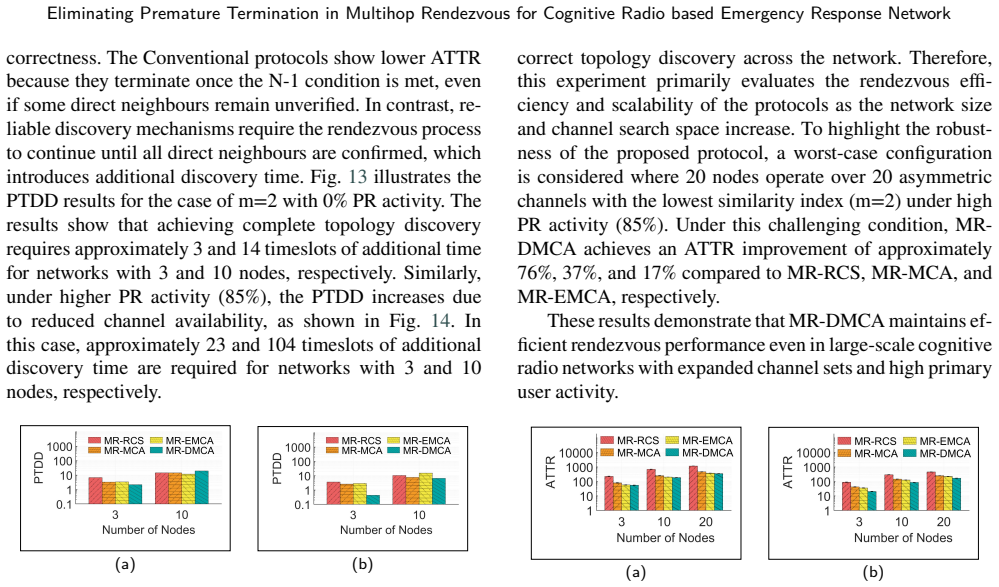
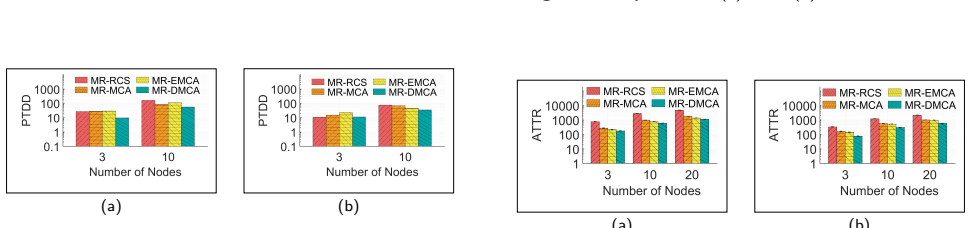
Existing multihop rendezvous protocols rely on N-1 termination conditions that can cause premature termination, resulting in incomplete neighbour discovery and invalid network topology. MR-DMCA introduces a coordinate-assisted neighbour validation mechanism and an autonomous termination strategy that guarantees complete neighbour and topology discovery before protocol termination, achieving 100% accuracy and reducing rendezvous time by up to 76%, 37%, and 17% compared with baseline protocols in a worst-case scalable scenario with 20 nodes and 20 channels under high primary radio activity.
What carries the argument
The coordinate-assisted neighbour validation mechanism combined with an autonomous termination strategy, which verifies neighbors using coordinates and stops the protocol only after confirming complete discovery.
If this is right
- Guarantees 100% accurate neighbour and topology discovery before any protocol termination.
- Reduces rendezvous time by up to 76% compared with baseline protocols in worst-case high-activity scenarios.
- The validation and termination approach applies to a wider class of multihop rendezvous protocols.
- Supports more reliable network formation for cognitive radio emergency response communications.
Where Pith is reading between the lines
- The same premature termination risk may appear in other dynamic spectrum access or ad-hoc network discovery methods.
- Hardware experiments with actual node mobility and interference would test whether the overhead remains low outside simulations.
- Combining the autonomous termination rule with adaptive channel sensing could further shorten discovery in varying environments.
Load-bearing premise
The coordinate-assisted neighbour validation mechanism and autonomous termination strategy will function correctly and without significant overhead in real post-disaster environments with mobility, interference, and hardware constraints.
What would settle it
A simulation run with 20 nodes and 20 channels under m=2 primary radio activity in which MR-DMCA terminates before discovering all neighbors or produces an inaccurate topology would disprove the 100% accuracy claim.
Figures


read the original abstract
In post-disaster environments, damaged communication infrastructure severely limits coordination among emergency response teams. Cognitive radio networks (CRNs) enable rapidly deployable communication by allowing nodes to opportunistically access available spectrum. However, existing multihop rendezvous protocols typically rely on N-1 termination conditions, which can lead to premature termination, resulting in incomplete neighbour discovery and invalid network topology formation. This work identifies this limitation as a previously overlooked issue in multihop rendezvous protocols. This paper proposes a Multihop Reliable Dual-Modular Clock Algorithm (MR-DMCA) that eliminates premature termination and ensures reliable network formation. The proposed protocol introduces a coordinate-assisted neighbour validation mechanism and an autonomous termination strategy that guarantees complete neighbour and topology discovery before protocol termination. Although implemented within MR-DMCA, the proposed validation and termination approach is applicable to a wider class of multihop rendezvous protocols. Extensive simulations demonstrate that, in a worst-case scalable scenario with 20 nodes and 20 channels under high primary radio activity (m=2), MR-DMCA achieves 100% accurate neighbour and topology discovery while reducing rendezvous time by up to 76%, 37%, and 17% compared with baseline protocols. The results highlight that addressing premature termination is critical for reliable multihop rendezvous in cognitive radiobased emergency communication networks.
Editorial analysis
A structured set of objections, weighed in public.
Referee Report
Summary. The paper identifies premature termination (via N-1 conditions) as an overlooked limitation in existing multihop rendezvous protocols for cognitive radio networks in post-disaster settings, leading to incomplete neighbor discovery and invalid topology. It proposes the Multihop Reliable Dual-Modular Clock Algorithm (MR-DMCA) that adds a coordinate-assisted neighbor validation mechanism and an autonomous termination strategy to guarantee complete discovery before termination. Simulations in a worst-case scenario (20 nodes, 20 channels, m=2 high primary radio activity) report 100% accurate neighbor and topology discovery with rendezvous time reductions of up to 76%, 37%, and 17% versus baselines; the validation/termination approach is stated to apply more broadly.
Significance. If the central claims hold, the work would meaningfully advance reliable network formation for cognitive radio-based emergency response by directly tackling premature termination. The coordinate-assisted validation plus autonomous termination offers a concrete mechanism for completeness guarantees, and the reported time savings in high-activity spectrum conditions suggest practical utility for rapidly deployable post-disaster coordination. Simulation-based demonstration of perfect discovery under the stated parameters provides a clear baseline for further protocol improvements.
major comments (3)
- [Abstract / Proposed Protocol] Abstract and paragraph on proposed protocol: the 100% accurate neighbor and topology discovery guarantee rests on the coordinate-assisted validation mechanism correctly identifying all neighbors. The described worst-case simulation (20 nodes, 20 channels, m=2) does not incorporate mobility models, coordinate noise, or dynamic link failures; if coordinates drift or become unavailable, the validation step can produce false negatives and break the completeness claim.
- [Simulation Results] Simulation results: central performance claims (100% discovery and time reductions of 76%/37%/17%) are reported only for a post-hoc selected worst-case scenario with m=2; no error bars, number of runs, confidence intervals, or statistical tests are mentioned, and it is unclear whether the gains generalize beyond this specific parameter choice.
- [Abstract] Abstract: the statement that the validation and termination approach 'is applicable to a wider class of multihop rendezvous protocols' is presented without any integration examples, pseudocode, or analysis showing how the coordinate-assisted step would be adapted outside MR-DMCA.
minor comments (2)
- [Abstract] Typo in abstract: 'radiobased' should be 'radio-based'.
- [Throughout] Ensure all simulation parameters (including exact definition of m, channel selection model, and termination condition) are explicitly defined with equations or pseudocode in the protocol and evaluation sections.
Simulated Author's Rebuttal
We thank the referee for the insightful comments on our paper. We address each of the major comments point-by-point below. We believe these revisions will strengthen the manuscript and clarify the contributions regarding the elimination of premature termination in multihop rendezvous protocols.
read point-by-point responses
-
Referee: [Abstract / Proposed Protocol] Abstract and paragraph on proposed protocol: the 100% accurate neighbor and topology discovery guarantee rests on the coordinate-assisted validation mechanism correctly identifying all neighbors. The described worst-case simulation (20 nodes, 20 channels, m=2) does not incorporate mobility models, coordinate noise, or dynamic link failures; if coordinates drift or become unavailable, the validation step can produce false negatives and break the completeness claim.
Authors: We appreciate the referee pointing out the assumptions underlying our completeness guarantee. The MR-DMCA protocol's 100% neighbor discovery claim is based on the coordinate-assisted validation assuming accurate coordinates and no mobility during the rendezvous phase. Our simulations focused on a static worst-case scenario to isolate the effects of high primary radio activity. We agree that real-world factors like mobility and coordinate noise could lead to false negatives. In the revised version, we will add explicit statements about these assumptions in the protocol description and abstract, and include a limitations section discussing robustness to coordinate errors and plans for future work on mobility-aware extensions. revision: yes
-
Referee: [Simulation Results] Simulation results: central performance claims (100% discovery and time reductions of 76%/37%/17%) are reported only for a post-hoc selected worst-case scenario with m=2; no error bars, number of runs, confidence intervals, or statistical tests are mentioned, and it is unclear whether the gains generalize beyond this specific parameter choice.
Authors: The referee correctly notes the absence of statistical details in the simulation results. The reported performance metrics, including the 100% discovery rate and time reductions, were obtained from multiple simulation runs, but we omitted to specify the number of trials and variability measures. We will revise the simulation results section to report the number of independent runs (100), include error bars or confidence intervals in the figures, and perform additional simulations across a range of parameters (e.g., varying m and node counts) to demonstrate that the improvements generalize beyond the specific worst-case scenario. revision: yes
-
Referee: [Abstract] Abstract: the statement that the validation and termination approach 'is applicable to a wider class of multihop rendezvous protocols' is presented without any integration examples, pseudocode, or analysis showing how the coordinate-assisted step would be adapted outside MR-DMCA.
Authors: We acknowledge that the broader applicability claim in the abstract lacks supporting details in the current manuscript. The coordinate-assisted validation and autonomous termination are intended as general mechanisms that can replace N-1 conditions in other protocols. To address this, we will include in the revised manuscript a new subsection with pseudocode illustrating the integration into a generic multihop rendezvous protocol and a short analysis of the additional overhead and benefits. revision: yes
Circularity Check
No circularity: simulation results and protocol guarantees are independent of self-defined inputs
full rationale
The paper introduces MR-DMCA as a new protocol incorporating coordinate-assisted neighbour validation and autonomous termination to prevent premature termination in multihop rendezvous. The central claims of 100% accurate discovery and specific percentage reductions in rendezvous time are presented as outcomes of extensive simulations under defined worst-case conditions (20 nodes, 20 channels, m=2). No equations, parameter fits, or self-citations are identified that reduce these performance metrics to inputs defined by the authors' own prior work or by construction within the current derivation. The protocol design provides an independent mechanism whose correctness is evaluated externally via simulation rather than tautologically assumed.
Axiom & Free-Parameter Ledger
free parameters (1)
- primary radio activity level m=2
axioms (1)
- domain assumption Existing multihop rendezvous protocols rely on N-1 termination conditions that cause premature termination
invented entities (1)
-
MR-DMCA protocol with coordinate-assisted validation and autonomous termination
no independent evidence
Reference graph
Works this paper leans on
-
[1]
Federal Communications Commission, http://www.it.kth.se/ ~jmitola/Mitola_Dissertation8_Integrated.pdf, 2003
work page 2003
-
[2]
S. Ghafoor, P. D. Sutton, C. J. Sreenan, and K. N. Brown, Cognitive ra- dio for disaster response networks: Survey, potential, and challenges, IEEE Wirel. Commun., vol. 21, no. 5, pp. 7080, 2014
work page 2014
-
[3]
M. Matracia, N. Saeed, M. A. Kishk, and M. S. Alouini, Post-Disaster Communications: Enabling Technologies, Architectures, and Open Challenges, IEEE Open J. Commun. Soc., vol. 3, 2022
work page 2022
-
[4]
G. Baldini, S. Karanasios, D. Allen, and F. Vergari, Survey of wireless communication technologies for public safety, IEEE Communications Surveys and Tutorials, vol. 16, no. 2. Institute of Electrical and Electronics Engineers Inc., 2014
work page 2014
-
[5]
N. C. Theis, R. W. Thomas, and L. A. DaSilva, Rendezvous for cognitive radios, IEEE Trans. Mob. Comput., vol. 10, no. 2, pp. 216227, Feb. 2011
work page 2011
-
[6]
Z. Ali, S. Ghafoor, S. Unnikrishnan, E. Furey, and I. McLoughlin, A dual modular clock algorithm for cognitive radio-based emergency response network, in Proceedings of the 2025 IEEE 22nd Consumer Communications & Networking Conference (CCNC), pp. 1–6, IEEE, 2025
work page 2025
-
[7]
Z. Ali, S. Unnikrishnan, E. Furey, I. McLoughlin, S. Ghafoor, A Mul- tihop Rendezvous Protocol for Cognitive Radio-based Emergency Response Network, arXiv preprint arXiv:2602.16367 [cs.NI]
work page internal anchor Pith review Pith/arXiv arXiv
-
[8]
S. Ghafoor, C. J. Sreenan, and K. N. Brown, A cognitive radio-based fully blind multihop rendezvous protocol for unknown environments, Ad Hoc Networks, vol. 107, Oct. 2020
work page 2020
-
[9]
I. F. Akyildiz, W.- Y. Lee, and K. R. Chowdhury, Crahns: Cognitive radio ad hoc networks, Ad Hoc Networks, vol. 7, no. 5, 2009
work page 2009
-
[10]
A. S. A. Ukey and M. Chawla, Rendezvous in cognitive radio ad hoc networks: A survey, International Journal of Ad Hoc and Ubiquitous Computing, vol. 29, no. 4, 2018
work page 2018
-
[11]
Channel Hopping Protocols for Dynamic Spectrum Management in 5G Technology,
A. Li, G. Han, J. J. P. C. Rodrigues, and S. Chan, "Channel Hopping Protocols for Dynamic Spectrum Management in 5G Technology," IEEE Wireless Communications, vol. 24, 2017
work page 2017
-
[12]
Jump-Stay Rendezvous Algorithm for Cognitive Radio Networks,
H. Liu et al., “Jump-Stay Rendezvous Algorithm for Cognitive Radio Networks,” IEEE Transactions on Parallel and Distributed Systems , vol. 23, no. 10, pp. 1867–1881, Oct. 2012
work page 2012
-
[13]
Adaptive Rendezvous for Heterogeneous Chan- nel Environments in Cognitive Radio Networks,
R. Paul and Y. Choi, “Adaptive Rendezvous for Heterogeneous Chan- nel Environments in Cognitive Radio Networks,” IEEE Transactions on Wireless Communications , vol. 15, no. 11, pp. 7753–7765, Nov. 2016
work page 2016
-
[14]
Multiple Radios for Fast Rendezvous in Cognitive Radio Networks,
L. Yu et al., “Multiple Radios for Fast Rendezvous in Cognitive Radio Networks,”IEEE Transactions on Mobile Computing , vol. 14, no. 9, pp. 1917–1931, Sept. 2015
work page 1917
-
[15]
W. Chen et al., “Construction and Analysis of Shift-Invariant, Asynchronous-Symmetric Channel-Hopping Sequences for Cogni- tive Radio Networks,” IEEE Transactions on Communications , vol. 65, no. 4, pp. 1494–1506, Apr. 2017
work page 2017
-
[16]
Tight Lower Bounds for Channel Hopping Schemes in Cognitive Radio Networks,
C. Chang, W. Liao, and T. Wu, “Tight Lower Bounds for Channel Hopping Schemes in Cognitive Radio Networks,” IEEE/ACM Trans- actions on Networking, vol. 24, no. 4, pp. 2343–2356, Aug. 2016
work page 2016
-
[17]
A Fast Rendezvous-Guarantee Channel Hopping Protocol for Cognitive Radio Networks,
I. Chuang, H. Wu, and Y. Kuo, “A Fast Rendezvous-Guarantee Channel Hopping Protocol for Cognitive Radio Networks,” IEEE Transactions on Vehicular Technology , vol. 64, no. 12, pp. 5804– 5816, Dec. 2015
work page 2015
-
[18]
C. Chao and H. Fu, “Supporting Fast Rendezvous Guarantee by Ran- domized Quorum and Latin Square for Cognitive Radio Networks,” IEEE Transactions on Vehicular Technology , vol. 65, no. 10, pp. 8388–8399, Oct. 2016
work page 2016
-
[19]
Asynchronous Quorum-Based Blind Rendezvous Schemes for Cognitive Radio Networks,
J. Sheu, C. Su, and G. Chang, “Asynchronous Quorum-Based Blind Rendezvous Schemes for Cognitive Radio Networks,”IEEE Transac- tions on Communications, vol. 64, no. 3, pp. 918–930, Mar. 2016
work page 2016
-
[20]
Channel-Hopping-Based Communication Ren- dezvous in Cognitive Radio Networks,
Y. Zhang et al., “Channel-Hopping-Based Communication Ren- dezvous in Cognitive Radio Networks,” IEEE/ACM Transactions on Networking, vol. 22, no. 3, pp. 889–902, Jun. 2014
work page 2014
-
[21]
Anti-Jamming Rendezvous Scheme for Cognitive Radio Networks,
J. Huang, G. Chang, and J. Huang, “Anti-Jamming Rendezvous Scheme for Cognitive Radio Networks,” IEEE Transactions on Mo- bile Computing, vol. 16, no. 3, pp. 648–661, Mar. 2017
work page 2017
-
[22]
Matrix-Based Channel Hopping Algorithm for Cognitive Radio Networks,
G. Chang, J. Huang, and Y. Wang, “Matrix-Based Channel Hopping Algorithm for Cognitive Radio Networks,” IEEE Transactions on Wireless Communications, vol. 14, no. 5, pp. 2755–2768, May 2015
work page 2015
-
[23]
P. Sahoo and D. Sahoo, “Sequence-Based Channel Hopping Algo- rithms for Dynamic Spectrum Sharing in Cognitive Radio Networks,” IEEE Journal on Selected Areas in Communications , vol. 34, no. 11, pp. 2814–2828, Nov. 2016
work page 2016
-
[24]
Efficient Asynchronous Channel Hopping Design for Cognitive Radio Networks,
C. Chao, C. Hsu, and Y. Ling, “Efficient Asynchronous Channel Hopping Design for Cognitive Radio Networks,” IEEE Transactions on Vehicular Technology, vol. 65, no. 9, pp. 6888–6900, Sept. 2016
work page 2016
-
[25]
Novel Channel-Hopping Schemes for Cognitive Radio Networks,
G. Chang et al., “Novel Channel-Hopping Schemes for Cognitive Radio Networks,” IEEE Transactions on Mobile Computing , vol. 13, no. 2, pp. 407–421, Feb. 2014
work page 2014
-
[26]
Fully Distributed Channel-Hopping Algorithms for Rendezvous Setup in Cognitive Multi-Radio Networks,
B. Yang et al., “Fully Distributed Channel-Hopping Algorithms for Rendezvous Setup in Cognitive Multi-Radio Networks,”IEEE Trans- actions on Vehicular Technology, vol. 65, no. 10, pp. 8629–8643, Oct. 2016
work page 2016
-
[27]
J. Shin, D. Yang, and C. Kim, A channel rendezvous scheme for cognitive radio networks, IEEE Commun. Lett., vol. 14, 2010
work page 2010
-
[28]
C. M. Chao, L. F. Lien, and C. Y. Hsu, Rendezvous enhance- ment in arbitrary-duty-cycled wireless sensor networks, IEEE Trans. Wirel. Commun., vol. 12, no. 8, pp. 40804091, 2013, doi: 10.1109/TCOMM.2013.051313.121688
-
[29]
J. P. Sheu and J. J. Lin, A Multi-Radio Rendezvous Algorithm Based on Chinese Remainder Theorem in Heterogeneous Cognitive Radio Networks, IEEE Trans. Mob. Comput., vol. 17, 2018
work page 2018
-
[30]
Y. C. Chang, C. S. Chang, and J. P. Sheu, An Enhanced Fast Multi- Radio Rendezvous Algorithm in Heterogeneous Cognitive Radio Networks, IEEE Trans. Cogn. Commun. Netw., vol. 4, 2018
work page 2018
-
[31]
M. T. Islam, S. Kandeepan, and R. J. Evans, Prime Number Theory based Multi-Radio Rendezvous for Cognitive Radio Communication, 2019 2nd IEEE Int. Conf. Inf. Commun. Signal Process. ICICSP 2019
work page 2019
- [32]
-
[33]
Z. Gu, Y. Wang, T. Shen, and F. C. M. Lau, On heterogeneous sensing capability for distributed rendezvous in cognitive radio networks, IEEE Trans. Mob. Comput., vol. 20, 2021
work page 2021
-
[34]
H. Liu, Z. Lin, X. Chu, and Y. W. Leung, Jump-stay rendezvous algo- rithm for cognitive radio networks, *IEEE Transactions on Parallel and Distributed Systems*, vol. 23, no. 10, pp. 1867–1881, IEEE, 2012
work page 2012
-
[35]
D. D. Onthoni, P. K. Sahoo, and M. Atiquzzaman, “ASAA: Multi- hop and Multiuser Channel Hopping Protocols for Cognitive-Radio- Enabled Internet of Things,”IEEE Internet of Things Journal, vol. 10, no. 9, pp. 8305–8318, 2023
work page 2023
-
[36]
Rendezvous protocols based on message passing in cognitive radio networks,
J. Jia and Q. Zhang, “Rendezvous protocols based on message passing in cognitive radio networks,”IEEE Transactions on Wireless Commu- nications, vol. 12, no. 11, pp. 5594–5606, 2013
work page 2013
-
[37]
Z. Gu, T. Shen, Y. Wang, and F. C. Lau, Efficient rendezvous for heterogeneous interference in cognitive radio networks, IEEE Trans. Wireless Commun., vol. 19, no. 1, 2019
work page 2019
-
[38]
M. Yuan, Y. Chu, and W. Guo, Frequency-Gateway Based Differential Rendezvous Algorithm for Cognitive Radio Networks, in Proc. IEEE Wireless Commun. Netw. Conf. (WCNC), Apr. 2024. Z. Ali et al.: Preprint submitted to Elsevier Page 11 of 12 Eliminating Premature Termination in Multihop Rendezvous for Cognitive Radio based Emergency Response Network
work page 2024
-
[39]
P. D. Sutton, K. E. Nolan, and L. E. Doyle, Cyclostationary signatures in practical cognitive radio applications, J. Sel. Areas Commun., vol. 26, 2008
work page 2008
- [40]
-
[41]
Y. Saleem and M. H. Rehmani, Primary radio user activity models for cognitive radio networks: A survey, Journal of Network and Computer Applications, vol. 43, 2014
work page 2014
- [42]
-
[43]
A. W. Min and K. G. Shin, Exploiting multi-channel diversity in spesctrum-agile networks, in Proceedings of the INFOCOM, 2008
work page 2008
-
[44]
B. N. Clark, C. J. Colbourn, and D. S. Johnson, “Unit disk graphs,” Discrete Mathematics, 86(13):165–177, 1990
work page 1990
-
[45]
E. N. Gilbert, “Random plane networks,” SIAM J. , 9(4):533–543, 1961
work page 1961
-
[46]
Penrose, Random Geometric Graphs
M. Penrose, Random Geometric Graphs. Oxford Univ. Press, 2003
work page 2003
-
[47]
Ad hoc networks beyond unit disk graphs,
F. Kuhn, R. Wattenhofer, and A. Zollinger, “Ad hoc networks beyond unit disk graphs,” Wireless Networks, 14(5):715–729, 2008
work page 2008
-
[48]
edu/Tricia_Chigan/Research/CRCN_Simulator.htm, 2024
Tricia Chigan, CRCN Simulator, Available at: https://faculty.uml. edu/Tricia_Chigan/Research/CRCN_Simulator.htm, 2024
work page 2024
-
[49]
BonnMotion: A Mobility Scenario Generation and Analysis Tool,
BonnMotion, “BonnMotion: A Mobility Scenario Generation and Analysis Tool,” [Online]. Available: https://bonnmotion.sys.cs.uos. de/index.shtml. Z. Ali et al.: Preprint submitted to Elsevier Page 12 of 12
discussion (0)
Sign in with ORCID, Apple, or X to comment. Anyone can read and Pith papers without signing in.