Simulation of Rydberg Ionization in Atomic Beams for FIB Optimization
Pith reviewed 2026-05-22 01:26 UTC · model grok-4.3
The pith
Optimizing Rydberg states and ionization regions in atomic beam simulations reduces axial energy spread and ionization extent for low-energy FIBs.
A machine-rendered reading of the paper's core claim, the machinery that carries it, and where it could break.
Core claim
The simulations demonstrate that the chosen Rydberg state, ionization region characteristics, and velocity dispersions in the atomic beam strongly affect final ion beam quality. Optimizing these parameters yields a significant reduction of the axial energy spread and the longitudinal extent of the ionization region, enabling ion beams with good performance at low energies.
What carries the argument
Custom Lua program integrated into SIMION that models particle distributions, laser excitation, and Rydberg ionization while incorporating excitation and ionization rates, Stark shifts, Doppler effects, and electric fields.
If this is right
- Lower axial energy spread improves beam focus at low energies.
- Reduced longitudinal extent of the ionization region improves position control of the ions.
- The method generates ion beams with usable quality at energies where traditional sources suffer from dispersion.
- The simulation framework supplies a toolkit for designing next-generation ion sources.
Where Pith is reading between the lines
- The same modeling approach could be applied to different atomic species to check whether similar reductions appear.
- Direct comparison of simulated beam properties with laboratory measurements would test whether the predicted improvements hold in practice.
- Tighter low-energy beams might open gentler ion-beam processing in surface studies or device fabrication.
Load-bearing premise
The custom Lua program inside SIMION correctly captures the combined effects of excitation rates, ionization rates, Stark shifts, Doppler effects, and electric fields on real particle trajectories without unmodeled errors.
What would settle it
An experiment that implements the simulated optimized Rydberg state and ionization parameters and measures whether the axial energy spread and longitudinal ionization extent are actually smaller than in non-optimized cases.
Figures


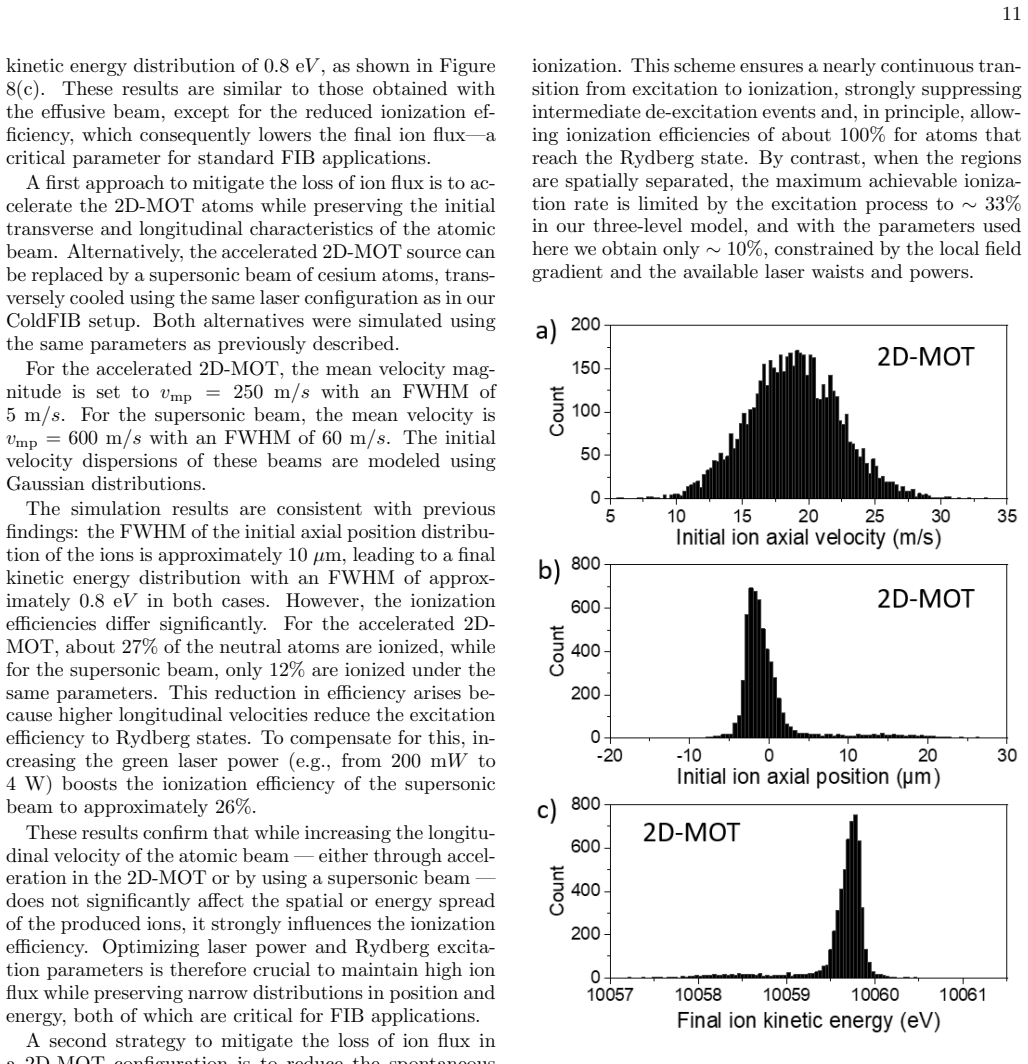


read the original abstract
This study explores the excitation and ionization of an atomic beam as a pathway to optimize focused ion beams (FIBs) for high-precision applications. Leveraging the unique advantages of Rydberg excitation followed by field ionization -- specifically its ability to minimize velocity and position dispersions -- we present a method to generate ion beams with good performance at low energies. A custom Lua program, integrated into the SIMION simulation platform, models the intricate processes of particle distributions, laser excitation, and Rydberg ionization. This integrated approach incorporates essential parameters such as excitation and ionization rates, Stark shifts, Doppler effects, and electric fields, enabling a detailed analysis of ion beam properties. Our simulations demonstrate the influence of critical factors such as the chosen Rydberg state, ionization region characteristics, and velocity dispersions on the final ion beam quality. By optimizing these parameters, we achieve significant reduction of the axial energy spread and the longitudinal extent of the ionization region. This framework bridges theoretical modeling and experimental validation, offering a comprehensive toolkit for the development of next-generation ion sources and advancing FIB technologies across various scientific domains.
Editorial analysis
A structured set of objections, weighed in public.
Referee Report
Summary. The paper presents a simulation study of Rydberg excitation followed by field ionization in an atomic beam, implemented via a custom Lua program integrated with the SIMION platform. The model incorporates excitation/ionization rates, Stark shifts, Doppler effects, and electric fields to analyze ion beam properties. By optimizing the Rydberg state, ionization region characteristics, and velocity dispersions, the authors report significant reductions in axial energy spread and the longitudinal extent of the ionization region, positioning the framework as a tool for improving low-energy focused ion beam (FIB) sources.
Significance. If the integrated model proves accurate, the work could supply a practical simulation toolkit for designing Rydberg-based ion sources with reduced dispersions, which would be valuable for high-precision FIB applications. The explicit inclusion of multiple physical effects (rates, shifts, Doppler, fields) in a single trajectory-propagation framework is a constructive step toward more realistic modeling than isolated analytic treatments.
major comments (2)
- [Methods (Lua/SIMION integration)] Methods section describing the custom Lua program: the manuscript states that the code incorporates excitation and ionization rates, Stark shifts, Doppler effects, and electric fields to propagate particle trajectories, yet supplies no benchmark against measured beam emittance, no cross-check with an analytic two-level ionization model, and no sensitivity analysis to omitted terms such as blackbody ionization or finite laser linewidth. This validation gap directly undermines the quantitative claims of optimized reductions in axial energy spread.
- [Results (optimization of Rydberg state and ionization region)] Results and optimization discussion: the headline result that parameter optimization yields 'significant reduction of the axial energy spread and the longitudinal extent of the ionization region' rests entirely on the forward-model outputs; without reported comparisons to independent analytics or experimental anchors, it is impossible to determine whether the predicted improvements are robust or artifacts of the specific rate equations and field approximations chosen in the script.
minor comments (2)
- [Abstract] Abstract: the phrase 'good performance at low energies' is used without defining quantitative metrics (e.g., specific energy-spread targets or emittance values) that would allow readers to assess the claimed improvements.
- [Abstract and Conclusions] The statement that the framework 'bridges theoretical modeling and experimental validation' appears in the abstract and conclusion, but the presented work contains only simulation results; if no experimental data are included, this phrasing should be revised to reflect the current scope.
Simulated Author's Rebuttal
We thank the referee for their constructive feedback on our manuscript. We address each of the major comments below and have revised the paper to incorporate additional validation where feasible.
read point-by-point responses
-
Referee: Methods section describing the custom Lua program: the manuscript states that the code incorporates excitation and ionization rates, Stark shifts, Doppler effects, and electric fields to propagate particle trajectories, yet supplies no benchmark against measured beam emittance, no cross-check with an analytic two-level ionization model, and no sensitivity analysis to omitted terms such as blackbody ionization or finite laser linewidth. This validation gap directly undermines the quantitative claims of optimized reductions in axial energy spread.
Authors: We acknowledge the importance of model validation. In the revised manuscript, we have added a cross-check against an analytic two-level ionization model for a simplified scenario, demonstrating consistent ionization probabilities. Additionally, we include a sensitivity analysis addressing the effects of blackbody ionization and finite laser linewidth, showing their influence is minimal under the conditions studied. A benchmark against measured beam emittance is not available as this is a simulation-based study; we have clarified the scope and limitations in the methods section to reflect this. revision: partial
-
Referee: Results and optimization discussion: the headline result that parameter optimization yields 'significant reduction of the axial energy spread and the longitudinal extent of the ionization region' rests entirely on the forward-model outputs; without reported comparisons to independent analytics or experimental anchors, it is impossible to determine whether the predicted improvements are robust or artifacts of the specific rate equations and field approximations chosen in the script.
Authors: We agree that independent comparisons enhance credibility. The revised results section now includes comparisons of the simulated axial energy spreads to analytic predictions from Doppler and Stark effect models, confirming that the observed reductions follow expected physical behavior. We have also expanded the discussion of the model's assumptions to better contextualize the optimization outcomes. revision: yes
- Benchmarking against experimental measurements of beam emittance, as the work is a computational simulation without new experimental data.
Circularity Check
No significant circularity; forward simulation of parameter optimization
full rationale
The manuscript describes a forward-modeling pipeline in which physical input rates, Stark shifts, Doppler terms, and field configurations are supplied to a custom Lua script inside SIMION; particle trajectories are then integrated and beam-quality metrics (axial energy spread, longitudinal ionization extent) are computed. Optimization consists of varying those same inputs within the model and recording the resulting metric improvements. No equation or result is defined in terms of its own output, no fitted parameter is relabeled as a prediction, and no load-bearing claim rests on a self-citation chain. The derivation therefore remains self-contained as a computational exploration rather than a tautological re-expression of its inputs.
Axiom & Free-Parameter Ledger
free parameters (2)
- excitation and ionization rates
- Rydberg state selection and ionization region size
axioms (1)
- domain assumption Rydberg excitation followed by field ionization minimizes velocity and position dispersions compared to other ionization methods
Lean theorems connected to this paper
-
IndisputableMonolith/Cost/FunctionalEquation.leanwashburn_uniqueness_aczel unclear?
unclearRelation between the paper passage and the cited Recognition theorem.
The Lua program ... implements the internal-state stochastic dynamics ... using the Time-Dependent Kinetic Monte Carlo (TDKMC) algorithm ... Eq. (7) ... Γion = Γ0 exp[(F−Fion)/σ]
-
IndisputableMonolith/Foundation/RealityFromDistinction.leanreality_from_one_distinction unclear?
unclearRelation between the paper passage and the cited Recognition theorem.
We use SIMION to compute electrostatic fields and charged-particle trajectories ... custom Lua module that implements ... excitation and ionization rates, Stark shifts, Doppler effects
What do these tags mean?
- matches
- The paper's claim is directly supported by a theorem in the formal canon.
- supports
- The theorem supports part of the paper's argument, but the paper may add assumptions or extra steps.
- extends
- The paper goes beyond the formal theorem; the theorem is a base layer rather than the whole result.
- uses
- The paper appears to rely on the theorem as machinery.
- contradicts
- The paper's claim conflicts with a theorem or certificate in the canon.
- unclear
- Pith found a possible connection, but the passage is too broad, indirect, or ambiguous to say the theorem truly supports the claim.
Reference graph
Works this paper leans on
-
[1]
This laser is ori- ented transversely to the atomic beam
A 852 nm laser, locked at resonance, excites atoms from the 6S 1/2,F=4 ground state|0⟩to the 6P3/2,F=5 intermediate state|1⟩. This laser is ori- ented transversely to the atomic beam
-
[2]
This laser is also transverse to the beam and perpendicular to the first laser
A second laser, operating at 508–512 nm, further excites the atoms from 6P 3/2,F=5 to a Rydberg 3 state|2⟩. This laser is also transverse to the beam and perpendicular to the first laser. Experimentally, the efficiency of excitation to a Rydberg state depends on the laser polarization. In this work, this effect is taken into account implicitly: the laser ...
-
[3]
We choose a unit-interval uniform random number generatoru: 0< u≤1
At timet=t 0, the system has evolved (or has been created) in a given statek. We choose a unit-interval uniform random number generatoru: 0< u≤1. We initiatei= 0,I= 0. The safer is to initiate Γ ′ k,approx(t0) to a very large value so that the first time step (∆t max,approx(t0)) will be small enough to ensure proper estimation of Γ ′ k,approx, but if the ...
-
[4]
Calculate the new rate list Γ l←k(ti) for all pos- sible states|l⟩, calculate Γ k(ti) = PN l=1 Γl←k(ti) and estimate Γ ′ k(ti) by (fori >0) Γ ′ k,approx(ti) = Γk(ti)−Γk(ti−1) ti−ti−1
-
[5]
Take for the evolution time ∆t, the smallest of the three times (the first 2 being skipped, or taken as large values, if Γ k(ti) = 0): •∆t 1 the one given by ∆t= −lnu−I Γk(ti) . 17 •∆t 2 the maximum allowed one, to control the errorϵ, ∆t max,approx(ti) =ϵ Γk(ti) |Γ′ k,approx(ti)| (care has to be done to avoid division by zero, either with a test, either b...
-
[6]
If the time chosen ∆twas the first one (so ∆t 1), goes to the next step (step 5), if not make increase Iby ∆tΓ k(ti), increaseiby one unit, and go back to step 2
-
[7]
We calculate the new rate list Γ lk(t′)
We are at timet ′ =t i+1 and so a reaction occur. We calculate the new rate list Γ lk(t′). We choose a unit-interval uniform random number generatoru ′: 0< u ′ ≤1 and searching for the integerlfor which Rl−1 < u ′RN ≤R l whereR j =P i=1,j Γik(t′) and R0 = 0
-
[8]
Setting the system to state|l⟩. Then go back to step 1. [1]Materials Characterization(ASM International, 2019)
work page 2019
-
[9]
Lauchtet al., Nanotechnology32, 162003 (2021)
A. Lauchtet al., Nanotechnology32, 162003 (2021)
work page 2021
-
[10]
H¨ oflichet al., Applied Physics Reviews10, 041311 (2023)
K. H¨ oflichet al., Applied Physics Reviews10, 041311 (2023)
work page 2023
-
[11]
P. W. Hawkes and J. C. Spence,Springer handbook of microscopy(Springer Nature, 2019)
work page 2019
- [12]
-
[13]
A. C. Gallagher and G. York, Review of Scientific In- struments45, 662 (1974)
work page 1974
-
[14]
P. Musumeciet al., Nuclear Instruments and Methods in Physics Research Section A: Accelerators, Spectrometers, Detectors and Associated Equipment907, 209 (2018)
work page 2018
-
[15]
J. J. McClellandet al., Applied physics reviews3(2016)
work page 2016
-
[16]
A. J. McCulloch, B. M. Sparkes, and R. E. Scholten, Journal of Physics B: Atomic, Molecular and Optical Physics49, 164004 (2016)
work page 2016
-
[17]
T. F. Gallagher, Rydberg atoms, inSpringer Handbook of Atomic, Molecular, and Optical Physics, pp. 231–240, Springer, 1994
work page 1994
-
[18]
R. Hahn, A. Trimeche, C. Lopez, D. Comparat, and Y. Picard, Physical Review A103, 042821 (2021)
work page 2021
-
[19]
A. Trimeche, C. Lopez, D. Comparat, and Y. Picard, Physical Review Research2, 043295 (2020)
work page 2020
- [20]
-
[21]
McCullochet al., Physical Review A95, 063845 (2017)
A. McCullochet al., Physical Review A95, 063845 (2017)
work page 2017
-
[22]
Viteauet al., Ultramicroscopy164, 70 (2016)
M. Viteauet al., Ultramicroscopy164, 70 (2016)
work page 2016
-
[23]
Antoni-Micollieret al., Optics letters43, 3937 (2018)
L. Antoni-Micollieret al., Optics letters43, 3937 (2018)
work page 2018
-
[24]
Reveillardet al., Microscopy and Microanalysis24, 804 (2018)
M. Reveillardet al., Microscopy and Microanalysis24, 804 (2018)
work page 2018
-
[25]
Hahnet al., Review of Scientific Instruments93 (2022)
R. Hahnet al., Review of Scientific Instruments93 (2022)
work page 2022
-
[26]
D. Manura and D. A. Dahl, Simion 8.0 user manual; scientific instrument services, inc: Ringoes, nj, usa, 2008
work page 2008
-
[27]
M. A. Viray, E. Paradis, and G. Raithel, New Journal of Physics23, 063022 (2021)
work page 2021
-
[28]
Comparat, Physical Review A89, 043410 (2014)
D. Comparat, Physical Review A89, 043410 (2014)
work page 2014
-
[29]
Moufarejet al., Physical Review A95, 043409 (2017)
E. Moufarejet al., Physical Review A95, 043409 (2017)
work page 2017
-
[30]
C. Chardonnet, D. Delande, and J. Gay, Optics commu- nications51, 249 (1984)
work page 1984
-
[31]
D. A. Harmin, Phys. Rev. A30, 2413 (1984)
work page 1984
-
[32]
Ceccatto, Physical Review B33, 4734 (1986)
H. Ceccatto, Physical Review B33, 4734 (1986)
work page 1986
- [33]
-
[34]
Kimeet al., Physical Review A: Atomic, Molecular, and Optical Physics88, 033424 (2013)
L. Kimeet al., Physical Review A: Atomic, Molecular, and Optical Physics88, 033424 (2013)
work page 2013
-
[35]
Reveillardet al., The European Physical Journal D 76, 35 (2022)
M. Reveillardet al., The European Physical Journal D 76, 35 (2022)
work page 2022
- [36]
-
[37]
K. T. Mitchellet al., Phys. Rev. A112, 023108 (2025)
work page 2025
- [38]
-
[39]
K. A. Fichthorn, The Journal of chemical physics95, 1090 (1991)
work page 1991
-
[40]
K. Binder and D. W. Heermann,Monte Carlo Simu- lation in Statistical Physics: An IntroductionGraduate Texts in Physics, 6 ed. (Springer Cham, 2019), 150 b/w illustrations, 5 illustrations in colour
work page 2019
-
[41]
D. Landau and K. Binder,A guide to Monte Carlo simu- lations in statistical physics(Cambridge university press, 2021)
work page 2021
-
[42]
A. P. J. Jansen,An introduction to kinetic Monte Carlo simulations of surface reactions(Springer, Berlin, Ger- many, 2012)
work page 2012
-
[43]
A. B. Bortz, M. H. Kalos, and J. L. Lebowitz, Journal of Computational physics17, 10 (1975)
work page 1975
-
[44]
D. T. Gillespie, The journal of physical chemistry81, 2340 (1977)
work page 1977
-
[45]
D. F. Anderson, The Journal of chemical physics127 (2007)
work page 2007
-
[46]
V. H. Thanh and C. Priami, The Journal of chemical physics143(2015)
work page 2015
-
[47]
M. Andersen, C. Panosetti, and K. Reuter, Frontiers in chemistry7, 202 (2019)
work page 2019
-
[48]
S. S. Chittari and Z. Lu, The Journal of Chemical Physics 161(2024)
work page 2024
discussion (0)
Sign in with ORCID, Apple, or X to comment. Anyone can read and Pith papers without signing in.