Changes in behaviour when adherers to an intervention experience a different epidemic than non-adherers
Pith reviewed 2026-05-22 01:12 UTC · model grok-4.3
The pith
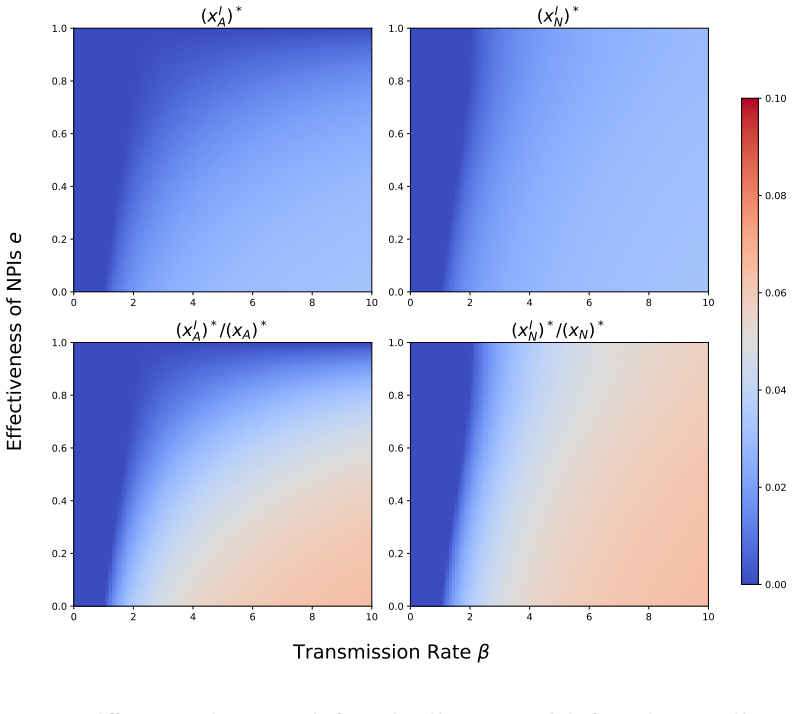
Coupling individual cost-benefit choices to transmission rates lets modestly effective NPIs sharply cut infections in severe outbreaks.
A machine-rendered reading of the paper's core claim, the machinery that carries it, and where it could break.
Core claim
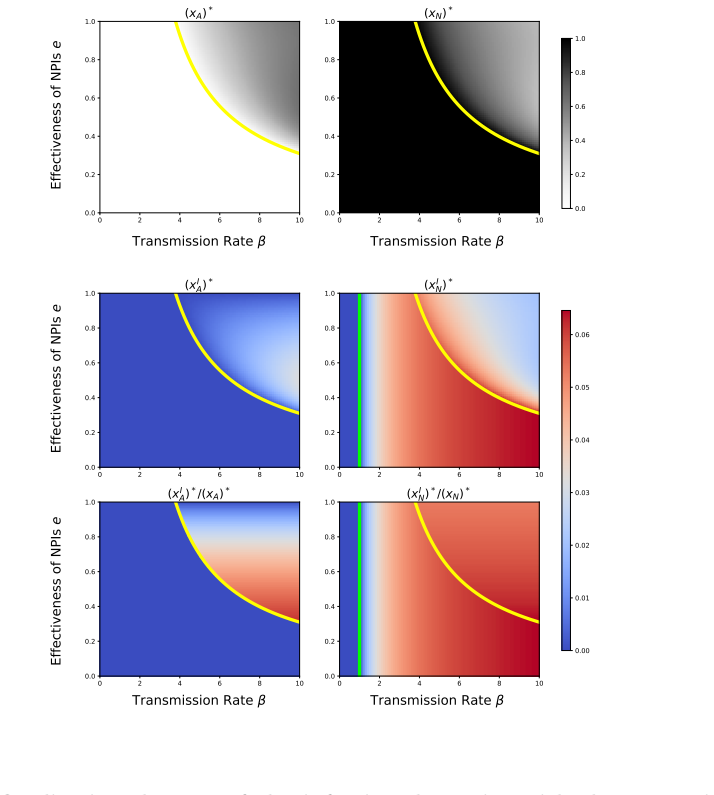
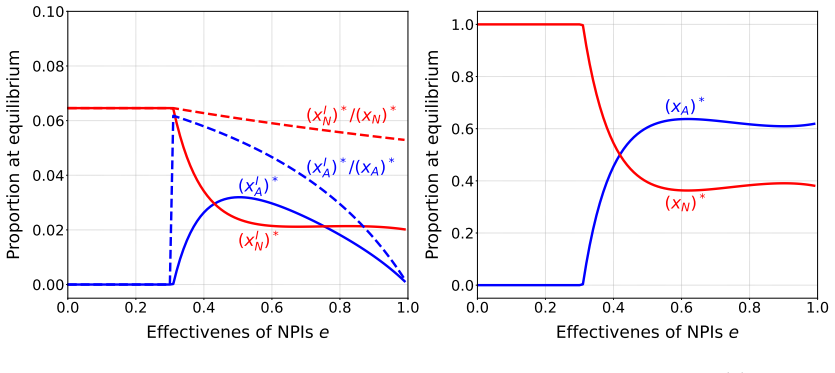
Adding behavioral switching based on perceived costs and benefits to the SIR framework creates a dynamic feedback in which higher transmission promotes adherence, which in turn reduces transmission; the net result is that modestly effective NPIs produce substantially fewer infections than fixed-strategy models predict, especially during severe outbreaks.
What carries the argument
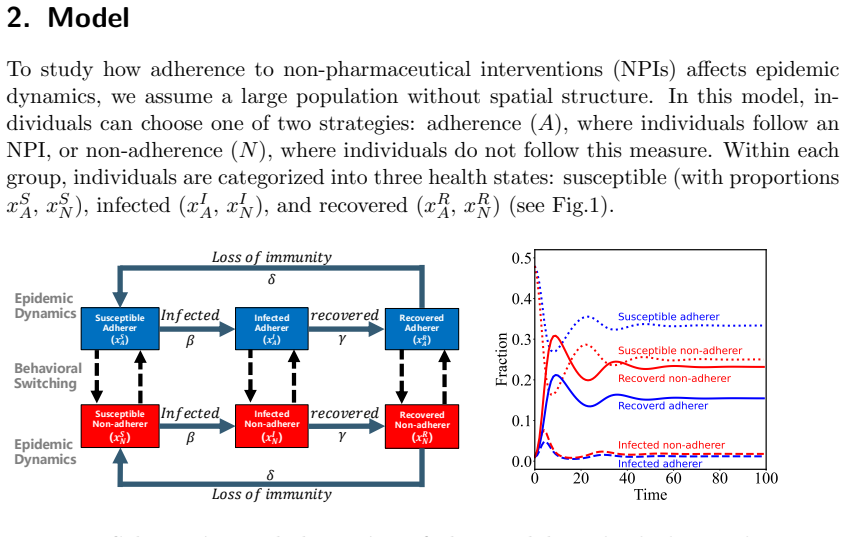
The six-compartment behavioral-epidemiological extension of the SIR model in which individuals switch between adherence and non-adherence states according to the current benefits and costs that depend on transmission and infection levels.
Load-bearing premise
People switch between adherence and non-adherence by comparing the perceived personal benefits and costs of each choice, and those switches directly change the population-wide transmission rate.
What would settle it
Data from a high-severity outbreak showing that adherence rates stay flat or fall as cases rise, or that total infections remain high despite the presence of modestly effective NPIs, would contradict the predicted feedback effect.
Figures
read the original abstract
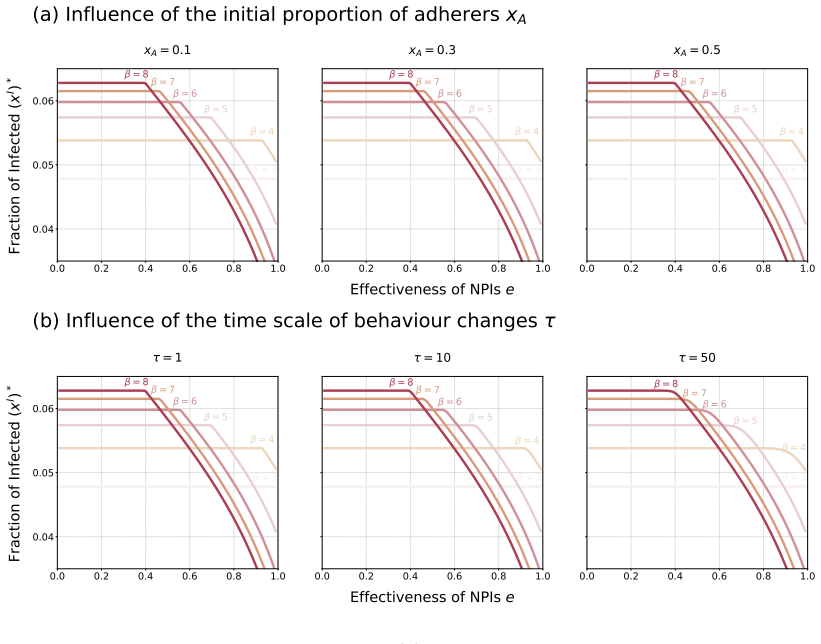
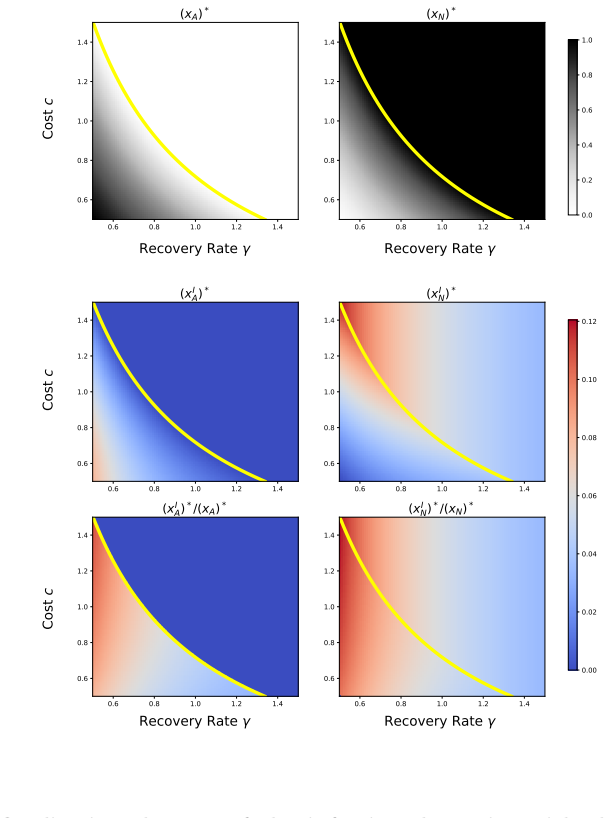
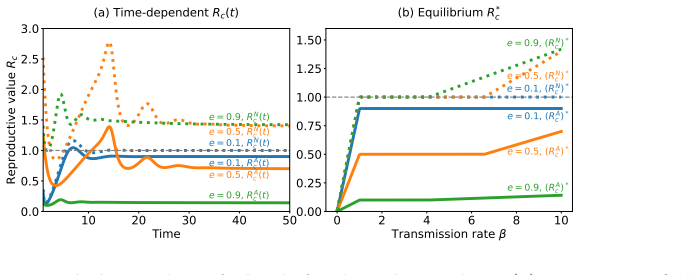
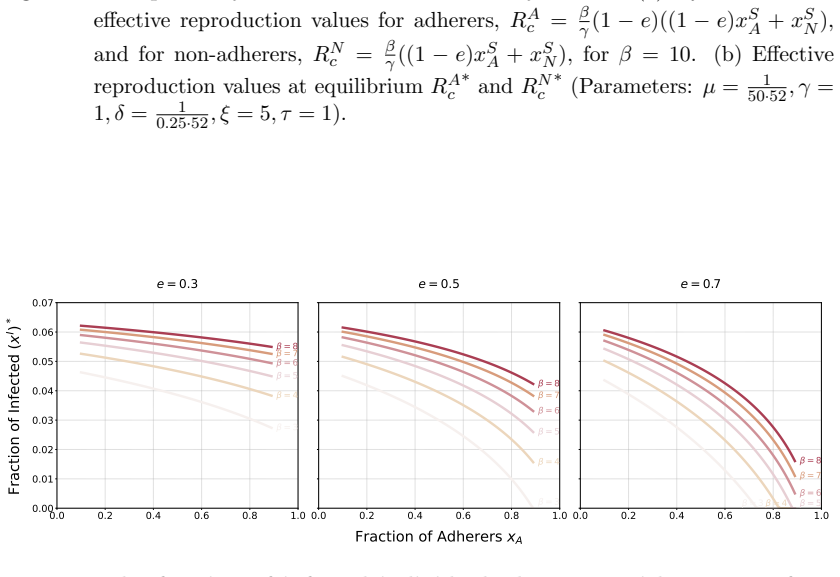
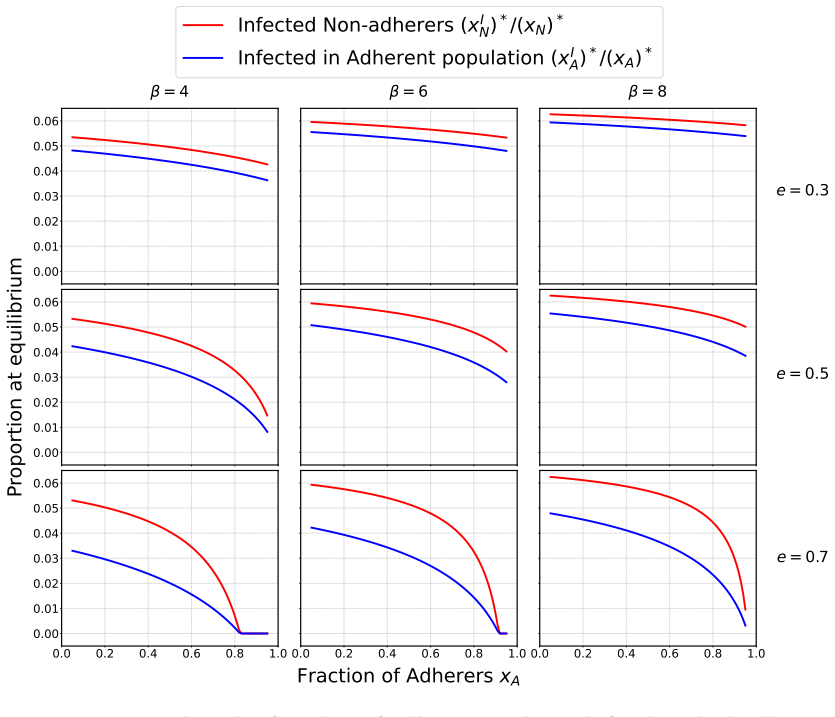
Non-pharmaceutical interventions (NPIs), including mask-wearing, physical distancing, and hygiene measures, provide the primary means of reducing transmission in the early stages of an epidemic. Individuals adopt one of two strategies-adherence (A) or non-adherence (N) to NPIs. These strategies influence the transmission rate and thus the number of infections, but they also come with inherent costs and benefits. We propose a model coupling behavior and disease dynamics in adherers and non-adherers based on the SIR framework. This gives rise to six behavioral-epidemiological compartments. Using numerical simulations and analytical considerations, we first examine the case where strategies are fixed. Stronger NPIs and more initial adherers lead to fewer infections, and adherers consistently experience lower infection risk than non-adherers. We then introduce behavioral switching based on the benefits and costs of the two strategies. When NPIs are effective, higher transmission rates promote adherence, resulting in fewer infections. Strikingly, in high-severity outbreaks, even modestly effective NPIs can significantly reduce infections. These findings highlight the critical role of the coupling between behavior and disease dynamics, and underscore how individual choices can compromise or compensate public health interventions.
Editorial analysis
A structured set of objections, weighed in public.
Referee Report
Summary. The paper develops a six-compartment extension of the SIR model coupling disease dynamics with adherence (A) or non-adherence (N) to NPIs. For fixed strategies, stronger NPIs and higher initial adherence reduce total infections, with adherers facing lower infection risk. Introducing behavioral switching driven by perceived benefits and costs leads to the finding that higher transmission rates increase adherence when NPIs are effective, and that modestly effective NPIs can substantially curb infections in severe outbreaks.
Significance. If substantiated, the work would be significant for behavioral epidemiology by showing how feedback between individual cost-benefit choices and epidemic severity can amplify NPI effects beyond fixed-compliance models. The differential epidemics experienced by adherers versus non-adherers offers a useful framing. The combination of numerical simulations and analytical considerations is noted as a methodological strength, though details are absent from the provided text.
major comments (1)
- [Abstract] Abstract: The abstract asserts that 'numerical simulations and analytical considerations support the claims,' yet no model equations, switching functions, transmission-rate feedback terms, parameter values, or result tables are supplied. This prevents verification of the central claim that modestly effective NPIs significantly reduce infections in high-severity outbreaks via behavioral switching.
Simulated Author's Rebuttal
We thank the referee for their thoughtful review and constructive comments on our manuscript. We provide a point-by-point response to the major comment below and outline the revisions we plan to make.
read point-by-point responses
-
Referee: [Abstract] Abstract: The abstract asserts that 'numerical simulations and analytical considerations support the claims,' yet no model equations, switching functions, transmission-rate feedback terms, parameter values, or result tables are supplied. This prevents verification of the central claim that modestly effective NPIs significantly reduce infections in high-severity outbreaks via behavioral switching.
Authors: The referee correctly notes that the abstract does not contain the detailed model specifications. Abstracts are limited in length and typically summarize findings without full technical details. The complete manuscript includes the six-compartment behavioral-epidemiological model extending the SIR framework, with explicit equations for the dynamics in adherer and non-adherer groups, the functional form of the behavioral switching rates based on cost-benefit analysis, the transmission rate differences, chosen parameter values for the numerical simulations, and figures/tables presenting the results. These support the claims regarding reduced infections with behavioral switching. To improve clarity and verifiability, we will revise the manuscript by adding a short overview of the model structure and key parameters early in the text, and ensure the abstract is updated if space allows to hint at the methods used. revision: yes
Circularity Check
No significant circularity in derivation chain
full rationale
The paper proposes a six-compartment behavioral-epidemiological extension of the SIR model and obtains its central claims (including the striking reduction in infections from modestly effective NPIs in high-severity outbreaks) via numerical simulations and analytical considerations applied to the forward dynamics of that model. No equations, fitted parameters, self-citations, or uniqueness theorems are supplied in the abstract, so no load-bearing step can be shown to reduce by construction to its own inputs. The results are therefore self-contained against external benchmarks and receive the default non-circularity finding.
Axiom & Free-Parameter Ledger
axioms (2)
- domain assumption Adherers and non-adherers experience different transmission rates due to NPIs
- domain assumption Individuals switch strategies based on benefits and costs of adherence versus non-adherence
invented entities (1)
-
Six behavioral-epidemiological compartments
no independent evidence
Lean theorems connected to this paper
-
IndisputableMonolith/Cost/FunctionalEquation.leanwashburn_uniqueness_aczel unclear?
unclearRelation between the paper passage and the cited Recognition theorem.
payoff matrix and replicator switching term 1/τ [xS_N xA (πA − πN) − xS_A xN (πN − πA)] in Eq. (1)
-
IndisputableMonolith/Foundation/RealityFromDistinction.leanreality_from_one_distinction unclear?
unclearRelation between the paper passage and the cited Recognition theorem.
six-compartment behavioral-epidemiological model with fixed vs. switching strategies
What do these tags mean?
- matches
- The paper's claim is directly supported by a theorem in the formal canon.
- supports
- The theorem supports part of the paper's argument, but the paper may add assumptions or extra steps.
- extends
- The paper goes beyond the formal theorem; the theorem is a base layer rather than the whole result.
- uses
- The paper appears to rely on the theorem as machinery.
- contradicts
- The paper's claim conflicts with a theorem or certificate in the canon.
- unclear
- Pith found a possible connection, but the passage is too broad, indirect, or ambiguous to say the theorem truly supports the claim.
Reference graph
Works this paper leans on
-
[1]
S. Steiner, A. Kratzel, G. T. Barut, R. M. Lang, E. Aguiar Moreira, L. Thomann, J. N. Kelly, V. Thiel, Sars-cov-2 biology and host interactions, Nature Reviews Microbiology 22 (4) (2024) 206–225
work page 2024
-
[2]
T. K. Yamana, M. Galanti, S. Pei, M. Di Fusco, F. J. Angulo, M. M. Moran, F. Khan, D. L. Swerdlow, J. Shaman, The impact of covid-19 vaccination in the us: averted burden of sars-cov-2-related cases, hospitalizations and deaths, PLoS One 18 (4) (2023) e0275699
work page 2023
-
[3]
B. K.-F. Wong, N. A. Mabbott, Systematic review and meta-analysis of covid- 19 mrna vaccine effectiveness against hospitalizations in adults, Immunotherapy Advances 4 (1) (2024) ltae011
work page 2024
-
[4]
R. E. Baker, C. M. Saad-Roy, S. W. Park, J. Farrar, C. J. E. Metcalf, B. T. Grenfell, Long-term benefits of nonpharmaceutical interventions for endemic infections are shaped by respiratory pathogen dynamics, Proceedings of the National Academy of Sciences 119 (49) (2022) e2208895119
work page 2022
-
[5]
C. T. Bauch, D. J. D. Earn, Vaccination and the theory of games, Proc Natl Acad Sci U S A 101 (36) (2004) 13391–13394. 16
work page 2004
-
[6]
A. Perisic, C. T. Bauch, Social contact networks and disease eradicability under voluntary vaccination, PLoS Comput Biol 5 (2) (2009) e1000280
work page 2009
-
[7]
Z. Wang, C. T.Bauch, S. Bhattacharyya, A. d’Onofrio, P. Manfredi, M. Perc, N. Perra, M. Salath´ e, D. Zhao, Statistical physics of vaccination, Phys. Rep. 664 (2016) 1–113
work page 2016
-
[8]
T. C. Reluga, Game theory of social distancing in response to an epidemic, PLoS Computational Biology 6 (5) (2010) e1000793
work page 2010
-
[9]
S. Flaxman, S. Mishra, A. Gandy, H. J. T. Unwin, T. A. Mellan, H. Coupland, C. Whittaker, H. Zhu, T. Berah, J. W. Eaton, et al., Estimating the effects of non-pharmaceutical interventions on covid-19 in europe, Nature 584 (7820) (2020) 257–261
work page 2020
-
[10]
A. Mendez-Brito, C. El Bcheraoui, F. Pozo-Martin, Systematic review of empiri- cal studies comparing the effectiveness of non-pharmaceutical interventions against covid-19, Journal of Infection 83 (3) (2021) 281–293
work page 2021
-
[11]
S. Lai, N. W. Ruktanonchai, L. Zhou, O. Prosper, W. Luo, J. R. Floyd, A. Wesolowski, M. Santillana, C. Zhang, X. Du, et al., Effect of non-pharmaceutical interventions to contain covid-19 in china, nature 585 (7825) (2020) 410–413
work page 2020
-
[12]
Z. Wei, J. Zhuang, On the adoption of nonpharmaceutical interventions during the pandemic: An evolutionary game model, Risk Analysis 43 (11) (2023) 2298–2311
work page 2023
- [13]
-
[14]
E. P. Fenichel, C. Castillo-Chavez, M. G. Ceddia, G. Chowell, P. A. G. Parra, G. J. Hickling, G. Holloway, R. Horan, B. Morin, C. Perrings, et al., Adaptive human behavior in epidemiological models, Proceedings of the National Academy of Sciences 108 (15) (2011) 6306–6311
work page 2011
- [15]
-
[16]
C. T. Bergstrom, W. P. Hanage, Human behavior and disease dynamics, Proceed- ings of the National Academy of Sciences 121 (1) (2024) e2317211120
work page 2024
-
[17]
Y. Liu, B. Wu, Coevolution of vaccination behavior and perceived vaccination risk can lead to a stag-hunt-like game, Physical Review E 106 (3) (2022) 034308
work page 2022
-
[18]
C. M. Saad-Roy, A. Traulsen, Dynamics in a behavioral–epidemiological model for individual adherence to a nonpharmaceutical intervention, Proceedings of the National Academy of Sciences 120 (44) (2023) e2311584120. 17
work page 2023
-
[19]
S. Shi, Z. Wang, X. Chen, F. Fu, Determinants of successful disease control through voluntary quarantine dynamics on social networks, Mathematical Biosciences 377 (2024) 109288
work page 2024
-
[20]
C. T. Bauch, Imitation dynamics predict vaccinating behaviour, Proceedings of the Royal Society B: Biological Sciences 272 (1573) (2005) 1669–1675
work page 2005
-
[21]
C. T. Bauch, A. P. Galvani, Social factors in epidemiology, Science 342 (6154) (2013) 47–49
work page 2013
-
[22]
A. Glaubitz, F. Fu, Population heterogeneity in vaccine coverage impacts epidemic thresholds and bifurcation dynamics, Heliyon 9 (9) (2023)
work page 2023
-
[23]
S. Hu, Y. Liu, B. Wu, Evolutionary dynamics of voluntary vaccination for imperfect multi-efficacy vaccines, Proceedings of the Royal Society A: Mathematical, Physical and Engineering Sciences 480 (2301) (2024) 20230743
work page 2024
- [24]
-
[25]
C.-J. Karlsson, J. Rowlett, Decisions and disease: a mechanism for the evolution of cooperation, Scientific Reports 10 (1) (2020) 13113
work page 2020
-
[26]
Tanimoto, Sociophysics approach to epidemics, Vol
J. Tanimoto, Sociophysics approach to epidemics, Vol. 23, Springer, 2021
work page 2021
-
[27]
A. Traulsen, S. A. Levin, C. M. Saad-Roy, Individual costs and societal benefits of interventions during the covid-19 pandemic, Proceedings of the National Academy of Sciences 120 (24) (2023) e2303546120
work page 2023
-
[28]
L. S. Flores, A. d. Azevedo-Lopes, C. M. Saad-Roy, A. Traulsen, Seasonal social dilemmas, npj Complexity 2 (1) (2025) 17
work page 2025
-
[29]
A. Glaubitz, F. Fu, Social dilemma of nonpharmaceutical interventions: Determi- nants of dynamic compliance and behavioral shifts, Proceedings of the National Academy of Sciences 121 (50) (2024) e2407308121
work page 2024
-
[30]
F. Chen, M. Jiang, S. Rabidoux, S. Robinson, Public avoidance and epidemics: insights from an economic model, Journal of theoretical biology 278 (1) (2011) 107– 119
work page 2011
-
[31]
B. Espinoza, S. Swarup, C. L. Barrett, M. Marathe, Heterogeneous adaptive be- havioral responses may increase epidemic burden, Scientific Reports 12 (1) (2022) 11276
work page 2022
-
[32]
S. Funk, E. Gilad, C. Watkins, V. A. Jansen, The spread of awareness and its impact on epidemic outbreaks, Proceedings of the National Academy of Sciences 106 (16) (2009) 6872–6877. 18
work page 2009
-
[33]
J. Hofbauer, K. Sigmund, Evolutionary games and population dynamics, Cambridge university press, 1998
work page 1998
-
[34]
R. Cressman, Y. Tao, The replicator equation and other game dynamics, Proceed- ings of the National Academy of Sciences 111 (supplement 3) (2014) 10810–10817
work page 2014
-
[35]
P. Schuster, K. Sigmund, Replicator dynamics, Journal of theoretical biology 100 (3) (1983) 533–538
work page 1983
-
[36]
J. M. Heffernan, R. J. Smith, L. M. Wahl, Perspectives on the basic reproductive ratio, Journal of the Royal Society Interface 2 (4) (2005) 281–293
work page 2005
-
[37]
A. Traulsen, C. S. Gokhale, S. Shah, H. Uecker, The Covid-19 pandemic: Basic insights from basic mathematical models, Nova Acta Leopoldina 2022 (3) (2022). 19
work page 2022
discussion (0)
Sign in with ORCID, Apple, or X to comment. Anyone can read and Pith papers without signing in.