Decoding the Radial Velocity Signatures of Solar Faculae with 3D MHD Simulations
Pith reviewed 2026-05-22 03:28 UTC · model grok-4.3
The pith
Solar faculae produce a redshift near disk center but switch to blueshift beyond 60 degrees from center.
A machine-rendered reading of the paper's core claim, the machinery that carries it, and where it could break.
Core claim
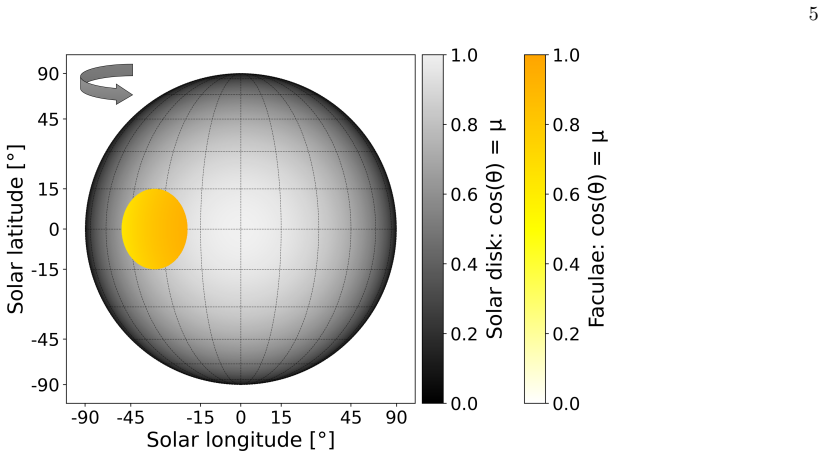
Faculae inhibit convective blueshift near disk centre and produce a relative redshift, but at heliocentric angles greater than about 60° the same magnetic fields affect horizontal flows and their visibility to produce a relative blueshift instead. Combined with solar rotation, this centre-to-limb dependence yields a complex RV profile during facular transit and a phase lag between the RV maximum and central meridian crossing. The facular signal varies strongly with spectral line, in contrast to stellar reflex motion.
What carries the argument
Center-to-limb variation of facular radial velocity extracted from MURaM 3D MHD photospheric simulations and MPS-ATLAS spectral synthesis for a transiting facular patch.
If this is right
- The facular RV maximum occurs after the feature crosses the central meridian because the blueshift contribution grows toward the limb.
- The amplitude and detailed shape of the facular RV signal change markedly with the spectral line used for the measurement.
- Stellar activity corrections for Sun-like stars must incorporate this position-dependent facular contribution to avoid systematic errors in radial velocity time series.
Where Pith is reading between the lines
- The phase lag between RV peak and central meridian crossing could help distinguish facular signals from planetary orbits in long-term monitoring data.
- Multi-line observations might reduce the impact of facular noise on precision radial velocity measurements of Sun-like stars.
- The same simulation approach could be used to predict radial velocity contributions from other magnetic structures such as network or plage.
Load-bearing premise
The chosen facular patch and MURaM simulation parameters capture the real center-to-limb radial velocity behavior of solar faculae without major numerical artifacts.
What would settle it
Measure the radial velocity time series of the Sun while a tracked facular region crosses from center to limb and test whether the signal reverses to blueshift beyond 60 degrees with a phase lag matching the simulated transit profile.
Figures



read the original abstract
We model the solar radial velocity (RV) signal induced by faculae, the dominant contributor to RV variability in Sun-like stars. We use a representative case of a facular patch transiting the visible solar disk as the Sun rotates to disentangle various physical effects contributing to the RV signal. Our approach is based on 3D radiative magnetohydrodynamic (MHD) simulations of the solar photosphere and upper convection zone with the MURaM code and spectral synthesis with the MPS-ATLAS code. We show that the faculae-induced RV strongly depends on the facular position on the solar disk. Near disk centre, facular magnetic fields inhibit the convective blueshift and thus produce a relative redshift of the solar spectrum. Surprisingly, when located closer to the limb, namely at heliocentric angles greater than about $60^\circ$, faculae produce a relative blueshift. This transition from redshift to blueshift is caused by the effect of magnetic fields on horizontal flows, which dominate the signal near the limb, and on the visibility of these flows. In combination with solar rotation, this centre-to-limb dependence of the facular effect leads to a complex RV profile during the facular transit and, in particular, to a phase lag between the maximum of the RV signal and the facular crossing of the central meridian. We further show that, in contrast to stellar reflex motion, the facular signal strongly depends on the spectral line in which it is measured.
Editorial analysis
A structured set of objections, weighed in public.
Referee Report
Summary. The manuscript models the radial velocity (RV) signal induced by a transiting solar facular patch using 3D radiative MHD simulations with the MURaM code and spectral synthesis with MPS-ATLAS. It claims that faculae produce a relative redshift near disk center by inhibiting convective blueshift, but a relative blueshift at heliocentric angles greater than about 60° due to the influence of magnetic fields on horizontal flows and their visibility; this center-to-limb dependence, combined with solar rotation, produces a complex RV profile during transit with a phase lag between RV maximum and central-meridian crossing, and the signal is strongly line-dependent unlike stellar reflex motion.
Significance. If the center-to-limb sign reversal and resulting phase lag hold, the work supplies a physically grounded, forward-model explanation for the dominant stellar-activity contribution to RV variability in Sun-like stars. This is directly relevant to exoplanet detection and could guide more accurate activity mitigation strategies. The use of self-consistent 3D MHD plus spectral synthesis on a representative facular configuration is a clear methodological strength.
major comments (2)
- [Simulation setup and Results sections] The central claim of a redshift-to-blueshift transition at heliocentric angles ≳60° and the consequent complex RV profile rest on results from a single representative MURaM facular patch. The horizontal-flow suppression and visibility effects that dominate the limb signal are sensitive to magnetic-field strength, geometry, box size, and boundary conditions; without additional runs exploring these parameters, it is unclear whether the reported transition angle and phase lag generalize to actual solar faculae or are specific to the chosen setup.
- [Spectral synthesis and line-dependence discussion] The manuscript states that the facular RV signal 'strongly depends on the spectral line' but does not quantify the line-to-line differences or demonstrate that the 60° transition angle itself is robust across lines. If the transition angle shifts with line formation height or depth, the predicted phase lag would change, weakening the claim that the behavior is a general property of faculae.
minor comments (2)
- [Abstract and §3] The abstract and main text refer to 'about 60°' without stating the precise angle at which the sign change occurs in the simulations or how it was measured from the extracted RV curves.
- [Figures] Figure captions and axis labels should explicitly indicate the heliocentric angles corresponding to each RV time series shown during the transit.
Simulated Author's Rebuttal
We thank the referee for the constructive comments and for recognizing the potential importance of this work for understanding stellar activity signals in radial velocity measurements. We address each major comment below and indicate the revisions we will make to the manuscript.
read point-by-point responses
-
Referee: [Simulation setup and Results sections] The central claim of a redshift-to-blueshift transition at heliocentric angles ≳60° and the consequent complex RV profile rest on results from a single representative MURaM facular patch. The horizontal-flow suppression and visibility effects that dominate the limb signal are sensitive to magnetic-field strength, geometry, box size, and boundary conditions; without additional runs exploring these parameters, it is unclear whether the reported transition angle and phase lag generalize to actual solar faculae or are specific to the chosen setup.
Authors: We acknowledge that the analysis is based on a single representative facular patch. This setup was selected because it reproduces observed facular properties in terms of magnetic field strength and spatial scale, allowing a focused examination of the physical mechanisms. The redshift-to-blueshift transition stems from well-established effects: magnetic inhibition of convection near disk center and the increasing contribution of magnetically modified horizontal flows whose visibility changes with heliocentric angle. To address the concern, we will add a paragraph in the revised manuscript that justifies the chosen parameters by reference to solar observations and prior MURaM studies, explicitly discusses possible sensitivities, and identifies broader parameter exploration as future work. revision: partial
-
Referee: [Spectral synthesis and line-dependence discussion] The manuscript states that the facular RV signal 'strongly depends on the spectral line' but does not quantify the line-to-line differences or demonstrate that the 60° transition angle itself is robust across lines. If the transition angle shifts with line formation height or depth, the predicted phase lag would change, weakening the claim that the behavior is a general property of faculae.
Authors: We agree that a quantitative demonstration of line-to-line behavior would strengthen the manuscript. In the revised version we will expand the spectral synthesis discussion to include explicit comparisons of the RV time series for several lines spanning a range of formation heights. These additions will show the amplitude variations and confirm that the center-to-limb transition angle remains near 60° across the lines examined, thereby supporting the generality of the predicted phase lag. We will also explain the origin of the line dependence in terms of the height-dependent velocity and magnetic field structure within the facular atmosphere. revision: yes
Circularity Check
No circularity: forward-model outputs from standard MHD and spectral synthesis codes
full rationale
The paper's central results—the center-to-limb RV dependence, redshift-to-blueshift transition near 60°, and resulting phase lag—are obtained by running MURaM 3D radiative MHD simulations of a representative facular patch followed by MPS-ATLAS spectral synthesis. These are direct numerical outputs under stated boundary conditions and magnetic configurations; they do not reduce to any fitted parameter, self-defined quantity, or load-bearing self-citation. The derivation chain consists of standard forward modeling steps whose outputs are independent of the target RV observations they are later compared against.
Axiom & Free-Parameter Ledger
axioms (2)
- domain assumption The MURaM code accurately solves the MHD equations and radiative transfer in the solar photosphere and upper convection zone for the chosen resolution and boundary conditions.
- domain assumption The MPS-ATLAS spectral synthesis produces realistic line profiles from the simulated atmospheres.
Lean theorems connected to this paper
-
IndisputableMonolith/Cost/FunctionalEquation.leanwashburn_uniqueness_aczel unclear?
unclearRelation between the paper passage and the cited Recognition theorem.
Near disk centre, facular magnetic fields inhibit the convective blueshift and thus produce a relative redshift... at heliocentric angles greater than about 60°, faculae produce a relative blueshift. This transition... is caused by the effect of magnetic fields on horizontal flows
-
IndisputableMonolith/Foundation/ArithmeticFromLogic.leanLogicNat.equivNat unclear?
unclearRelation between the paper passage and the cited Recognition theorem.
the facular-transit RV profile is symmetric about its central meridian crossing. Including rotational Doppler shifts produces an asymmetric RV curve and a phase lag
What do these tags mean?
- matches
- The paper's claim is directly supported by a theorem in the formal canon.
- supports
- The theorem supports part of the paper's argument, but the paper may add assumptions or extra steps.
- extends
- The paper goes beyond the formal theorem; the theorem is a base layer rather than the whole result.
- uses
- The paper appears to rely on the theorem as machinery.
- contradicts
- The paper's claim conflicts with a theorem or certificate in the canon.
- unclear
- Pith found a possible connection, but the passage is too broad, indirect, or ambiguous to say the theorem truly supports the claim.
Reference graph
Works this paper leans on
-
[1]
, year = 1993, month = mar, volume =
Smallscale Solar Magnetic Fields - an Overview. , year = 1993, month = mar, volume =. doi:10.1007/BF00749277 , adsurl =
-
[2]
The origin of the reversed granulation in the solar photosphere
The origin of the reversed granulation in the solar photosphere. , keywords =. doi:10.1051/0004-6361:20066390 , archivePrefix =. astro-ph/0612464 , primaryClass =
work page internal anchor Pith review Pith/arXiv arXiv doi:10.1051/0004-6361:20066390
-
[3]
Measuring precise radial velocities on individual spectral lines. I. Validation of the method and application to mitigate stellar activity. , keywords =. doi:10.1051/0004-6361/201833795 , archivePrefix =. 1809.01548 , primaryClass =
work page internal anchor Pith review Pith/arXiv arXiv doi:10.1051/0004-6361/201833795
-
[4]
Limb Shift of the Fe I 6569 A line on the Sun. arXiv e-prints , keywords =. doi:10.48550/arXiv.2602.04274 , archivePrefix =. 2602.04274 , primaryClass =
-
[5]
Simulations of stellar convection with CO5BOLD
Simulations of stellar convection with CO5BOLD. Journal of Computational Physics , keywords =. doi:10.1016/j.jcp.2011.09.026 , archivePrefix =. 1110.6844 , primaryClass =
work page internal anchor Pith review Pith/arXiv arXiv doi:10.1016/j.jcp.2011.09.026 2011
-
[6]
Granulation properties of giants, dwarfs, and white dwarfs from the CIFIST 3D model atmosphere grid
Granulation properties of giants, dwarfs, and white dwarfs from the CIFIST 3D model atmosphere grid. , keywords =. doi:10.1051/0004-6361/201321878 , archivePrefix =. 1307.2810 , primaryClass =
work page internal anchor Pith review Pith/arXiv arXiv doi:10.1051/0004-6361/201321878
-
[7]
Spatially resolved spectroscopy across stellar surfaces. IV. F, G, and K-stars: Synthetic 3D spectra at hyper-high resolution. , keywords =. doi:10.1051/0004-6361/202039995 , archivePrefix =. 2103.03880 , primaryClass =
-
[8]
Solar photospheric spectrum microvariability. arXiv e-prints , keywords =. doi:10.48550/arXiv.2509.18242 , archivePrefix =. 2509.18242 , primaryClass =
-
[9]
Towards understanding stellar variability at the sub m/s level: isolating granulation signals in synthetic spectral lines. , keywords =. doi:10.1093/mnras/staf639 , archivePrefix =. 2504.17011 , primaryClass =
-
[10]
Radial-velocity fitting challenge. II. First results of the analysis of the data set. , keywords =. doi:10.1051/0004-6361/201628671 , archivePrefix =. 1609.03674 , primaryClass =
work page internal anchor Pith review Pith/arXiv arXiv doi:10.1051/0004-6361/201628671
-
[11]
Intensity contrast of solar network and faculae close to the solar limb, observed from two vantage points. , keywords =. doi:10.1051/0004-6361/202346037 , archivePrefix =. 2309.01474 , primaryClass =
-
[12]
SOAP. A tool for the fast computation of photometry and radial velocity induced by stellar spots
SOAP. A tool for the fast computation of photometry and radial velocity induced by stellar spots. , keywords =. doi:10.1051/0004-6361/201219115 , archivePrefix =. 1206.5493 , primaryClass =
work page internal anchor Pith review Pith/arXiv arXiv doi:10.1051/0004-6361/201219115
-
[13]
Using the Sun to estimate Earth-like planets detection capabilities. V. Parameterizing the impact of solar activity components on radial velocities. , keywords =. doi:10.1051/0004-6361/201425007 , archivePrefix =. 1505.07361 , primaryClass =
work page internal anchor Pith review Pith/arXiv arXiv doi:10.1051/0004-6361/201425007
-
[14]
The Sun as a planet-host star: Proxies from SDO images for HARPS radial-velocity variations
The Sun as a planet-host star: proxies from SDO images for HARPS radial-velocity variations. , keywords =. doi:10.1093/mnras/stw187 , archivePrefix =. 1601.05651 , primaryClass =
work page internal anchor Pith review Pith/arXiv arXiv doi:10.1093/mnras/stw187
-
[15]
Based on TESS and HARPS observations
The correlation between photometric variability and radial velocity jitter. Based on TESS and HARPS observations. , keywords =. doi:10.1051/0004-6361/202038035 , archivePrefix =. 2005.10105 , primaryClass =
-
[16]
On the Origin of Solar Faculae. , keywords =. doi:10.1086/421553 , adsurl =
-
[17]
3D spectral synthesis and rotational line broadening
3D spectral synthesis and rotational line broadening. , keywords =. doi:10.1051/0004-6361:20066909 , archivePrefix =. 0707.3347 , primaryClass =
work page internal anchor Pith review Pith/arXiv arXiv doi:10.1051/0004-6361:20066909
-
[18]
Using the Sun to estimate Earth-like planets detection capabilities . II. Impact of plages. , keywords =. doi:10.1051/0004-6361/200913551 , archivePrefix =. 1001.1638 , primaryClass =
work page internal anchor Pith review Pith/arXiv arXiv doi:10.1051/0004-6361/200913551
-
[19]
Using the Sun to estimate Earth-like planets detection capabilities . I. Impact of cold spots. , keywords =. doi:10.1051/0004-6361/200913071 , archivePrefix =. 1001.1449 , primaryClass =
work page internal anchor Pith review Pith/arXiv arXiv doi:10.1051/0004-6361/200913071
-
[20]
Using the Sun to estimate Earth-like planets detection capabilities. IV. Correcting for the convective component. , keywords =. doi:10.1051/0004-6361/201219917 , adsurl =
-
[21]
HARPS-N Solar Radial-Velocity Variations Are Dominated By Large, Bright Magnetic Regions
HARPS-N Solar RVs Are Dominated by Large, Bright Magnetic Regions. , keywords =. doi:10.3847/1538-4357/ab064a , archivePrefix =. 1902.04184 , primaryClass =
work page internal anchor Pith review Pith/arXiv arXiv doi:10.3847/1538-4357/ab064a 1902
-
[22]
Solar Irradiance Variability and Climate
Solar Irradiance Variability and Climate. , keywords =. doi:10.1146/annurev-astro-082812-141007 , archivePrefix =. 1306.2770 , primaryClass =
work page internal anchor Pith review Pith/arXiv arXiv doi:10.1146/annurev-astro-082812-141007
-
[23]
The spectral impact of magnetic activity on disc-integrated HARPS-N solar observations: exploring new activity indicators. , keywords =. doi:10.1093/mnras/staa1010 , archivePrefix =. 2004.09830 , primaryClass =
-
[24]
Investigating stellar activity through eight years of Sun-as-a-star observations. , keywords =. doi:10.1093/mnras/stae1313 , archivePrefix =. 2405.12065 , primaryClass =
-
[25]
Three years of HARPS-N high-resolution spectroscopy and precise radial velocity data for the Sun. , keywords =. doi:10.1051/0004-6361/202039350 , archivePrefix =. 2009.01945 , primaryClass =
-
[26]
A Decade of Solar High-Fidelity Spectroscopy and Precise Radial Velocities from HARPS-N. arXiv e-prints , keywords =. doi:10.48550/arXiv.2510.27635 , archivePrefix =. 2510.27635 , primaryClass =
-
[27]
Precise and efficient modeling of stellar-activity-affected solar spectra using SOAP-GPU. , keywords =. doi:10.1051/0004-6361/202450993 , archivePrefix =. 2412.13500 , primaryClass =
-
[28]
MPS-ATLAS: A fast all-in-one code for synthesising stellar spectra. , keywords =. doi:10.1051/0004-6361/202140275 , archivePrefix =. 2105.13611 , primaryClass =
-
[29]
Testing MURaM and MPS-ATLAS against the quiet solar spectrum. , keywords =. doi:10.1051/0004-6361/202346099 , archivePrefix =. 2310.05652 , primaryClass =
-
[30]
Small-scale dynamo in cool stars. II. The effect of metallicity. , keywords =. doi:10.1051/0004-6361/202244771 , archivePrefix =. 2211.02722 , primaryClass =
-
[31]
Can 1D Radiative-equilibrium Models of Faculae Be Used for Calculating Contamination of Transmission Spectra?. , keywords =. doi:10.3847/2041-8213/aca671 , archivePrefix =. 2211.02860 , primaryClass =
-
[32]
Small-scale dynamo in cool stars. I. Changes in stratification and near-surface convection for main-sequence spectral types. , keywords =. doi:10.1051/0004-6361/202243607 , archivePrefix =. 2206.00064 , primaryClass =
-
[33]
Nature Astronomy , year = 2024, month = jul, volume =
Magnetic origin of the discrepancy between stellar limb-darkening models and observations. Nature Astronomy , year = 2024, month = jul, volume =. doi:10.1038/s41550-024-02252-5 , adsurl =
-
[34]
The IAG solar flux atlas: Accurate wavelengths and absolute convective blueshift in standard solar spectra. , keywords =. doi:10.1051/0004-6361/201527530 , archivePrefix =. 1511.03014 , primaryClass =
work page internal anchor Pith review Pith/arXiv arXiv doi:10.1051/0004-6361/201527530
-
[35]
Radial velocity signatures of Zeeman broadening
Radial velocity signatures of Zeeman broadening. , keywords =. doi:10.1051/0004-6361/201220437 , archivePrefix =. 1301.2951 , primaryClass =
work page internal anchor Pith review Pith/arXiv arXiv doi:10.1051/0004-6361/201220437
-
[36]
Three years of Sun-as-a-star radial-velocity observations on the approach to solar minimum
Three years of Sun-as-a-star radial-velocity observations on the approach to solar minimum. , keywords =. doi:10.1093/mnras/stz1215 , archivePrefix =. 1904.12186 , primaryClass =
work page internal anchor Pith review Pith/arXiv arXiv doi:10.1093/mnras/stz1215 1904
-
[37]
SOAP 2.0: A Tool to Estimate the Photometric and Radial Velocity Variations Induced by Stellar Spots and Plages. , keywords =. doi:10.1088/0004-637X/796/2/132 , archivePrefix =. 1409.3594 , primaryClass =
work page internal anchor Pith review Pith/arXiv arXiv doi:10.1088/0004-637x/796/2/132
-
[38]
Planetary detection limits taking into account stellar noise. I. Observational strategies to reduce stellar oscillation and granulation effects. , keywords =. doi:10.1051/0004-6361/201014097 , archivePrefix =. 1010.2616 , primaryClass =
work page internal anchor Pith review Pith/arXiv arXiv doi:10.1051/0004-6361/201014097
-
[39]
Approximations for non-grey radiative transfer in numerical simulations of the solar photosphere. , keywords =. doi:10.1051/0004-6361:20047043 , adsurl =
-
[40]
Equations, methods, and results of the MURaM code
Simulations of magneto-convection in the solar photosphere. Equations, methods, and results of the MURaM code. , keywords =. doi:10.1051/0004-6361:20041507 , adsurl =
-
[41]
Are solar brightness variations faculae- or spot-dominated?
Are solar brightness variations faculae- or spot-dominated?. , keywords =. doi:10.1051/0004-6361/201527527 , archivePrefix =. 1602.04447 , primaryClass =
work page internal anchor Pith review Pith/arXiv arXiv doi:10.1051/0004-6361/201527527
-
[42]
PoET: the Paranal solar ESPRESSO Telescope. arXiv e-prints , keywords =. doi:10.48550/arXiv.2505.08540 , archivePrefix =. 2505.08540 , primaryClass =
-
[43]
Simulations of the solar near-surface layers with the CO5BOLD, MURaM, and Stagger codes
Simulations of the solar near-surface layers with the CO5BOLD, MURaM, and Stagger codes. , keywords =. doi:10.1051/0004-6361/201118252 , archivePrefix =. 1201.1103 , primaryClass =
work page internal anchor Pith review Pith/arXiv arXiv doi:10.1051/0004-6361/201118252
-
[44]
Propagating Wave Phenomena Detected in Observations and Simulations of the Lower Solar Atmosphere
Propagating Wave Phenomena Detected in Observations and Simulations of the Lower Solar Atmosphere. , keywords =. doi:10.1088/0004-637X/746/2/183 , archivePrefix =. 1201.1981 , primaryClass =
work page internal anchor Pith review Pith/arXiv arXiv doi:10.1088/0004-637x/746/2/183 1981
-
[45]
Stellar Surface Magneto-convection as a Source of Astrophysical Noise. I. Multi-component Parameterization of Absorption Line Profiles. , keywords =. doi:10.1088/0004-637X/763/2/95 , archivePrefix =. 1212.0236 , primaryClass =
work page internal anchor Pith review Pith/arXiv arXiv doi:10.1088/0004-637x/763/2/95
-
[46]
Pressure equilibrium and energy balance of small photospheric fluxtubes. , keywords =. doi:10.1007/BF00155292 , adsurl =
-
[47]
Properties of the Smallest Solar Magnetic Elements. I. Facular Contrast near Sun Center. , keywords =. doi:10.1086/171721 , adsurl =
-
[48]
Contrast of faculae near the disk center and solar variability. , keywords =. doi:10.1029/93JA01942 , adsurl =
-
[49]
On the intensity contrast of solar photospheric faculae and network elements
On the intensity contrast of solar photospheric faculae and network elements. , keywords =. doi:10.1051/0004-6361:20020500 , archivePrefix =. astro-ph/0207008 , primaryClass =
work page internal anchor Pith review Pith/arXiv arXiv doi:10.1051/0004-6361:20020500
-
[50]
Frequent Occurrence of High-speed Local Mass Downflows on the Solar Surface
Frequent Occurrence of High-Speed Local Mass Downflows on the Solar Surface. , keywords =. doi:10.1086/588775 , archivePrefix =. 0804.1167 , primaryClass =
work page internal anchor Pith review Pith/arXiv arXiv doi:10.1086/588775
-
[51]
Three-dimensional simulations of near-surface convection in main-sequence stars. III. The structure of small-scale magnetic flux concentrations. , keywords =. doi:10.1051/0004-6361/201525788 , archivePrefix =. 1505.04739 , primaryClass =
work page internal anchor Pith review Pith/arXiv arXiv doi:10.1051/0004-6361/201525788
-
[52]
Facular contrasts for cool main-sequence stars
Spectral variability of photospheric radiation due to faculae - II. Facular contrasts for cool main-sequence stars. , keywords =. doi:10.1093/mnras/stad1738 , archivePrefix =. 2306.04669 , primaryClass =
-
[53]
Sub-m s ^ -1 upper limits from a deep HARPS-N radial-velocity search for planets orbiting HD 166620 and HD 144579. , keywords =. doi:10.1093/mnras/stad2381 , archivePrefix =. 2308.01348 , primaryClass =
-
[54]
under review in ApJ , year = 2025, Note =
Sensitivity of Spectral lines to granulation: The Sun. under review in ApJ , year = 2025, Note =
work page 2025
-
[55]
, year = 1995, month = nov, volume =
A Jupiter-mass companion to a solar-type star. , year = 1995, month = nov, volume =. doi:10.1038/378355a0 , adsurl =
-
[56]
Fundamental photon noise limit to radial velocity measurements. , keywords =. doi:10.1051/0004-6361:20010730 , adsurl =
-
[57]
Spectrum radial velocity analyser (SERVAL). High-precision radial velocities and two alternative spectral indicators. , keywords =. doi:10.1051/0004-6361/201731483 , archivePrefix =. 1710.10114 , primaryClass =
work page internal anchor Pith review Pith/arXiv arXiv doi:10.1051/0004-6361/201731483
-
[58]
Measuring precise radial velocities on individual spectral lines. II. Dependance of stellar activity signal on line depth. , keywords =. doi:10.1051/0004-6361/201936548 , archivePrefix =. 1912.05192 , primaryClass =
-
[59]
Measuring precise radial velocities on individual spectral lines. III. Dependence of stellar activity signal on line formation temperature. , keywords =. doi:10.1051/0004-6361/202243276 , archivePrefix =. 2205.07047 , primaryClass =
-
[60]
Measuring precise radial velocities on individual spectral lines. IV. Stellar activity correlation with line formation temperature. , keywords =. doi:10.1051/0004-6361/202348150 , archivePrefix =. 2312.10836 , primaryClass =
-
[61]
The Changing Face of $\alpha$ Centauri B: Probing plage and stellar activity in K-dwarfs
The changing face of Centauri B: probing plage and stellar activity in K dwarfs. , keywords =. doi:10.1093/mnrasl/slx018 , archivePrefix =. 1702.01647 , primaryClass =
work page internal anchor Pith review Pith/arXiv arXiv doi:10.1093/mnrasl/slx018
-
[62]
New Methods for Finding Activity-sensitive Spectral Lines: Combined Visual Identification and an Automated Pipeline Find a Set of 40 Activity Indicators. , keywords =. doi:10.3847/1538-3881/aadd94 , archivePrefix =. 1808.09009 , primaryClass =
work page internal anchor Pith review Pith/arXiv arXiv doi:10.3847/1538-3881/aadd94
-
[63]
Solar limb faculae: intensity contrast from two vantage points. arXiv e-prints , keywords =. doi:10.48550/arXiv.2510.00320 , archivePrefix =. 2510.00320 , primaryClass =
-
[64]
The Observation and Analysis of Stellar Photospheres
-
[65]
The Observation and Analysis of Stellar Photospheres. 2022 , isbn =. doi:10.1017/9781009082136 , adsurl =
-
[66]
The solar magnetic field. Reports on Progress in Physics , keywords =. doi:10.1088/0034-4885/69/3/R02 , archivePrefix =. 1008.0771 , primaryClass =
work page internal anchor Pith review Pith/arXiv arXiv doi:10.1088/0034-4885/69/3/r02
-
[67]
A comprehensive study on radial velocity signals using ESPRESSO: Pushing precision to the 10 cm/s level. , keywords =. doi:10.1051/0004-6361/202553869 , archivePrefix =. 2507.07514 , primaryClass =
-
[68]
Three-dimensional simulations of near-surface convection in main-sequence stars. IV. Effect of small-scale magnetic flux concentrations on centre-to-limb variation and spectral lines. , keywords =. doi:10.1051/0004-6361/201525874 , archivePrefix =. 1505.04744 , primaryClass =
work page internal anchor Pith review Pith/arXiv arXiv doi:10.1051/0004-6361/201525874
-
[69]
Properties of solar plage from a spatially coupled inversion of Hinode SP data
Properties of solar plage from a spatially coupled inversion of Hinode SP data. , keywords =. doi:10.1051/0004-6361/201424970 , archivePrefix =. 1501.01151 , primaryClass =
work page internal anchor Pith review Pith/arXiv arXiv doi:10.1051/0004-6361/201424970
-
[70]
Solar granulation - Influence of convection on spectral line asymmetries and wavelength shifts. , keywords =
-
[71]
Activity-Related Radial Velocity Variation in Cool Stars. , keywords =. doi:10.1086/304392 , adsurl =
-
[72]
No planet for HD 166435. , keywords =. doi:10.1051/0004-6361:20011308 , archivePrefix =. astro-ph/0109491 , primaryClass =
work page internal anchor Pith review Pith/arXiv arXiv doi:10.1051/0004-6361:20011308
-
[73]
A solar surface dynamo. , keywords =. doi:10.1051/0004-6361:20077253 , archivePrefix =. astro-ph/0702681 , primaryClass =
work page internal anchor Pith review Pith/arXiv arXiv doi:10.1051/0004-6361:20077253
-
[74]
Strong horizontal photospheric magnetic field in a surface dynamo simulation
Strong horizontal photospheric magnetic field in a surface dynamo simulation. , keywords =. doi:10.1051/0004-6361:20078998 , archivePrefix =. 0801.1250 , primaryClass =
work page internal anchor Pith review Pith/arXiv arXiv doi:10.1051/0004-6361:20078998
-
[75]
Numerical simulations of quiet Sun magnetism: On the contribution from a small-scale dynamo
Numerical Simulations of Quiet Sun Magnetism: On the Contribution from a Small-scale Dynamo. , keywords =. doi:10.1088/0004-637X/789/2/132 , archivePrefix =. 1405.6814 , primaryClass =
work page internal anchor Pith review Pith/arXiv arXiv doi:10.1088/0004-637x/789/2/132
-
[76]
Solar photospheric spectrum microvariability. I. Theoretical searches for proxies of radial-velocity jittering. , keywords =. doi:10.1051/0004-6361/202347142 , archivePrefix =. 2308.10937 , primaryClass =
-
[77]
Solar photospheric spectrum microvariability. II. Observed relations to magnetic activity and radial-velocity modulation. , keywords =. doi:10.1051/0004-6361/202449707 , archivePrefix =. 2404.08035 , primaryClass =
-
[78]
Modelling the photosphere of active stars for planet detection and characterization
Modelling the photosphere of active stars for planet detection and characterization. , keywords =. doi:10.1051/0004-6361/201425369 , archivePrefix =. 1511.06717 , primaryClass =
work page internal anchor Pith review Pith/arXiv arXiv doi:10.1051/0004-6361/201425369
discussion (0)
Sign in with ORCID, Apple, or X to comment. Anyone can read and Pith papers without signing in.