Experimental Evaluation of Data Upload Efficiency and Guiding Challenges for a Vehicular-to-Road System Using 60-GHz mmWave Ultra-Spots
Pith reviewed 2026-05-25 04:03 UTC · model grok-4.3
The pith
Experiments show optimal vehicle paths through narrow 60-GHz mmWave spots raise uploaded data volume by 6 to 8 times.
A machine-rendered reading of the paper's core claim, the machinery that carries it, and where it could break.
Core claim
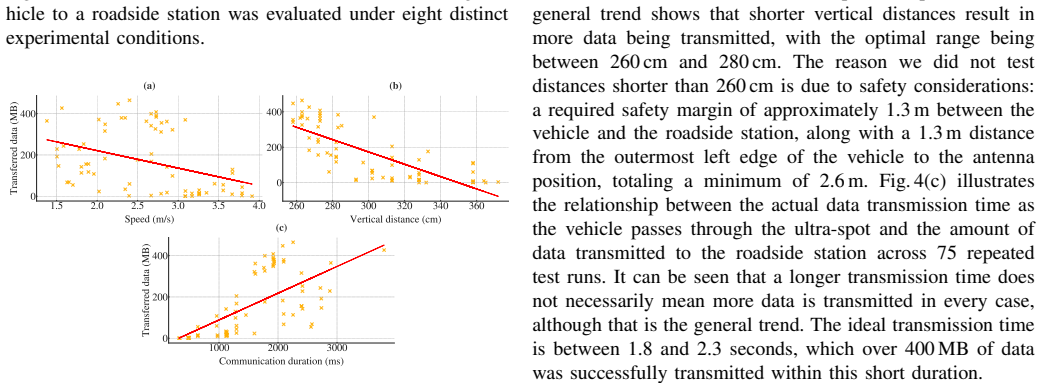
Based on 75 experimental cases, the paper establishes that an optimal travel trajectory combined with appropriate movement speed, antenna placement, and prior estimation of the ultra-spot area allows a vehicle to pass through the narrow 60-GHz mmWave zone effectively, improving the amount of transferred data by 6 to 8 times compared to suboptimal conditions.
What carries the argument
The ultra-spot, the narrow coverage footprint of a 60-GHz roadside unit, whose size and location relative to the vehicle's chosen path determine link duration and total data volume.
If this is right
- Data volume scales directly with the time the vehicle remains inside the ultra-spot when trajectory and speed are matched to the spot geometry.
- Antenna placement must be chosen so the link remains stable throughout the passage rather than only at the closest point.
- Advance knowledge of ultra-spot location is required to plan entry angle and speed; without it the measured gains disappear.
- Autonomous guidance becomes necessary to convert the identified conditions into repeatable performance.
Where Pith is reading between the lines
- Roadside unit spacing could be designed around the optimal trajectories rather than around worst-case random paths.
- Vehicle-to-vehicle links might be used to coordinate speed adjustments between nearby cars to improve collective upload efficiency.
- Real mixed-traffic tests would show how much of the 6-8 times gain survives when human drivers replace perfect autonomous guidance.
Load-bearing premise
The 75 test cases represent the main real-world variations in routes, speeds, angles and distances, and an autonomous system can repeatedly execute the optimal trajectories.
What would settle it
Additional runs with unguided or randomly chosen trajectories that produce data-volume gains below a factor of six, or field measurements showing the guiding system cannot maintain the required path accuracy.
Figures


read the original abstract
Maximizing data uploading efficiency in a vehicular-to-road data uploading system using millimeter-wave communication is a challenging issue, as the wireless zone is often critically narrow, and vehicles can easily fail to pass through it without the aid of an autonomous guiding system. Variations in driving routes, speeds, approach angles, and distances to the ultra-spot can significantly affect data transmission performance, leading to either efficient or suboptimal results. This study presents a comprehensive analysis based on 75 experimental cases to identify the optimal travel trajectory and conditions that allow the vehicle to pass through the ultra-spot and enhance data transmission effectively. Experimental results show that with an optimal travel trajectory, appropriate movement speed, antenna placement, and prior estimation of the ultra-spot area, the amount of transferred data can be improved by 6 to 8 times.
Editorial analysis
A structured set of objections, weighed in public.
Referee Report
Summary. The manuscript reports an experimental study of data upload efficiency in a vehicular-to-road mmWave (60 GHz) system. Through 75 controlled experimental cases varying routes, speeds, approach angles, and distances, the authors identify optimal trajectory, speed, antenna placement, and prior ultra-spot estimation that yield a 6–8× increase in transferred data volume. The work emphasizes that an autonomous guiding system would be needed to realize these optima in practice.
Significance. If the reported factor-of-6–8 improvement is reproducible and an autonomous controller can reliably deliver vehicles through the narrow ultra-spot under the identified conditions, the results would be practically relevant for mmWave V2I deployments. The purely experimental nature and absence of any fitted models or derivations are strengths in avoiding circularity, but the lack of closed-loop validation and statistical detail limits the strength of the central claim.
major comments (2)
- [Abstract] The central claim of a 6–8× improvement rests on 75 experimental cases, yet the manuscript provides no statistical details, error bars, raw data, or description of how the cases were selected or randomized (Abstract and Experimental Results sections). Without these, it is impossible to assess whether the reported gain is robust or an artifact of post-hoc selection of optimal conditions.
- The practical utility of the identified optima depends on an autonomous guiding system achieving the required trajectories under realistic sensor noise, latency, and road disturbances, but the manuscript contains no closed-loop experiments in which a controller attempts to track those trajectories and reports success rate or resulting data volume (Introduction and Conclusion). This assumption is load-bearing for the claimed improvement and remains untested.
minor comments (1)
- [Abstract] The abstract states that vehicles 'can easily fail to pass through' the ultra-spot without guidance, but the experimental protocol for how the 75 cases were executed (manual driving vs. any form of assistance) is not described.
Simulated Author's Rebuttal
We thank the referee for the constructive feedback on our experimental study. The work identifies optimal conditions through systematic open-loop trials, and we address the concerns on statistical presentation and scope limitations below. Revisions will be made to improve methodological transparency while maintaining the paper's focus on experimental characterization.
read point-by-point responses
-
Referee: [Abstract] The central claim of a 6–8× improvement rests on 75 experimental cases, yet the manuscript provides no statistical details, error bars, raw data, or description of how the cases were selected or randomized (Abstract and Experimental Results sections). Without these, it is impossible to assess whether the reported gain is robust or an artifact of post-hoc selection of optimal conditions.
Authors: We agree that explicit details on experimental design are needed. The 75 cases were chosen to systematically vary routes, speeds, angles, and distances, deliberately including both optimal and suboptimal trajectories to illustrate performance differences. We will revise the Experimental Results section to describe the case selection criteria and include any available variability measures from repeated trials under matched conditions. Raw data will be made available as supplementary material upon request. These additions will allow better assessment of robustness without altering the reported gains. revision: yes
-
Referee: [—] The practical utility of the identified optima depends on an autonomous guiding system achieving the required trajectories under realistic sensor noise, latency, and road disturbances, but the manuscript contains no closed-loop experiments in which a controller attempts to track those trajectories and reports success rate or resulting data volume (Introduction and Conclusion). This assumption is load-bearing for the claimed improvement and remains untested.
Authors: The manuscript's scope is limited to open-loop experiments that identify the trajectories and conditions yielding the reported gains; the abstract and conclusion already state that an autonomous guiding system is required to realize these in practice. We do not present the 6–8× improvement as achieved under closed-loop control. We will revise the Introduction and Conclusion to more explicitly separate the current experimental characterization from future closed-loop validation. Full closed-loop testing with sensor noise and disturbances is beyond the present work's resources and is noted as future research. revision: partial
Circularity Check
No circularity: purely experimental identification of optima from 75 cases
full rationale
The paper reports results from 75 experimental cases that vary routes, speeds, angles, and distances to identify conditions maximizing mmWave data upload. The 6-8× improvement is stated as a direct empirical outcome of those measurements under the tested trajectories and placements, with no equations, fitted models, predictions derived from parameters, self-citations, or ansatzes present in the abstract or described methodology. No derivation chain exists that could reduce to its own inputs by construction.
Axiom & Free-Parameter Ledger
axioms (1)
- domain assumption The 75 cases sufficiently represent real-world variations in vehicle movement and environment.
Reference graph
Works this paper leans on
-
[1]
P. Nguyenet al.,“Prediction of Ultra-high-speed Spots Using RTK- GNSS Sensor Fusion for UA V-to-UA V mmWave/THz Communications”, inIEEE Access(2025)
work page 2025
-
[2]
Y . Guangronget al.,“Millimeter-wave system for high-speed train com- munications between train and trackside: System design and channel measurements”, inIEEE Transactions on Vehicular Technology. vol. 68, no. 12, pp.11746-11761, 2019
work page 2019
-
[3]
L. Xichenet al.,“Measurements and Modeling of Millimeter-Wave Vehicle-to-Vehicle Propagation With Vehicle Obstructions”, inIEEE Transactions on Wireless Communications(2025)
work page 2025
discussion (0)
Sign in with ORCID, Apple, or X to comment. Anyone can read and Pith papers without signing in.