On the Applicability of the Gas-Kinetic Scheme with Kinetic Boundary Conditions for Near-Continuum Hypersonic Flows
Pith reviewed 2026-05-25 03:26 UTC · model grok-4.3
The pith
Gas-kinetic scheme with built-in kinetic boundary conditions accurately models near-continuum hypersonic flows by capturing natural velocity slip and temperature jump.
A machine-rendered reading of the paper's core claim, the machinery that carries it, and where it could break.
Core claim
By adopting the same kinetic boundary conditions as the unified gas-kinetic scheme, the GKS naturally incorporates non-equilibrium wall effects and delivers more accurate aerodynamic forces and heat transfer in near-continuum hypersonic regimes than conventional CFD equipped with Maxwell slip conditions.
What carries the argument
The natural kinetic slip boundary condition in GKS, which derives velocity slip and temperature jump directly from the kinetic distribution function at the wall.
If this is right
- GKS can be applied to predict lift, drag, and moments on hypersonic vehicles at altitudes where continuum assumptions begin to fail.
- Aerodynamic heating rates obtained from GKS should be closer to DSMC results than those from Navier-Stokes solvers with slip corrections.
- The same boundary-condition treatment allows GKS to bridge the gap between continuum CFD and full kinetic methods without the full cost of UGKS.
Where Pith is reading between the lines
- The method may lower the computational expense of simulating transitional flows on complex vehicle shapes compared with particle-based kinetic solvers.
- Similar kinetic boundary conditions could be tested on other continuum solvers to isolate whether accuracy gains come from the boundary treatment or the interior scheme.
- Extension to unsteady or three-dimensional cases with stronger non-equilibrium would test the current applicability limits.
Load-bearing premise
The Chapman-Enskog expansion inside the GKS stays accurate enough for the moderate non-equilibrium effects encountered in the tested near-continuum hypersonic cases.
What would settle it
Direct comparison of surface pressure, shear stress, or heat flux distributions on the blunted-cone or Apollo geometries against DSMC or wind-tunnel data that shows systematic deviation larger than the difference between GKS and Maxwell-slip CFD.
Figures


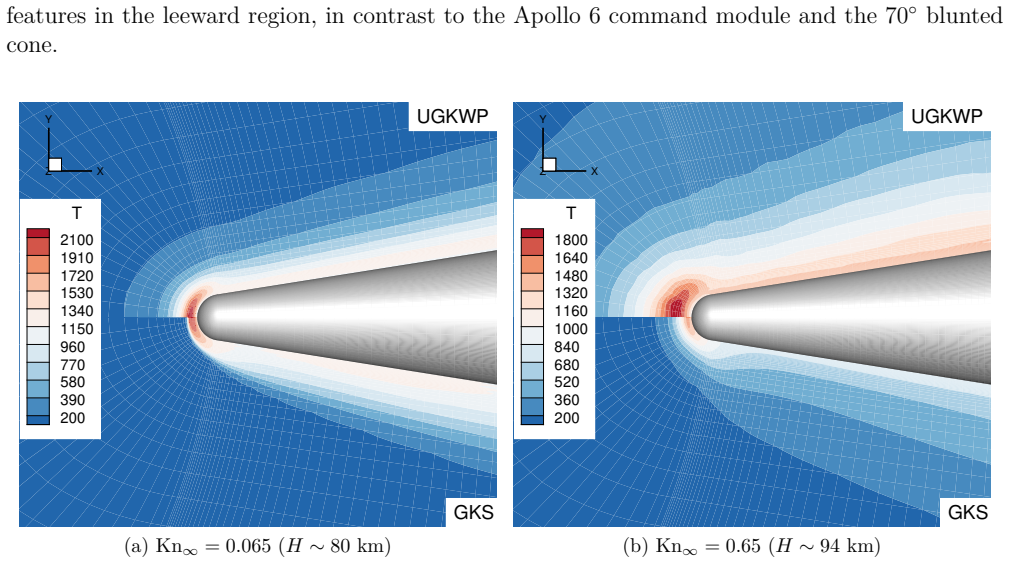


read the original abstract
Rarefied gas effects are of critical importance for the aerodynamic performance of hypersonic vehicles operating at high altitudes. In these scenarios, conventional computational fluid dynamics (CFD) solvers break down as the linear constitutive relations underlying the Navier-Stokes equations cease to be valid. Based on direct modeling, the unified gas-kinetic scheme (UGKS) and the unified gas-kinetic wave-particle (UGKWP) method successfully capture non-equilibrium physics across all Knudsen numbers, yet they incur substantially higher computational costs than continuum solvers. Within the same kinetic framework, the gas-kinetic scheme (GKS) employs the Chapman-Enskog expansion for near-equilibrium flow physics and adopts the same kinetic boundary conditions as UGKS and UGKWP. This formulation naturally permits velocity slip and temperature jump, thereby extending the applicability of GKS into the slip and transitional regimes. By utilizing this natural kinetic slip boundary condition, the GKS provides a more physically faithful representation of non-equilibrium wall interactions than conventional CFD solvers equipped with Maxwell-type slip conditions, ultimately yielding more accurate aerodynamic predictions. To determine the applicability of the GKS in near-continuum flow regimes, we first examine a simple circular cylinder geometry, comparing surface quantities and distribution functions in detail. Furthermore, we investigate a 9{\deg}blunted cone, a 70{\deg} blunted cone with a cylindrical sting, and the Apollo 6 command module. This analysis focuses on integrated aerodynamic predictions, which are validated against experimental data, Direct Simulation Monte Carlo (DSMC) simulations, and other kinetic methods.
Editorial analysis
A structured set of objections, weighed in public.
Referee Report
Summary. The manuscript examines the gas-kinetic scheme (GKS) with its built-in kinetic boundary conditions for near-continuum hypersonic flows. It claims that these conditions naturally capture velocity slip and temperature jump, providing a more physically faithful wall treatment than Maxwell-type slip conditions in conventional Navier-Stokes CFD solvers and thereby producing more accurate surface quantities and integrated aerodynamic forces. Validation cases include a circular cylinder (with detailed surface and distribution-function comparisons), a 9° blunted cone, a 70° blunted cone with sting, and the Apollo 6 command module; results are compared to experiments, DSMC, and other kinetic methods.
Significance. If substantiated, the work would establish GKS as a computationally lighter alternative to UGKS/UGKWP for the slip and early transitional regimes in hypersonic aerodynamics, while offering a clearer physical basis for wall modeling than ad-hoc slip corrections in continuum codes.
major comments (3)
- [Abstract] Abstract: the central comparative claim that the kinetic slip BC yields 'more accurate aerodynamic predictions' than conventional CFD with Maxwell-type slip conditions is unsupported by any direct head-to-head simulations on the same geometries; without NS+Maxwell runs, any observed agreement with experiment cannot be attributed specifically to the boundary condition rather than the GKS flux construction.
- [Abstract] Abstract: no quantitative error metrics (percentage errors, L2 norms), mesh-convergence data, or uncertainty estimates are supplied for surface pressure, heat flux, or integrated forces, so the accuracy statements relative to experiment and DSMC cannot be verified.
- [Abstract] Abstract (GKS formulation paragraph): the assertion that the Chapman-Enskog expansion remains adequate for the non-equilibrium effects in the tested hypersonic near-continuum cases is stated without supporting diagnostics (e.g., local Knudsen-number maps or comparison of higher-order moments), leaving the weakest assumption unexamined.
minor comments (1)
- [Abstract] Abstract: the notation '9{°}blunted cone' is a typesetting artifact and should be rendered consistently as 9°.
Simulated Author's Rebuttal
We thank the referee for the detailed and constructive report. We address each major comment below and indicate the revisions planned for the manuscript.
read point-by-point responses
-
Referee: [Abstract] Abstract: the central comparative claim that the kinetic slip BC yields 'more accurate aerodynamic predictions' than conventional CFD with Maxwell-type slip conditions is unsupported by any direct head-to-head simulations on the same geometries; without NS+Maxwell runs, any observed agreement with experiment cannot be attributed specifically to the boundary condition rather than the GKS flux construction.
Authors: We agree that the manuscript does not contain direct head-to-head comparisons of GKS against Navier-Stokes solvers employing Maxwell slip conditions on identical geometries and meshes. The abstract statement is motivated by the physical consistency of the kinetic boundary conditions (identical to those in UGKS/UGKWP) versus the approximate Maxwell model, together with the observed agreement of GKS results with DSMC and experiment. Because the attribution cannot be rigorously demonstrated without the missing comparisons, we will revise the abstract to remove the direct comparative claim of superior accuracy and instead emphasize the physical basis of the boundary condition and the agreement with reference data. revision: yes
-
Referee: [Abstract] Abstract: no quantitative error metrics (percentage errors, L2 norms), mesh-convergence data, or uncertainty estimates are supplied for surface pressure, heat flux, or integrated forces, so the accuracy statements relative to experiment and DSMC cannot be verified.
Authors: The referee correctly observes that the manuscript presents only qualitative visual comparisons. In the revised version we will add quantitative error metrics (percentage errors and L2 norms) for surface pressure, heat flux, and integrated aerodynamic coefficients against the available experimental and DSMC data. A short discussion of mesh convergence for the cylinder and cone cases will also be included. revision: yes
-
Referee: [Abstract] Abstract (GKS formulation paragraph): the assertion that the Chapman-Enskog expansion remains adequate for the non-equilibrium effects in the tested hypersonic near-continuum cases is stated without supporting diagnostics (e.g., local Knudsen-number maps or comparison of higher-order moments), leaving the weakest assumption unexamined.
Authors: We accept that supporting diagnostics are needed to justify the Chapman-Enskog assumption. The revised manuscript will include local Knudsen-number distributions for all test cases to confirm that the flows remain within the near-continuum regime. If space allows, selected higher-order moment comparisons will be added for the cylinder case. revision: yes
Circularity Check
No circularity: derivation relies on external benchmarks
full rationale
The paper applies the pre-existing GKS formulation (Chapman-Enskog expansion plus kinetic boundary conditions adopted from UGKS/UGKWP) to near-continuum cases and reports surface quantities and forces validated directly against independent experimental data, DSMC, and other kinetic methods. No parameter is fitted to the target aerodynamic quantities, no result is redefined in terms of itself, and no load-bearing step reduces by construction to a self-citation or internal fit. The comparative claim about Maxwell slip is an assertion tested via external data rather than a self-referential derivation.
Axiom & Free-Parameter Ledger
axioms (1)
- domain assumption Chapman-Enskog expansion remains valid for near-continuum non-equilibrium effects
Lean theorems connected to this paper
-
IndisputableMonolith/Foundation/ArithmeticFromLogic.lean (and Cost/FunctionalEquation.lean)reality_from_one_distinction; washburn_uniqueness_aczel unclear?
unclearRelation between the paper passage and the cited Recognition theorem.
The GKS employs the Chapman–Enskog expansion for near-equilibrium flow physics and adopts the same kinetic boundary conditions as UGKS and UGKWP... natural kinetic slip boundary condition
-
IndisputableMonolith/Foundation/AbsoluteFloorClosure.leanabsolute_floor_iff_bare_distinguishability unclear?
unclearRelation between the paper passage and the cited Recognition theorem.
the kinetic boundary condition... incident gas distribution function is derived from the Chapman–Enskog (CE) expansion, while the reflected distribution function is determined by the wall Maxwellian
What do these tags mean?
- matches
- The paper's claim is directly supported by a theorem in the formal canon.
- supports
- The theorem supports part of the paper's argument, but the paper may add assumptions or extra steps.
- extends
- The paper goes beyond the formal theorem; the theorem is a base layer rather than the whole result.
- uses
- The paper appears to rely on the theorem as machinery.
- contradicts
- The paper's claim conflicts with a theorem or certificate in the canon.
- unclear
- Pith found a possible connection, but the passage is too broad, indirect, or ambiguous to say the theorem truly supports the claim.
Reference graph
Works this paper leans on
-
[1]
M. S. Ivanov, S. F. Gimelshein, Computational hypersonic rarefied flows, Annual Review of Fluid Mechanics 30 (1) (1998) 469–505. doi:10.1146/annurev.fluid.30.1.469
-
[2]
I. D. Boyd, T. E. Schwartzentruber, Nonequilibrium Gas Dynamics and Molecular Simulation, Cambridge University Press, 2017. doi:10.1017/9781139683494
-
[3]
A. J. Lofthouse, I. D. Boyd, M. J. Wright, Effects of continuum breakdown on hypersonic aerothermodynamics, Physics of Fluids 19 (2) (2007) 027105. doi:10.1063/1.2710289
-
[4]
G. A. Bird, Molecular Gas Dynamics and the Direct Simulation of Gas Flows, Oxford Uni- versity Press, Oxford, 1994. doi:10.1093/oso/9780198561958.001.0001
-
[5]
K. Xu, Direct Modeling for Computational Fluid Dynamics, Advances in Computational Fluid Dynamics, World Scientific, 2015. doi:10.1142/9324
-
[6]
K. Xu, J.-C. Huang, A unified gas-kinetic scheme for continuum and rarefied flows, Journal of Computational Physics 229 (20) (2010) 7747–7764. doi:10.1016/j.jcp.2010.06.032
-
[7]
G. A. Bird, Direct simulation and the Boltzmann equation, Physics of Fluids 13 (11) (1970) 2676–2681. doi:10.1063/1.1692849
-
[8]
J. E. Broadwell, Study of rarefied shear flow by the discrete velocity method, Journal of Fluid Mechanics 19 (3) (1964) 401–414. doi:10.1017/S0022112064000817
-
[9]
K. Xu, A gas-kinetic BGK scheme for the Navier–Stokes equations and its connection with artificial dissipation and Godunov method, Journal of Computational Physics 171 (1) (2001) 289–335. doi:10.1006/jcph.2001.6790
-
[11]
Y. Wei, W. Long, K. Xu, Adaptive unified gas-kinetic scheme for diatomic gases with rota- tional and vibrational nonequilibrium, Computer Physics Communications 305 (2024) 109324. doi:10.1016/j.cpc.2024.109324
-
[12]
Y. Wei, J. Cao, K. Xu, Unified gas-kinetic scheme for reactive flow with multi-scale transport and chemical non-equilibrium, Journal of Computational Physics 546 (2026) 114514. doi: 10.1016/j.jcp.2025.114514
-
[14]
Y. Zhu, C. Zhong, K. Xu, Unified gas-kinetic scheme with multigrid convergence for rarefied flow study, Physics of Fluids 29 (9) (2017) 096102. doi:10.1063/1.4994020. 25
-
[15]
Y. Zhu, C. Zhong, K. Xu, An implicit unified gas-kinetic scheme for unsteady flow in all Knudsen regimes, Journal of Computational Physics 386 (2019) 190–217. doi:10.1016/j. jcp.2019.01.033
work page doi:10.1016/j 2019
-
[16]
S. Chen, K. Xu, C. Lee, Q. Cai, A unified gas kinetic scheme with moving mesh and velocity space adaptation, Journal of Computational Physics 231 (20) (2012) 6643–6664. doi:10. 1016/j.jcp.2012.05.019
work page 2012
-
[17]
T. Xiao, C. Liu, K. Xu, Q. Cai, A velocity-space adaptive unified gas kinetic scheme for continuum and rarefied flows, Journal of Computational Physics 415 (2020) 109535. doi: 10.1016/j.jcp.2020.109535
-
[18]
W. Long, Y. Wei, K. Xu, An implicit adaptive unified gas-kinetic scheme for steady-state solu- tions of nonequilibrium flows, Physics of Fluids 36 (2024) 106114. doi:10.1063/5.0232275
-
[19]
Y. Zhang, Y. Wei, W. Long, K. Xu, An efficiency and memory-saving programming paradigm for the unified gas-kinetic scheme, Computer Physics Communications 314 (2025) 109684. doi:10.1016/j.cpc.2025.109684
-
[20]
Y. Zhu, C. Liu, C. Zhong, K. Xu, Unified gas-kinetic wave-particle methods. II. multiscale simulation on unstructured mesh, Physics of Fluids 31 (6) (2019) 067105. doi:10.1063/1. 5097645
work page doi:10.1063/1 2019
-
[21]
C. Liu, Y. Zhu, K. Xu, Unified gas-kinetic wave-particle methods I: continuum and rarefied gas flow, Journal of Computational Physics 401 (2020) 108977. doi:10.1016/j.jcp.2019. 108977
-
[22]
Y. Chen, Y. Zhu, K. Xu, A three-dimensional unified gas-kinetic wave-particle solver for flow computation in all regimes, Physics of Fluids 32 (9) (2020) 096108. doi:10.1063/5.0021199
-
[23]
W. Long, Y. Wei, K. Xu, Nonequilibrium flow simulations using unified gas-kinetic wave- particle method, AIAA Journal 62 (4) (2024) 1411–1433. doi:10.2514/1.J063641
-
[24]
W. Li, C. Liu, Y. Zhu, J. Zhang, K. Xu, Unified gas-kinetic wave-particle methods III: multiscale photon transport, Journal of Computational Physics 408 (2020) 109280. doi: 10.1016/j.jcp.2020.109280
-
[25]
C. Liu, K. Xu, Unified gas-kinetic wave-particle methods IV: multi-species gas mix- ture and plasma transport, Advances in Aerodynamics 3 (1) (2021) 9. doi:10.1186/ s42774-021-00062-1
work page 2021
- [26]
-
[27]
Z. Pu, K. Xu, Electromagnetic flow control in hypersonic rarefied environment, Journal of Fluid Mechanics 1033 (2026) A37. doi:10.1017/jfm.2026.11462. 26
-
[28]
X. Xu, Y. Chen, C. Liu, Z. Li, K. Xu, Unified gas-kinetic wave-particle methods V: diatomic molecular flow, Journal of Computational Physics 442 (2021) 110496. doi:10.1016/j.jcp. 2021.110496
-
[29]
Y. Wei, Y. Zhu, K. Xu, Unified gas-kinetic wave-particle methods VII: diatomic gas with rota- tional and vibrational nonequilibrium, Journal of Computational Physics 497 (2024) 112610. doi:10.1016/j.jcp.2023.112610
-
[30]
X. Yang, C. Liu, X. Ji, W. Shyy, K. Xu, Unified gas-kinetic wave-particle methods VI: disperse dilute gas-particle multiphase flow, Communications in Computational Physics 31 (3) (2022) 669–706. doi:10.4208/cicp.OA-2021-0153
-
[31]
X. Yang, W. Shyy, K. Xu, Unified gas-kinetic wave-particle method for gas-particle two- phase flow from dilute to dense solid particle limit, Physics of Fluids 34 (2) (2022) 023312. doi:10.1063/5.0081105
-
[32]
X. Yang, Y. Wei, W. Shyy, K. Xu, Unified gas-kinetic wave-particle method for three- dimensional simulation of gas-particle fluidized bed, Chemical Engineering Journal 453 (2023) 139541. doi:10.1016/j.cej.2022.139541
-
[33]
X. Yang, W. Shyy, K. Xu, Unified gas-kinetic wave-particle method for polydisperse gas-solid particle multiphase flow, Journal of Fluid Mechanics 983 (2024) A37. doi:10.1017/jfm. 2024.80
work page doi:10.1017/jfm 2024
-
[34]
C. Liu, W. Li, Y. Wang, P. Song, K. Xu, An implicit unified gas-kinetic wave-particle method for radiative transport process, Physics of Fluids 35 (11) (2023) 112013. doi:10.1063/5. 0174774
work page doi:10.1063/5 2023
-
[35]
X. Yang, Y. Zhu, C. Liu, K. Xu, Unified gas-kinetic wave-particle method for frequency- dependent radiation transport equation, Journal of Computational Physics 522 (2025) 113587. doi:10.1016/j.jcp.2024.113587
-
[36]
H. Liu, X. Yang, C. Zhang, X. Ji, K. Xu, Unified gas-kinetic wave-particle method for multi- scale phonon transport, Physical Review E 112 (2025) 065304. doi:10.1103/hz9s-5qbm
-
[37]
X. Yang, K. Xu, Wave-particle based multiscale modeling and simulation of non-equilibrium turbulent flows (2025). arXiv:2503.07207, doi:10.48550/arXiv.2503.07207. URL https://arxiv.org/abs/2503.07207
-
[38]
Y. Wei, J. Cao, X. Ji, K. Xu, Adaptive wave-particle decomposition in UGKWP method for high-speed flow simulations, Advances in Aerodynamics 5 (2023) 25. doi:10.1186/ s42774-023-00156-y
work page 2023
-
[39]
J. Cao, Y. Wei, W. Long, C. Zhong, K. Xu, Adaptive criterion and modification of wave- particle decomposition in UGKWP method for high-speed flow simulation, Computers & Fluids 305 (2026) 106896. doi:10.1016/j.compfluid.2025.106896
- [40]
-
[41]
Q. Li, S. Fu, K. Xu, Application of gas-kinetic scheme with kinetic boundary conditions in hypersonic flow, AIAA Journal 43 (10) (2005) 2170–2176. doi:10.2514/1.14130
-
[42]
E. M. Shakhov, Generalization of the Krook kinetic relaxation equation, Fluid Dynamics 3 (5) (1968) 95–96. doi:10.1007/BF01029546
-
[43]
Y. Zhang, X. Ji, K. Xu, A high-order compact gas-kinetic scheme in a rotating coordinate frame and on sliding mesh, International Journal of Computational Fluid Dynamics 37 (2) (2023) 105–128. doi:10.1080/10618562.2023.2178647
-
[44]
X. Ji, W. Shyy, K. Xu, A gradient compression-based compact high-order gas-kinetic scheme on 3D hybrid unstructured meshes, International Journal of Computational Fluid Dynamics 35 (7) (2021) 485–509. doi:10.1080/10618562.2021.1991329
-
[45]
C. J. Greenshields, J. M. Reese, Rarefied hypersonic flow simulations using the Navier–Stokes equations with non-equilibrium boundary conditions, Progress in Aerospace Sciences 52 (2012) 80–87. doi:10.1016/j.paerosci.2011.08.001
-
[46]
J. N. Moss, C. E. Glass, F. A. Greene, DSMC simulations of apollo capsule aerodynamics for hypersonic rarefied conditions, in: Proceedings of the 9th AIAA/ASME Joint Thermophysics and Heat Transfer Conference, no. AIAA Paper 2006-3577, 2006. doi:10.2514/6.2006-3577
-
[47]
R. Zhang, S. Liu, J. Chen, C. Zhuo, C. Zhong, A conservative implicit scheme for three- dimensional steady flows of diatomic gases in all flow regimes using unstructured meshes in the physical and velocity spaces, Physics of Fluids 36 (1) (2024) 016114. doi:10.1063/5.0186520
-
[48]
J. Allègre, D. Bisch, J.-C. Lengrand, Experimental rarefied aerodynamic forces at hypersonic conditions over 70-degree blunted cone, Journal of Spacecraft and Rockets 34 (6) (1997) 719–
work page 1997
-
[49]
R. C. Palharini, C. White, T. J. Scanlon, R. E. Brown, M. K. Borg, J. M. Reese, Benchmark numerical simulations of rarefied non-reacting gas flows using an open-source DSMC code, Computers & Fluids 120 (2015) 140–157. doi:10.1016/j.compfluid.2015.07.021
-
[50]
J. N. Moss, V. K. Dogra, J. M. Price, D. B. Hash, Comparison of DSMC and experimental results for hypersonic external flows, in: 30th Thermophysics Conference, 1995, AIAA Paper 95-2028. doi:10.2514/6.1995-2028
-
[51]
M. Schouler, Y. Prévereaud, L. Mieussens, Survey of flight and numerical data of hypersonic rarefied flows encountered in Earth orbit and atmospheric reentry, Progress in Aerospace Sciences 118 (2020) 100638. doi:10.1016/j.paerosci.2020.100638
-
[52]
J. Cao, S. Liu, C. Zhong, C. Zhuo, K. Xu, Multiple solutions of nonlinear coupled constitu- tive relation model and its rectification in non-equilibrium flow computation, Computers & Mathematics with Applications 174 (2024) 1–17. doi:10.1016/j.camwa.2024.08.017
-
[53]
X. Jin, C. Liu, X. Wang, X. Cheng, Q. Wang, B. Wang, Computational and experimental study of rarefied aerodynamic forces of blunted cone, AIAA Journal 64 (1) (2026) 468–477. doi:10.2514/1.J065362. 28
-
[54]
F. Palacios, T. D. Economon, A. C. Aranake, S. R. Copeland, A. K. Lonkar, T. W. Lukaczyk, D. E. Manosalvas, K. R. Naik, S. A. Padrón, B. D. Tracey, A. Variyar, J. J. Alonso, Stanford university unstructured (SU2): Analysis and design technology for turbulent flows, in: 52nd AIAA Aerospace Sciences Meeting, no. AIAA 2014-0243, 2014. doi:10.2514/6.2014-0243
-
[55]
D. E. Boylan, J. L. Potter, Aerodynamics of typical lifting bodies under conditions simulating very high altitudes, AIAA Journal 5 (2) (1967) 226–232. doi:10.2514/3.3946
-
[56]
J. F. Padilla, I. D. Boyd, Assessment of rarefied hypersonic aerodynamics modeling and windtunnel data, in: 9th AIAA/ASME Joint Thermophysics and Heat Transfer Conference, no. AIAA 2006-3390, 2006. doi:10.2514/6.2006-3390. 29
discussion (0)
Sign in with ORCID, Apple, or X to comment. Anyone can read and Pith papers without signing in.