On the treatment of topology changes on 3D polyhedral moving meshes via 4D space-time hole-like elements in direct ALE ADER-DG methods
Pith reviewed 2026-05-25 03:38 UTC · model grok-4.3
The pith
Direct ALE ADER-DG schemes handle 3D mesh topology changes via 4D hole-like elements while preserving conservation and order.
A machine-rendered reading of the paper's core claim, the machinery that carries it, and where it could break.
Core claim
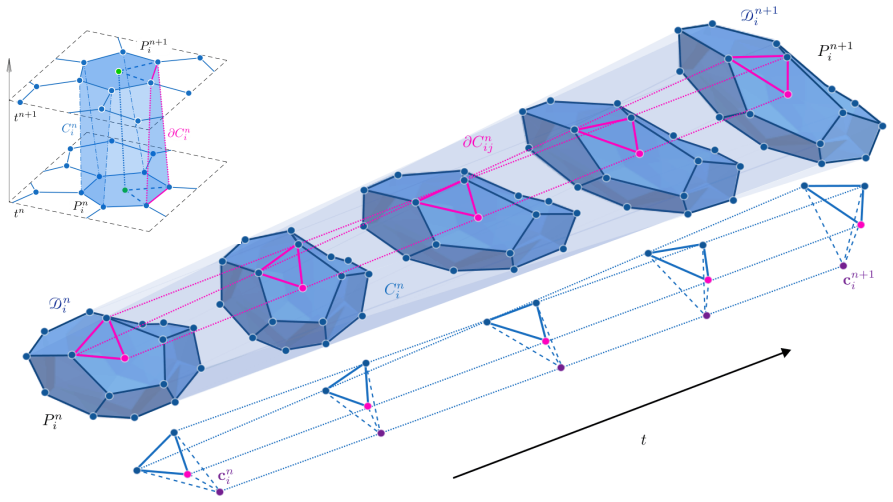
By defining hole-like 4D space-time elements that connect elements with different neighborhoods due to 2-3, 3-2, and 4-4 flips on a Delaunay tetrahedralization, the method integrates the PDE over space-time control volumes that accommodate topology changes. These elements have zero three-dimensional volume at both the initial and final times but a strictly positive four-dimensional volume, enabling a consistent high-order evolution without complex remapping techniques.
What carries the argument
Hole-like 4D elements: degenerate space-time volumes with zero 3D volume at both ends of the time interval but positive 4D measure, inserted to fill gaps arising from topology changes in the underlying 3D mesh.
If this is right
- The numerical scheme remains fully conservative across topology changes.
- The geometric conservation law is satisfied on the evolving meshes.
- The method maintains its designed order of convergence in the presence of frequent topology changes.
- No projection-reconstruction or mesh intersection operations are required between time levels.
- The construction applies directly to 2-3, 3-2, and 4-4 flips on Delaunay tetrahedralizations.
Where Pith is reading between the lines
- Analogous degenerate space-time fillers could be constructed for other classes of topology transitions beyond the three flips treated here.
- The same space-time connection strategy might reduce implementation cost when coupling the scheme to adaptive mesh refinement algorithms.
- The explicit geometric description of the 4D volumes supplies a template that other high-order space-time methods could reuse for arbitrary polyhedral meshes.
- Visualization techniques introduced for these elements may help diagnose conservation errors in any 4D space-time discretization that permits mesh reconfiguration.
Load-bearing premise
The geometric construction and quadrature rules for the hole-like 4D elements can be defined and integrated without introducing conservation errors or order reduction for the listed flips on Delaunay tetrahedralizations.
What would settle it
A simulation run with repeated 2-3 and 3-2 flips in which either total conserved quantities deviate from the reference value beyond truncation error or the observed convergence rate falls below the theoretical order for the chosen polynomial degree.
Figures




read the original abstract
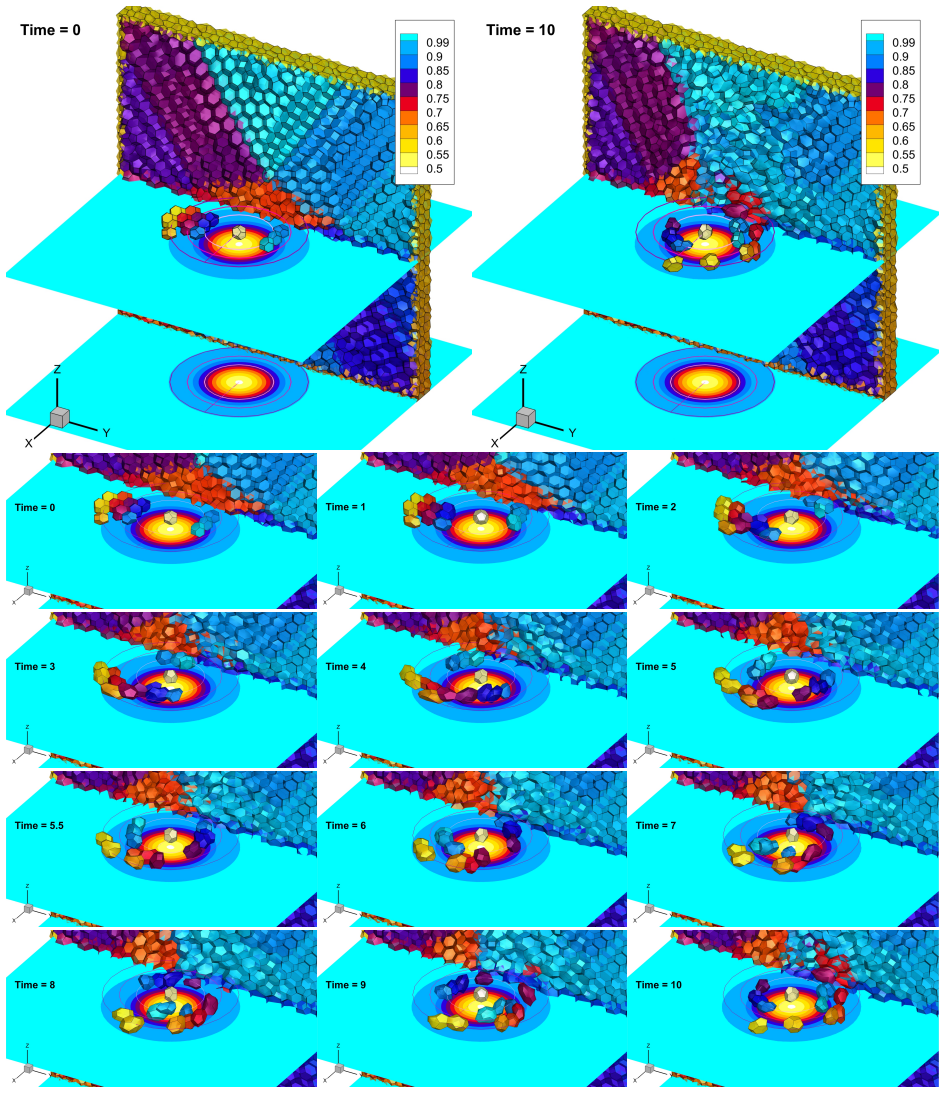
This work investigates a novel approach for the high order evolution of hyperbolic PDEs using ADER discontinuous Galerkin schemes within a direct Arbitrary-Lagrangian-Eulerian (ALE) framework on 3D moving polyhedral meshes with topology changes. Our direct ALE method is based on the PDE integration over 4D (3D+time) space-time control volumes connecting the elements of two subsequent tessellations, so to simultaneously evolve the solution both in time and between the two different meshes in an effective and high order manner. In this way, we also avoid any complex and expensive projection-reconstruction techniques and any mesh intersection operation typical of indirect ALE schemes. The crucial step consists in the strategy for building space-time control volumes that also connect elements with different shapes and neighborhoods due to a change in topology. In fact, simply linking existing elements by collapsing or expanding their edges would leave a "hole" in the space-time domain. To fill it, we introduce additional degenerate elements that we call hole-like elements. These are 4D objects with zero 3D volume at both the beginning and end of the timestep, but which possess a strictly non-zero 4D space-time volume. Given the uniqueness of this space-time approach in 3D+time and the necessity of characterizing the geometry of such elements, the main objective of this paper is the formal geometrical and numerical description of the method as well as the presentation of new and intuitive visualization strategies. In particular, we provide a detailed characterization of the hole-like elements arising in correspondence to 2-3, 3-2, and 4-4 flips on the underlying Delaunay tetrahedralization. Finally, we numerically show that the method is fully conservative, satisfies the GCL and maintains the correct order of convergence even in the presence of frequent topology changes.
Editorial analysis
A structured set of objections, weighed in public.
Referee Report
Summary. The manuscript presents a direct ALE ADER discontinuous Galerkin method for 3D hyperbolic PDEs on polyhedral moving meshes that undergo topology changes. Space-time control volumes are constructed by connecting elements across timesteps; for 2-3, 3-2 and 4-4 flips on Delaunay tetrahedralizations, additional degenerate 4D 'hole-like' elements (zero 3D volume at both temporal endpoints but positive 4D measure) are introduced to fill gaps. The authors supply a geometric characterization of these elements together with visualization techniques and report numerical experiments asserting that the resulting scheme remains fully conservative, satisfies the geometric conservation law, and retains its design order of accuracy.
Significance. If the quadrature rules on the hole-like elements can be shown to be algebraically consistent with the space-time divergence theorem, the approach would remove the need for projection or intersection operations in direct ALE schemes while handling topology changes at high order. The explicit construction for the listed Delaunay flips and the new visualization strategies constitute concrete technical contributions to the literature on arbitrary-Lagrangian-Eulerian methods.
major comments (2)
- [Numerical results] Numerical verification section: the claims of exact conservation, GCL satisfaction and order preservation are stated without accompanying quantitative tables (e.g., global conservation errors, GCL violation norms, or L2 error tables versus polynomial degree both with and without topology changes). This absence prevents assessment of whether the hole-like element quadrature introduces any residual that would violate the central assertions.
- [Geometric construction of hole-like elements] Section describing the quadrature rules for hole-like elements (2-3, 3-2 and 4-4 flips): the geometric mapping is defined such that the 3D volume vanishes at the temporal endpoints while the 4D measure is positive, yet no explicit quadrature formula or algebraic verification is supplied showing that the space-time divergence theorem holds exactly for the polynomial degree of the underlying ADER-DG scheme. Without this step the conservation and GCL properties remain formally unproven for the degenerate case.
minor comments (2)
- [Abstract] The abstract and introduction would benefit from a single sentence clarifying that the method is restricted to the three enumerated flip types on Delaunay tetrahedralizations.
- [Figures] Figure captions for the 4D visualizations should explicitly label the time coordinate and the two temporal faces to aid readers unfamiliar with the space-time construction.
Simulated Author's Rebuttal
We thank the referee for the positive assessment of the significance of the work and for the constructive comments. We address each major point below and will revise the manuscript to strengthen the numerical verification and formal proofs as requested.
read point-by-point responses
-
Referee: [Numerical results] Numerical verification section: the claims of exact conservation, GCL satisfaction and order preservation are stated without accompanying quantitative tables (e.g., global conservation errors, GCL violation norms, or L2 error tables versus polynomial degree both with and without topology changes). This absence prevents assessment of whether the hole-like element quadrature introduces any residual that would violate the central assertions.
Authors: We agree that the current presentation relies primarily on figures and qualitative assertions. In the revised manuscript we will add explicit quantitative tables reporting global conservation errors, GCL violation norms, and L2 error tables versus polynomial degree, both for runs with and without topology changes. These tables will directly quantify any residual introduced by the hole-like element quadrature. revision: yes
-
Referee: [Geometric construction of hole-like elements] Section describing the quadrature rules for hole-like elements (2-3, 3-2 and 4-4 flips): the geometric mapping is defined such that the 3D volume vanishes at the temporal endpoints while the 4D measure is positive, yet no explicit quadrature formula or algebraic verification is supplied showing that the space-time divergence theorem holds exactly for the polynomial degree of the underlying ADER-DG scheme. Without this step the conservation and GCL properties remain formally unproven for the degenerate case.
Authors: We concur that an explicit algebraic verification is required for a formal proof. The revised version will supply the concrete quadrature formulas for the 2-3, 3-2 and 4-4 hole-like elements and will demonstrate algebraically that the space-time divergence theorem holds exactly for the polynomial degree employed by the ADER-DG scheme, thereby confirming conservation and GCL compliance for the degenerate elements. revision: yes
Circularity Check
No significant circularity detected
full rationale
The paper presents a novel geometric construction for 4D hole-like elements to handle topology changes in direct ALE ADER-DG schemes on 3D meshes. Conservation, GCL compliance, and order of accuracy are asserted via numerical tests on specific Delaunay flips rather than by algebraic reduction to fitted inputs or self-citations. No equations, parameter fits, or load-bearing uniqueness theorems are shown to collapse by construction to the authors' prior definitions or ansatzes. The derivation chain remains self-contained against external benchmarks.
Axiom & Free-Parameter Ledger
invented entities (1)
-
hole-like elements
no independent evidence
Reference graph
Works this paper leans on
-
[1]
F. Alauzet. A changing-topology moving mesh technique for large displacements. Engineering with Computers, 30(2):175–200, 2014
work page 2014
-
[2]
R.W. Anderson, V .A Dobrev, T.V . Kolev, R.N. Rieben, and V .Z. Tomov. High-order multi-material ALE hydrodynamics. SIAM Journal on Scientific Computing, 40(1):B32–B58, 2018
work page 2018
-
[3]
D.S. Balsara. Self-adjusting, positivity preserving high order schemes for hydrodynamics and magnetohydrody- namics. Journal of Computational Physics, 231(22):7504–7517, 2012
work page 2012
- [4]
- [5]
-
[6]
T.B. Belytschko and J.M. Kennedy. Computer models for subassembly simulation. Nuclear Engineering and Design, 49(1-2):17–38, 1978
work page 1978
-
[7]
D.J. Benson. Computational methods in Lagrangian and Eulerian hydrocodes. Computer methods in Applied mechanics and Engineering, 99(2-3):235–394, 1992
work page 1992
- [8]
- [9]
-
[10]
W. Bo and M.J. Shashkov. Adaptive reconnection-based arbitrary Lagrangian Eulerian method. Journal of Computational Physics, 299:902–939, 2015. 32
work page 2015
- [11]
-
[12]
M. Bonafini, D. Torlo, and E. Gaburro. Stability analysis of Arbitrary-Lagrangian-Eulerian ADER-DG methods on classical and degenerate spacetime geometries. arXiv preprint arXiv:2602.09198, 2026
-
[13]
W. Boscheri and M. Dumbser. Arbitrary–Lagrangian–Eulerian One–Step WENO Finite V olume Schemes on Unstructured Triangular Meshes. Communications in Computational Physics, 14:1174–1206, 2013
work page 2013
-
[14]
W. Boscheri and M. Dumbser. A direct Arbitrary-Lagrangian-Eulerian ADER-WENO finite volume scheme on unstructured tetrahedral meshes for conservative and non-conservative hyperbolic systems in 3d. Journal of Computational Physics, 275:484 – 523, 2014
work page 2014
-
[15]
W. Boscheri, M. Dumbser, and E. Gaburro. Continuous Finite Element Subgrid Basis Functions for Discontinu- ous Galerkin Schemes on Unstructured Polygonal V oronoi Meshes.Communications in Computational Physics, 32(1):259–298, 2022
work page 2022
-
[16]
W. Boscheri, M. Dumbser, and M. Righetti. A semi-implicit scheme for 3D free surface flows with high-order velocity reconstruction on unstructured V oronoi meshes.International journal for numerical methods in fluids, 72(6):607–631, 2013
work page 2013
-
[17]
W. Boscheri, M. Dumbser, and O. Zanotti. High order cell-centered Lagrangian-type finite volume schemes with time-accurate local time stepping on unstructured triangular meshes. Journal of Computational Physics, 291:120–150, 2015
work page 2015
- [18]
-
[19]
S. Busto and M. Dumbser. A new family of thermodynamically compatible discontinuous Galerkin methods for continuum mechanics and turbulent shallow water flows. Journal of Scientific Computing, 93(2):56, 2022
work page 2022
-
[20]
E.J. Caramana and M.J. Shashkov. Elimination of artificial grid distorsion and hourglass–type motions by means of Lagrangian subzonal masses and pressures. Journal of Computational Physics, 142:521–561, 1998
work page 1998
-
[21]
M.J. Castro, J.M. Gallardo, J.A. López, and C. Parés. Well-balanced high order extensions of godunov’s method for semilinear balance laws. SIAM Journal of Numerical Analysis, 46:1012–1039, 2008
work page 2008
-
[22]
M.J. Castro, J.M. Gallardo, and C. Parés. High-order finite volume schemes based on reconstruction of states for solving hyperbolic systems with nonconservative products. Applications to shallow-water systems. Mathematics of Computation, 75:1103–1134, 2006
work page 2006
-
[23]
S. Chiocchetti, I. Peshkov, S. Gavrilyuk, and M. Dumbser. High order ADER schemes and GLM curl cleaning for a first order hyperbolic formulation of compressible flow with surface tension. Journal of Computational Physics, 426:109898, 2021
work page 2021
-
[24]
M. Ciallella, S. Clain, E. Gaburro, and M. Ricchiuto. Very high order treatment of embedded curved boundaries in compressible flows: ADER discontinuous Galerkin with a space-time Reconstruction for Off-site data. Computers & Mathematics with Applications, 175:1–18, 2024
work page 2024
-
[25]
A. Colaïtis, S. Guisset, and J. Breil. A cell-centered Amr-Ale framework for 3d multi-material hydrodynamics. Part I: Lagrangian and indirect Euler Amr algorithms. Journal of Computational Physics, page 114701, 2026
work page 2026
-
[26]
A. Colaïtis, S. Guisset, and J. Breil. A cell-centered AMR-ALE framework for 3D multi-material hydrodynamics. Part II: linesweep ALE rezoning for nonconformal block-structured AMR meshes. Journal of Computational Physics, page 114702, 2026
work page 2026
-
[27]
M. Cremonesi, A. Frangi, and U. Perego. A lagrangian finite element approach for the analysis of fluid–structure interaction problems. International Journal for Numerical Methods in Engineering, 84(5):610–630, 2010. 33
work page 2010
-
[28]
M. Cremonesi, S. Meduri, U. Perego, and A. Frangi. An explicit lagrangian finite element method for free-surface weakly compressible flows. Computational Particle Mechanics, 4(3):357–369, 2017
work page 2017
-
[29]
F. Dassi, L. Kamenski, P. Farrell, and S. Hang. Tetrahedral mesh improvement using moving mesh smooth- ing, lazy searching flips, and RBF surface reconstruction. Computer-Aided Design, 103:2–13, 2018. 25th International Meshing Roundtable Special Issue: Advances in Mesh Generation
work page 2018
-
[30]
E. B. de L’isle and P. L. George. Optimization of tetrahedral meshes. In Modeling, Mesh Generation, and Adaptive Numerical Methods for Partial DifferentialEquations. The IMA V olumesin Mathematics and its Applications., volume 75, pages 97–127. Springer New York, 1995
work page 1995
-
[31]
S. Del Pino and I. Marmajou. Triangular metric-based mesh adaptation for compressible multi-material flows in semi-Lagrangian coordinates. Journal of Computational Physics, 478:111975, 2023
work page 2023
-
[32]
B. Després. Numerical methods for Eulerian and Lagrangian conservation laws. Birkhäuser, 2017
work page 2017
-
[33]
B. Després. Lagrangian voronoï meshes and particle dynamics with shocks. Computer Methods in Applied Mechanics and Engineering, 418:116427, 2024
work page 2024
-
[34]
D. Di Cristofaro, A. Frangi, and M. Cremonesi. 3d fluid–structure interaction simulation with an Arbitrary– Lagrangian–Eulerian approach with applications to flying objects. Engineering with Computers, pages 1–23, 2024
work page 2024
-
[35]
V .A. Dobrev, T.E. Ellis, Tz.V . Kolev, and R.N. Rieben. High order curvilinear finite elements for axisymmetric Lagrangian hydrodynamics. Computers and Fluids, 83:58–69, 2013
work page 2013
- [36]
-
[37]
Donea, SHJP Giuliani, and J.-P
J. Donea, SHJP Giuliani, and J.-P. Halleux. An arbitrary Lagrangian-Eulerian finite element method for transient dynamic fluid-structure interactions. Computer methods in applied mechanics and engineering, 33(1-3):689– 723, 1982
work page 1982
-
[38]
M. Dumbser. Arbitrary–Lagrangian–Eulerian ADER–WENO finite volume schemes with time–accurate local time stepping for hyperbolic conservation laws. Computer Methods in Applied Mechanics and Engineering, 280:57–83, 2014
work page 2014
-
[39]
M. Dumbser, D.S. Balsara, E.F. Toro, and C.-D. Munz. A unified framework for the construction of one-step finite volume and discontinuous Galerkin schemes on unstructured meshes. Journal of Computational Physics, 227(18):8209–8253, 2008
work page 2008
-
[40]
M. Dumbser, I. Peshkov, E. Romenski, and O. Zanotti. High order ADER schemes for a unified first order hyperbolic formulation of continuum mechanics: viscous heat-conducting fluids and elastic solids. Journal of Computational Physics, 314:824–862, 2016
work page 2016
-
[41]
M. Dumbser, I. Peshkov, E. Romenski, and O. Zanotti. High order ADER schemes for a unified first order hyper- bolic formulation of Newtonian continuum mechanics coupled with electro-dynamics. Journal of Computational Physics, 348:298–342, 2017
work page 2017
-
[42]
M. Dumbser, O. Zanotti, E. Gaburro, and I. Peshkov. A well-balanced discontinuous Galerkin method for the first–order Z4 formulation of the Einstein–Euler system. Journal of Computational Physics, page 112875, 2024
work page 2024
-
[43]
D.C. Eder, C. Parisuana, A. Fisher, P. Yip, T. Schwartzentruber, and A. Koniges. A 3D Arbitrary Lagrangian Eulerian Adaptive Mesh Refinement Framework for Simulating Hypersonic Raindrop Impacts. In AIAA SCITECH 2026 Forum, page 0730, 2026. 34
work page 2026
-
[44]
F. Fambri. Discontinuous Galerkin methods for compressible and incompressible flows on space–time adaptive meshes: toward a novel family of efficient numerical methods for fluid dynamics.Archives of Computational Methods in Engineering, 27(1):199–283, 2020
work page 2020
-
[45]
E. Guerrero Fernández, M.J. Castro Díaz, M. Dumbser, and T. Morales De Luna. An arbitrary high order well-balanced ADER-DG numerical scheme for the multilayer shallow-water model with variable density. Journal of Scientific Computing, 90(1):52, 2022
work page 2022
-
[46]
L. A. Freitag and C. Ollivier-Gooch. Tetrahedral mesh improvement using swapping and smoothing.International Journal for Numerical Methods in Engineering, 40(21):3979–4002, 1997
work page 1997
-
[47]
E. Gaburro. A unified framework for the solution of hyperbolic PDE systems using high order direct Arbitrary- Lagrangian–Eulerian schemes on moving unstructured meshes with topology change.Archives of Computational Methods in Engineering, 28(3):1249–1321, 2021
work page 2021
-
[48]
E. Gaburro. High order well-balanced Arbitrary-Lagrangian-Eulerian ADER discontinuous Galerkin schemes on general polygonal moving meshes. Computers & Fluids, page 106764, 2025
work page 2025
-
[49]
E. Gaburro, W. Boscheri, S. Chiocchetti, C. Klingenberg, V . Springel, and M. Dumbser. High order di- rect arbitrary-lagrangian-eulerian schemes on moving voronoi meshes with topology changes. Journal of Computational Physics, 407:109167, 2020
work page 2020
-
[50]
E. Gaburro, W. Boscheri, S. Chiocchetti, and M. Ricchiuto. Discontinuous Galerkin schemes for hyperbolic systems in non-conservative variables: quasi-conservative formulation with subcell finite volume corrections. Computer Methods in Applied Mechanics and Engineering, 431:117311, 2024
work page 2024
-
[51]
E. Gaburro and S. Chiocchetti. High-order Arbitrary-Lagrangian-Eulerian schemes on crazy moving V oronoi meshes. In Young Researchers Conference, pages 99–119. Springer, 2021
work page 2021
-
[52]
E. Gaburro, M. Dumbser, and M.J. Castro. Direct Arbitrary-Lagrangian-Eulerian finite volume schemes on moving nonconforming unstructured meshes. Computers & Fluids, 159:254–275, 2017
work page 2017
-
[53]
E. Gaburro, M. Ricchiuto, and M. Dumbser. On general and complete multidimensional riemann solvers for nonlinear systems of hyperbolic conservation laws. Computers and Fluids, 311, 2026
work page 2026
-
[54]
G. Gallice, A. Chan, R. Loubère, and P.-H. Maire. Entropy stable and positivity preserving Godunov-type schemes for multidimensional hyperbolic systems on unstructured grid. Journal of Computational Physics, 468:111493, 2022
work page 2022
-
[55]
S. Guisset, G. Damour, and J. Breil. Cell-centered indirect Arbitrary Lagrangian-Eulerian numerical strategy for solving 3D gas dynamics equations. Journal of Computational Physics, 505:112903, 2024
work page 2024
-
[56]
M. Han Veiga, P. Öffner, and D. Torlo. Dec and ader: similarities, differences and a unified framework.Journal of Scientific Computing, 87(1):1–35, 2021
work page 2021
-
[57]
S. Hang. TetGen, a Delaunay-based quality tetrahedral mesh generator. ACM Trans. Math. Softw, 41(2):11, 2015
work page 2015
-
[58]
A. Hidalgo and M. Dumbser. ADER schemes for nonlinear systems of stiffadvection–diffusion–reaction equations. Journal of Scientific Computing, 48(1-3):173–189, 2011
work page 2011
- [59]
-
[60]
C. Hu and C.W. Shu. A high-order WENO finite difference scheme for the equations of ideal magnetohydrody- namics. Journal of Computational Physics, 150:561 – 594, 1999. 35
work page 1999
-
[61]
T. JR Hughes, W. K. Liu, and T.K. Zimmermann. Lagrangian-Eulerian finite element formulation for incom- pressible viscous flows. Computer methods in applied mechanics and engineering, 29(3):329–349, 1981
work page 1981
-
[62]
H. Jackson. On the eigenvalues of the ADER-WENO Galerkin predictor. Journal of Computational Physics, 333:409–413, 2017
work page 2017
-
[63]
F. Kemm, E. Gaburro, F. Thein, and M. Dumbser. A simple diffuse interface approach for compressible flows around moving solids of arbitrary shape based on a reduced Baer–Nunziato model. Computers & fluids, 204:104536, 2020
work page 2020
-
[64]
M. Kenamond, D. Kuzmin, and M. Shashkov. A positivity-preserving and conservative intersection-distribution- based remapping algorithm for staggered ale hydrodynamics on arbitrary meshes. Journal of Computational Physics, 435:110254, 2021
work page 2021
- [65]
- [66]
- [67]
-
[68]
B. M. Klingner and J. R. Shewchuk. Aggressive tetrahedral mesh improvement. In Proceedings of the 16th International Meshing Roundtable (Seattle, Washington), pages 3–23, 2007
work page 2007
-
[69]
M. Kucharik and M. Shashkov. Extension of efficient, swept-integration-based conservative remapping method for meshes with changing connectivity. International Journal for Numerical Methods in Fluids, 56(8):1359– 1365, 2008
work page 2008
- [70]
-
[71]
N. Lei, J. Cheng, and C.-W. Shu. A high order positivity-preserving polynomial projection remapping method. Journal of Computational Physics, 474:111826, 2023
work page 2023
-
[72]
B. Lévy. Exact predicates, exact constructions and combinatorics for mesh CSG. ACM Transactions on Graphics, 44(5):1–27, 2025
work page 2025
-
[73]
W. Liu, J. Cheng, and C.W. Shu. High order conservative Lagrangian schemes with Lax–Wendrofftype time discretization for the compressible Euler equations. Journal of Computational Physics, 228:8872–8891, 2009
work page 2009
-
[74]
R. Loubère, P. H. Maire, and M.J. Shashkov. ReALE: A Reconnection Arbitrary-Lagrangian–Eulerian method in cylindrical geometry. Computers and Fluids, 46:59–69, 2011
work page 2011
-
[75]
R. Loubère, P. H. Maire, M.J. Shashkov, J. Breil, and S. Galera. ReALE: A reconnection-based arbitrary- Lagrangian–Eulerian method. Journal of Computational Physics, 229:4724–4761, 2010
work page 2010
-
[76]
R. Loubère and M.J. Shashkov. A subcell remapping method on staggered polygonal grids for arbitrary– lagrangian–eulerian methods. Journal of Computational Physics, 23:155–160, 2004
work page 2004
-
[77]
P.H. Maire. A unified sub-cell force-based discretization for cell-centered Lagrangian hydrodynamics on polygonal grids. International Journal for Numerical Methods in Fluids, 65:1281–1294, 2011
work page 2011
- [78]
- [79]
-
[80]
L. Micalizzi, D. Torlo, and W. Boscheri. Efficient iterative arbitrary high-order methods: an adaptive bridge between low and high order. Communications on Applied Mathematics and Computation, pages 1–38, 2023
work page 2023
discussion (0)
Sign in with ORCID, Apple, or X to comment. Anyone can read and Pith papers without signing in.