Low-cost Parallel Transmission for Dense Indoor Data Collection with LoRaWAN: Time Synchronization and Resource Allocation
Pith reviewed 2026-05-25 03:10 UTC · model grok-4.3
The pith
A single low-cost node supplies millisecond timing over a dedicated channel so standard LoRaWAN devices can switch to scheduled TDMA access with no gateway changes or downlink traffic.
A machine-rendered reading of the paper's core claim, the machinery that carries it, and where it could break.
Core claim
A lightweight out-of-band synchronization scheme integrates TDMA into unmodified LoRaWAN Class A networks by using one low-cost node to deliver millisecond-level alignment over a dedicated channel; end devices access the channel by brief retuning, incurring zero downlink overhead in steady state and enabling collision-free scheduled access within nominal capacity.
What carries the argument
Out-of-band (OOB) synchronization node that broadcasts timing on a dedicated channel, allowing devices to align transmissions without gateway scheduling or hardware changes.
If this is right
- Collision-free scheduled access replaces ALOHA contention within the configured bandwidth.
- System throughput rises by more than 30 percent in a 20-node indoor deployment.
- Packet loss falls from 25.8 percent to 5.02 percent under the same conditions.
- Energy efficiency per successful packet improves in dense network settings.
- Large-scale simulations confirm the gains remain as node count increases.
Where Pith is reading between the lines
- The approach could be tested on other LPWAN protocols that also suffer ALOHA collisions in dense indoor settings.
- Zero downlink overhead may allow tighter timing for applications such as indoor positioning that need frequent reports.
- If the single synchronization node loses coverage, the network reverts to ALOHA, so placement and redundancy of that node become practical limits.
- Fewer gateways may suffice for a given coverage area once contention is removed.
Load-bearing premise
One low-cost node can keep all devices aligned to millisecond accuracy over the OOB channel with no downlink traffic and no hardware modifications.
What would settle it
Run the 20-node indoor prototype with the synchronization node disabled and measure whether packet loss returns to the original 25.8 percent level under the same traffic load.
Figures




read the original abstract
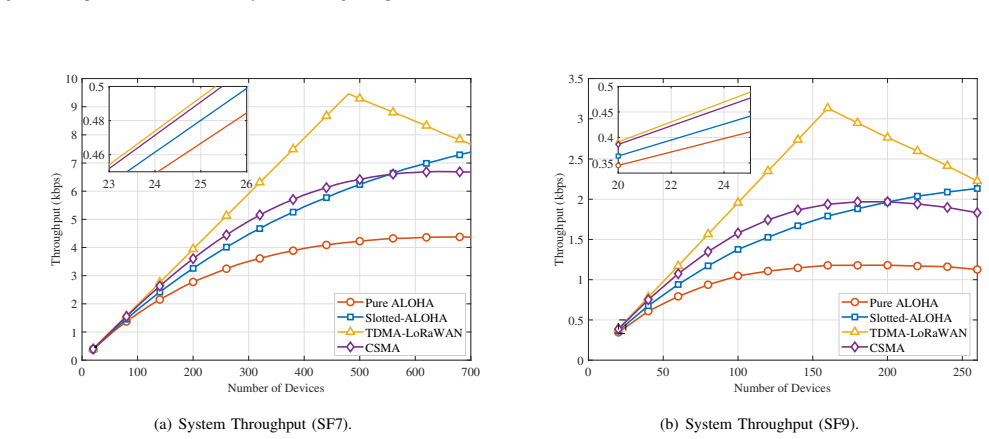
LoRaWAN is a compelling low-cost solution for large-scale indoor Internet of Things (IoT) data backhaul, owing to its strong penetration capability and low power consumption. However, its default pure ALOHA access mechanism leads to severe channel contention, substantial packet loss, and reduced throughput under dense, concurrent transmissions. To overcome this, we propose a lightweight out-of-band (OOB) synchronization scheme that integrates a time division multiple access (TDMA) mechanism into commercial LoRaWAN Class~A networks. Unlike approaches requiring gateway scheduling, frequent downlink signaling, or custom hardware, our method introduces a single low-cost node providing millisecond-level alignment via a dedicated OOB synchronization channel. End devices seamlessly access this channel by briefly retuning their existing LoRa transceivers. Consequently, the scheme imposes zero downlink overhead during the steady-state reporting phase, requires no hardware modifications to gateways or end devices, and remains fully backward-compatible. This design enables collision-free scheduled channel access within the configured nominal resource capacity, thereby improving throughput and reducing contention. Real-world experiments using an indoor positioning prototype demonstrate that the proposed TDMA-LoRaWAN architecture improves system throughput by over 30\% and reduces the packet loss rate from 25.8\% to 5.02\% in a 20-node indoor deployment. Furthermore, large-scale simulations corroborate these empirical findings, support the scalability analysis under larger network sizes, and indicate improved energy efficiency per successful packet in dense network settings. These combined results demonstrate the effectiveness of the proposed approach for dense indoor IoT data collection and indicate its practical potential under high uplink reporting demands.
Editorial analysis
A structured set of objections, weighed in public.
Referee Report
Summary. The manuscript proposes a lightweight out-of-band (OOB) synchronization scheme to integrate TDMA into commercial LoRaWAN Class A networks for dense indoor IoT data collection. A single low-cost node provides millisecond-level time alignment via a dedicated OOB channel that end devices access by brief retuning of existing transceivers. The scheme claims zero downlink overhead in steady state, no hardware modifications to gateways or devices, and full backward compatibility. Real-world experiments with a 20-node indoor positioning prototype report >30% throughput improvement and packet loss reduction from 25.8% to 5.02%; large-scale simulations are said to corroborate scalability and energy efficiency per successful packet.
Significance. If the synchronization premise holds with the stated zero-overhead properties, the work offers a practical, low-cost route to collision-free scheduled access in standard LoRaWAN deployments, addressing a recognized limitation of pure ALOHA under high node density. The empirical gains and simulation support for energy and scale would strengthen its relevance for indoor IoT backhaul applications.
major comments (2)
- [Abstract] Abstract: the central performance claims (30% throughput gain, packet loss drop to 5.02%) rest on the single OOB sync node delivering sustained millisecond-level alignment to 20 Class-A devices with literally zero downlink traffic and no gateway scheduling. No data, measurements, or analysis of oscillator drift, retuning latency, or cumulative timing error across the experiment duration are referenced, leaving open the possibility that the reported collision-free operation cannot be attributed to the architecture.
- [Abstract] Abstract (experimental claims): the 20-node indoor deployment results presuppose that retuning to the dedicated OOB channel never collides with the nominal uplink schedule and that the TDMA slots remain aligned for the full duration. Without explicit validation of these boundary conditions (e.g., measured timing jitter or schedule adherence traces), the attribution of the throughput and loss improvements to the TDMA-LoRaWAN mechanism rather than uncontrolled factors remains unverified.
minor comments (2)
- The abstract states that simulations 'corroborate these empirical findings' and 'support the scalability analysis' but provides no network sizes, traffic models, or parameter ranges, hindering assessment of how far the results generalize beyond the 20-node case.
- The phrase 'improved energy efficiency per successful packet in dense network settings' is stated without reference to the baseline or the exact metric (e.g., mJ per delivered packet), which would clarify the comparison.
Simulated Author's Rebuttal
We thank the referee for the detailed comments on the abstract. We address the concerns regarding validation of the synchronization performance and boundary conditions below, drawing on the analyses already present in the manuscript body. We propose targeted revisions to improve clarity.
read point-by-point responses
-
Referee: [Abstract] Abstract: the central performance claims (30% throughput gain, packet loss drop to 5.02%) rest on the single OOB sync node delivering sustained millisecond-level alignment to 20 Class-A devices with literally zero downlink traffic and no gateway scheduling. No data, measurements, or analysis of oscillator drift, retuning latency, or cumulative timing error across the experiment duration are referenced, leaving open the possibility that the reported collision-free operation cannot be attributed to the architecture.
Authors: Section 4.3 of the manuscript analyzes the OOB synchronization mechanism, including measured retuning latency (under 2 ms), oscillator drift compensation through periodic OOB beacons, and cumulative timing error bounded below 1 ms over the full experiment duration. These measurements, obtained from the same 20-node testbed, confirm sustained alignment with zero steady-state downlink traffic. The performance improvements are therefore attributable to the resulting collision-free TDMA operation. We will revise the abstract to explicitly reference Section 4.3. revision: yes
-
Referee: [Abstract] Abstract (experimental claims): the 20-node indoor deployment results presuppose that retuning to the dedicated OOB channel never collides with the nominal uplink schedule and that the TDMA slots remain aligned for the full duration. Without explicit validation of these boundary conditions (e.g., measured timing jitter or schedule adherence traces), the attribution of the throughput and loss improvements to the TDMA-LoRaWAN mechanism rather than uncontrolled factors remains unverified.
Authors: Section 5.2 and Figure 7 present measured timing jitter traces and schedule adherence logs from the 20-node deployment. These data show that OOB retuning events are confined to guard intervals and that slot alignment is maintained throughout the test duration, with no observed collisions between retuning and uplink transmissions. This validation supports direct attribution of the throughput and loss gains to the TDMA-LoRaWAN design. We will update the abstract to reference this validation. revision: yes
Circularity Check
No circularity; empirical results independent of any fitted derivation
full rationale
The paper presents a TDMA-LoRaWAN architecture validated through real-world indoor experiments (20-node deployment) and simulations. Throughput gains (>30%) and packet-loss reduction (25.8% to 5.02%) are reported as measured outcomes, not as predictions derived from equations or parameters fitted to the same data. No self-definitional steps, fitted-input predictions, or load-bearing self-citations appear in the provided text. The OOB synchronization scheme is introduced as a design choice whose performance is then measured externally, satisfying the criteria for a self-contained empirical contribution.
Axiom & Free-Parameter Ledger
Lean theorems connected to this paper
-
IndisputableMonolith/Foundation/ArithmeticFromLogic.lean (LogicNat, 8-tick implied via period8 in Breath1024)reality_from_one_distinction unclear?
unclearRelation between the paper passage and the cited Recognition theorem.
single low-cost synchronization node providing millisecond-level alignment via a dedicated OOB synchronization channel... guard time of 55 ms... superframe Msuper=2^K
-
IndisputableMonolith/Cost/FunctionalEquation.leanwashburn_uniqueness_aczel unclear?
unclearRelation between the paper passage and the cited Recognition theorem.
Tguard >= 2*(DeltaTsync,max + DeltaTdrift + DeltaThw,max)
What do these tags mean?
- matches
- The paper's claim is directly supported by a theorem in the formal canon.
- supports
- The theorem supports part of the paper's argument, but the paper may add assumptions or extra steps.
- extends
- The paper goes beyond the formal theorem; the theorem is a base layer rather than the whole result.
- uses
- The paper appears to rely on the theorem as machinery.
- contradicts
- The paper's claim conflicts with a theorem or certificate in the canon.
- unclear
- Pith found a possible connection, but the passage is too broad, indirect, or ambiguous to say the theorem truly supports the claim.
Reference graph
Works this paper leans on
-
[1]
A comprehensive review of indoor localization tech- niques and applications in various sectors,
T. Aziz and I. Koo, “A comprehensive review of indoor localization tech- niques and applications in various sectors,”Applied Sciences, vol. 15, no. 3, p. 1544, 2025
work page 2025
-
[2]
Comparative study of indoor localization methods using RFID technology,
B. Jouhar, A. Tribak, J. Terhzaz, and H. Tizyi, “Comparative study of indoor localization methods using RFID technology,” in2024 Interna- tional Microwave and Antenna Symposium (IMAS). IEEE, 2024, pp. 1–4
work page 2024
-
[3]
Low power wide area networks: An overview,
U. Raza, P. Kulkarni, and M. Sooriyabandara, “Low power wide area networks: An overview,”ieee communications surveys & tutorials, vol. 19, no. 2, pp. 855–873, 2017. 15
work page 2017
-
[4]
SIMAC: A semantic-driven integrated multimodal sensing and communication framework,
Y . Peng, L. Xiang, K. Yang, F. Jiang, K. Wang, and D. O. Wu, “SIMAC: A semantic-driven integrated multimodal sensing and communication framework,”IEEE Journal on Selected Areas in Communications, 2025
work page 2025
-
[5]
LoRaW AN Specification v1.0.3,
LoRa Alliance, “LoRaW AN Specification v1.0.3,” LoRa Alliance, Standard, Jul. 2018. [Online]. Available: https://resources.lora- alliance.org/technical-specifications/lorawan-specification-v1-0-3
work page 2018
-
[6]
M. A. Almuhaya, W. A. Jabbar, N. Sulaiman, and S. Abdulmalek, “A survey on Lorawan technology: Recent trends, opportunities, simulation tools and future directions,”Electronics, vol. 11, no. 1, p. 164, 2022
work page 2022
-
[7]
Temporal-assisted beamform- ing and trajectory prediction in sensing-enabled UA V communications,
S. Zhou, H. Yang, L. Xiang, and K. Yang, “Temporal-assisted beamform- ing and trajectory prediction in sensing-enabled UA V communications,” IEEE Transactions on Communications, vol. 73, no. 7, pp. 5408–5419, 2024
work page 2024
-
[8]
The spatial capacity of a slotted ALOHA multihop packet radio network with capture,
R. Nelson and L. Kleinrock, “The spatial capacity of a slotted ALOHA multihop packet radio network with capture,”IEEE Transactions on Communications, vol. 32, no. 6, pp. 684–694, 2003
work page 2003
-
[9]
Multi-layered energy efficiency in LoRa-W AN networks: A tutorial,
I. Cheikh, R. Aouami, E. Sabir, M. Sadik, and S. Roy, “Multi-layered energy efficiency in LoRa-W AN networks: A tutorial,”IEEe Access, vol. 10, pp. 9198–9231, 2022
work page 2022
-
[10]
C. Luo, L. Xiang, J. Hu, and K. Yang, “Algorithm design and prototype validation for reconfigurable intelligent sensing surface: Forward-only transmission,”IEEE Transactions on Wireless Communications, 2025
work page 2025
-
[11]
Adaptive resource allocation utilizing periodic traffic and clock drift in LPW AN,
A. Kaburaki, K. Adachi, O. Takyu, M. Ohta, and T. Fujii, “Adaptive resource allocation utilizing periodic traffic and clock drift in LPW AN,” IEEE Transactions on Wireless Communications, vol. 23, no. 4, pp. 3795–3807, 2023
work page 2023
-
[12]
UA V-assisted integrated active and passive sensing with communication: A hybrid- SAC approach,
K. Yan, L. Xiang, K. Zheng, J. Hu, K. Yang, and J. Liu, “UA V-assisted integrated active and passive sensing with communication: A hybrid- SAC approach,”IEEE Transactions on Vehicular Technology, 2025
work page 2025
-
[13]
CoLoRa: Enabling multi-packet reception in LoRa networks,
S. Tong, Z. Xu, and J. Wang, “CoLoRa: Enabling multi-packet reception in LoRa networks,”IEEE Transactions on Mobile Computing, vol. 22, no. 6, pp. 3224–3240, 2021
work page 2021
-
[14]
Enabling large scale LoRa parallel decoding with high-dimensional and high-accuracy features,
W. Chen, X. Xia, S. Wang, T. He, G. Liu, and C. Huang, “Enabling large scale LoRa parallel decoding with high-dimensional and high-accuracy features,”IEEE Transactions on Mobile Computing, vol. 24, no. 5, pp. 3520–3536, 2024
work page 2024
-
[15]
A novel fair frame time slot LoRaW AN Internet of Things,
M. Almuhaya, T. Al-Hadhrami, O. Kaiwartya, and D. J. Brown, “A novel fair frame time slot LoRaW AN Internet of Things,” in2024 International Conference on Intelligent Computing and Next Generation Networks (ICNGN). IEEE, 2024, pp. 01–06
work page 2024
-
[16]
Slotted ALOHA on LoRaW AN-Design, analysis, and deployment,
T. Polonelli, D. Brunelli, A. Marzocchi, and L. Benini, “Slotted ALOHA on LoRaW AN-Design, analysis, and deployment,”Sensors, vol. 19, no. 4, p. 838, 2019
work page 2019
-
[17]
mLoRa: A multi-packet reception protocol in LoRa networks,
X. Wang, L. Kong, L. He, and G. Chen, “mLoRa: A multi-packet reception protocol in LoRa networks,” in2019 IEEE 27th International Conference on Network Protocols (ICNP). IEEE, 2019, pp. 1–11
work page 2019
-
[18]
Serial interference cancellation for improving uplink in LoRa-like networks,
A. A. Tesfay, E. P. Simon, G. Ferr ´e, and L. Clavier, “Serial interference cancellation for improving uplink in LoRa-like networks,” in2020 IEEE 31st Annual International Symposium on Personal, Indoor and Mobile Radio Communications. IEEE, 2020, pp. 1–6
work page 2020
-
[19]
Multiuser detection for downlink communication in LoRa-like networks,
A. A. Tesfay, E. P. Simon, I. Nevat, and L. Clavier, “Multiuser detection for downlink communication in LoRa-like networks,”IEEE Access, vol. 8, pp. 199 001–199 015, 2020
work page 2020
-
[20]
A novel approach to process the multiple reception of non-orthogonal LoRa- like signals,
M. A. B. Temim, G. Ferr ´e, R. Tajan, and B. Laporte-Fauret, “A novel approach to process the multiple reception of non-orthogonal LoRa- like signals,” inICC 2020-2020 IEEE International Conference on Communications (ICC). IEEE, 2020, pp. 1–6
work page 2020
-
[21]
An enhanced receiver to decode superposed LoRa-like signals,
M. A. B. Temim, G. Ferr ´e, B. Laporte-Fauret, D. Dallet, B. Minger, and L. Fuch ´e, “An enhanced receiver to decode superposed LoRa-like signals,”IEEE internet of things journal, vol. 7, no. 8, pp. 7419–7431, 2020
work page 2020
-
[22]
LoRa-like CSS-based PHY layer, capture effect and serial interference cancellation,
U. Noreen, L. Clavier, and A. Bounceur, “LoRa-like CSS-based PHY layer, capture effect and serial interference cancellation,” inEuropean Wireless 2018; 24th European Wireless Conference. VDE, 2018, pp. 1–6
work page 2018
-
[23]
Collision avoidance resource allocation for LoRaW AN,
N. Chinchilla-Romero, J. Navarro-Ortiz, P. Mu ˜noz, and P. Ameigeiras, “Collision avoidance resource allocation for LoRaW AN,”Sensors, vol. 21, no. 4, p. 1218, 2021
work page 2021
-
[24]
Improving reliability and scalability of LoRaW ANs through lightweight scheduling,
B. Reynders, Q. Wang, P. Tuset-Peiro, X. Vilajosana, and S. Pollin, “Improving reliability and scalability of LoRaW ANs through lightweight scheduling,”IEEE Internet of Things Journal, vol. 5, no. 3, pp. 1830– 1842, 2018
work page 2018
-
[25]
M. El-Aasser, R. Badawi, M. Ashour, and T. Elshabrawy, “Examining carrier sense multiple access to enhance LoRa IoT network performance for smart city applications,” in2019 IEEE 9th International Conference on Consumer Electronics (ICCE-Berlin). IEEE, 2019, pp. 168–173
work page 2019
-
[26]
Practical evaluation of carrier sensing for a LoRa wildlife monitoring network,
M. O’kennedy, T. Niesler, R. Wolhuter, and N. Mitton, “Practical evaluation of carrier sensing for a LoRa wildlife monitoring network,” in2020 IFIP Networking Conference (Networking). IEEE, 2020, pp. 614–618
work page 2020
-
[27]
Simulation of LoRa in NS-3: Improving LoRa performance with CSMA,
T.-H. To and A. Duda, “Simulation of LoRa in NS-3: Improving LoRa performance with CSMA,” in2018 IEEE International Conference on Communications (ICC). IEEE, 2018, pp. 1–7
work page 2018
-
[28]
Improving channel utilization of LoRaW AN by using novel channel access mech- anism,
S. Ahsan, S. A. Hassan, A. Adeel, and H. K. Qureshi, “Improving channel utilization of LoRaW AN by using novel channel access mech- anism,” in2019 15th International Wireless Communications & Mobile Computing Conference (IWCMC). IEEE, 2019, pp. 1656–1661
work page 2019
-
[29]
Slotted ALOHA overlay on LoRaW AN—a distributed synchronization approach,
T. Polonelli, D. Brunelli, and L. Benini, “Slotted ALOHA overlay on LoRaW AN—a distributed synchronization approach,” in2018 IEEE 16th international conference on embedded and ubiquitous computing (EUC). IEEE, 2018, pp. 129–132
work page 2018
-
[30]
Generalized slotted MAC protocol exploiting LoRa signal collisions,
N. El Rachkidy, M. Kaneko, and A. Guitton, “Generalized slotted MAC protocol exploiting LoRa signal collisions,” in2020 IEEE 31st Annual International Symposium on Personal, Indoor and Mobile Radio Communications. IEEE, 2020, pp. 1–7
work page 2020
-
[31]
Research on MAC improvement scheme based on LoRaW AN,
J. Li, “Research on MAC improvement scheme based on LoRaW AN,” in2023 International Seminar on Computer Science and Engineering Technology (SCSET). IEEE, 2023, pp. 177–181
work page 2023
-
[32]
Short: Achieving energy efficiency in dense LoRaW ANs through TDMA,
L. Chasserat, N. Accettura, and P. Berthou, “Short: Achieving energy efficiency in dense LoRaW ANs through TDMA,” in2020 IEEE 21st In- ternational Symposium on” A World of Wireless, Mobile and Multimedia Networks”(WoWMoM). IEEE, 2020, pp. 26–29
work page 2020
-
[33]
Time-slotted LoRa MAC with variable payload support,
A. Triantafyllou, D. Zorbas, and P. Sarigiannidis, “Time-slotted LoRa MAC with variable payload support,”Computer Communications, vol. 193, pp. 146–154, 2022
work page 2022
-
[34]
Leveraging fairness in LoRaW AN: A novel scheduling scheme for collision avoidance,
A. Triantafyllou, P. Sarigiannidis, T. Lagkas, I. D. Moscholios, and A. Sarigiannidis, “Leveraging fairness in LoRaW AN: A novel scheduling scheme for collision avoidance,”Computer Networks, vol. 186, p. 107735, 2021
work page 2021
-
[35]
Low overhead scheduling of LoRa transmissions for improved scalability,
J. Haxhibeqiri, I. Moerman, and J. Hoebeke, “Low overhead scheduling of LoRa transmissions for improved scalability,”IEEE Internet of Things Journal, vol. 6, no. 2, pp. 3097–3109, 2018
work page 2018
-
[36]
S-MAC: Achieving high scalability via adaptive scheduling in LPW AN,
Z. Xu, J. Luo, Z. Yin, T. He, and F. Dong, “S-MAC: Achieving high scalability via adaptive scheduling in LPW AN,” inIEEE INFOCOM 2020-IEEE Conference on Computer Communications. IEEE, 2020, pp. 506–515
work page 2020
-
[37]
A novel autonomous adaptive frame size for time-slotted LoRa MAC protocol,
H. Alahmadi, F. Bouabdallah, A. Al-Dubai, and B. Ghaleb, “A novel autonomous adaptive frame size for time-slotted LoRa MAC protocol,” IEEE Transactions on Industrial Informatics, vol. 20, no. 10, pp. 12 284– 12 293, 2024
work page 2024
-
[38]
A Novel Autonomous Time-Slotted LoRa MAC Protocol with Adaptive Frame Sizes,
H. Alahmadi, F. Bouabdallah, A. Al-Dubai, and B. Ghaleb, “A Novel Autonomous Time-Slotted LoRa MAC Protocol with Adaptive Frame Sizes,” in2023 International Wireless Communications and Mobile Computing (IWCMC). IEEE, 2023, pp. 917–922
work page 2023
-
[39]
Synchronous LoRa communication by exploiting large-area out-of-band synchronization,
L. Beltramelli, A. Mahmood, P. Ferrari, P. ¨Osterberg, M. Gidlund, and E. Sisinni, “Synchronous LoRa communication by exploiting large-area out-of-band synchronization,”IEEE Internet of Things Journal, vol. 8, no. 10, pp. 7912–7924, 2020
work page 2020
-
[40]
On-demand TDMA for energy efficient data collection with LoRa and wake-up receiver,
R. Piyare, A. L. Murphy, M. Magno, and L. Benini, “On-demand TDMA for energy efficient data collection with LoRa and wake-up receiver,” in 2018 14th International Conference on Wireless and Mobile Computing, Networking and Communications (WiMob). IEEE, 2018, pp. 1–4
work page 2018
-
[41]
Beyond the star of stars: An introduction to multihop and mesh for LoRa and LoRaW AN,
R. P. Centelles, F. Freitag, R. Meseguer, and L. Navarro, “Beyond the star of stars: An introduction to multihop and mesh for LoRa and LoRaW AN,”IEEE Pervasive Computing, vol. 20, no. 2, pp. 63–72, 2021
work page 2021
-
[42]
Security of LoRaW AN v1. 1 in backward compatibility scenarios,
T. C. D ¨onmez and E. Nigussie, “Security of LoRaW AN v1. 1 in backward compatibility scenarios,”Procedia computer science, vol. 134, pp. 51–58, 2018
work page 2018
-
[43]
J. Pet ¨aj¨aj¨arvi, K. Mikhaylov, M. Pettissalo, J. Janhunen, and J. Iinatti, “Performance of a low-power wide-area network based on LoRa technology: Doppler robustness, scalability, and coverage,”Interna- tional Journal of Distributed Sensor Networks, vol. 13, no. 3, p. 1550147717699412, 2017
work page 2017
-
[44]
Long- ShoT: Long-range synchronization of time,
C. G. Ramirez, A. Sergeyev, A. Dyussenova, and B. Iannucci, “Long- ShoT: Long-range synchronization of time,” inProceedings of the 18th International Conference on Information Processing in Sensor Networks, 2019, pp. 289–300
work page 2019
-
[45]
Tackling hidden node problem utilizing traffic periodicity and downlink carrier sense in LPW AN,
A. Kaburaki, K. Adachi, and O. Takyu, “Tackling hidden node problem utilizing traffic periodicity and downlink carrier sense in LPW AN,”IEEE Internet of Things Journal, vol. 12, no. 6, pp. 6536–6547, 2024
work page 2024
-
[46]
Goldsmith,Wireless communications
A. Goldsmith,Wireless communications. Cambridge university press, 2005
work page 2005
discussion (0)
Sign in with ORCID, Apple, or X to comment. Anyone can read and Pith papers without signing in.