pith. sign in

arxiv: 2605.23679 · v1 · pith:3WVSW664new · submitted 2026-05-22 · 🧮 math.GT · math.DG

Geometrisation of 3-manifolds

Pith reviewed 2026-05-25 02:41 UTC · model grok-4.3

classification 🧮 math.GT math.DG
keywords 3-manifoldsgeometrisation theoremThurston geometriesPerelman proof3-manifold topologygeometric structuresmanifold decomposition
0
0 comments X

The pith

The geometrisation theorem decomposes every 3-manifold into pieces each carrying one of eight geometries.

A machine-rendered reading of the paper's core claim, the machinery that carries it, and where it could break.

This overview explains the content of the geometrisation theorem for 3-manifolds. The theorem, conjectured by Thurston in the 1980s and proved by Perelman in the 2000s, states that any such manifold can be cut along spheres and tori into pieces each admitting one of eight standard geometries. The paper also describes the theorem's effects in various situations. A sympathetic reader would care because the result supplies a structural classification that organizes many questions in 3-manifold topology.

Core claim

The geometrisation theorem asserts that every compact 3-manifold can be decomposed into pieces that each admit a geometric structure modeled on one of eight 3-dimensional geometries.

What carries the argument

The canonical decomposition of 3-manifolds into geometric pieces according to the eight Thurston geometries.

Load-bearing premise

The paper's explanations of the theorem's content and effects are accurate summaries of the established result and accessible to readers with standard background in 3-manifold topology.

What would settle it

A compact 3-manifold whose prime decomposition fails to produce pieces each carrying one of the eight Thurston geometries.

Figures

Figures reproduced from arXiv: 2605.23679 by Bruno Martelli.

Figure 1
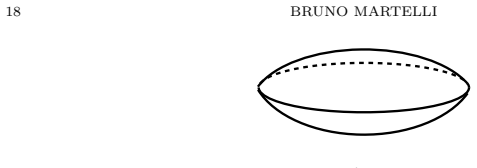
Figure 1. Figure 1: A sphere and a torus. These are the two orientable connected compact surfaces without boundary with χ ≥ 0. Every 3-manifold is cut canonicaly along some spheres and tori. Here locally homogeneous means that any two points in the manifold have iso￾metric neighbourhoods. There are in fact 8 possible types of such metrics, and we will describe them soon. We now explain all the terminology and the results stat… view at source ↗
Figure 2
Figure 2. Figure 2: The 15 knots in S 3 that can be described using a planar diagram with at most 7 crossings, considered up to isotopies and reflections. The knots 31 and 41 are called the trefoil knot and the figure eight knot [PITH_FULL_IMAGE:figures/full_fig_p003_2.png] view at source ↗
Figure 3
Figure 3. Figure 3: The closed tubular neighbourhood of a knot is a (knot￾ted) solid torus S 1 × D2 . Here we show the closed tubular neigh￾bourhoods of the trefoil and the figure eight knots [PITH_FULL_IMAGE:figures/full_fig_p003_3.png] view at source ↗
Figure 4
Figure 4. Figure 4: The connected sum of two knots. of a commutative monoid where the unknot is the identity element. A knot is prime if it cannot be obtained as the connected sum of two non-trivial knots, and the prime factorization theorem for knots ensures that every oriented knot may be [PITH_FULL_IMAGE:figures/full_fig_p003_4.png] view at source ↗
Figure 5
Figure 5. Figure 5: A compression of a surface. D S S D D' [PITH_FULL_IMAGE:figures/full_fig_p005_5.png] view at source ↗
Figure 6
Figure 6. Figure 6: An incompressible surface. then there is a disc D′ ⊂ S with ∂D = ∂D′ as in [PITH_FULL_IMAGE:figures/full_fig_p005_6.png] view at source ↗
Figure 7
Figure 7. Figure 7: The height function is a Morse function, with finitely many minima, saddle points, and maxima. P P [PITH_FULL_IMAGE:figures/full_fig_p006_7.png] view at source ↗
Figure 8
Figure 8. Figure 8: For every horizontal plane P, compress S starting from the innermost circles. We have cited Dehn’s lemma as the first important theorem on 3-manifolds. The following is arguably the second, proved by Alexander [Ale24] in 1924. Theorem 3 (Alexander’s Theorem). There are no essential surfaces in S 3 . Proof. Since S 3 is simply connected, by Dehn’s lemma every surface S of genus g ≥ 1 is compressible. We are… view at source ↗
Figure 9
Figure 9. Figure 9: After the multiple compressions, the resulting surface is a union of spheres as shown here. Each such sphere bounds a three-dimensional disc [PITH_FULL_IMAGE:figures/full_fig_p007_9.png] view at source ↗
Figure 10
Figure 10. Figure 10: Cutting a manifold along a codimension 1 submani￾fold with trivial tubular neighbourhood. The result of these compressions is a new surface S ′ that consists of many con￾nected components, that are in fact all spheres as in [PITH_FULL_IMAGE:figures/full_fig_p007_10.png] view at source ↗
Figure 11
Figure 11. Figure 11: A normal surface intersects every tetrahedron in tri￾angles or squares [PITH_FULL_IMAGE:figures/full_fig_p009_11.png] view at source ↗
Figure 12
Figure 12. Figure 12: After some compressions we get only discs and sur￾faces without boundary entirely contained in ∆, that we remove. many essential disjoint and pairwise non-parallel spheres (two spheres S, S′ are parallel if they cobound a piece diffeomorphic to S 2 ×[0, 1]). Kneser proved this by introducing a formidable tool called normal surface theory, that we briefly describe. Pick a triangulation for M. A surface S ⊂… view at source ↗
Figure 13
Figure 13. Figure 13: We remove the circular intersections of S with a tri￾angle of the triangulation by compressions, starting with the in￾nermost circles [PITH_FULL_IMAGE:figures/full_fig_p010_13.png] view at source ↗
Figure 14
Figure 14. Figure 14: If ∂D intersects an edge twice, we remove both in￾tersections with an isotopy (here again we start with innermost intersections) [PITH_FULL_IMAGE:figures/full_fig_p010_14.png] view at source ↗
Figure 15
Figure 15. Figure 15: By cutting M along a normal surface S we get a manifold that is obtained as the union of many prisms, and at most 6 other pieces for each tetrahedron (here we have 4 pyramids and two esahedra). If S is a set of spheres, the resulting normal surface S ′ is again a set of spheres. One proves that if the spheres in S are essential and pairwise non-parallel, then S ′ also contains a set of essential and pairw… view at source ↗
Figure 16
Figure 16. Figure 16: Every essential curve γ in a surface S intersects some other essential curve η in an essential way (there is no way to isotope η away from γ). same cardinality of S (essentiality cannot be lost in the process). We keep these spheres in S ′ and remove all the others. We conclude by noting that a normal surface S ′ may have at most k pairwise non￾parallel components, where k is some number that depends only… view at source ↗
Figure 17
Figure 17. Figure 17: The six flat orientable 3-manifolds are obtained from these Euclidean polyhedra by pairing their faces isometrically so that similar letters match. Each unlabeled face is paired with the opposite one with a translation: in the top-left cube every face is paired with the opposite one via a translation and we get the 3-torus; in the subsequent four polyhedra all the opposite faces are paired via a translati… view at source ↗
Figure 18
Figure 18. Figure 18: By pairing the opposite faces of a rhombic dodecahe￾dron with a π rotation we get the Hantsche – Wendt flat 3- manifold. π/3 π/2 2π/3 π/3, 2π/5 π/3, 2π/5, π/2 [PITH_FULL_IMAGE:figures/full_fig_p016_18.png] view at source ↗
Figure 19
Figure 19. Figure 19: The five regular polyhedra may be represented in H3 with the indicated dihedral angles. When the angles are red, the realization is via an ideal regular polyhedron [PITH_FULL_IMAGE:figures/full_fig_p016_19.png] view at source ↗
Figure 20
Figure 20. Figure 20: The Gieseking hyperbolic 3-manifold is obtained by pairing the faces of a single regular ideal tetrahedron as shown here (match the letters). We can check that the pairing identifies all the 6 edges as indicated by the arrows. angle is π/3 we get 6π/3 = 2π and hence we indeed get a hyperbolic manifold: the figure is a complete proof! This non-orientable hyperbolic 3-manifold, now known as the Giesking man… view at source ↗
Figure 21
Figure 21. Figure 21: A spherical lens. with dihedral angle 2π/p via a 2π/q turn (a lens is a portion of S 3 delimited by two geodesic discs sharing the same closed geodesic as in [PITH_FULL_IMAGE:figures/full_fig_p018_21.png] view at source ↗
Figure 22
Figure 22. Figure 22: A satellite knot is a knot that is contained non￾trivially in the tubular neighbourhood of another non-trival knot. 2.8. Sol. This geometry includes all the torus bundles over the circle with mon￾odromy A ∈ SL2R having |trA| > 2, and the manifolds covered by these. 3. Geometrisation in action We show the effect of geometrisation in a few different contexts. 3.1. Knots. By Alexander’s theorem, the exterior… view at source ↗
Figure 23
Figure 23. Figure 23: A geodesic foliation near a singular point with angle π (left) or 3π (center) in a flat cone surface. The angle π is allowed only at ideal points. A metrically inaccurate sketch of two orthog￾onal geodesic foliations (right). Hyperbolisation in this context is easy to state: If φ does not fix any finite set of essential curves up to isotopy, M is hyperbolic. This formulation says as usual that M is hyperb… view at source ↗
Figure 24
Figure 24. Figure 24: Some configurations of faces in a polyhedron P. In the left (center) figure we suppose that the 6 (8) endpoints of the 3 (4) edges cointaining the labels αi are all distinct (these config￾urations are called a 3-circuit and a 4-circuit). In the right figure we suppose that the left face does not contain the right vertex. (4) α1 +α2 +α3 +α4 ≥ 2π for some quadruple of faces as in [PITH_FULL_IMAGE:figures/f… view at source ↗
Figure 25
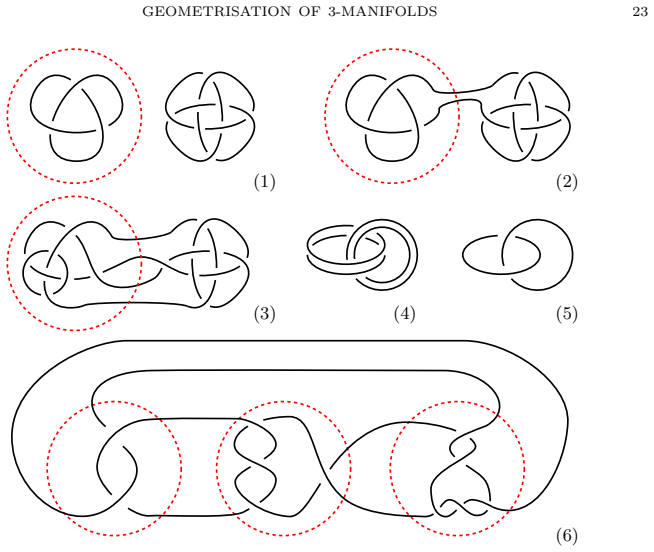
Figure 25. Figure 25: Obstructions for a double covering to be hyperbolic. Every dashed circle denotes a sphere intersecting the link in 0, 2, or 4 points. (4) S 3 \ L contains an essential torus; (5) L is a torus link; (6) L is a Montesinos link of length k ≤ 3. Some examples of the six types of obstructions are shown in [PITH_FULL_IMAGE:figures/full_fig_p023_25.png] view at source ↗
Figure 26
Figure 26. Figure 26: The Borromean rings. By assigning the label 0 to each component we get the 3-torus. References [Ago13] Ian Agol. The virtual Haken conjecture. Documenta Mathematica, 18:1045–1087, 2013. with an appendix of Ian Agol, Daniel Groves, and Jason Manning. [AL14] Ralf Aurich and Sven Lustig. The Hantzsche-Wendt manifold in cosmic topology. Clas￾sical and Quantum Gravity, 31(16):165009, 2014. [Ale19] James W. Ale… view at source ↗
read the original abstract

The geometrisation theorem of 3-manifolds was conjectured by Thurston the 1980s and proved by Perelman in the 2000s. This is an overview on the subject. We explain the content of the theorem and describe its effects in various situations.

Editorial analysis

A structured set of objections, weighed in public.

Desk editor's note, referee report, simulated authors' rebuttal, and a circularity audit. Tearing a paper down is the easy half of reading it; the pith above is the substance, this is the friction.

Referee Report

0 major / 1 minor

Summary. The manuscript is an overview of the geometrisation theorem of 3-manifolds. It recalls that the theorem was conjectured by Thurston in the 1980s and proved by Perelman in the 2000s, and explains the content of the theorem along with its effects in various situations.

Significance. The central historical attribution is standard and correct. As a purely expository overview with no new results, derivations, or machine-checked content, the paper's significance is limited to its potential pedagogical value in summarizing established material for readers with standard background in 3-manifold topology.

minor comments (1)
  1. [Abstract] Abstract: the phrase 'conjectured by Thurston the 1980s' is missing the word 'in'.

Simulated Author's Rebuttal

0 responses · 0 unresolved

We thank the referee for their review and for confirming the accuracy of the historical attributions in our expository overview of the geometrisation theorem. The report correctly notes that the manuscript contains no new results and is intended as a pedagogical summary. No specific major comments were raised.

Circularity Check

0 steps flagged

No circularity; paper is a non-derivational overview of established results

full rationale

The paper is explicitly an overview of the geometrisation theorem (conjectured by Thurston, proved by Perelman) with no equations, predictions, fitted parameters, or novel derivations. The central claim is a historical attribution and summary of prior work; no load-bearing step reduces by construction to inputs, self-citations, or ansatzes. This matches the default expectation of no circularity for summary papers.

Axiom & Free-Parameter Ledger

0 free parameters · 0 axioms · 0 invented entities

This is a review paper that introduces no new free parameters, axioms, or invented entities; it summarises an established theorem from the literature.

pith-pipeline@v0.9.0 · 5548 in / 908 out tokens · 21991 ms · 2026-05-25T02:41:54.810631+00:00 · methodology

discussion (0)

Sign in with ORCID, Apple, or X to comment. Anyone can read and Pith papers without signing in.

Lean theorems connected to this paper

Citations machine-checked in the Pith Canon. Every link opens the source theorem in the public Lean library.

  • Foundation/AlexanderDuality.lean alexander_duality_circle_linking echoes
    ?
    echoes

    ECHOES: this paper passage has the same mathematical shape or conceptual pattern as the Recognition theorem, but is not a direct formal dependency.

    Every 3-manifold decomposes canonically into geometric pieces... Thurston showed that only 8 possible geometries may arise: H3, R3, S3, S2×R, H2×R, gSL2, Nil, Sol.

What do these tags mean?
matches
The paper's claim is directly supported by a theorem in the formal canon.
supports
The theorem supports part of the paper's argument, but the paper may add assumptions or extra steps.
extends
The paper goes beyond the formal theorem; the theorem is a base layer rather than the whole result.
uses
The paper appears to rely on the theorem as machinery.
contradicts
The paper's claim conflicts with a theorem or certificate in the canon.
unclear
Pith found a possible connection, but the passage is too broad, indirect, or ambiguous to say the theorem truly supports the claim.

Reference graph

Works this paper leans on

47 extracted references · 47 canonical work pages · 4 internal anchors

  1. [1]

    , journal=

    Thurston, William P. , journal=. Three dimensional manifolds,. 1982 , publisher=

  2. [2]

    The entropy formula for the Ricci flow and its geometric applications

    Perelman, Grigori , year=. The entropy formula for the. math/0211159 , archivePrefix=

  3. [3]

    Ricci flow with surgery on three-manifolds

    Perelman, Grigori , year=. math/0303109 , archivePrefix=

  4. [4]

    Finite extinction time for the solutions to the Ricci flow on certain three-manifolds

    Perelman, Grigori , year=. Finite extinction time for the solutions to the. math/0307245 , archivePrefix=

  5. [5]

    , title =

    Burton, Benjamin A. , title =. 36th International Symposium on Computational Geometry (SoCG 2020) , series =. 2020 , publisher =

  6. [6]

    Die eindeutige

    Schubert, Horst , journal=. Die eindeutige

  7. [7]

    Algebraic & Geometric Topology , volume=

    The enumeration and classification of prime 20-crossing knots , author=. Algebraic & Geometric Topology , volume=. 2025 , publisher=

  8. [8]

    Proceedings of the American Mathematical Society , volume=

    Diffeomorphisms of the 2-sphere , author=. Proceedings of the American Mathematical Society , volume=. 1959 , publisher=

  9. [9]

    , title =

    Palais, Richard S. , title =. Proceedings of the American Mathematical Society , year =

  10. [10]

    Geschlossene

    Kneser, Hellmuth , journal=. Geschlossene

  11. [11]

    American Journal of Mathematics , volume=

    A unique decomposition theorem for 3-manifolds , author=. American Journal of Mathematics , volume=. 1962 , publisher=

  12. [12]

    Journal of the American Mathematical Society , volume=

    Knots are determined by their complements , author=. Journal of the American Mathematical Society , volume=. 1989 , publisher=

  13. [13]

    Mathematische Annalen , volume =

    Dehn, Max , title =. Mathematische Annalen , volume =. 1910 , publisher =

  14. [14]

    , title =

    Papakyriakopoulos, Christos D. , title =. Annals of Mathematics , volume =. 1957 , publisher =

  15. [15]

    , title =

    Alexander, James W. , title =. Proceedings of the National Academy of Sciences of the United States of America , volume =. 1924 , publisher =

  16. [16]

    2016 , publisher =

    Martelli, Bruno , title =. 2016 , publisher =

  17. [17]

    and Shalen, Peter B

    Jaco, William H. and Shalen, Peter B. , title =. Memoirs of the American Mathematical Society , year =

  18. [18]

    1979 , publisher =

    Johannson, Klaus , title =. 1979 , publisher =

  19. [19]

    and Swarup, Gadde A

    Neumann, Walter D. and Swarup, Gadde A. , title =. Geometry & Topology , year =

  20. [20]

    Beispiele geschlossener dreidimensionaler

    L. Beispiele geschlossener dreidimensionaler. Berichte

  21. [21]

    Analytische

    Gieseking, Hugo , year=. Analytische

  22. [22]

    Die beiden

    Weber, Constantin and Seifert, Herbert , journal=. Die beiden. 1933 , publisher=

  23. [23]

    Dreidimensionale euklidische

    Hantzsche, Werner and Wendt, Heinrich , journal=. Dreidimensionale euklidische. 1935 , publisher=

  24. [24]

    Aurich, Ralf and Lustig, Sven , journal=. The. 2014 , publisher=

  25. [25]

    1979 , publisher=

    The geometry and topology of three-manifolds , author=. 1979 , publisher=

  26. [26]

    Homotopieringe und

    Reidemeister, Kurt , journal=. Homotopieringe und. 1935 , publisher=

  27. [27]

    Transactions of the American Mathematical Society , volume=

    Note on two three-dimensional manifolds with the same group , author=. Transactions of the American Mathematical Society , volume=. 1919 , publisher=

  28. [28]

    Annals of Mathematics , volume=

    On incidence matrices, nuclei and homotopy types , author=. Annals of Mathematics , volume=. 1941 , publisher=

  29. [29]

    Bulletin of the American Mathematical Society , volume=

    On the geometry and dynamics of diffeomorphisms of surfaces , author=. Bulletin of the American Mathematical Society , volume=. 1988 , publisher=

  30. [30]

    Thurston, William P. , year=. Hyperbolic Structures on 3-manifolds,. math/9801045 , archivePrefix=

  31. [31]

    Otal, Jean-Pierre , journal=. Le th. 1996 , publisher=

  32. [32]

    The virtual

    Agol, Ian , journal=. The virtual. 2013 , publisher=

  33. [33]

    2021 , publisher=

    The structure of groups with a quasiconvex hierarchy , author=. 2021 , publisher=

  34. [34]

    , journal=

    Andreev, Evgenii M. , journal=. On convex polyhedra in. 1970 , publisher=

  35. [35]

    , journal=

    Andreev, Evgenii M. , journal=. On convex polyhedra of finite volume in. 1970 , publisher=

  36. [36]

    Annales de l'Institut Fourier , volume=

    Andreev's theorem on hyperbolic polyhedra , author=. Annales de l'Institut Fourier , volume=. 2007 , publisher=

  37. [37]

    Variedades de

    Montesinos, Jos. Variedades de. Bolet

  38. [38]

    , title =

    Bonahon, Francis and Siebenmann, Laurence C. , title =. 2010 , note =

  39. [39]

    Annals of Mathematics , year =

    Boileau, Michel and Leeb, Bernhard and Porti, Joan , title =. Annals of Mathematics , year =

  40. [40]

    Publications Math

    Mostow, George Daniel , title =. Publications Math. 1968 , volume =

  41. [41]

    1973 , address =

    Mostow, George Daniel , title =. 1973 , address =

  42. [42]

    Inventiones Mathematicae , year =

    Prasad, Gopal , title =. Inventiones Mathematicae , year =

  43. [43]

    Journal of the Institute of Mathematics of Jussieu , year =

    Italiano, Giovanni and Martelli, Bruno and Migliorini, Matteo , title =. Journal of the Institute of Mathematics of Jussieu , year =. doi:10.1017/S1474748022000536 , url =

  44. [44]

    2011 , address =

    Farb, Benson and Margalit, Dan , title =. 2011 , address =

  45. [45]

    , title =

    Wallace, Andrew H. , title =. Canadian Journal of Mathematics , year =

  46. [46]

    Lickorish, W. B. R. , title =. Annals of Mathematics , year =

  47. [47]

    and Goerner, Matthias and Weeks, Jeffrey R

    Culler, Marc and Dunfield, Nathan M. and Goerner, Matthias and Weeks, Jeffrey R. , title =