Astrophysical Parameters of 5056 Open Star Clusters from Bayesian Nested Sampling with PARSEC Isochrones
Pith reviewed 2026-05-25 03:12 UTC · model grok-4.3
The pith
Bayesian nested sampling with PARSEC isochrones yields a uniform catalogue of age, distance, metallicity and extinction for 5056 open clusters from Gaia DR3 data.
A machine-rendered reading of the paper's core claim, the machinery that carries it, and where it could break.
Core claim
The authors apply Bayesian nested sampling to PARSEC isochrones on Gaia DR3 colour-magnitude diagrams for all 5056 clusters drawn from the Unified Cluster Catalogue. Metallicity is treated as a free parameter throughout, priors come only from Gaia astrometry, XP spectra where available, and the SFD dust map, and the entire process runs without manual intervention on individual objects. The resulting catalogue reports age, [Fe/H], heliocentric distance and E(G_BP-G_RP) together with posterior chains; 3766 clusters (74.5 percent) pass a fit-quality threshold of eta_fit greater than or equal to 0.80.
What carries the argument
Bayesian nested sampling applied uniformly to PARSEC isochrones fitted to Gaia DR3 colour-magnitude diagrams, with priors from Gaia astrometry, XP spectra and the SFD dust map.
If this is right
- The catalogue supplies photometric metallicities for every cluster because initial metallicity remains a free parameter in every fit.
- Seventy-four point five percent of the sample meets the eta_fit greater than or equal to 0.80 quality cut and spans ages from a few million years to 5.5 Gyr and distances out to nearly 19 kpc.
- The full posterior chains are released so that downstream studies can propagate uncertainties directly rather than adopting single-point estimates.
- No external parameter catalogue is used to anchor the fits, so the results are independent of prior compilations.
Where Pith is reading between the lines
- The released posterior distributions could be combined with kinematic data to study cluster dissolution timescales as a function of metallicity.
- Repeating the identical pipeline on future Gaia releases would test whether the current distance and extinction values change systematically for the most distant clusters.
- Cross-matching the photometric [Fe/H] values against high-resolution spectroscopic surveys for the overlapping clusters would quantify any residual model-dependent bias.
Load-bearing premise
PARSEC isochrones accurately represent the observed colour-magnitude diagrams of open clusters across the full range of ages, metallicities and extinctions encountered in the sample.
What would settle it
Systematic offsets larger than the reported uncertainties between the catalogue ages or distances and independent measurements obtained for a substantial subset of the same clusters by another technique would falsify the central claim.
Figures
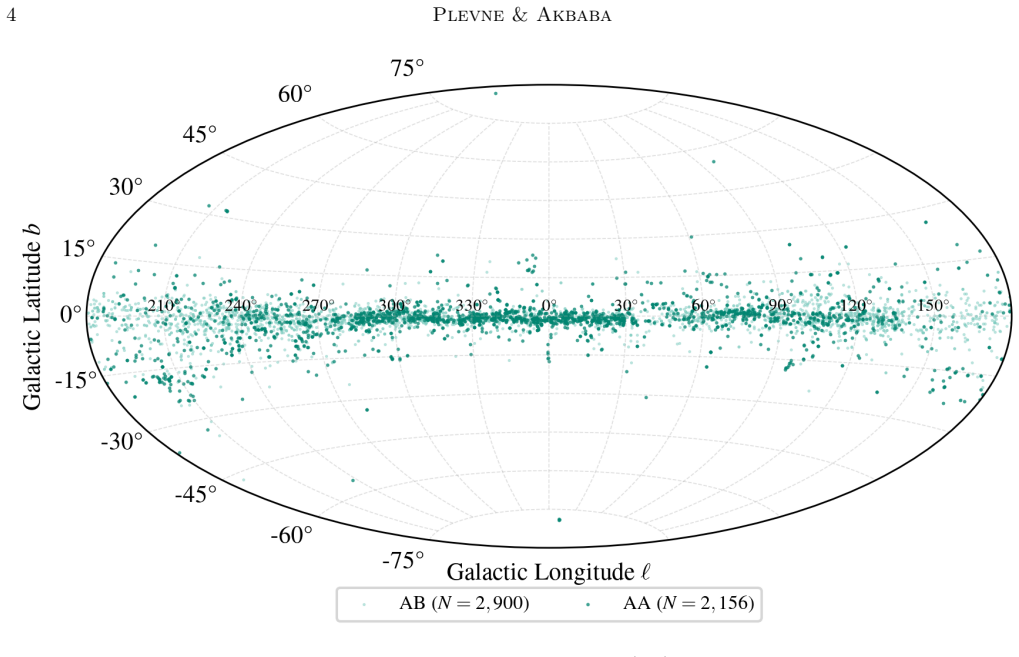


read the original abstract
We present a homogeneous catalogue of fundamental astrophysical parameters -- age, metallicity ([Fe/H]), heliocentric distance, and colour excess $E(G_{\mathrm{BP}}-G_{\mathrm{RP}})$ -- for 5,056 open star clusters drawn from the Unified Cluster Catalogue (UCC). All parameters are derived uniformly from Gaia Data Release 3 (DR3) colour-magnitude diagrams via Bayesian Nested Sampling with PARSEC stellar isochrones, with no manual intervention on individual clusters. Initial metallicity $Z_{\mathrm{ini}}$ is treated as a free parameter throughout, yielding a photometric [Fe/H] estimate for every cluster. Physically motivated priors -- parallax-based distances from Gaia DR3 astrometry, spectrophotometric metallicity constraints from Gaia XP spectra where available, and interstellar reddening from the Schlegel-Finkbeiner-Davis dust map -- reduce CMD degeneracies without anchoring the fit to any external parameter catalogue. Of the 5,056 clusters, 3,766 (74.5\%) satisfy the fit-quality criterion $\eta_{\mathrm{fit}} \ge 0.80$. This high-quality subset spans ages 0.003-5.5~Gyr ($\log(\mathrm{Age/yr})$ median $8.33 \pm 0.34$~dex), heliocentric distances 88-19,011 pc (median 2,150~pc), metallicities $-1.17 \le \mathrm{[Fe/H]} \le +0.42$~dex (median $+0.002$ dex), and extinctions up to $A_G = 7.37$~mag (median 1.07~mag). The catalogue is made publicly available via CDS/VizieR; the complete nested-sampling posterior chains are archived on Zenodo.
Editorial analysis
A structured set of objections, weighed in public.
Referee Report
Summary. The manuscript presents a homogeneous catalogue of age, [Fe/H], heliocentric distance and E(G_BP-G_RP) for 5056 open clusters from the UCC. Parameters are obtained uniformly via Bayesian nested sampling applied to Gaia DR3 colour-magnitude diagrams using PARSEC isochrones, with Z_ini treated as a free parameter and priors drawn from Gaia astrometry, XP spectra and the SFD dust map. No manual intervention is applied; 3766 clusters (74.5 %) satisfy η_fit ≥ 0.80, and the full posterior chains are released publicly.
Significance. If the PARSEC isochrones are shown to be an adequate representation of the observed CMDs across the reported parameter ranges and the priors introduce no net bias, the resulting catalogue would constitute a substantial, uniformly derived resource for open-cluster and Galactic-disk studies. The public archiving of complete nested-sampling chains is a clear strength that enhances reproducibility and downstream use.
major comments (1)
- [Abstract] Abstract (and fitting procedure): The claim that the derived parameters are free of coherent systematic bias rests on the assumption that PARSEC isochrones faithfully reproduce Gaia DR3 CMDs for all 5056 clusters (age 0.003–5.5 Gyr, [Fe/H] −1.17 to +0.42, distances to 19 kpc). No quantitative test against alternative isochrone libraries, no comparison with well-studied clusters having independent parameters, and no assessment of possible offsets arising from convective overshooting, helium enrichment or bolometric corrections are described. Because Z_ini is a free parameter and the isochrones are invoked at every step of the nested sampling, any model mismatch would propagate directly into the reported ages, distances and metallicities even for the η_fit ≥ 0.80 subset.
Simulated Author's Rebuttal
We thank the referee for their constructive review and for underscoring the need to address potential model-dependent systematics. We respond point-by-point below and outline revisions that will strengthen the manuscript without altering its core methodology or results.
read point-by-point responses
-
Referee: [Abstract] Abstract (and fitting procedure): The claim that the derived parameters are free of coherent systematic bias rests on the assumption that PARSEC isochrones faithfully reproduce Gaia DR3 CMDs for all 5056 clusters (age 0.003–5.5 Gyr, [Fe/H] −1.17 to +0.42, distances to 19 kpc). No quantitative test against alternative isochrone libraries, no comparison with well-studied clusters having independent parameters, and no assessment of possible offsets arising from convective overshooting, helium enrichment or bolometric corrections are described. Because Z_ini is a free parameter and the isochrones are invoked at every step of the nested sampling, any model mismatch would propagate directly into the reported ages, distances and metallicities even for the η_fit ≥ 0.80 subset.
Authors: We agree that the manuscript does not present quantitative comparisons to alternative isochrone sets (e.g., MIST or BaSTI) or direct validations against clusters with independent spectroscopic or asteroseismic parameters. Our work focuses on delivering a uniformly derived catalogue using a single, widely adopted library (PARSEC) together with Gaia-informed priors; the η_fit threshold is intended only as an internal consistency metric, not as proof of absolute accuracy. We will revise the abstract to remove any implication of zero systematic bias and add a dedicated paragraph in the Discussion section that (i) cites existing literature on PARSEC versus other isochrones for open clusters, (ii) notes that offsets in age, distance or metallicity of order 0.1–0.3 dex or 10–20 % in distance remain possible, and (iii) recommends that users treat the catalogue as a homogeneous but model-dependent resource. No new fits or external validations will be performed, but the added text will make the limitation explicit. revision: yes
Circularity Check
No circularity: parameters derived by direct Bayesian fit to independent Gaia CMD data
full rationale
The paper derives cluster parameters (age, [Fe/H], distance, extinction) via Bayesian nested sampling applied to observed Gaia DR3 colour-magnitude diagrams, using PARSEC isochrones as the forward model and external priors from Gaia astrometry, XP spectra, and the SFD dust map. No equation or step reduces any output quantity to a fitted input by construction, renames a prior result, or relies on a self-citation chain for its central claim. The fitting procedure is self-contained against the supplied data and model; the choice of PARSEC is an external modelling assumption whose validity is outside the scope of circularity analysis.
Axiom & Free-Parameter Ledger
free parameters (1)
- Z_ini
axioms (1)
- domain assumption PARSEC isochrones accurately represent the colour-magnitude diagrams of the open clusters in the sample across the fitted age, metallicity and extinction range
Reference graph
Works this paper leans on
-
[1]
2023, A&AS, 267, 8, doi: 10.3847/1538-4365/acd53e Astropy Collaboration, Robitaille, T
Andrae, R., Rix, H.-W., & Chandra, V. 2023, A&AS, 267, 8, doi: 10.3847/1538-4365/acd53e Astropy Collaboration, Robitaille, T. P., Tollerud, E. J., et al. 2013, A&A, 558, A33, doi: 10.1051/0004-6361/201322068
-
[2]
Demleitner, M., & Andrae, R. 2021, AJ, 161, 147, doi: 10.3847/1538-3881/abd806
work page internal anchor Pith review doi:10.3847/1538-3881/abd806 2021
-
[3]
Bressan, A., Marigo, P., Girardi, L., et al. 2012, MNRAS, 427, 127, doi: 10.1111/j.1365-2966.2012.21948.x
-
[4]
Campello, R. J. G. B., Moulavi, D., & Sander, J. 2013, Advances in Knowledge Discovery and Data Mining, 160
work page 2013
-
[5]
2022, Universe, 8, 111, doi: 10.3390/universe8020111
Cantat-Gaudin, T. 2022, Universe, 8, 111, doi: 10.3390/universe8020111
-
[6]
2020, A&A, 640, A1, doi: 10.1051/0004-6361/202038192
Cantat-Gaudin, T., Anders, F., Castro-Ginard, A., et al. 2020, A&A, 640, A1, doi: 10.1051/0004-6361/202038192
-
[7]
2021, A&A, 652, A25, doi: 10.1051/0004-6361/202039951
Casamiquela, L., Tarricq, Y., Soubiran, C., et al. 2021, A&A, 652, A25, doi: 10.1051/0004-6361/202039951
-
[8]
2014, MNRAS, 444, 2525, doi: 10.1093/mnras/stu1605 De Angeli, F., Weiler, M., Montegriffo, P., et al
Chen, Y., Girardi, L., Bressan, A., et al. 2014, MNRAS, 444, 2525, doi: 10.1093/mnras/stu1605 De Angeli, F., Weiler, M., Montegriffo, P., et al. 2023, A&A, 674, A2, doi: 10.1051/0004-6361/202243680
-
[9]
Dias, W. S., Alessi, B. S., Moitinho, A., & L´ epine, J. R. D. 2002, A&A, 389, 871, doi: 10.1051/0004-6361:20020668
-
[10]
S., Monteiro, H., Moitinho, A., et al
Dias, W. S., Monteiro, H., Moitinho, A., et al. 2021, MNRAS, 504, 356, doi: 10.1093/mnras/stab770
-
[11]
Donor, J., Frinchaboy, P. M., Cunha, K., et al. 2020, AJ, 159, 199, doi: 10.3847/1538-3881/ab77bc
-
[12]
Drimmel, R., & Spergel, D. N. 2001, ApJ, 556, 181, doi: 10.1086/321611 Gaia Collaboration, Brown, A. G. A., Vallenari, A., et al. 2018, A&A, 616, A1, doi: 10.1051/0004-6361/201833051 Gaia Collaboration, Brown, A. G. A., Vallenari, A., et al. 2021, A&A, 649, A1, doi: 10.1051/0004-6361/202039657 Gaia Collaboration, Vallenari, A., Brown, A. G. A., et al. 202...
-
[13]
Hunt, E. L., & Reffert, S. 2021, A&A, 646, A104, doi: 10.1051/0004-6361/202039341
-
[14]
Hunt, E. L., & Reffert, S. 2023, A&A, 673, A114, doi: 10.1051/0004-6361/202346267
-
[15]
Hunt, E. L., & Reffert, S. 2024, A&A, 686, A42, doi: 10.1051/0004-6361/202348929
-
[16]
Kharchenko, N. V., Piskunov, A. E., R¨ oser, S., Schilbach, E., & Scholz, R.-D. 2013, A&A, 558, A53, doi: 10.1051/0004-6361/201322302
-
[17]
Lindegren, L., Klioner, S. A., Hern´ andez, J., et al. 2021, A&A, 649, A2, doi: 10.1051/0004-6361/202039653
-
[18]
2018, A&A, 616, A2, doi: 10.1051/0004-6361/201832727
Lindegren, L., et al. 2018, A&A, 616, A2, doi: 10.1051/0004-6361/201832727
-
[19]
2017, ApJ, 835, 77, doi: 10.3847/1538-4357/835/1/77
Marigo, P., Girardi, L., Bressan, A., et al. 2017, ApJ, 835, 77, doi: 10.3847/1538-4357/835/1/77
-
[20]
Accelerated Hierarchical Density Clustering
McInnes, L., & Healy, J. 2017, arXiv e-prints, arXiv:1705.07321, doi: 10.48550/arXiv.1705.07321 M´ esz´ aros, S., Jofr´ e, P., Johnson, J. A., et al. 2025, AJ, 170, 96, doi: 10.3847/1538-3881/ade4b9
work page internal anchor Pith review Pith/arXiv arXiv doi:10.48550/arxiv.1705.07321 2017
-
[21]
Otto, J. M., Frinchaboy, P. M., Myers, N. R., et al. 2026, AJ, 171, 91, doi: 10.3847/1538-3881/ae28d8 22Plevne & Akbaba
-
[22]
Perren, G. I., V´ azquez, R. A., Piatti, A. E., et al. 2023, MNRAS, 526, 4107, doi: 10.1093/mnras/stad2826
-
[23]
Schlafly, E. F., & Finkbeiner, D. P. 2011, ApJ, 737, 103, doi: 10.1088/0004-637X/737/2/103
work page internal anchor Pith review doi:10.1088/0004-637x/737/2/103 2011
-
[24]
Maps of Dust IR Emission for Use in Estimation of Reddening and CMBR Foregrounds
Schlegel, D. J., Finkbeiner, D. P., & Davis, M. 1998, ApJ, 500, 525, doi: 10.1086/305772
work page internal anchor Pith review doi:10.1086/305772 1998
-
[25]
2004, in American Institute of Physics Conference Series, Vol
Skilling, J. 2004, in American Institute of Physics Conference Series, Vol. 735, Bayesian Inference and Maximum Entropy Methods in Science and Engineering, ed. R. Fischer, R. Preuss, & U. V. Toussaint, 395–405, doi: 10.1063/1.1835238
-
[26]
Speagle, J. S. 2020, MNRAS, 493, 3132, doi: 10.1093/mnras/staa278
-
[27]
2021, A&A, 647, A19, doi: 10.1051/0004-6361/202039388
Tarricq, Y., Soubiran, C., Casamiquela, L., et al. 2021, A&A, 647, A19, doi: 10.1051/0004-6361/202039388
-
[28]
2019, ApJ, 877, 116, doi: 10.3847/1538-4357/ab1c61
Wang, S., & Chen, X. 2019, ApJ, 877, 116, doi: 10.3847/1538-4357/ab1c61
discussion (0)
Sign in with ORCID, Apple, or X to comment. Anyone can read and Pith papers without signing in.