Anticipating Continued Global Fertility Decline via Neural Forecasting
Pith reviewed 2026-05-25 02:22 UTC · model grok-4.3
The pith
A neural network using only historical fertility data projects wider exposure to low fertility by 2040 than the UN BayesTFR model.
A machine-rendered reading of the paper's core claim, the machinery that carries it, and where it could break.
Core claim
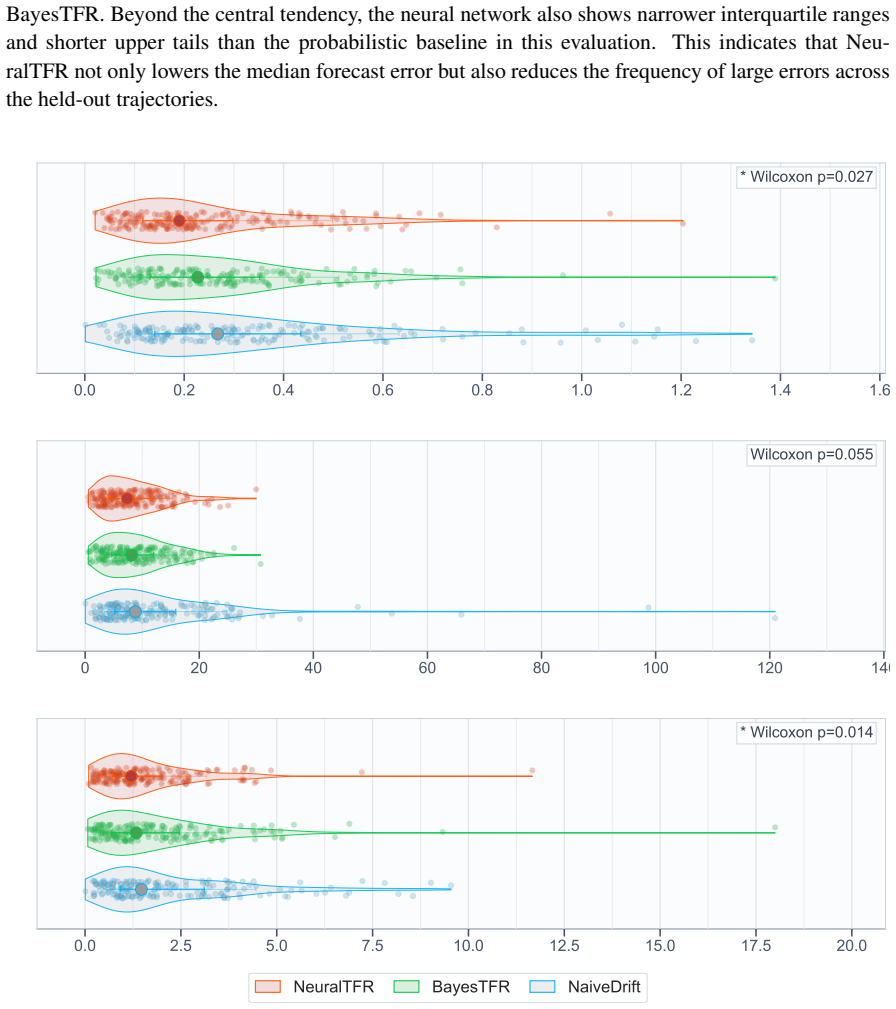
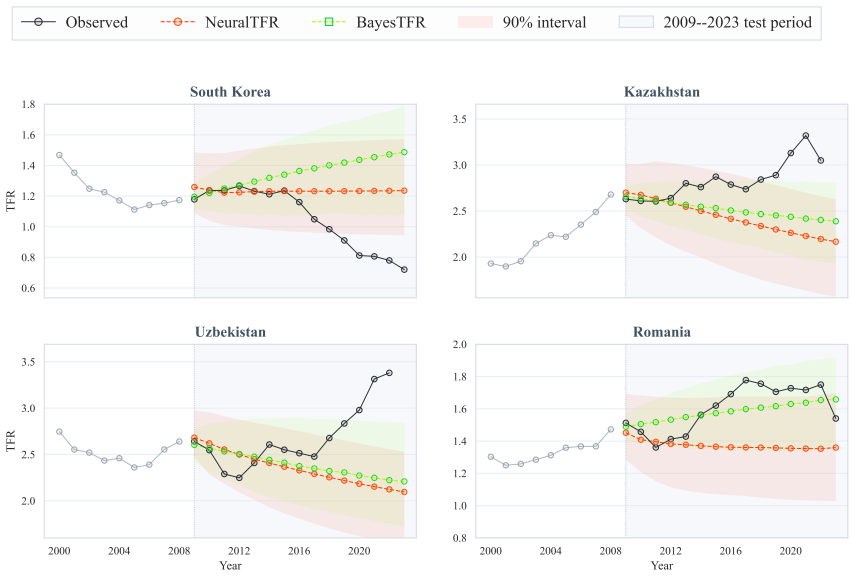
NeuralTFR, an endogenous global forecasting framework based on a recurrent neural network, achieves lower point-forecast errors than BayesTFR on 2009-2023 data and points to broader exposure to low and very low fertility by 2040, suggesting weaker support for near-term stabilization while still falling short of the most severe decline paths predicted by the Global Burden of Disease project.
What carries the argument
NeuralTFR, a recurrent neural network that pools cross-country historical fertility series to learn demographic momentum and generate empirical prediction intervals via multi-quantile regression.
If this is right
- NeuralTFR records lower point-forecast errors than Naive Drift and BayesTFR on the 2009-2023 evaluation period.
- Uncertainty calibration stays competitive with the UN benchmark model.
- Projections to 2040 show more countries entering low and very low fertility than BayesTFR indicates.
- The projected paths remain less extreme than Global Burden of Disease estimates.
Where Pith is reading between the lines
- If the historical-data-only assumption holds, population planning may need to prepare for longer periods of low fertility rather than assuming quick recovery.
- Adding post-2023 observations would provide a direct test of whether the learned momentum patterns continue.
- The same recurrent-network pooling approach could be applied to other series such as mortality or migration where cross-country regularities exist.
Load-bearing premise
Historical fertility series alone contain sufficient learnable structure to generate reliable out-of-sample forecasts without external covariates or policy variables.
What would settle it
Actual fertility rates recorded after 2023 that track BayesTFR stabilization paths more closely than NeuralTFR's low-fertility projections would falsify the central claim.
Figures





read the original abstract
The accelerating shift toward low and ultra-low fertility has intensified the debate over whether countries now undergoing rapid decline are approaching stabilization or entering a more persistent low-fertility regime. Existing projection systems answer that question differently because they embed different assumptions about recovery and about the role of external drivers. To provide an empirical benchmark in this debate, we introduce NeuralTFR, an endogenous global forecasting framework based on a recurrent neural network. Drawing on a harmonized panel of historical fertility series from 196 countries and territories, the model pools cross-country information to learn demographic momentum and generate empirical prediction intervals via multi-quantile regression. Evaluated on a held-out period (2009--2023), NeuralTFR achieves lower point-forecast errors than a Naive Drift baseline and BayesTFR, the United Nations' Bayesian Hierarchical Model, while maintaining competitive uncertainty calibration. In forward projections to 2040, NeuralTFR points to broader exposure to low and very low fertility than BayesTFR, suggesting weaker support for near-term stabilization while still falling short of the most severe decline paths predicted by the Global Burden of Disease project.
Editorial analysis
A structured set of objections, weighed in public.
Referee Report
Summary. The manuscript introduces NeuralTFR, a recurrent neural network model for global total fertility rate (TFR) forecasting. Trained on harmonized historical TFR series from 196 countries and territories, the model pools cross-country information to capture demographic momentum and generates empirical prediction intervals through multi-quantile regression. On a 2009-2023 hold-out period, NeuralTFR reports lower point-forecast errors than a Naive Drift baseline and the UN's BayesTFR model while maintaining competitive uncertainty calibration. Forward projections to 2040 indicate broader exposure to low and very low fertility than BayesTFR, though less severe than Global Burden of Disease estimates.
Significance. If the performance advantages hold under scrutiny, the work supplies a useful empirical benchmark in the fertility-projection literature by offering a purely endogenous, data-driven alternative to models that embed explicit recovery assumptions or external drivers. The multi-quantile approach for uncertainty is a constructive methodological choice. The central projection result—that NeuralTFR anticipates wider low-fertility exposure by 2040—would, if substantiated, weaken support for near-term stabilization relative to BayesTFR.
major comments (3)
- [Abstract] Abstract: the claim that NeuralTFR achieves lower point-forecast errors than BayesTFR on the 2009-2023 hold-out is presented without accompanying numerical error values, confidence intervals, or statistical tests; this omission prevents assessment of whether the reported advantage is practically meaningful or statistically reliable.
- [Methods] Methods (model description): the central projection claim—that NeuralTFR forecasts broader low-fertility exposure by 2040—rests on the assumption that historical TFR trajectories alone contain sufficient stationary structure for reliable extrapolation to 2040; no sensitivity analysis to potential regime shifts or external drivers is reported, leaving the long-horizon validity untested.
- [Evaluation] Evaluation section: the manuscript provides no details on network architecture, training procedure, quantile loss specification, or data harmonization steps; without these, the soundness of the reported out-of-sample performance cannot be verified and the comparison to BayesTFR remains non-reproducible.
minor comments (2)
- [Abstract] Abstract: the precise error metric (MAE, RMSE, or other) underlying the 'lower point-forecast errors' claim is not stated.
- The paper would benefit from an explicit statement of the number of countries/territories with complete series and any imputation rules applied.
Simulated Author's Rebuttal
We thank the referee for these constructive comments, which highlight opportunities to strengthen the clarity, reproducibility, and robustness of the manuscript. We respond to each major comment below and will incorporate revisions accordingly.
read point-by-point responses
-
Referee: [Abstract] Abstract: the claim that NeuralTFR achieves lower point-forecast errors than BayesTFR on the 2009-2023 hold-out is presented without accompanying numerical error values, confidence intervals, or statistical tests; this omission prevents assessment of whether the reported advantage is practically meaningful or statistically reliable.
Authors: We agree that the abstract would be strengthened by quantitative detail. In the revised manuscript we will insert the specific point-forecast error values (MAE or equivalent) achieved by NeuralTFR, the Naive Drift baseline, and BayesTFR on the 2009-2023 hold-out. If formal statistical tests were conducted we will report them; otherwise the comparison will be presented descriptively with the numerical results. revision: yes
-
Referee: [Methods] Methods (model description): the central projection claim—that NeuralTFR forecasts broader low-fertility exposure by 2040—rests on the assumption that historical TFR trajectories alone contain sufficient stationary structure for reliable extrapolation to 2040; no sensitivity analysis to potential regime shifts or external drivers is reported, leaving the long-horizon validity untested.
Authors: NeuralTFR is intentionally constructed as a purely endogenous benchmark that learns only from historical TFR series, deliberately avoiding recovery assumptions or external covariates that appear in other models. We recognize that this leaves long-horizon extrapolation sensitive to possible regime shifts. We will add a dedicated sensitivity subsection that retrains the model on truncated historical windows and examines forecast stability under simulated non-stationarities. revision: yes
-
Referee: [Evaluation] Evaluation section: the manuscript provides no details on network architecture, training procedure, quantile loss specification, or data harmonization steps; without these, the soundness of the reported out-of-sample performance cannot be verified and the comparison to BayesTFR remains non-reproducible.
Authors: We apologize for the lack of explicit detail. The Methods section already specifies an LSTM-based recurrent architecture, multi-quantile (pinball) loss, and harmonized UN/national TFR series, but these elements will be expanded with concrete hyperparameters (layers, hidden units, optimizer, epochs), the exact quantile loss formulation, and a step-by-step description of the data harmonization pipeline. Reproducible code or pseudocode will also be supplied. revision: yes
Circularity Check
NeuralTFR derives forecasts from trained RNN on historical data with no reduction by construction
full rationale
The paper trains a recurrent neural network on harmonized historical TFR series from 196 countries/territories, evaluates point-forecast errors and uncertainty calibration on a 2009-2023 hold-out period against baselines including BayesTFR, and then generates forward projections to 2040. No equations, model descriptions, or claims indicate that the 2040 projections or the claim of broader low-fertility exposure reduce by construction to quantities already fitted inside the model itself. The derivation chain is a standard supervised learning setup (endogenous RNN + multi-quantile regression) whose outputs are not definitionally equivalent to its training inputs. No self-citation load-bearing steps, uniqueness theorems, or ansatz smuggling appear in the provided text. This is the most common honest non-finding for empirical forecasting papers.
Axiom & Free-Parameter Ledger
free parameters (1)
- RNN weights, biases, and quantile parameters
axioms (1)
- domain assumption Historical fertility series from 196 countries contain learnable endogenous momentum sufficient for out-of-sample prediction
Reference graph
Works this paper leans on
-
[1]
Akiba, T., S. Sano, T. Yanase, T. Ohta, and M. Koyama (2019). Optuna: A next-generation hyperparameter optimization framework. In Proceedings of the 25th ACM SIGKDD international conference on knowledge discovery & data mining , pp.\ 2623--2631
work page 2019
-
[2]
Alkema, L., A. E. Raftery, P. Gerland, S. J. Clark, F. Pelletier, T. Buettner, and G. K. Heilig (2011). Probabilistic projections of the total fertility rate for all countries. Demography\/ 48\/ (3), 815--839
work page 2011
-
[3]
Bandara, K., P. Shi, C. Bergmeir, H. Hewamalage, Q. Tran, and B. Seaman (2019). Sales demand forecast in e-commerce using a long short-term memory neural network methodology. In T. Gedeon, K. W. Wong, and M. Lee (Eds.), Neural Information Processing , Cham, pp.\ 462--474. Springer International Publishing
work page 2019
-
[4]
Basten, S., T. Sobotka, and K. Zeman (2014). Future fertility in low fertility countries. In W. Lutz, W. P. Butz, and S. KC (Eds.), World Population and Human Capital in the Twenty-First Century , pp.\ 39--146. Oxford University Press
work page 2014
-
[5]
Beyaztas, U. and H. Shang (2022). Machine-learning-based functional time series forecasting: Application to age-specific mortality rates. Forecasting\/ 4\/ (1), 394--408
work page 2022
-
[6]
Campisi, N., H. Kulu, J. Mikolai, S. Kl \"u sener, and M. Myrskyl \"a (2023). A spatial perspective on the unexpected nordic fertility decline: The relevance of economic and social contexts. Applied Spatial Analysis and Policy\/ 16\/ (1), 1--31
work page 2023
-
[7]
Cho, K., B. Van Merri \"e nboer, C . Gul c ehre, D. Bahdanau, F. Bougares, H. Schwenk, and Y. Bengio (2014). Learning phrase representations using rnn encoder--decoder for statistical machine translation. In Proceedings of the 2014 conference on empirical methods in natural language processing (EMNLP) , pp.\ 1724--1734
work page 2014
-
[8]
Fischer, T. and C. Krauss (2018). Deep learning with long short-term memory networks for financial market predictions. European Journal of Operational Research\/ 270\/ (2), 654--669
work page 2018
-
[9]
GBD 2021 Fertility and Forecasting Collaborators (2024). Global fertility in 204 countries and territories, 1950--2021, with forecasts to 2100: a comprehensive demographic analysis for the global burden of disease study 2021. The Lancet\/ 403\/ (10440), 2057--2099
work page 2021
-
[10]
Gietel-Basten, S. and T. Sobotka (2020). Uncertain population futures: Critical reflections on the ihme scenarios of future fertility, mortality, migration and population trends from 2017 to 2100. OSF Preprints\/ 10
work page 2020
-
[11]
Gietel-Basten, S., T. Sobotka, et al. (2020). Letter on ' Fertility , mortality, migration, and population scenarios for 195 countries and territories from 2017 to 2100: a forecasting analysis for the Global Burden of Disease Study ' by S. E. Vollset et al. https://osf.io/ytf6m/overview?view_only=5389a004f7e94917b30b5a4d4ea7a154
work page 2020
-
[12]
Gneiting, T. and M. Katzfuss (2014). Probabilistic forecasting. Annual Review of Statistics and Its Application\/ 1\/ (1), 125--151
work page 2014
-
[13]
Gneiting, T. and A. E. Raftery (2007). Strictly proper scoring rules, prediction, and estimation. Journal of the American Statistical Association\/ 102\/ (477), 359--378
work page 2007
-
[14]
Goujon, A. (2025). The demographic future that we do not know about. Science\/ 390\/ (6725)
work page 2025
-
[15]
Hellstrand, J., J. Nis \'e n, V. Miranda, P. Fallesen, L. Dommermuth, and M. Myrskyl \"a (2021). Not just later, but fewer: Novel trends in cohort fertility in the nordic countries. Demography\/ 58\/ (4), 1373--1399
work page 2021
-
[16]
Hochreiter, S. and J. Schmidhuber (1997). Long short-term memory. Neural computation\/ 9\/ (8), 1735--1780
work page 1997
-
[17]
Global fertility, mortality, migration, and population forecasts 2017--2100
Institute for Health Metrics and Evaluation (IHME) (2020). Global fertility, mortality, migration, and population forecasts 2017--2100
work page 2020
-
[18]
Januschowski, T., J. Gasthaus, Y. Wang, D. Salinas, V. Flunkert, M. Bohlke-Schneider, and L. Callot (2020). Criteria for classifying forecasting methods. international Journal of forecasting\/ 36\/ (1), 167--177
work page 2020
- [19]
-
[20]
Kearney, M. S., P. B. Levine, and L. Pardue (2022). The puzzle of falling US birth rates since the Great Recession . Journal of Economic Perspectives\/ 36\/ (1), 151--176
work page 2022
-
[21]
Koenker, R. and G. Bassett Jr (1978). Regression quantiles. Econometrica: journal of the Econometric Society\/ , 33--50
work page 1978
- [22]
-
[23]
Lutz, W., W. P. Butz, et al. (2014). World population and human capital in the twenty-first century . OUP Oxford
work page 2014
- [24]
-
[25]
Lutz, W., V. Skirbekk, and M. R. Testa (2006). The low-fertility trap hypothesis: Forces that may lead to further postponement and fewer births in Europe . Vienna yearbook of population research\/ , 167--192
work page 2006
-
[26]
Montero-Manso, P. and R. J. Hyndman (2021). Principles and algorithms for forecasting groups of time series: Locality and globality. International Journal of Forecasting\/ 37\/ (4), 1632--1653
work page 2021
-
[27]
Myrskyl \"a , M., H.-P. Kohler, and F. C. Billari (2009). Advances in development reverse fertility declines . Nature\/ 460\/ (7256), 741--743
work page 2009
-
[28]
Nigri, A., S. Levantesi, M. Marino, S. Scognamiglio, and F. Perla (2019). A deep learning integrated lee-carter model. Risks\/ 7\/ (1), 33
work page 2019
-
[29]
Paranhos, L. (2025). Predicting inflation with recurrent neural networks. International Journal of Forecasting\/ . Article in press
work page 2025
-
[30]
Park, P. (2025). Next-generation mortality forecasting with deep learning. OSF Preprints\/
work page 2025
-
[31]
Raftery, A. E., L. Alkema, and P. Gerland (2014). Bayesian population projections for the united nations. Statistical science: a review journal of the Institute of Mathematical Statistics\/ 29\/ (1), 58
work page 2014
-
[32]
Raftery, A. E. and H. S ev c \' kov \'a (2023). Probabilistic population forecasting: Short to very long-term. International Journal of Forecasting\/ 39\/ (1), 73--97
work page 2023
-
[33]
Salinas, D., V. Flunkert, J. Gasthaus, and T. Januschowski (2020). Deepar: Probabilistic forecasting with autoregressive recurrent networks. International Journal of Forecasting\/ 36\/ (3), 1181--1191
work page 2020
-
[34]
Smyl, S. (2020). A hybrid method of exponential smoothing and recurrent neural networks for time series forecasting. International Journal of Forecasting\/ 36\/ (1), 75--85
work page 2020
-
[35]
Susmann, H. and L. Alkema (2025). Flexible modelling of demographic transition processes with a bayesian hierarchical b-splines model. Journal of the Royal Statistical Society Series C: Applied Statistics\/ 74 , 1340--1371
work page 2025
-
[36]
Sutskever, I., O. Vinyals, and Q. V. Le (2014). Sequence to sequence learning with neural networks. Advances in neural information processing systems\/ 27
work page 2014
-
[37]
World Population Prospects 2024: Summary of Results
United Nations (2024). World Population Prospects 2024: Summary of Results . New York: United Nations Department of Economic and Social Affairs, Population Division
work page 2024
-
[38]
Zheng, H., H. Wang, R. Zhu, and J.-H. Xue (2025). A brief review of deep learning methods in mortality forecasting. Annals of Actuarial Science\/ , 1--16
work page 2025
-
[39]
International Journal of Forecasting , year =
Paranhos, Livia , title =. International Journal of Forecasting , year =
-
[40]
Neural Information Processing , editor =
Bandara, Kasun and Shi, Peng and Bergmeir, Christoph and Hewamalage, Hansika and Tran, Quang and Seaman, Bill , title =. Neural Information Processing , editor =. 2019 , address =
work page 2019
-
[41]
European Journal of Operational Research , volume =
Fischer, Thomas and Krauss, Christopher , title =. European Journal of Operational Research , volume =. 2018 , doi =
work page 2018
-
[42]
International Journal of Forecasting , volume =
Salinas, David and Flunkert, Valentin and Gasthaus, Jan and Januschowski, Tim , title =. International Journal of Forecasting , volume =. 2020 , doi =
work page 2020
-
[43]
International Journal of Forecasting , volume =
Smyl, Slawek , title =. International Journal of Forecasting , volume =. 2020 , doi =
work page 2020
-
[44]
Lai, Guokun and Chang, Wei-Cheng and Yang, Yiming and Liu, Hanxiao , title =. The 41st International ACM SIGIR Conference on Research & Development in Information Retrieval , pages =. 2018 , doi =
work page 2018
- [45]
-
[46]
Kearney, Melissa S. and Levine, Phillip B. and Pardue, Luke , title =. Journal of Economic Perspectives , volume =. 2022 , doi =
work page 2022
-
[47]
Campisi, Natalie and Kulu, Hill and Mikolai, Julia and Kl. A Spatial Perspective on the Unexpected Nordic Fertility Decline: The Relevance of Economic and Social Contexts , journal =. 2023 , doi =
work page 2023
-
[48]
Annual Review of Statistics and Its Application , volume =
Probabilistic Forecasting , author =. Annual Review of Statistics and Its Application , volume =. 2014 , publisher =
work page 2014
-
[49]
Journal of the American Statistical Association , volume =
Strictly Proper Scoring Rules, Prediction, and Estimation , author =. Journal of the American Statistical Association , volume =. 2007 , publisher =
work page 2007
-
[50]
Journal of the Royal Statistical Society Series C: Applied Statistics , volume =
Susmann, Herbert and Alkema, Leontine , title =. Journal of the Royal Statistical Society Series C: Applied Statistics , volume =. 2025 , doi =
work page 2025
discussion (0)
Sign in with ORCID, Apple, or X to comment. Anyone can read and Pith papers without signing in.