The Phenomenological Nature of Quasar-type Blazars (BZQ). I. Revisiting the Flat-Spectrum Paradigm
Pith reviewed 2026-06-30 21:03 UTC · model grok-4.3
The pith
The flat-spectrum label does not capture the radio spectral diversity of quasar-type blazars.
A machine-rendered reading of the paper's core claim, the machinery that carries it, and where it could break.
Core claim
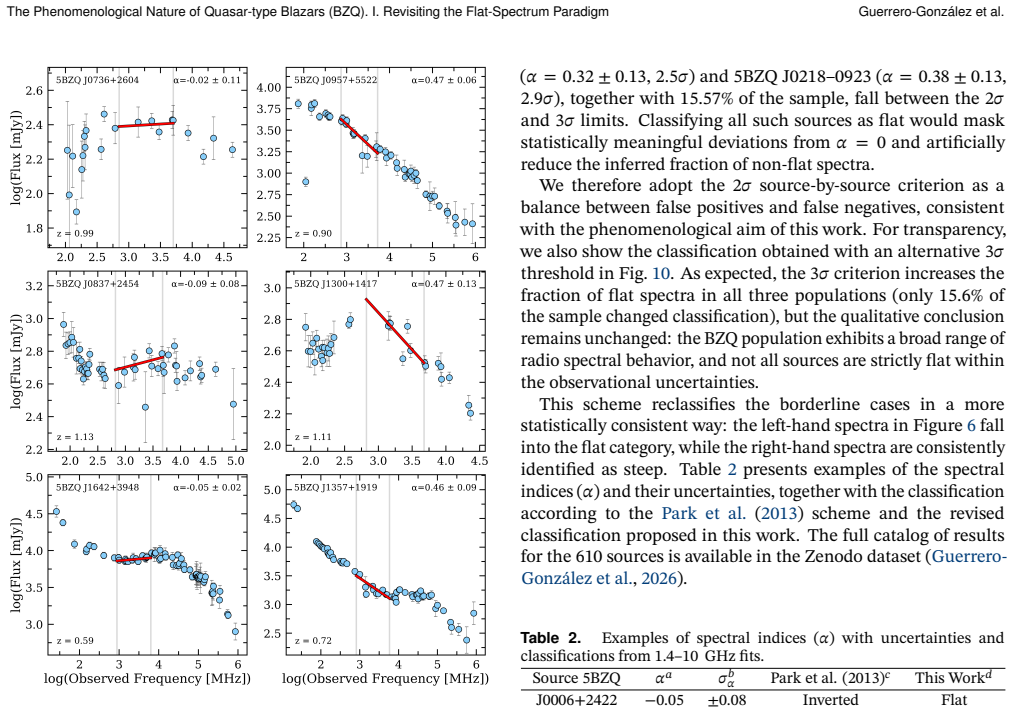
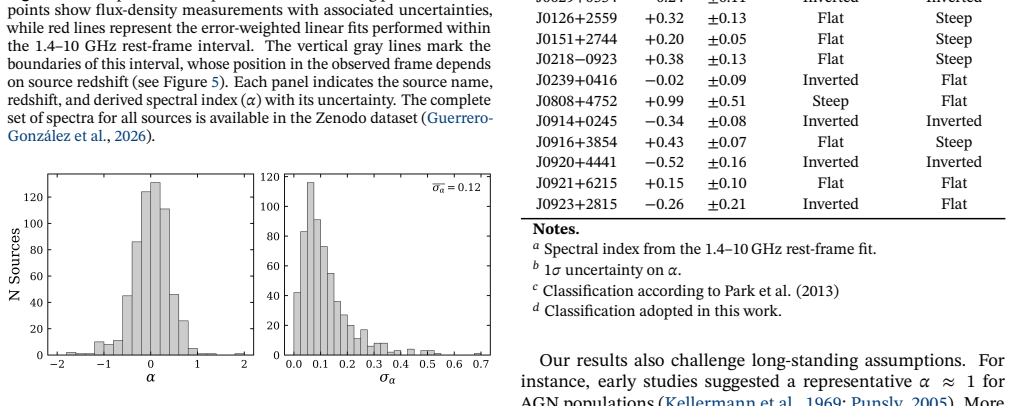
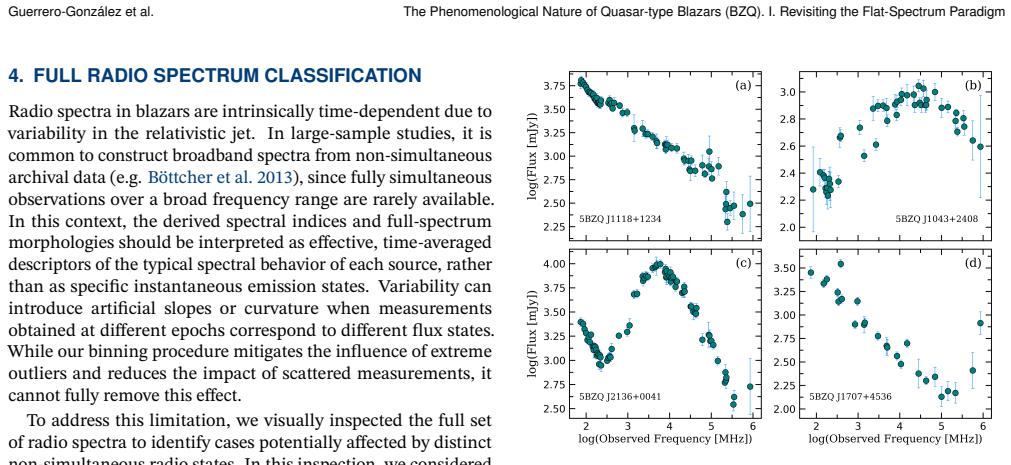
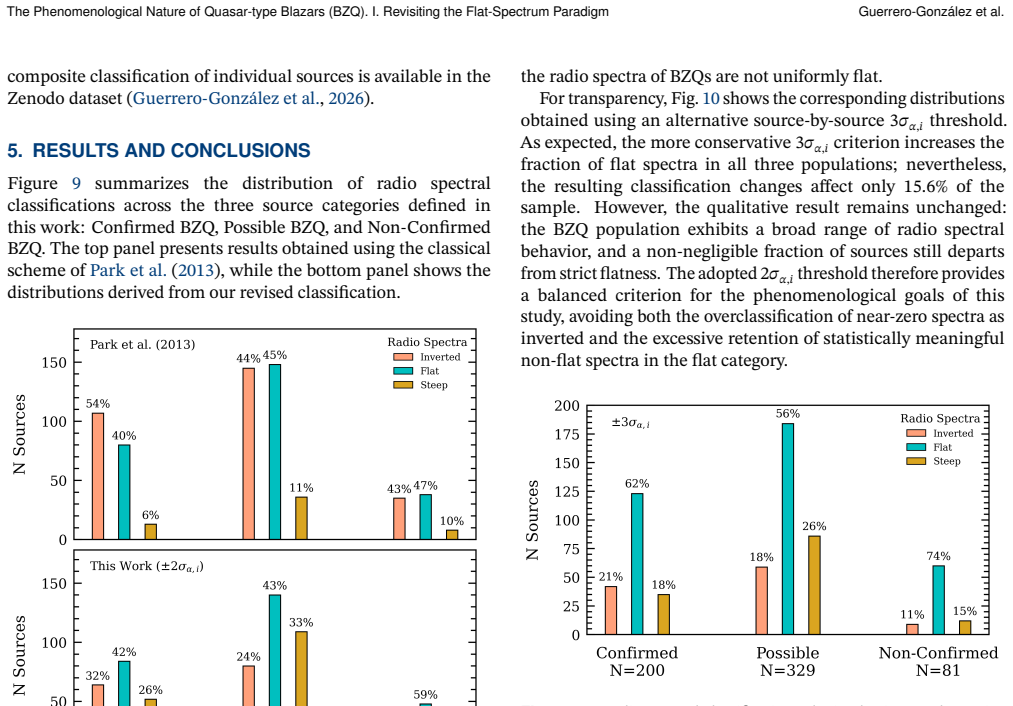
Rest-frame radio spectra of the 610 sources were homogenized across instruments and fitted with error-weighted power laws. A source-by-source criterion classifies spectra as flat when the absolute index is no larger than twice its uncertainty, as prominently steep when the index exceeds twice its uncertainty, and as inverted when the index falls below twice the negative uncertainty. Most sources meet the flat criterion within errors, but non-negligible fractions depart from it. Full spectral morphologies are typed as power-law, peaked, restarted-peaked, or inverted-peaked and linked to separate jet processes; roughly 60 percent of sources with at least two decades of frequency coverage displ
What carries the argument
Per-source radio spectral index classification using the threshold |α_i| ≤ 2σ_α,i for flat spectra, together with morphological typing of the full spectrum into power-law, peaked, restarted-peaked, or inverted-peaked classes.
If this is right
- Most sources remain consistent with flat spectra once individual measurement uncertainties are taken into account.
- A non-negligible fraction of the population shows prominently steep or inverted spectra.
- Roughly 60 percent of sources with broad frequency coverage exhibit restarted-peaked spectra, pointing to recurrent jet activity.
- Distinct morphological classes correspond to separate jet processes and activity cycles.
- The term BZQ more accurately captures the full range of observed properties than the flat-spectrum radio quasar label.
Where Pith is reading between the lines
- The uncertainty-based classification could be applied to larger blazar catalogs to improve population statistics.
- The high rate of restarted morphologies implies that single-epoch radio data may underestimate the frequency of jet reactivation cycles.
- Linking optical variability strength to radio morphology classes may sharpen the separation between confirmed BZQs and contaminants.
- Surveys that deliberately span multiple decades in frequency would directly test how often restarted activity appears across the broader blazar population.
Load-bearing premise
Spectra from heterogeneous instruments can be combined and fitted as single rest-frame power laws without systematic offsets from resolution, calibration, or frequency coverage that would alter the per-source 2σ classifications.
What would settle it
Acquire new radio observations of a representative subset of these sources with one uniform telescope array spanning 1.4-10 GHz and test whether the fraction of sources outside the flat classification changes by more than the original uncertainties.
Figures
read the original abstract
We reevaluate 610 sources classified as Flat-spectrum radio quasars (FSRQs) in the 5th edition of the Roma-BZCAT. Optical spectra from SDSS DR16 confirm broad emission lines within $0.11 \leq z \leq 5.28$. To assess their blazar-like behavior, we combine ZTF optical variability with radio morphologies from FIRST, LOFAR, and VLBI, defining Confirmed, Possible, and Non-Confirmed BZQs. Rest-frame 1.4--10 GHz radio spectra were homogenized and fitted with error-weighted power laws. We show that the scheme of Park et al. (2013) often misclassifies nearly flat spectra as inverted and some prominently steep spectra as flat. Using the individual uncertainty $\sigma_{\alpha,i}$, we classify spectra as flat if $|\alpha_i| \leq 2\sigma_{\alpha,i}$, prominently steep if $\alpha_i > 2\sigma_{\alpha,i}$, and inverted if $\alpha_i < -2\sigma_{\alpha,i}$. This source-by-source criterion, intended as a phenomenological classification for this sample, better reflects the observed spectral shapes and confirms that most BZQs are consistent with being flat within measurement precision, although a non-negligible fraction departs from strict flatness. We also classify full spectral morphologies as power-law, peaked, restarted-peaked, or inverted-peaked, associated with distinct jet processes and activity cycles. About 60% of the sources with at least two decades of frequency coverage exhibit restarted-peaked spectra, suggesting recurrent jet activity. The observed diversity indicates that the label "Flat-spectrum radio quasar" does not fully describe this population, and that the more general term BZQ may better reflect its phenomenological diversity.
Editorial analysis
A structured set of objections, weighed in public.
Referee Report
Summary. The paper reevaluates 610 Roma-BZCAT sources classified as flat-spectrum radio quasars (FSRQs) using SDSS DR16 spectra to confirm broad lines (0.11 ≤ z ≤ 5.28), ZTF variability, and radio morphologies from FIRST/LOFAR/VLBI to define Confirmed/Possible/Non-Confirmed BZQs. Rest-frame 1.4–10 GHz spectra are homogenized across instruments and fitted with error-weighted power laws; sources are then classified source-by-source as flat if |α_i| ≤ 2σ_α,i, prominently steep if α_i > 2σ_α,i, or inverted if α_i < −2σ_α,i. This yields ~40 % non-flat sources and shows that ~60 % of sources with ≥2 decades of coverage exhibit restarted-peaked morphologies. The authors conclude that the FSRQ label fails to capture the observed spectral and morphological diversity and propose the more general term BZQ.
Significance. If the homogenization and per-source classification are robust, the result would establish that a substantial fraction of traditionally labeled FSRQs exhibit non-flat spectra and diverse jet-related morphologies (including recurrent activity), providing a data-driven argument for revising phenomenological classifications in blazar studies. The individual-uncertainty approach avoids some fixed-threshold biases and directly ties spectral shapes to distinct physical processes.
major comments (1)
- [Abstract / spectral analysis] Abstract and spectral-analysis section: the central claim that ~40 % of sources depart from flatness (and that morphological diversity supports replacing FSRQ with BZQ) rests on the error-weighted power-law fits after homogenization of FIRST/LOFAR/VLBI data. No quantitative description of the homogenization procedure, cross-calibration offsets, or tests for residual systematic errors in α (arising from resolution, calibration, or frequency-coverage differences) is supplied; if such systematics exceed the quoted per-source σ_α,i, the 2σ classification threshold will reclassify a non-negligible fraction of sources and alter the reported non-flat fraction and restarted-peaked statistics.
Simulated Author's Rebuttal
We thank the referee for the careful and constructive review. The concern about the lack of quantitative details on spectral homogenization is valid and will be addressed in revision. We provide a point-by-point response below.
read point-by-point responses
-
Referee: [Abstract / spectral analysis] Abstract and spectral-analysis section: the central claim that ~40 % of sources depart from flatness (and that morphological diversity supports replacing FSRQ with BZQ) rests on the error-weighted power-law fits after homogenization of FIRST/LOFAR/VLBI data. No quantitative description of the homogenization procedure, cross-calibration offsets, or tests for residual systematic errors in α (arising from resolution, calibration, or frequency-coverage differences) is supplied; if such systematics exceed the quoted per-source σ_α,i, the 2σ classification threshold will reclassify a non-negligible fraction of sources and alter the reported non-flat fraction and restarted-peaked statistics.
Authors: We agree that the manuscript as submitted lacks a quantitative description of the homogenization steps. In the revised version we will add a dedicated methods subsection that (i) specifies the reference frequency and flux scale adopted for homogenization, (ii) reports the median cross-calibration offsets derived from the 87 sources with overlapping FIRST–LOFAR and FIRST–VLBI measurements (with 1σ scatter of 0.12 dex in log S), (iii) describes how resolution differences were mitigated by restricting the fit to the common 1.4–10 GHz rest-frame window and by using only compact-core flux densities from VLBI where available, and (iv) presents two robustness tests: (a) recomputing α after adding a conservative 10 % systematic floor to all flux uncertainties and (b) repeating the classification after excluding the lowest- and highest-frequency points. These additions will allow readers to evaluate whether residual systematics could move sources across the 2σ_α threshold. We do not expect the overall ~40 % non-flat fraction or the 60 % restarted-peaked statistic to change materially, because the per-source σ_α,i already incorporate the dominant measurement scatter, but the new section will make this explicit. revision: yes
Circularity Check
No significant circularity; purely observational classification
full rationale
The paper conducts source-by-source spectral fitting of homogenized radio data and applies an explicit, user-defined classification rule (|α_i| ≤ 2σ_α,i for flat) that is stated as a phenomenological choice rather than a derived prediction. No equations reduce the diversity conclusion to a fit by construction, no self-citations are load-bearing for the central claim, and the argument rests on direct comparison of observed spectral shapes to an external scheme (Park et al. 2013) without self-referential loops. The result is self-contained against the input catalog and measurements.
Axiom & Free-Parameter Ledger
free parameters (1)
- 2σ threshold for flat/inverted classification
axioms (1)
- domain assumption Radio spectra from different instruments can be reliably homogenized to a common rest-frame frequency range and fitted with error-weighted power laws
Reference graph
Works this paper leans on
-
[1]
Abdo,A.A.,Ackermann,M.,Agudo,I.,etal.2010a,ApJ,716,30, doi:10.1088/0004-637X/716/1/30
-
[2]
A., Ackermann, M., Ajello, M., et al
Abdo, A. A., Ackermann, M., Ajello, M., et al. 2010b, ApJ, 715, 429,doi:10.1088/0004-637X/715/1/429 Aharonian,F.,Akhperjanian,A.G.,Bazer-Bachi,A.R.,etal.2007, ApJ,664,L71,doi:10.1086/520635 Amador-Portes,A.,García-Pérez,A.,Chavushyan,V.,&Patiño- Álvarez,V.M.2024,ApJ,977,178,doi:10.3847/1538-4357/ad 8ddd Amaya-Almazán,R.A.,Chavushyan,V.,&Patiño-Álvarez,V.M...
-
[3]
Anticipated Performance of the Square Kilometre Array – Phase1(SKA1)
Braun, R., Bonaldi, A., Bourke, T., Keane, E., & Wagg, J. 2019, "Anticipated Performance of the Square Kilometre Array – Phase1(SKA1)",arXive-prints,arXiv:1912.12699,doi:10.485 50/arXiv.1912.12699 Brienza,M.,Morganti,R.,Harwood,J.,etal.2020,A&A,638,A29, doi:10.1051/0004-6361/202037457 Callingham,J.R.,Ekers,R.D.,Gaensler,B.M.,etal.2017,ApJ, 836,174,doi:10....
-
[4]
Chen, Y. Y., Zhang, X., Zhang, H. J., & Yu, X. L. 2015, MNRAS, 451,4193,doi:10.1093/mnras/stv658 Condon,J.J.1984,ApJ,287,461,doi:10.1086/162705
-
[5]
Delvecchio, I., Daddi, E., Sargent, M. T., et al. 2022, A&A, 668, A81,doi:10.1051/0004-6361/202244639
-
[6]
D., Schlickeiser, R., & Mastichiadis, A
Dermer, C. D., Schlickeiser, R., & Mastichiadis, A. 1992, A&A, 256,L27 Dewdney,P.E.,Hall,P.J.,Schilizzi,R.T.,&Lazio,T.J.L.W.2009, IEEEProceedings,97,1482,doi:10.1109/JPROC.2009.2021005 Dey,S.,Goyal,A.,Małek,K.,etal.2022,ApJ,938,152,doi:10.3 847/1538-4357/ac82f2 Edwards,P.G.,&Tingay,S.J.2004,A&A,424,91,doi:10.1051/ 0004-6361:20035749
-
[7]
Fernandes, S., Patiño-Álvarez, V. M., Chavushyan, V., Schlegel, E. M., & Valdés, J. R. 2020, MNRAS, 497, 2066, doi: 10.1093/ mnras/staa2013 Fossati,G.,Maraschi,L.,Celotti,A.,Comastri,A.,&Ghisellini,G. 1998,MNRAS,299,433,doi:10.1046/j.1365-8711.1998.01828.x Gaur,H.,Gupta,A.C.,Strigachev,A.,etal.2012,MNRAS,425, 3002,doi:10.1111/j.1365-2966.2012.21583.x Ghis...
-
[8]
Hancock, P. J., Sadler, E. M., Mahony, E. K., & Ricci, R. 2010, MNRAS,408,1187,doi:10.1111/j.1365-2966.2010.17199.x Hayashida,M.,Nalewajko,K.,Madejski,G.M.,etal.2015,ApJ, 807,79,doi:10.1088/0004-637X/807/1/79 Hogan,M.T.,Edge,A.C.,Geach,J.E.,etal.2015,MNRAS,453, 1223,doi:10.1093/mnras/stv1518 Hovatta,T.,&Lindfors,E.2019,NewAR,87,101541,doi:10.101 6/j.newar...
-
[9]
Hovatta, T., Aller, M. F., Aller, H. D., et al. 2014, AJ, 147, 143, doi:10.1088/0004-6256/147/6/143
-
[10]
Kadler, M., Ros, E., Lobanov, A. P., Falcke, H., & Zensus, J. A. 2004,A&A,426,481,doi:10.1051/0004-6361:20041051 Kameno,S.,Horiuchi,S.,Shen,Z.-Q.,etal.2000,PASJ,52,209, doi:10.1093/pasj/52.1.209 Kellermann,K.I.,Pauliny-Toth,I.I.K.,&Williams,P.J.S.1969, ApJ,157,1,doi:10.1086/150046 Kerrison,E.F.,Allison,J.R.,Moss,V.A.,Sadler,E.M.,&Rees, G.A.2024,MNRAS,533,...
-
[11]
Kovalev, Y. Y., Kovalev, Y. A., Nizhelsky, N. A., & Bogdantsov, A.B.2002,PASA,19,83,doi:10.1071/AS01109 Kukreti,P.,&Morganti,R.2024,A&A,690,A140,doi:10.1051/ 0004-6361/202450454 Kukreti,P.,Morganti,R.,Tadhunter,C.,&Santoro,F.2023,A&A, 674,A198,doi:10.1051/0004-6361/202245691 Lister,M.L.,&Homan,D.C.2005,AJ,130,1389,doi:10.1086/43 2969 Lyke,B.W.,Higley,A.N....
-
[12]
, year = 2019, month = jan, volume =
Masci, F. J., Laher, R. R., Rusholme, B., et al. 2019, PASP, 131, 018003,doi:10.1088/1538-3873/aae8ac —.2023,arXive-prints,arXiv:2305.16279,doi:10.48550/arXiv.2 305.16279
work page internal anchor Pith review doi:10.1088/1538-3873/aae8ac 2019
-
[13]
2009, A&A, 495, 691, doi:10.1051/0004-6361:200810161
Massaro, E., Giommi, P., Leto, C., et al. 2009, A&A, 495, 691, doi:10.1051/0004-6361:200810161
-
[14]
2015, Ap&SS, 357, 75, doi:10.1007/s10509-015-2254-2
Massaro, E., Maselli, A., Leto, C., et al. 2015, Ap&SS, 357, 75, doi:10.1007/s10509-015-2254-2
-
[15]
Meyer, M., Scargle, J. D., & Blandford, R. D. 2019, ApJ, 877, 39, doi:10.3847/1538-4357/ab1651 Mücke,A.,Protheroe,R.J.,Engel,R.,Rachen,J.P.,&Stanev,T. 2003, Astroparticle Physics, 18, 593, doi: 10.1016/S0927-650 5(02)00185-8
-
[16]
Science with an ngVLA: The ngVLA Science Case and Associated Science Requirements
Murphy, E. J., Bolatto, A., Chatterjee, S., et al. 2018, in AstronomicalSocietyofthePacificConferenceSeries,Vol.517, SciencewithaNextGenerationVeryLargeArray,ed.E.Murphy, 3,doi:10.48550/arXiv.1810.07524 O’Dea,C.P.,&Saikia,D.J.2021,A&ARev.,29,3,doi:10.1007/s0 0159-021-00131-w Orienti,M.,Dallacasa,D.,&Stanghellini,C.2007,A&A,475,813, doi:10.1051/0004-6361:2...
work page internal anchor Pith review Pith/arXiv arXiv doi:10.48550/arxiv.1810.07524 2018
-
[17]
Pacholczyk, A. G. 1973, Radio astrophysics. Non-thermal processesingalacticandextragalacticsources. Padovani,P.2017,NatureAstronomy,1,0194,doi:10.1038/s415 50-017-0194 Park,S.,Sohn,B.W.,&Yi,S.K.2013,A&A,560,A80,doi:10.105 1/0004-6361/201321310 Patiño-Álvarez,V.M.,Dzib,S.A.,Lobanov,A.,&Chavushyan,V. 2019,A&A,630,A56,doi:10.1051/0004-6361/201834401 Petrov,L...
-
[18]
R., Sarkar, A., Chatterjee, A., & Chitnis, V
Roy, A., Patel, S. R., Sarkar, A., Chatterjee, A., & Chitnis, V. R. 2021,MNRAS,504,1103,doi:10.1093/mnras/stab975
-
[19]
Rybicki, G. B., & Lightman, A. P. 1979, Radiative processes in astrophysics 10 Guerrero-González et al. The Phenomenological Nature of Quasar-type Blazars (BZQ). I. Revisiting the Flat-Spectrum Paradigm Selina,R.J.,Murphy,E.J.,McKinnon,M.,etal.2018a,inSociety ofPhoto-OpticalInstrumentationEngineers(SPIE)Conference Series,Vol.10700,Ground-basedandAirborneT...
-
[20]
Science with an ngVLA: The ngVLA Reference Design
Selina, R. J., Murphy, E. J., McKinnon, M., et al. 2018b, in AstronomicalSocietyofthePacificConferenceSeries,Vol.517, SciencewithaNextGenerationVeryLargeArray,ed.E.Murphy, 15,doi:10.48550/arXiv.1810.08197 Sher,D.1968,JRASC,62,105 Shimwell,T.W.,Hardcastle,M.J.,Tasse,C.,etal.2022,A&A,659, A1,doi:10.1051/0004-6361/202142484 Shuvo,O.I.,Johnson,M.C.,Secrest,N....
work page internal anchor Pith review Pith/arXiv arXiv doi:10.48550/arxiv.1810.08197 1968
-
[21]
Sikora, M., Begelman, M. C., & Rees, M. J. 1994, ApJ, 421, 153, doi:10.1086/173633 Sikora,M.,Stawarz,Ł.,Moderski,R.,Nalewajko,K.,&Madejski, G.M.2009,ApJ,704,38,doi:10.1088/0004-637X/704/1/38 Snellen,I.A.G.,Schilizzi,R.T.,deBruyn,A.G.,etal.1998,A&AS, 131,435,doi:10.1051/aas:1998281
-
[22]
Stickel, M., Padovani, P., Urry, C. M., Fried, J. W., & Kuehr, H. 1991,ApJ,374,431,doi:10.1086/170133 Stocke,J.T.,Morris,S.L.,Gioia,I.M.,etal.1991,ApJS,76,813, doi:10.1086/191582
-
[23]
The ASDC SED Builder Tool description and Tutorial
Stratta, G., Capalbi, M., Giommi, P., et al. 2011, "The ASDC SED Builder Tool description and Tutorial", arXiv e-prints, arXiv:1103.0749,doi:10.48550/arXiv.1103.0749
-
[24]
Thekkoth, A., Baheeja, C., Sahayanathan, S., & C. D., R. 2024, JournalofHighEnergyAstrophysics,42,115,doi:10.1016/j.jh eap.2024.04.005 Ulrich,M.-H.,Maraschi,L.,&Urry,C.M.1997,ARA&A,35,445, doi:10.1146/annurev.astro.35.1.445 Urry,C.M.,&Padovani,P.1995,PASP,107,803,doi:10.1086/13 3630 vanHaarlem,M.P.,Wise,M.W.,Gunst,A.W.,etal.2013,A&A, 556,A2,doi:10.1051/00...
discussion (0)
Sign in with ORCID, Apple, or X to comment. Anyone can read and Pith papers without signing in.