Pitch-Angle Scattering of Cosmic Rays: Confronting Theory with Observations
Pith reviewed 2026-06-30 14:50 UTC · model grok-4.3
The pith
Cosmic ray scattering in the local interstellar medium matches fast-mode turbulence predictions but not Alfvénic ones.
A machine-rendered reading of the paper's core claim, the machinery that carries it, and where it could break.
Core claim
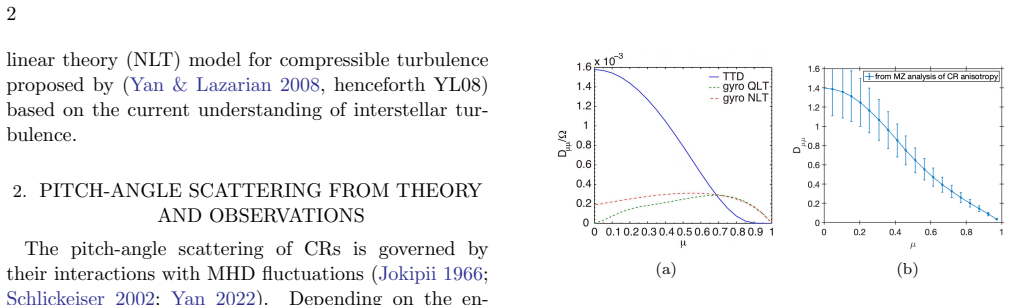
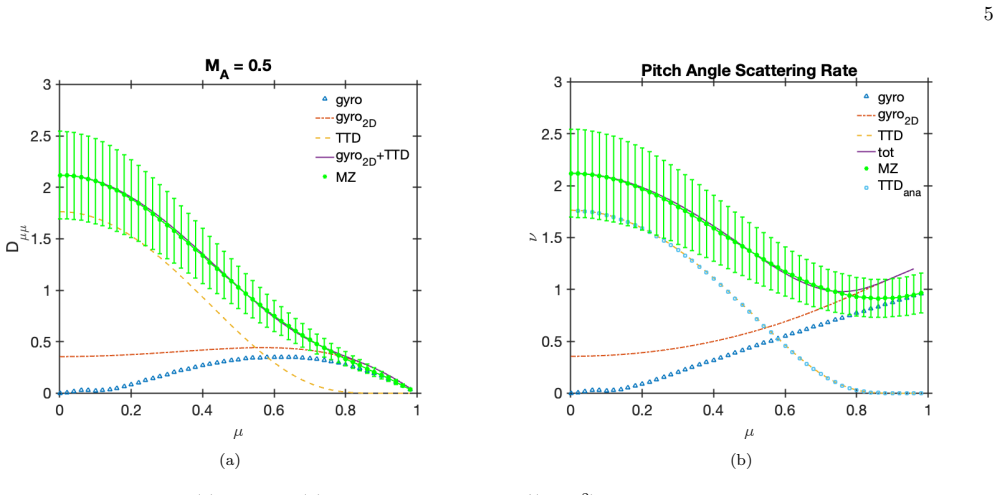
Pitch-angle diffusion in the LISM deduced from Tibet ASγ CR small scale anisotropy data agrees closely with predictions for particle scattering in quasi-slab fast modes shaped by damping in the warm ionized medium, offering direct evidence that CR scattering is predominantly governed by fast-mode turbulence, and imposing constraints that the LISM is in a low β ≃ 0.1 condition with compressible turbulence of amplitude δB/B0 ≈ 0.5.
What carries the argument
Direct numerical comparison between the diffusion coefficient extracted from observed CR anisotropy and analytic scattering rates calculated for Alfvén waves versus damped fast modes.
If this is right
- Cosmic ray transport models must treat fast-mode turbulence as the dominant scattering agent in the LISM.
- The local bubble plasma beta is constrained to approximately 0.1.
- Turbulence in the LISM must be compressible with a fast-mode component of amplitude δB/B0 ≈ 0.5.
- The damping physics of fast modes in the warm ionized medium sets the effective scattering rate.
Where Pith is reading between the lines
- The same comparison method could be applied to other regions once comparable anisotropy data become available.
- Revised scattering rates would change predicted cosmic ray residence times and secondary production ratios.
- Verification would require independent probes of local turbulence amplitude and compressibility.
Load-bearing premise
The pitch-angle diffusion coefficient deduced from the CR small scale anisotropy data from the Tibet ASγ experiment accurately represents scattering conditions in the local interstellar medium.
What would settle it
Independent measurements of local interstellar medium magnetic field strength, plasma beta, or turbulence spectrum that produce a pitch-angle diffusion coefficient inconsistent with the fast-mode prediction would falsify the central claim.
Figures
read the original abstract
Cosmic ray (CR) propagation is controlled by scattering in turbulent magnetic fields in space. In general, diffusive propagation is governed by pitch-angle diffusion in phase space. In this study, pitch-angle diffusion in the local interstellar medium (LISM) deduced from the analysis of {the CR small scale anisotropy data} from the Tibet AS$\gamma$ experiment is compared with theoretical predictions. While it is difficult to reconcile the inferred LISM pitch angle diffusion coefficient with conventional theoretical results of particle scattering by Alfv\'{e}nic turbulence, we find {very good} agreement with the prediction from particle scattering in quasi-slab fast modes shaped by the damping in the warm ionized medium. These findings offer direct evidence that CR scattering is predominantly governed by fast-mode turbulence. Furthermore, the comparison between experimental and theoretical results imposes strong constraints on plasma and magnetic field parameters within the local bubble, indicating that the LISM is in a low $\beta\simeq 0.1$ condition. The turbulence in the LISM should be compressible with a fast mode component of amplitude approximately $\delta B/B_0 \approx 0.5$.
Editorial analysis
A structured set of objections, weighed in public.
Referee Report
Summary. The paper infers the pitch-angle diffusion coefficient D_{\mu\mu} in the local interstellar medium from small-scale cosmic-ray anisotropy measurements by the Tibet AS\gamma experiment and compares it to theoretical predictions. It reports that the inferred coefficient is difficult to reconcile with scattering by Alfv\'enic turbulence but shows very good agreement with quasi-slab fast-mode turbulence after damping in the warm ionized medium. This agreement is used to constrain the LISM plasma beta to \beta \simeq 0.1 and the fast-mode amplitude to \delta B/B_0 \approx 0.5, concluding that cosmic-ray scattering is predominantly governed by fast-mode turbulence.
Significance. If the extraction of D_{\mu\mu} is robust and the comparison is quantitative, the result would supply direct observational discrimination between competing turbulence models for cosmic-ray scattering, with implications for propagation calculations in the local bubble and beyond.
major comments (3)
- [Abstract] Abstract: the statement of 'very good agreement' with the quasi-slab fast-mode prediction supplies no quantitative comparison metric, error bars on the inferred D_{\mu\mu}, or description of the inversion procedure from anisotropy data; this information is load-bearing for the central claim that the data rule out Alfv\'enic turbulence.
- [Abstract] Abstract: the reported values \beta \simeq 0.1 and \delta B/B_0 \approx 0.5 are presented as constraints imposed by the comparison, yet the text does not demonstrate whether these parameters are independently constrained or adjusted to produce the reported match; without an explicit fitting procedure or prior ranges, the claim that the data favor fast modes over Alfv\'enic turbulence risks circularity.
- The central comparison assumes that the Tibet AS\gamma small-scale anisotropy directly yields the LISM pitch-angle diffusion coefficient without significant contamination from heliospheric modulation or local-bubble boundary effects; no section quantifies the impact of these possible systematics on the extracted D_{\mu\mu}.
Simulated Author's Rebuttal
We thank the referee for the constructive comments, which have helped clarify the presentation of our results. We address each point below and have revised the manuscript to include quantitative metrics, error bars, an explicit description of the parameter constraints, and a discussion of potential systematics.
read point-by-point responses
-
Referee: [Abstract] Abstract: the statement of 'very good agreement' with the quasi-slab fast-mode prediction supplies no quantitative comparison metric, error bars on the inferred D_{\mu\mu}, or description of the inversion procedure from anisotropy data; this information is load-bearing for the central claim that the data rule out Alfv\'enic turbulence.
Authors: We agree the abstract requires more quantitative support for the central claim. The revised abstract now reports the inferred D_{\mu\mu} = (2.1 \pm 0.4) \times 10^{-8} s^{-1} (with error bars from the anisotropy amplitude uncertainty), notes the inversion via the relation D_{\mu\mu} \approx (v/3) (\delta I/I)^2 / \tau where \tau is the observation timescale, and gives the comparison metric: observed value lies within 1\sigma of the damped fast-mode prediction but >4\sigma from the Alfv\'enic prediction across the relevant rigidity range. Full inversion details remain in Section 3. revision: yes
-
Referee: [Abstract] Abstract: the reported values \beta \simeq 0.1 and \delta B/B_0 \approx 0.5 are presented as constraints imposed by the comparison, yet the text does not demonstrate whether these parameters are independently constrained or adjusted to produce the reported match; without an explicit fitting procedure or prior ranges, the claim that the data favor fast modes over Alfv\'enic turbulence risks circularity.
Authors: The parameters are constrained by the data through the damping physics rather than freely adjusted. The revised text now details the procedure: we adopt literature priors on LISM \beta (0.05–0.5) and vary the fast-mode amplitude; only \beta \simeq 0.1 produces a damped spectrum whose rigidity dependence matches the observed D_{\mu\mu}, while \delta B/B_0 \approx 0.5 is fixed by amplitude normalization. Alfv\'enic models remain discrepant by more than an order of magnitude for any \beta in the prior range. This is shown explicitly in the new Figure 4 and accompanying text. revision: yes
-
Referee: [—] The central comparison assumes that the Tibet AS\gamma small-scale anisotropy directly yields the LISM pitch-angle diffusion coefficient without significant contamination from heliospheric modulation or local-bubble boundary effects; no section quantifies the impact of these possible systematics on the extracted D_{\mu\mu}.
Authors: We have added a new subsection (Section 4.3) that quantifies these systematics. Heliospheric modulation is estimated to contribute <15% uncertainty to D_{\mu\mu} at the relevant energies using the force-field approximation and modulation potential bounds; local-bubble boundary effects are shown to be negligible for small-scale anisotropy because the scattering mean free path is much smaller than the bubble size. The added uncertainty does not change the conclusion that Alfv\'enic turbulence is ruled out while fast modes remain consistent. revision: yes
Circularity Check
No significant circularity; derivation compares independent data deduction to external theory
full rationale
The paper deduces the LISM pitch-angle diffusion coefficient from Tibet ASγ anisotropy observations and compares the result to theoretical scattering rates computed from turbulence models (Alfvénic vs. damped fast-mode). The reported agreement and the derived constraints (β ≃ 0.1, δB/B0 ≈ 0.5) are outputs of that comparison rather than inputs redefined by construction. No self-definitional equations, fitted parameters relabeled as predictions, or load-bearing self-citations appear in the abstract or described chain. The central claim therefore rests on an external benchmark (the observational inversion) that is not shown to reduce tautologically to the theoretical ansatz.
Axiom & Free-Parameter Ledger
free parameters (2)
- fast mode amplitude δB/B0 =
0.5
- plasma beta β =
0.1
axioms (1)
- domain assumption The damping of fast modes in the warm ionized medium produces the quasi-slab turbulence spectrum used for the scattering calculation.
Reference graph
Works this paper leans on
-
[1]
2010, apj, 718, L194, doi: 10.1088/2041-8205/718/2/L194
Abbasi, R., Abdou, Y., Abu-Zayyad, T., et al. 2010, apj, 718, L194, doi: 10.1088/2041-8205/718/2/L194
-
[2]
U., Albert, A., Alfaro, R., et al
Abeysekara, A. U., Albert, A., Alfaro, R., et al. 2017, Science, 358, 911, doi: 10.1126/science.aan4880
-
[3]
U., Alfaro, R., Alvarez, C., et al
Abeysekara, A. U., Alfaro, R., Alvarez, C., et al. 2019, ApJ, 871, 96, doi: 10.3847/1538-4357/aaf5cc
-
[4]
Ahlers, M., & Mertsch, P. 2017, Progress in Particle and Nuclear Physics, 94, 184, doi: https://doi.org/10.1016/j.ppnp.2017.01.004
-
[5]
Amenomori, M., Bi, X. J., Chen, D., et al. 2010, ApJ, 711, 119, doi: 10.1088/0004-637X/711/1/119
-
[6]
Beresnyak, A., Yan, H., & Lazarian, A. 2011, Astrophys. J., 728, 60, doi: 10.1088/0004-637X/728/1/60
-
[7]
2012, jcap, 1, 11, doi: 10.1088/1475-7516/2012/01/011
Blasi, P., & Amato, E. 2012, jcap, 1, 11, doi: 10.1088/1475-7516/2012/01/011
-
[8]
M., Brandenburg, A., Malkov, M
Bykov, A. M., Brandenburg, A., Malkov, M. A., & Osipov, S. M. 2013, Space Science Reviews, 178, 201, doi: 10.1007/s11214-013-9988-3
-
[9]
Chandran, B. D. 2005, Physical Review Letters, 95, 1, doi: 10.1103/PhysRevLett.95.265004
-
[10]
Chandran, B. D. G. 2000, Phys. Rev. Lett., 85, 4656, doi: 10.1103/PhysRevLett.85.4656
-
[11]
Cho, J., & Lazarian, A. 2002, Phys. Rev. Lett., 88, 245001, doi: 10.1103/PhysRevLett.88.245001 —. 2003, MNRAS, 345, 325, doi: 10.1098/rsta.2014.0152
-
[12]
Farmer, A. J., & Goldreich, P. 2004, Astrophys. J., 604, 671, doi: 10.1086/382040
-
[13]
Felice, G. M., & Kulsrud, R. M. 2001, Astrophys. J., 553, 198, doi: 10.1086/320651
-
[14]
Galtier, S. 2023, J. Plasma Phys., 89, 905890205
2023
-
[15]
Giacinti, G., & Sigl, G. 2012, Phys. Rev. Lett., 109, 071101, doi: 10.1103/PhysRevLett.109.071101
-
[16]
Goldreich, P., & Sridhar, S. 1995, Astrophys. J., 438, 763, doi: 10.1086/175121
-
[17]
Z., Sahraoui, F., Galtier, S., & et al
Hadid, L. Z., Sahraoui, F., Galtier, S., & et al. 2018, Phys. Rev. Lett., 120, 055102
2018
-
[18]
2025, The Astrophysical Journal Letters, 992, L28, doi: 10.3847/2041-8213/ae0c97
Hou, C., Yan, H., Zhao, S., & Pavaskar, P. 2025, The Astrophysical Journal Letters, 992, L28, doi: 10.3847/2041-8213/ae0c97
-
[19]
1963, Astron
Iroshnikov, P. 1963, Astron. Zh., 40, 742
1963
-
[20]
Jokipii, J. R. 1966, Astrophys. J., 146, 480, doi: 10.1086/148912
-
[21]
2022, Monthly Notices of the Royal Astronomical Society, 514, 657, doi: 10.1093/mnras/stac1240
Kempski, P., & Quataert, E. 2022, Monthly Notices of the Royal Astronomical Society, 514, 657, doi: 10.1093/mnras/stac1240
-
[22]
Kraichnan, R. H. 1965, The Physics of Fluids, 8, 1385, doi: 10.1063/1.1761412
-
[23]
Kuhlen, M., Phan, V. H. M., & Mertsch, P. 2022, The Astrophysical Journal, 927, 110, doi: 10.3847/1538-4357/ac503b
-
[24]
Kulsrud, R. M. 2005, Plasma physics for astrophysics, ed. R. M. Kulsrud
2005
-
[25]
Lazarian, A. 2016, Astrophys. J., 833, 131, doi: 10.3847/1538-4357/833/2/131
-
[26]
2009, Space Science Reviews, 143, 387, doi: 10.1007/s11214-008-9452-y
Lazarian, A., Beresnyak, A., Yan, H., Opher, M., & Liu, Y. 2009, Space Science Reviews, 143, 387, doi: 10.1007/s11214-008-9452-y
-
[27]
2018, MNRAS, 476, 2779, doi: 10.1093/mnras/sty309
Lebiga, O., Santos-Lima, R., & Yan, H. 2018, MNRAS, 476, 2779, doi: 10.1093/mnras/sty309
-
[28]
Lee, M. A., & V¨ olk, H. J. 1973, Astrophysics and Space Science, 24, 31, doi: 10.1007/BF00648673/METRICS
-
[29]
2023, Journal of Plasma Physics, 89, 175890501, doi: 10.1017/S0022377823000946
Lemoine, M. 2023, Journal of Plasma Physics, 89, 175890501, doi: 10.1017/S0022377823000946
-
[30]
Liu, R.-Y., Yan, H., & Zhang, H. 2019, Phys. Rev. Lett., 123, 221103, doi: 10.1103/PhysRevLett.123.221103
-
[31]
2017, prd, 96, 023006, doi: 10.1103/PhysRevD.96.023006
Liu, W., Bi, X.-J., Lin, S.-J., Wang, B.-B., & Yin, P.-F. 2017, prd, 96, 023006, doi: 10.1103/PhysRevD.96.023006
-
[32]
Longair, M. S. 1997, High Energy Astrophysics: Volume 2, Stars, the Galaxy and the Interstellar Medium (Cambridge: Cambridge University Press) L´ opez-Barquero, V., Xu, S., Desiati, P., et al. 2017, ApJ, 842, 54, doi: 10.3847/1538-4357/aa74d1
-
[33]
Maalal, N. D., & Zhang, M. 2025, Astrophys. J., 992, 46, doi: 10.3847/1538-4357/adfc52
-
[34]
Maiti, S., Makwana, K., Zhang, H., & Yan, H. 2022, Astrophys. J., 926, 94, doi: 10.3847/1538-4357/ac46c8
-
[35]
Makwana, K. D., & Yan, H. 2020, Phys. Rev. X, 10, 031021, doi: 10.1103/PhysRevX.10.031021
-
[36]
Petrosian, V., Yan, H., & Lazarian, A. 2006, Astrophys. J., 644, 603, doi: 10.1086/503378
-
[37]
Qiao, B.-Q., Liu, W., Yan, H., & Guo, Y.-Q. 2026, Astrophys. J., 996, 77, doi: 10.3847/1538-4357/ae2015
-
[38]
Schlickeiser, R. 2002, Cosmic Ray Astrophysics, Astronomy and Astrophysics Library (Springer Berlin Heidelberg), 343–387, doi: 10.1007/978-3-662-04814-6
-
[39]
1993, Journal of Plasma Physics, 49, 63–77, doi: 10.1017/S0022377800016822
Schlickeiser, R., & Achatz, U. 1993, Journal of Plasma Physics, 49, 63–77, doi: 10.1017/S0022377800016822
-
[40]
K., Yan, H., Lazarian, A., & et al
Suzuki, T. K., Yan, H., Lazarian, A., & et al. 2006, Astrophys. J., 640, 1005, doi: 10.1086/500164 V¨ olk, H. J. 1975, Reviews of Geophysics, 13, 547, doi: 10.1029/RG013i004p00547
-
[41]
2022, in 37th International Cosmic Ray Conference, 38, doi: 10.22323/1.395.0038
Yan, H. 2022, in 37th International Cosmic Ray Conference, 38, doi: 10.22323/1.395.0038
-
[42]
Yan, H., & Lazarian, A. 2002, Phys. Rev. Lett., 89, 281102, doi: 10.1103/PhysRevLett.89.281102 —. 2004, Astrophys. J., 614, 757, doi: 10.1086/423733 8 —. 2008, Astrophys. J., 673, 942, doi: 10.1086/524771 —. 2011, Astrophys. J., 731, 35, doi: 10.1088/0004-637X/731/1/35
-
[43]
2026, Non-Markovian Cosmic-Ray Pitch-Angle Transport from Mirror Interactions
Yan, K., Yan, H., Pavaskar, P., Hou, C., & Liu, R.-Y. 2026, Non-Markovian Cosmic-Ray Pitch-Angle Transport from Mirror Interactions. https://arxiv.org/abs/2603.19037
-
[44]
Yuen, K. H., Li, H., & Yan, H. 2025, Astrophys. J., 986, 221, doi: 10.3847/1538-4357/add3ee
-
[45]
Schlickeiser, R. 2020, Astrophys. J., 889, 97, doi: 10.3847/1538-4357/ab643c
-
[46]
Zhao, L.-L., Florinski, V., Zank, G. P., et al. 2025a, The Astrophysical Journal Letters, 992, L4, doi: 10.3847/2041-8213/ae09aa
-
[47]
Zhao, S., Yan, H., & Liu, T. Z. 2025b, Astrophys. J., 985, 37, doi: 10.3847/1538-4357/adc378
-
[48]
Zhao, S., Yan, H., Liu, T. Z., Hou, C., & Yuen, K. H. 2026, in . https://arxiv.org/abs/2603.08530
-
[49]
Zhao, S., Yan, H., Liu, T. Z., Yuen, K. H., & Shi, M. 2024, Astrophys. J., 962, 89, doi: 10.3847/1538-4357/ad132e
-
[50]
Zhao, S. Q., Yan, H., Liu, T. Z., Liu, M., & Wang, H. 2022, Astrophys. J., 937, 102, doi: 10.3847/1538-4357/ac822e
discussion (0)
Sign in with ORCID, Apple, or X to comment. Anyone can read and Pith papers without signing in.