Ant Backpressure Routing for Dynamic Wireless Multi-hop Networks with Mixed Traffic Patterns
Pith reviewed 2026-06-30 14:06 UTC · model grok-4.3
The pith
Ant-BP routing uses virtual shortest-path backpressure updates to set pheromone probabilities for per-neighbor FIFO forwarding in wireless networks.
A machine-rendered reading of the paper's core claim, the machinery that carries it, and where it could break.
Core claim
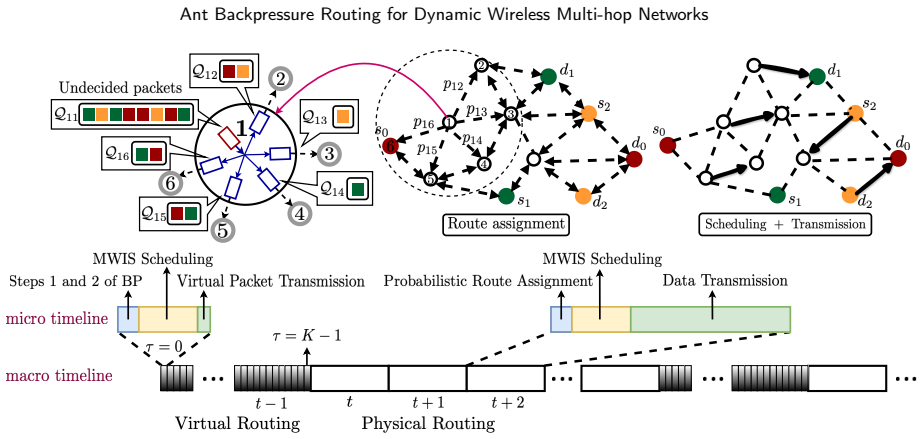
Ant-BP is a periodic fully distributed scheme that builds pheromone-based forwarding probabilities from virtual SP-BP updates while forwarding actual packets through per-neighbor first-in-first-out queues with probabilistic next-hop selection. This architecture decouples route learning from packet forwarding, enables link-capacity sharing across commodities, mitigates starvation of short-lived traffic, and extends SP-BP benefits to per-neighbor FIFO architectures. Periodic virtual updates further allow adaptation to transient link failures and mobility-induced changes, with analysis showing higher-quality policies at lower overhead than conventional ACO routing.
What carries the argument
Pheromone probabilities derived from periodic virtual SP-BP updates that guide probabilistic next-hop selection on per-neighbor FIFO queues.
If this is right
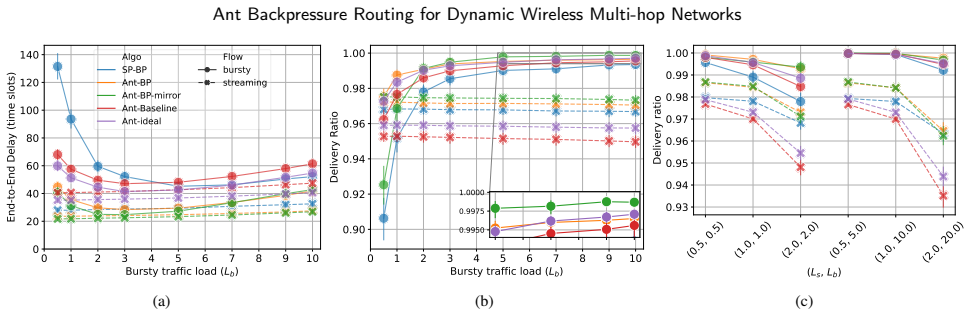
- Ant-BP improves latency and delivery ratio over SP-BP and ACO baselines under mixed streaming and bursty traffic.
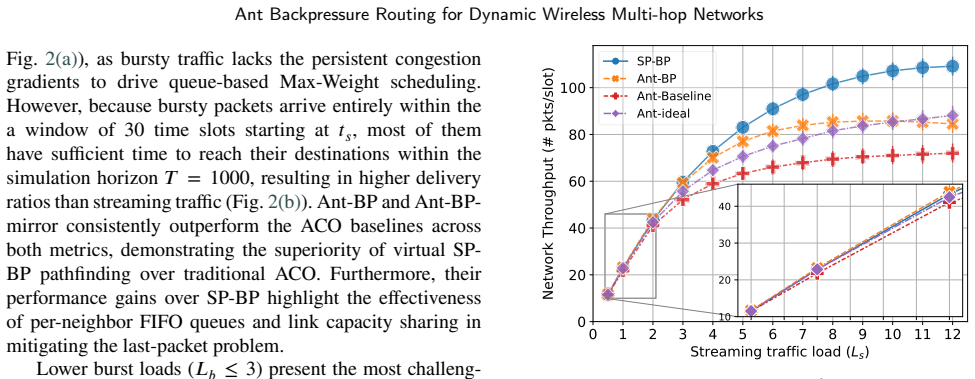
- Throughput remains comparable to SP-BP at low and medium traffic loads.
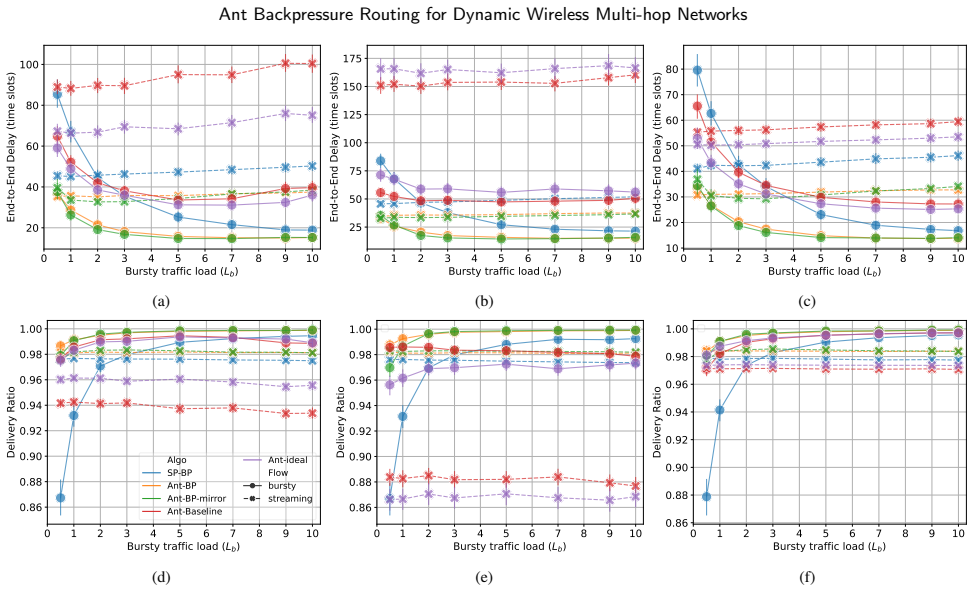
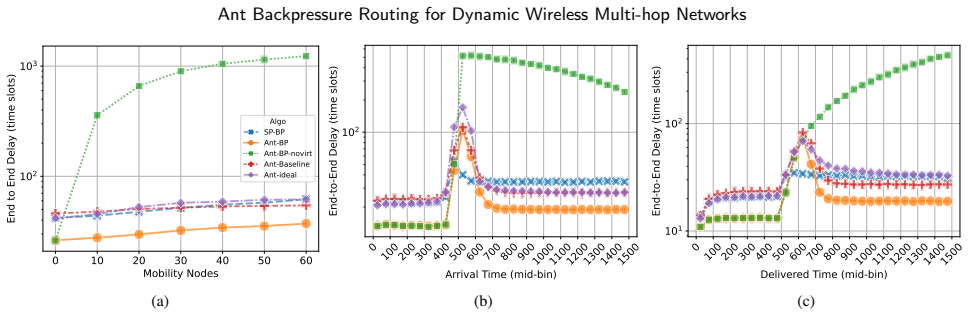
- The scheme stays robust under mismatched virtual-traffic assumptions, transient link failures, and node mobility.
- Virtual SP-BP updates produce higher-quality forwarding policies with lower overhead than conventional ACO routing.
Where Pith is reading between the lines
- The FIFO-only data plane could allow deployment on legacy wireless devices that cannot maintain per-commodity state.
- Periodic virtual updates may support routing in other environments with limited per-flow state at forwarding nodes.
- The learning-forwarding split could be applied to additional routing algorithms to reduce data-plane complexity.
Load-bearing premise
Pheromone probabilities derived from virtual SP-BP updates will produce effective forwarding policies when actual packets use only per-neighbor FIFO queues without per-commodity state.
What would settle it
A simulation run with mixed streaming and bursty traffic in which Ant-BP shows no reduction in latency or increase in delivery ratio relative to SP-BP.
Figures
read the original abstract
Backpressure (BP) routing and its shortest-path biased variant (SP-BP) provide powerful congestion-aware multipath resource allocation for wireless multi-hop networks, but they rely on per-commodity queueing and slot-by-slot control that may be difficult to realize under practical or legacy forwarding architectures. Moreover, even state-of-the-art SP-BP still suffers from the last-packet problem when short-lived traffic coexists with streaming flows. To address these limitations, we propose Ant Backpressure (Ant-BP), a periodic and fully distributed routing scheme that decouples route learning from packet forwarding. Ant-BP uses virtual SP-BP to construct pheromone-based forwarding probabilities, while actual packets are forwarded through per-neighbor first-in-first-out (FIFO) queues with probabilistic next-hop selection. This architecture enables link-capacity sharing across commodities, mitigates starvation of short-lived traffic, and extends the benefits of SP-BP to network architectures based on per-neighbor FIFO forwarding. Through periodic virtual updates, Ant-BP also adapts to transient link failures and mobility-induced topology changes. Our theoretical analysis and simulations show that, compared with conventional ant colony optimization (ACO) routing, virtual SP-BP enables Ant-BP to establish higher-quality forwarding policies with lower overhead. As a result, Ant-BP improves latency and delivery ratio over SP-BP and ACO-based baselines under mixed streaming and bursty traffic, achieves throughput comparable to SP-BP at low and medium traffic load, and remains robust to mismatched virtual-traffic assumptions, transient link failures, and node mobility.
Editorial analysis
A structured set of objections, weighed in public.
Referee Report
Summary. The paper proposes Ant Backpressure (Ant-BP), a distributed routing scheme for wireless multi-hop networks that decouples route computation from packet forwarding: periodic virtual SP-BP updates generate pheromone-based next-hop probabilities, while actual packets are forwarded using only per-neighbor FIFO queues with probabilistic selection. It claims this architecture enables capacity sharing across commodities, mitigates the last-packet problem for short-lived flows, extends SP-BP benefits to legacy FIFO architectures, and yields lower latency and higher delivery ratio than SP-BP and ACO baselines under mixed streaming/bursty traffic while remaining robust to mobility, link failures, and mismatched virtual traffic assumptions.
Significance. If the performance claims hold under the stated conditions, the work would be significant for practical wireless network design by bridging theoretical backpressure routing with implementable per-neighbor FIFO forwarding. The periodic virtual-update mechanism for adaptation is a concrete strength, and the explicit comparison to both SP-BP and ACO baselines provides a useful reference point for mixed-traffic scenarios.
major comments (3)
- [Architecture description] Architecture description (abstract and § on system model): the central claim that pheromone probabilities derived from virtual SP-BP updates remain effective proxies for congestion when actual forwarding uses only per-neighbor FIFO queues (without per-commodity state) is load-bearing for all latency, delivery-ratio, and capacity-sharing assertions, yet no formal approximation bound or error analysis is supplied showing that the mapping preserves the throughput-optimality or delay properties of SP-BP under mixed traffic.
- [Theoretical analysis section] Theoretical analysis section: the abstract states that theoretical analysis supports the performance claims, but the provided text gives no model assumptions, queueing dynamics, or proof sketch establishing that the virtual-update period and pheromone update rule suffice to control the deviation from per-commodity backpressure when real queues lack commodity differentiation.
- [Simulation results] Simulation results (abstract): robustness claims to mismatched virtual-traffic assumptions and transient failures are asserted, but without reported details on traffic generation, statistical significance, confidence intervals, or data-exclusion rules, it is impossible to verify whether the reported gains over SP-BP are statistically reliable or sensitive to the FIFO approximation.
minor comments (2)
- Notation for pheromone probabilities and virtual queue updates should be defined explicitly with symbols before first use to improve readability.
- The abstract mentions 'periodic virtual updates' but does not specify the update interval relative to packet arrival rates; a brief clarification would help readers assess overhead.
Simulated Author's Rebuttal
We thank the referee for the constructive and detailed comments. We address each major comment point-by-point below. We agree that the current version lacks a formal error analysis and expanded simulation statistics, and we will incorporate clarifications and additions in the revised manuscript.
read point-by-point responses
-
Referee: [Architecture description] Architecture description (abstract and § on system model): the central claim that pheromone probabilities derived from virtual SP-BP updates remain effective proxies for congestion when actual forwarding uses only per-neighbor FIFO queues (without per-commodity state) is load-bearing for all latency, delivery-ratio, and capacity-sharing assertions, yet no formal approximation bound or error analysis is supplied showing that the mapping preserves the throughput-optimality or delay properties of SP-BP under mixed traffic.
Authors: We acknowledge that the manuscript does not supply a formal approximation bound or error analysis quantifying how closely the pheromone probabilities track per-commodity backpressure under FIFO forwarding. The existing theoretical discussion focuses on the comparative advantage of virtual SP-BP over ACO for establishing high-quality policies with lower overhead. In revision we will add an explicit discussion of the approximation, including any available bounds derived from the virtual-update period, pheromone evaporation rate, and queueing deviation under mixed traffic. revision: yes
-
Referee: [Theoretical analysis section] Theoretical analysis section: the abstract states that theoretical analysis supports the performance claims, but the provided text gives no model assumptions, queueing dynamics, or proof sketch establishing that the virtual-update period and pheromone update rule suffice to control the deviation from per-commodity backpressure when real queues lack commodity differentiation.
Authors: The theoretical analysis section in the manuscript is limited to a comparative argument showing that virtual SP-BP yields superior forwarding policies than standard ACO at comparable overhead; it does not contain a full queueing model or proof sketch for bounded deviation under the FIFO approximation. We will expand this section in revision to state the model assumptions (periodic virtual updates, pheromone update rule, per-neighbor FIFO dynamics) and provide a high-level sketch relating update frequency to deviation from ideal per-commodity backpressure. revision: yes
-
Referee: [Simulation results] Simulation results (abstract): robustness claims to mismatched virtual-traffic assumptions and transient failures are asserted, but without reported details on traffic generation, statistical significance, confidence intervals, or data-exclusion rules, it is impossible to verify whether the reported gains over SP-BP are statistically reliable or sensitive to the FIFO approximation.
Authors: The full manuscript describes the traffic generation process (mixed streaming and bursty flows with explicit arrival rates and packet sizes), mobility and failure models, and reports averages over multiple independent simulation runs. We agree, however, that confidence intervals, statistical significance tests, and any data-exclusion criteria are not explicitly stated. In the revision we will add these details, including error bars and p-values where appropriate, to allow verification of the reported gains. revision: yes
Circularity Check
No circularity: claims rest on external baselines and independent theoretical analysis
full rationale
The paper's central claims derive from simulations comparing Ant-BP against SP-BP and ACO baselines plus a stated theoretical analysis showing virtual SP-BP yields higher-quality policies than ACO. No equation or step reduces by construction to a fitted parameter renamed as prediction, a self-definition, or a load-bearing self-citation chain; the architecture (virtual updates feeding per-neighbor FIFO forwarding) is presented as an explicit design choice whose benefits are externally validated rather than tautological.
Axiom & Free-Parameter Ledger
Reference graph
Works this paper leans on
-
[1]
Erfaniantaghvayi, Z
N. Erfaniantaghvayi, Z. Zhao, K. Chan, G. Verma, A. Swami, S.Segarra, Antbackpressureroutingforwirelessmulti-hopnetworks with mixed traffic patterns, in: IEEE Military Communications Conference (MILCOM), Washington DC, USA, 2024, pp. 1174–
2024
-
[2]
doi:10.1109/MILCOM61039.2024.10774011
-
[3]
X.Lin,N.B.Shroff,R.Srikant, Atutorialoncross-layeroptimization in wireless networks, IEEE J. Sel. Areas Commun. 24 (2006) 1452– 1463
2006
-
[4]
S. K. Sarkar, T. G. Basavaraju, C. Puttamadappa, Ad hoc Mobile Wireless Networks: Principles, Protocols and Applications, CRC Press, 2013
2013
-
[5]
N. Patriciello, C. A. Grazia, J. Núñez-Martínez, J. Baranda, J. Mangues-Bafalluy, M. Casoni, Performance evaluation of back- pressure routing in integrated satellite-terrestrial backhaul for PPDR networks, in: IEEE Intl. Conf. on Wireless and Mobile Computing, Netw. and Communs. (WiMob), 2016, pp. 1–8. doi:10.1109/WiMOB. 2016.7763187
-
[6]
A.Kott,A.Swami,B.J.West, Theinternetofbattlethings, Computer 49 (2016) 70–75
2016
-
[7]
Large language model (LLM)-enabled reinforcement learning for wireless network optimization,
M. Cudak, A. Ghosh, A. Ghosh, J. Andrews, Integrated access and backhaul: A key enabler for 5G millimeter-wave deployments, IEEE Communications Magazine 59 (2021) 88–94. doi:10.1109/MCOM.001. 2000690
-
[8]
I.F.Akyildiz,A.Kak,S.Nie, 6Gandbeyond:Thefutureofwireless communications systems, IEEE Access 8 (2020) 133995–134030
2020
-
[9]
Tassiulas, A
L. Tassiulas, A. Ephremides, Stability properties of constrained queueing systems and scheduling policies for maximum throughput inmultihopradionetworks, in:IEEEConf.onDecisionandControl, IEEE, 1990, pp. 2130–2132
1990
-
[10]
J. Ryu, L. Ying, S. Shakkottai, Back-pressure routing for intermit- tently connected networks, in: 2010 Proceedings IEEE INFOCOM, IEEE, 2010, pp. 1–5
2010
-
[11]
Georgiadis, M
L. Georgiadis, M. J. Neely, L. Tassiulas, Resource allocation and cross-layer control in wireless networks, Foundations and Trends® in Networking 1 (2006) 1–144. Erfaniantaghvayi et al.:Preprint submitted to Elsevier Page 12 of 14 Ant Backpressure Routing for Dynamic Wireless Multi-hop Networks
2006
-
[12]
M. J. Neely, E. Modiano, C. E. Rohrs, Dynamic power allocation and routing for time-varying wireless networks, IEEE J. Sel. Areas Commun. 23 (2005) 89–103. doi:10.1109/JSAC.2004.837349
-
[13]
Conf.onAcoustics,SpeechandSignalProcess.(ICASSP),2023,pp
Z.Zhao,B.Radojicic,G.Verma,A.Swami,S.Segarra, Delay-aware backpressure routing using graph neural networks, in: IEEE Intl. Conf.onAcoustics,SpeechandSignalProcess.(ICASSP),2023,pp. 4720–4724
2023
-
[14]
Z. Zhao, G. Verma, A. Swami, S. Segarra, Enhanced backpressure routing using wireless link features, in: IEEE Intl. Wrksp. Computat. Advances Multi-Sensor Adaptive Process. (CAMSAP), 2023, pp. 1–
2023
-
[15]
doi:10.1109/CAMSAP58922.2023.10403470
-
[16]
Z. Zhao, B. Radojičić, G. Verma, A. Swami, S. Segarra, Biased Backpressure routing using link features and graph neural networks, IEEE Transactions on Machine Learning in Communications and Networking (2024) 1424 – 1439
2024
-
[17]
Z. Jiao, B. Zhang, W. Gong, H. Mouftah, A virtual queue-based back-pressure scheduling algorithm for wireless sensor networks, EURASIP J. on Wireless Commun. and Netw. 2015 (2015) 1–9
2015
-
[18]
Moeller, A
S. Moeller, A. Sridharan, B. Krishnamachari, O. Gnawali, Routing without routes: The backpressure collection protocol, in: Proceed- ings of the 9th ACM/IEEE International Conference on Information Processing in Sensor Networks, 2010, pp. 279–290
2010
-
[19]
M. Alresaini, K.-L. Wright, B. Krishnamachari, M. J. Neely, Back- pressure delay enhancement for encounter-based mobile networks while sustaining throughput optimality, IEEE/ACM Trans. Netw. 24 (2016) 1196–1208. doi:10.1109/TNET.2015.2404331
-
[20]
B. Ji, C. Joo, N. B. Shroff, Delay-based back-pressure scheduling in multihop wireless networks, IEEE/ACM Trans. Netw. 21 (2012) 1539–1552
2012
-
[21]
Liaskos, K
C. Liaskos, K. Alexandris, A. Das, S. Tang, L. Tassiulas, Analysis and evaluation of fully TCP-compatible backpressure-driven traffic engineering, IEEETrans.onNetw.ScienceandEng.10(2023)4056– 4070
2023
-
[22]
C. Joo, N. B. Shroff, Local greedy approximation for scheduling in multihop wireless networks, IEEE Trans. Mobile Computing 11 (2011) 414–426
2011
-
[23]
Z. Zhao, G. Verma, C. Rao, A. Swami, S. Segarra, Link scheduling using graph neural networks, IEEE Trans. Wireless Commun. 22 (2023) 3997–4012
2023
- [24]
- [25]
-
[26]
C. Liaskos, K. Alexandris, A. Das, S. Tang, L. Tassiulas, Analysis and evaluation of fully tcp-compatible backpressure-driven traffic engineering, IEEETransactionsonNetworkScienceandEngineering 10 (2023) 4056–4070. doi:10.1109/TNSE.2023.3282642
-
[27]
J. T. Moy, OSPF: anatomy of an Internet routing protocol, Addison- Wesley Professional, 1998
1998
-
[28]
McKeown, T
N. McKeown, T. Anderson, H. Balakrishnan, G. Parulkar, L. Peter- son,J.Rexford,S.Shenker,J.Turner, Openflow:enablinginnovation in campus networks, ACM SIGCOMM computer communication review 38 (2008) 69–74
2008
-
[29]
Kreutz, F
D. Kreutz, F. M. Ramos, P. E. Verissimo, C. E. Rothenberg, S. Azodolmolky, S. Uhlig, Software-defined networking: A compre- hensive survey, Proceedings of the IEEE 103 (2014) 14–76
2014
-
[30]
C.A.Oliveira,P.M.Pardalos,etal.,Mathematicalaspectsofnetwork routing optimization, volume 53, Springer, 2011
2011
-
[31]
Abolhasan, T
M. Abolhasan, T. Wysocki, E. Dutkiewicz, A review of routing protocols for mobile ad hoc networks, Ad hoc networks 2 (2004) 1–22
2004
-
[32]
Chlamtac, M
I. Chlamtac, M. Conti, J. J.-N. Liu, Mobile ad hoc networking: imperatives and challenges, Ad hoc networks 1 (2003) 13–64
2003
-
[33]
I.T.Haque,N.Abu-Ghazaleh, Wirelesssoftwaredefinednetworking: Asurveyandtaxonomy, IEEECommunicationsSurveys&Tutorials 18 (2016) 2713–2737
2016
-
[34]
Routing Protocols for Mobile and Vehicular Ad-Hoc Networks: A Comparative Analysis
P. Vinayakray-Jani, S. Sanyal, Routing protocols for mobile and vehicular ad-hoc networks: A comparative analysis, arXiv preprint arXiv:1206.1918 (2012)
work page internal anchor Pith review Pith/arXiv arXiv 1918
-
[35]
Aggarwal, S
A. Aggarwal, S. Gandhi, N. Chaubey, Performance analysis of AODV, DSDV and DSR in MANETs, International Journal of Distributed and Parallel Systems 2 (2011)
2011
-
[36]
Telecommunications 16 (2005) 443–455
G.DiCaro,F.Ducatelle,L.M.Gambardella, AntHocNet:anadaptive nature-inspired algorithm for routing in mobile ad hoc networks, European Trans. Telecommunications 16 (2005) 443–455
2005
-
[37]
P. Purkayastha, J. S. Baras, Convergence results for ant routing algo- rithmsviastochasticapproximation, ACMTrans.Auton.Adapt.Syst. 8 (2013). URL: https://doi.org/10.1145/2451248.2451251. doi:10. 1145/2451248.2451251
-
[38]
Zhang, X
H. Zhang, X. Wang, P. Memarmoshrefi, D. Hogrefe, A survey of ant colony optimization based routing protocols for mobile ad hoc networks, IEEE Access 5 (2017) 24139–24161
2017
-
[39]
Dorigo, T
M. Dorigo, T. Stützle, Ant colony optimization: overview and recent advances, Springer, 2019
2019
-
[40]
D. B. Johnson, D. A. Maltz, Dynamic source routing in ad hoc wireless networks, in: Mobile computing, Springer, 1996, pp. 153– 181
1996
-
[41]
D.B.Johnson,D.A.Maltz,J.Broch,etal., Dsr:Thedynamicsource routing protocol for multi-hop wireless ad hoc networks, Ad hoc networking 5 (2001) 139–172
2001
-
[42]
Leung, J
R. Leung, J. Liu, E. Poon, A.-L. Chan, B. Li, Mp-dsr: a qos- awaremulti-pathdynamicsourceroutingprotocolforwirelessad-hoc networks, in:ProceedingsLCN2001.26thAnnualIEEEConference on Local Computer Networks, IEEE, 2001, pp. 132–141
2001
-
[43]
S.-J. Lee, E. M. Belding-Royer, C. E. Perkins, Scalability study of the ad hoc on-demand distance vector routing protocol, International journal of network management 13 (2003) 97–114
2003
-
[44]
T.Saravanan,N.Nithya, Modelingdisplacementanddirectionaware adhocon-demanddistancevectorroutingstandardformobileadhoc networks, Mobile Networks and Applications 24 (2019) 1804–1813
2019
-
[45]
M. K. Marina, S. R. Das, On-demand multipath distance vector routing in ad hoc networks, in: Proceedings ninth international conferenceonnetworkprotocols.ICNP2001,IEEE,2001,pp.14–23
2001
-
[46]
E. M. Royer, C. E. Perkins, Multicast operation of the ad-hoc on- demand distance vector routing protocol, in: Proceedings of the 5th annual ACM/IEEE international conference on Mobile computing and networking, 1999, pp. 207–218
1999
-
[47]
A. A. Bhorkar, M. Naghshvar, T. Javidi, B. D. Rao, Adaptive opportunistic routing for wireless ad hoc networks, IEEE/ACM Transactions On Networking 20 (2011) 243–256
2011
-
[48]
Zhang, R
Z. Zhang, R. Krishnan, An overview of opportunistic routing in mobile ad hoc networks, in: MILCOM 2013-2013 IEEE Military Communications Conference, IEEE, 2013, pp. 119–124
2013
-
[49]
Chakchouk, A survey on opportunistic routing in wireless com- municationnetworks, IEEECommunicationsSurveys&Tutorials17 (2015) 2214–2241
N. Chakchouk, A survey on opportunistic routing in wireless com- municationnetworks, IEEECommunicationsSurveys&Tutorials17 (2015) 2214–2241
2015
-
[50]
Biswas, R
S. Biswas, R. Morris, Exor: Opportunistic multi-hop routing for wireless networks, in: Proceedings of the 2005 conference on Applications, technologies, architectures, and protocols for computer communications, 2005, pp. 133–144
2005
-
[51]
Z.Wang,Y.Chen,C.Li, Corman:Anovelcooperativeopportunistic routing scheme in mobile ad hoc networks, IEEE journal on selected areas in communications 30 (2012) 289–296
2012
-
[52]
Bhorkar, M
A. Bhorkar, M. Naghshvar, T. Javidi, Opportunistic routing with congestion diversity in wireless ad hoc networks, IEEE/ACM Trans- actions on Networking 24 (2015) 1167–1180
2015
-
[53]
Kathiravelu, N
T. Kathiravelu, N. Ranasinghe, A. Pears, An enhanced congestion aware adaptive routing protocol for opportunistic networks, in: 2011 6th International Conference on Industrial and Information Systems, IEEE, 2011, pp. 210–215. Erfaniantaghvayi et al.:Preprint submitted to Elsevier Page 13 of 14 Ant Backpressure Routing for Dynamic Wireless Multi-hop Networks
2011
-
[54]
M.Shelke,A.Malhotra,P.N.Mahalle,Congestion-awareopportunis- ticroutingprotocolinwirelesssensornetworks, in:SmartComputing andInformatics:ProceedingsoftheFirstInternationalConferenceon SCI 2016, Volume 1, Springer, 2017, pp. 63–72
2016
-
[55]
Sharma, K
I. Sharma, K. Ramkumar, A survey on aco based multipath routing algorithms for ad hoc networks, International Journal of Pervasive Computing and Communications 13 (2017) 370–385
2017
-
[56]
S. U. Rehman, M. A. Khan, T. A. Zia, A. Y. Zomaya, Joint rate and queue based routing for vehicular ad-hoc networks, in: 2016 IEEE 41st Conference on Local Computer Networks Workshops (LCN Workshops), IEEE, 2016, pp. 165–172
2016
-
[57]
Naseem, C
M. Naseem, C. Kumar, Queue-based multiple path load balancing routingprotocolformanets, InternationalJournalofCommunication Systems 30 (2017) e3141
2017
-
[58]
L. A. Maglaras, D. Katsaros, Delay efficient backpressure routing in wireless ad hoc networks, EAI Endorsed Transactions on Mobile Communications and Applications 1 (2014)
2014
-
[59]
L. Hai, Q. Gao, J. Wang, H. Zhuang, P. Wang, Delay-optimal back- pressure routing algorithm for multihop wireless networks, IEEE Transactions on Vehicular Technology 67 (2018) 2617–2630
2018
-
[60]
C. Shan, Y. Xia, Z. Guo, G. Wang, J. Zhang, Tsbs: A two-stage backpressureschedulingschemeovermultihopwirelessnetworks,Ad Hoc Networks 132 (2022) 102874
2022
-
[61]
V. Kawadia, P. R. Kumar, A cautionary perspective on cross-layer design, Wireless Commun. 12 (2005) 3–11. doi:10.1109/MWC.2005. 1404568
-
[62]
J. Yang, S. C. Draper, R. Nowak, Learning the interference graph of a wireless network, IEEE Trans. Signal Inf. Process. Netw. 3 (2016) 631–646
2016
-
[63]
Varaiya, Max pressure control of a network of signalized inter- sections, TransportationResearchPartC:EmergingTechnologies36 (2013) 177–195
P. Varaiya, Max pressure control of a network of signalized inter- sections, TransportationResearchPartC:EmergingTechnologies36 (2013) 177–195
2013
-
[64]
M. W. Levin, Max-pressure traffic signal timing: A summary of methodological and experimental results, Journal of Transportation Engineering, Part A: Systems 149 (2023) 03123001. doi:10.1061/ JTEPBS.TEENG-7578
2023
-
[65]
on Wireless Com- mun
C.Joo,G.Sharma,N.B.Shroff,R.R.Mazumdar, Onthecomplexity of scheduling in wireless networks, EURASIP J. on Wireless Com- mun. and Netw. 2010 (2010) 1–13
2010
-
[66]
Neely, Stochastic network optimization with application to com- munication and queueing systems, Morgan & Claypool Publishers, 2010
M. Neely, Stochastic network optimization with application to com- munication and queueing systems, Morgan & Claypool Publishers, 2010. Erfaniantaghvayi et al.:Preprint submitted to Elsevier Page 14 of 14
2010
discussion (0)
Sign in with ORCID, Apple, or X to comment. Anyone can read and Pith papers without signing in.