A Parameterized Algorithm for Testing whether the Limit of a Diagram is Empty
Pith reviewed 2026-06-30 14:24 UTC · model grok-4.3
The pith
A parameterized algorithm decides whether the limit of a structured co-decomposition in FinSet^J is empty.
A machine-rendered reading of the paper's core claim, the machinery that carries it, and where it could break.
Core claim
We construct a fast algorithm (in the sense of parameterized complexity theory) that solves this problem when E is of the form FinSet^J for a finite category J and d is a structured co-decomposition, i.e. a diagram arising from the opposite of the Grothendieck construction of a simple graph.
What carries the argument
A structured co-decomposition, i.e., a diagram obtained from the opposite of the Grothendieck construction of a simple graph.
If this is right
- The emptiness-of-limit decision problem is fixed-parameter tractable on the class of structured co-decompositions.
- For any such diagram the algorithm returns a correct yes-or-no answer to the question of whether a solution exists in the category.
- When the algorithm reports that the limit is not empty, the diagram is consistent and admits at least one interpretation in FinSet^J.
Where Pith is reading between the lines
- The same reduction technique might be reusable for diagram-emptiness questions in other presheaf categories once the input diagrams are suitably restricted.
- Because the input originates from ordinary graphs, the algorithm may yield new tractability results for consistency problems already studied in graph databases or knowledge representation.
Load-bearing premise
The input diagram must be a structured co-decomposition arising from the opposite of the Grothendieck construction of a simple graph.
What would settle it
A concrete simple graph together with a finite category J such that the algorithm applied to the induced diagram outputs the incorrect answer on whether the limit is empty.
Figures
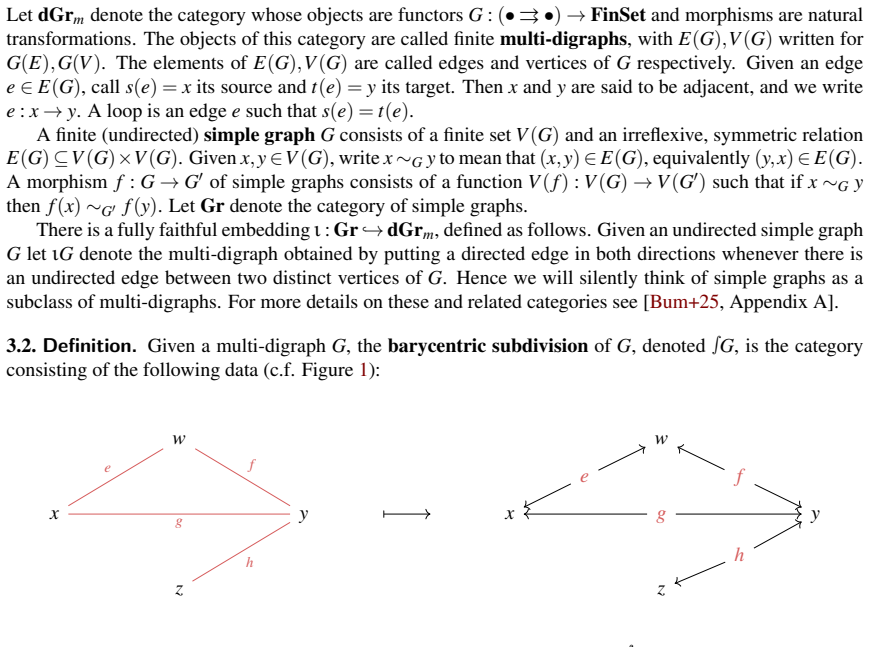
read the original abstract
A limit of a (small) diagram $d : J \to E$ in a complete category $E$ can be thought of as specifying a set of equations involving the objects of $E$. To motivate this intuitively, one can think of each object $d(j)$ as a "variable" and each morphism in $J$ as a "constraint" connecting these variables. If $E$ has an initial object, a natural question arises: does our set of equations have any solution at all? Equivalently, we can ask: is the limit of $d$ initial? In this paper we consider the computational problem that, given finite diagram $d$ in a finitely complete category $E$, asks whether its limit is empty. We construct a fast algorithm (in the sense of parameterized complexity theory) that solves this problem when $E$ is of the form $\mathbf{FinSet}^{J}$ for a finite category $J$ and $d$ is a structured co-decomposition, i.e. a diagram arising from the opposite of the Grothendieck construction of a simple graph.
Editorial analysis
A structured set of objections, weighed in public.
Referee Report
Summary. The paper claims to construct a parameterized (FPT) algorithm deciding whether lim(d) is empty for diagrams d : J → FinSet^J (J finite) that are structured co-decompositions arising as the opposite of the Grothendieck construction of a simple graph.
Significance. If the claimed algorithm exists and runs in FPT time under the stated restrictions, the result would supply a concrete, efficiently decidable special case of limit-emptiness in a finitely complete category, linking categorical limits to parameterized complexity; the explicit restriction to structured co-decompositions is a strength that keeps the claim falsifiable and scoped.
minor comments (2)
- The abstract states the existence of the algorithm but does not exhibit its description, running-time analysis, or correctness argument; if these appear only in later sections, a brief forward reference in the abstract would improve readability.
- The precise definition of 'structured co-decomposition' and the translation from the opposite Grothendieck construction of a simple graph should be stated as a numbered definition early in the paper to make the input class unambiguous.
Simulated Author's Rebuttal
We thank the referee for their review and for recommending minor revision. The report provides a positive assessment of the work's significance but does not list any specific major comments requiring response.
Circularity Check
No significant circularity; algorithmic construction is self-contained
full rationale
The paper presents a constructive result: an FPT algorithm deciding emptiness of lim(d) for diagrams d that are structured co-decompositions in FinSet^J (J finite). The input restriction is stated explicitly in the abstract and is the precise domain of the claimed algorithm; no generality beyond this class is asserted. No self-definitional equations, fitted parameters renamed as predictions, load-bearing self-citations, or imported uniqueness theorems appear in the provided text. The derivation consists of exhibiting the algorithm and (presumably) proving its correctness on the restricted inputs, which is independent of the result itself. This is the normal case of a self-contained constructive proof in parameterized complexity.
Axiom & Free-Parameter Ledger
axioms (2)
- domain assumption E is a finitely complete category
- domain assumption J is a finite category
Reference graph
Works this paper leans on
- [1]
-
[2]
Computational category-theoretic rewriting
Cambridge University Press, 1994.DOI: https://doi.org/10.1017/CBO9780511525858 (p. 8). [Bro+23] Kristopher Brown et al. “Computational category-theoretic rewriting”. In:Journal of Logical and Algebraic Methods in Programming134 (2023).DOI: https://doi.org/10.1016/j.jlamp. 2023.100888 (p. 1). [Bum+25] Benjamin Merlin Bumpus et al.Structured Decompositions:...
-
[3]
Efficient Computation of the Characteristic Polynomial of a Tree and Related Tasks,
arXiv: 2207.06091[math.CT](pp. 2, 8, 13, 16). [CCL15] Yixin Cao, Jianer Chen, and Yang Liu. “On feedback vertex set: New measure and new struc- tures”. In:Algorithmica73.1 (2015), pp. 63–86.DOI: https://doi.org/10.1007/s00453- 014- 9904-6 (p. 16). [Che+08] Jianer Chen et al. “Improved algorithms for feedback vertex set problems”. In:Journal of Com- puter ...
-
[4]
arXiv: 2601.00209[math.AT](pp. 1, 9). [GMM24] Gabriel Goren-Roig, Joshua Meyers, and Emilio Minichiello. “Presenting Profunctors”. In: EPTCS 429(2024), pp. 88–114.DOI: https://doi.org/10.4204/EPTCS.429.5 (p. 1). 17 [Gra21] Marino Gran. “An introduction to regular categories”. In:New Perspectives in Algebra, Topol- ogy and Categories: Summer School, Louvai...
-
[5]
Reducibility among combinatorial problems
Springer, 2021, pp. 113–145.DOI: https://doi.org/10.1007/978-3-030- 84319-9 4 (p. 6). [Kar09] Richard M Karp. “Reducibility among combinatorial problems”. In:50 Years of Integer Pro- gramming 1958-2008: from the Early Years to the State-of-the-Art. Springer, 2009, pp. 219– 241.DOI: https://doi.org/10.1007/978-3-540-68279-0 8 (p. 16). [MSW22] Joshua Meyers...
discussion (0)
Sign in with ORCID, Apple, or X to comment. Anyone can read and Pith papers without signing in.