Characterization of Aluminum Microwave SQUID Multiplexers for CEνNS Detection
Pith reviewed 2026-06-30 14:05 UTC · model grok-4.3
The pith
Aluminum microwave SQUID multiplexers achieve flux sensitivity of 0.3-0.6 μΦ₀/√Hz with parametric amplification for TES readout.
A machine-rendered reading of the paper's core claim, the machinery that carries it, and where it could break.
Core claim
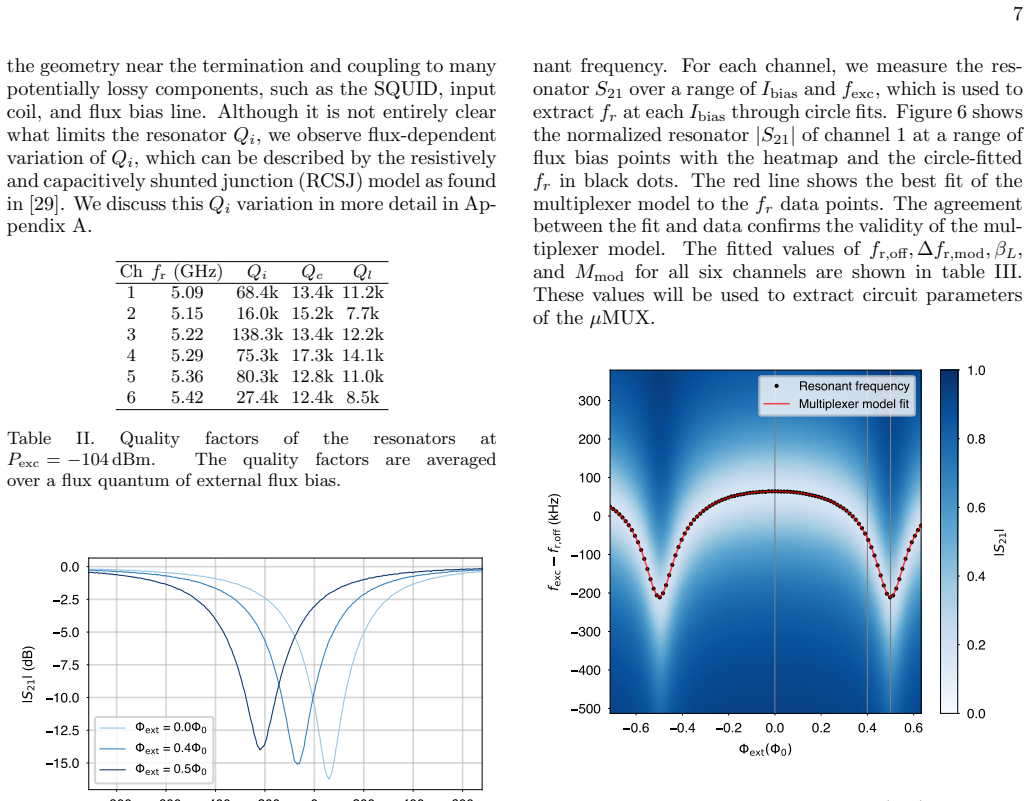
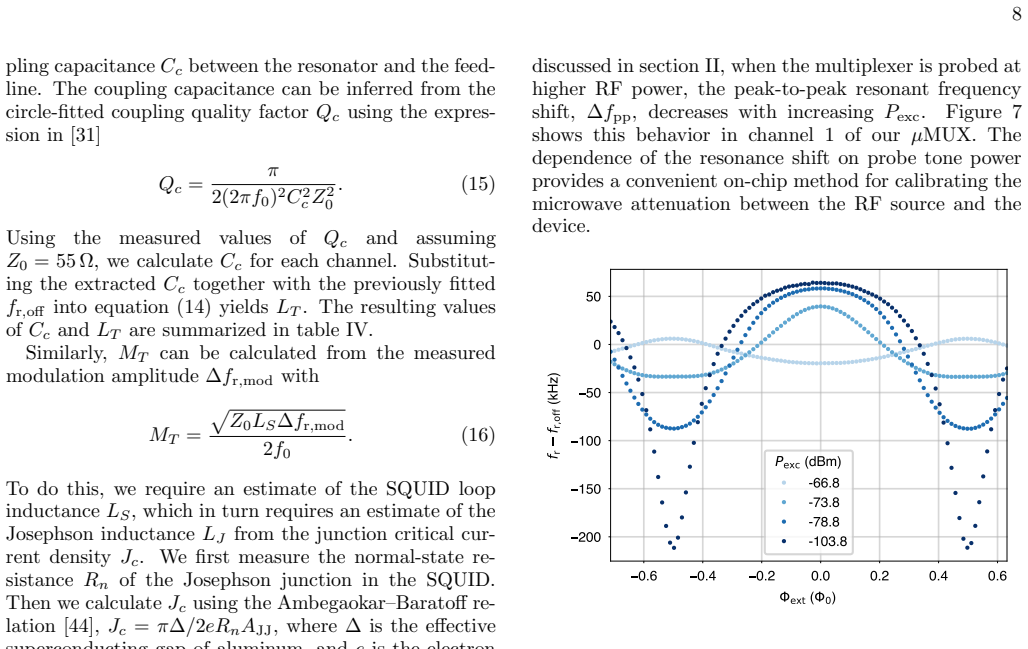
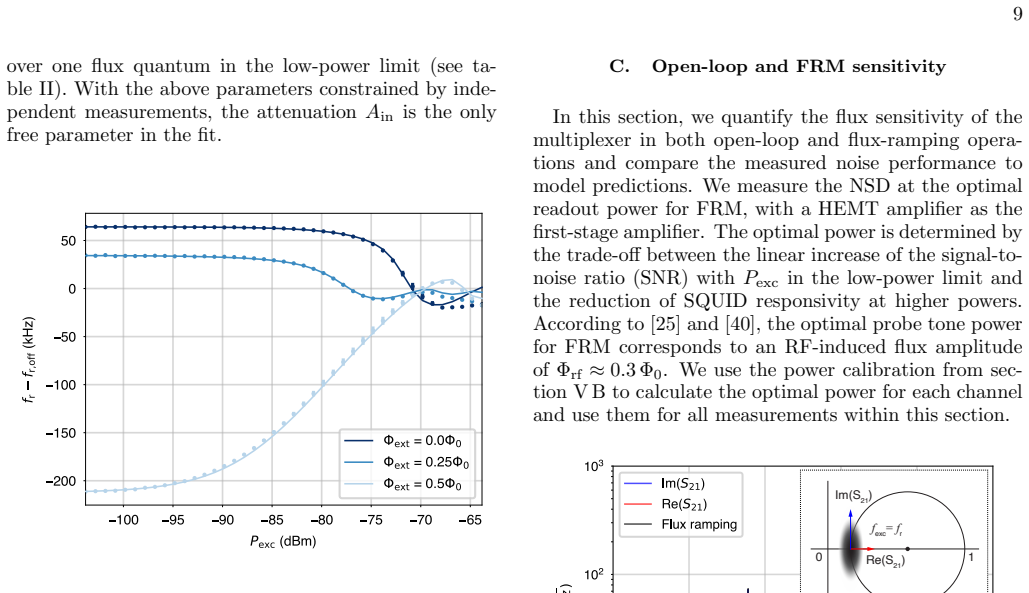
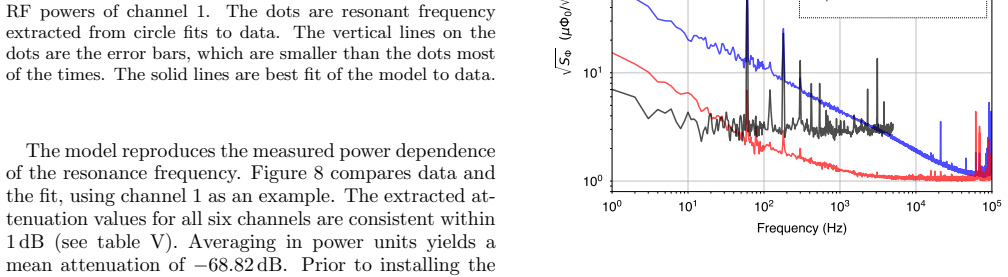
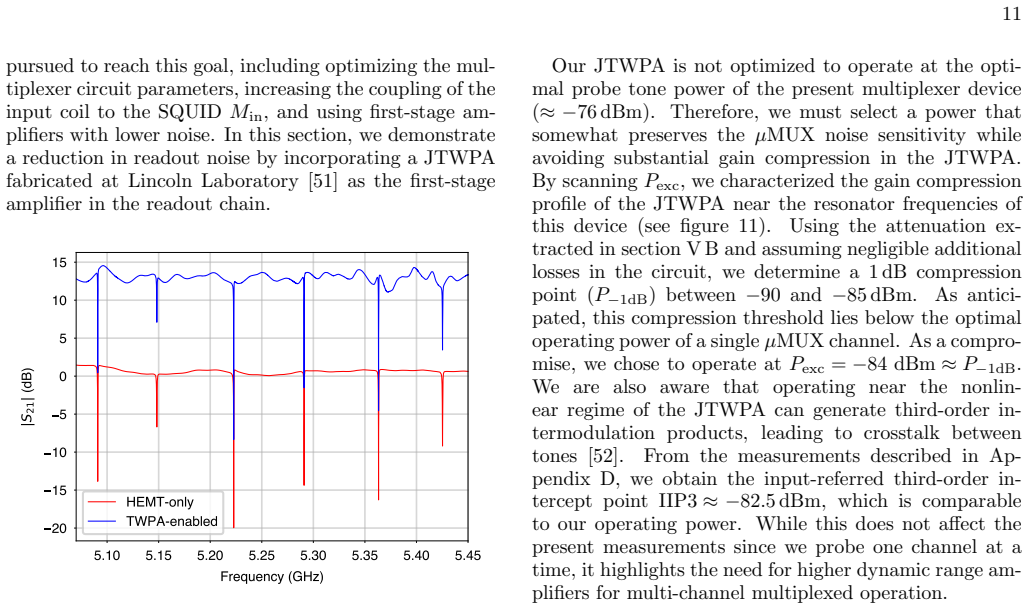
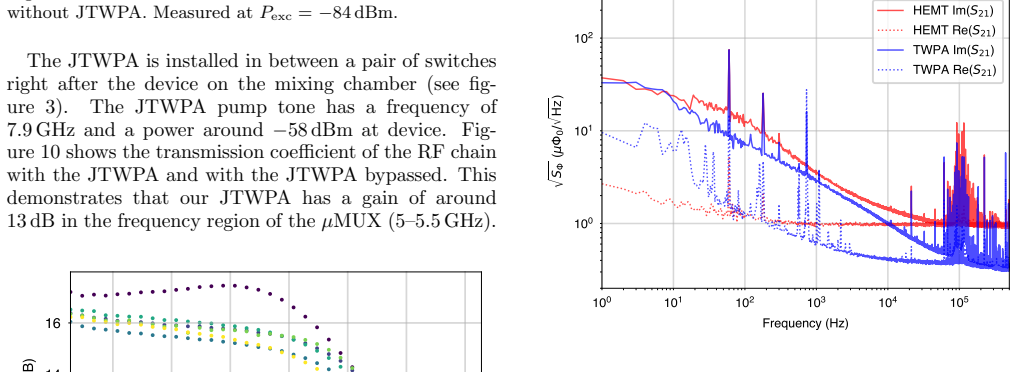
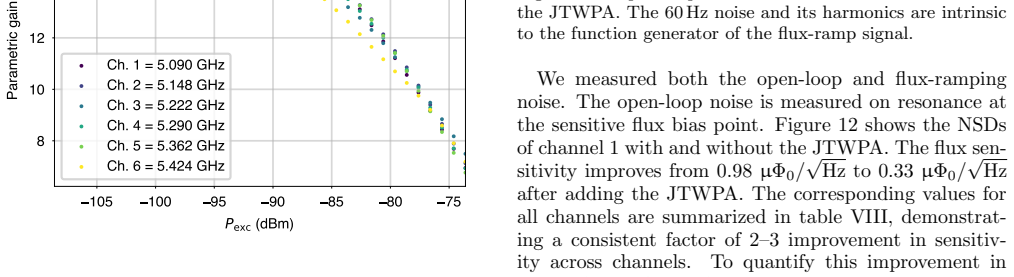
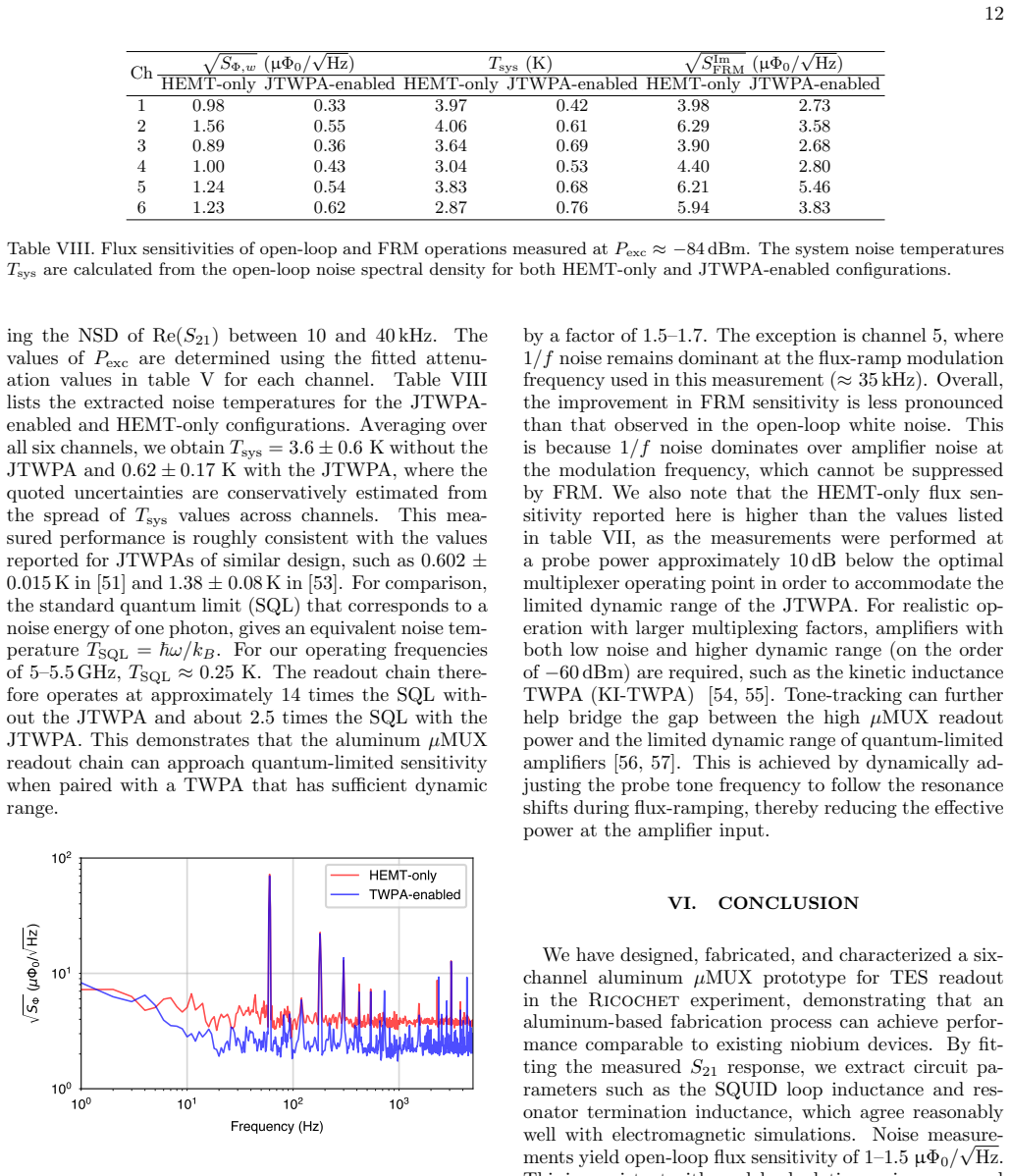
The aluminum μMUX prototype uses coplanar-waveguide resonators and RF SQUIDs with Dolan-style Al/AlOx/Al junctions. Device response agrees with multiplexer models. Open-loop flux sensitivity is 1-1.5 μΦ₀/√Hz with HEMT amplification and improves to 0.3-0.6 μΦ₀/√Hz with a JTWPA, yielding system noise temperature below 1 K. Flux-ramp modulation gives 3-4 μΦ₀/√Hz sensitivity while suppressing low-frequency noise.
What carries the argument
Aluminum coplanar-waveguide resonators coupled to RF SQUIDs that enable frequency-domain multiplexing of multiple TES channels.
If this is right
- Resonator scattering parameters match model predictions across the tested range of probe conditions.
- Flux-ramp modulation suppresses 1/f noise and delivers usable current sensitivity at the input coil.
- Inserting a JTWPA between the μMUX and HEMT reduces effective system noise temperature below 1 K.
- The demonstrated performance supports extension of aluminum μMUX technology to larger channel counts in cryogenic arrays.
Where Pith is reading between the lines
- The aluminum fabrication route may reduce complexity when scaling to arrays with hundreds of channels compared with other superconducting materials.
- Lab results at selected bias points leave open whether additional environmental noise appears once the full RICOCHET cryostat and wiring are used.
- The same resonator-SQUID architecture could be adapted for other low-temperature sensing applications that require multiplexed readout of many sensors.
Load-bearing premise
The noise and scattering measurements taken at the tested frequencies, powers, and bias points represent performance under actual RICOCHET operating conditions.
What would settle it
A measurement of flux sensitivity worse than 5 μΦ₀/√Hz or clear mismatch with model predictions when the device is operated at RICOCHET temperatures and signal levels would undermine the viability conclusion.
Figures
read the original abstract
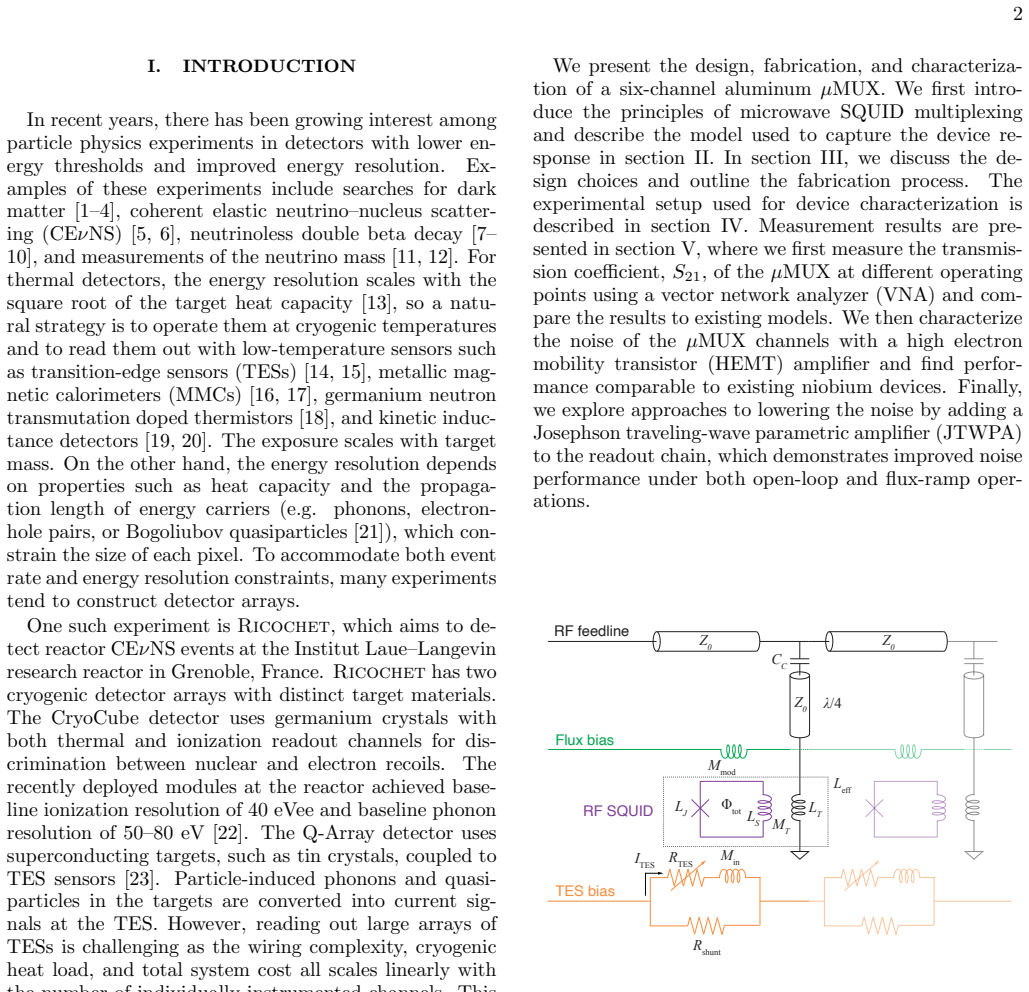
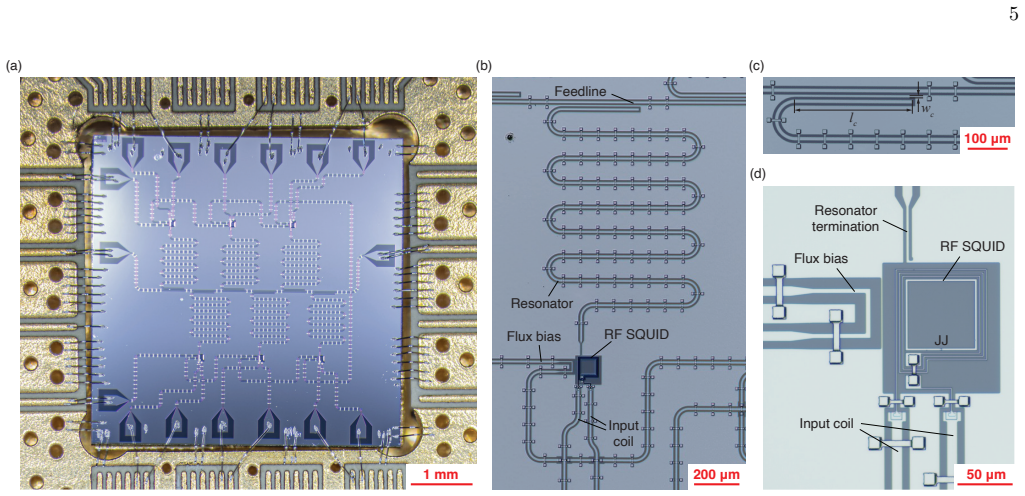
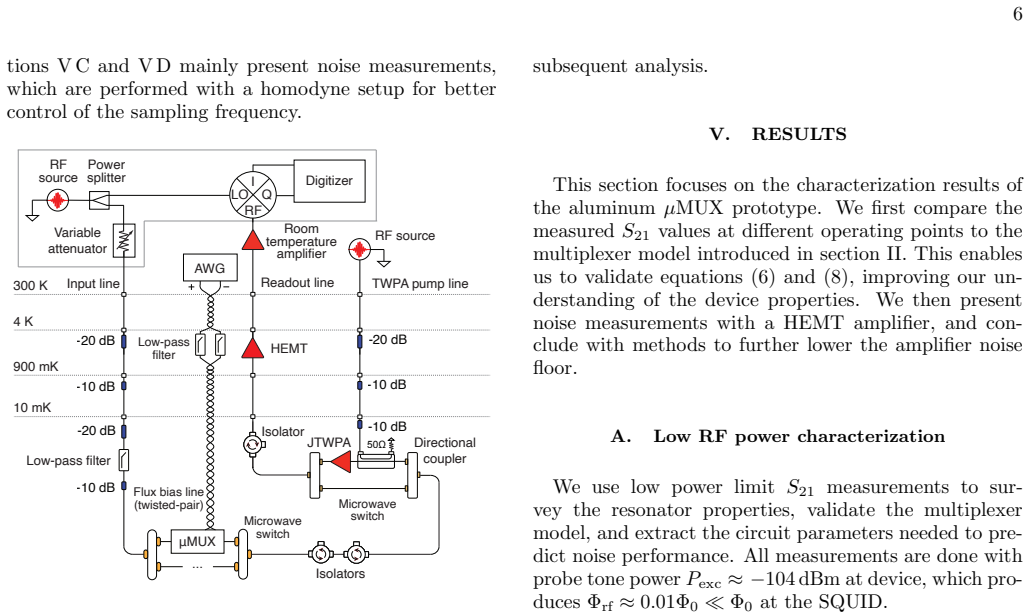
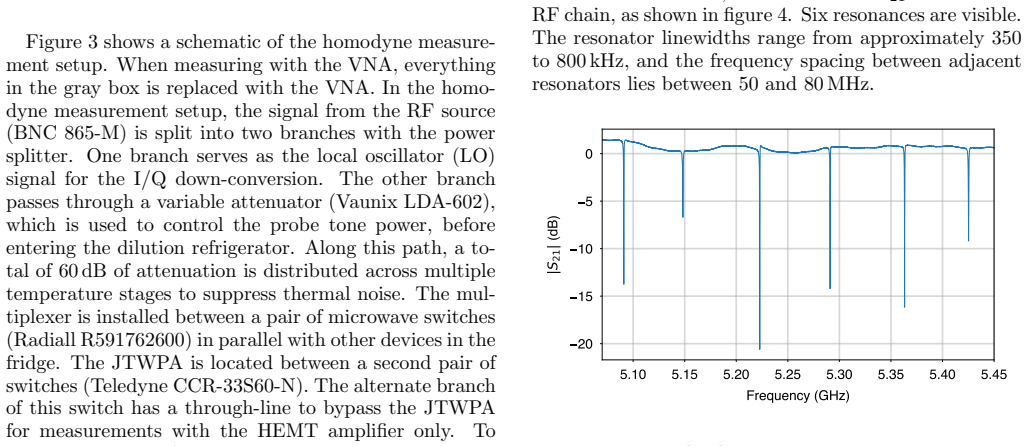
We present the design, fabrication, and characterization of an aluminum-based six-channel microwave SQUID multiplexer ($\mu$MUX) prototype for transition-edge sensor (TES) readout in the RICOCHET experiment. The device consists of aluminum coplanar-waveguide resonators and RF SQUIDs with Dolan-style Al/AlO$_x$/Al Josephson junctions. By measuring the resonator scattering parameters at a range of probe tone frequencies, powers, and flux bias points, we demonstrate agreement between the device response and existing multiplexer models. We also characterize the noise performance in both open-loop and flux-ramping modes. With a high electron mobility transistor (HEMT) amplifier, open-loop measurements yield a flux sensitivity of 1-1.5 $\mu\Phi_0/\sqrt{Hz}$. With flux-ramp modulation, low-frequency 1/f noise is suppressed, and the flux sensitivity is around 3-4 $\mu\Phi_0/\sqrt{Hz}$, corresponding to a current sensitivity of 24-33 $pA/\sqrt{Hz}$ at the input coil. We further demonstrate a reduction in readout noise by incorporating a Josephson traveling-wave parametric amplifier (JTWPA) between the $\mu$MUX and the HEMT. This achieves an open-loop flux sensitivity of 0.3-0.6 $\mu\Phi_0/\sqrt{Hz}$ and an effective system noise temperature below 1 K. These results establish aluminum $\mu$MUX devices as a viable and extensible readout technology for low-noise cryogenic detector arrays.
Editorial analysis
A structured set of objections, weighed in public.
Referee Report
Summary. The manuscript presents the design, fabrication, and experimental characterization of a six-channel aluminum-based microwave SQUID multiplexer (μMUX) prototype with coplanar-waveguide resonators and RF SQUIDs using Dolan-style Josephson junctions, intended for TES readout in the RICOCHET CEνNS experiment. Measurements of scattering parameters over ranges of probe frequencies, powers, and flux biases are reported to agree with existing multiplexer models. Noise performance is characterized in open-loop (1-1.5 μΦ₀/√Hz with HEMT) and flux-ramped modes (3-4 μΦ₀/√Hz, or 24-33 pA/√Hz at input coil), with further improvement to 0.3-0.6 μΦ₀/√Hz using a JTWPA, yielding system noise temperature below 1 K. The work concludes that these results establish aluminum μMUX devices as viable and extensible for low-noise cryogenic detector arrays.
Significance. If the reported sensitivities prove representative of RICOCHET conditions, the work supplies a concrete experimental benchmark for aluminum μMUX technology, including the first reported JTWPA integration for this application and direct model comparisons. This strengthens the case for scalable, low-noise readout in CEνNS and related cryogenic experiments. The provision of specific numerical sensitivities in multiple operating modes is a positive feature that enables direct comparison with other readout approaches.
major comments (2)
- [Abstract] Abstract: The viability claim for RICOCHET rests on the measured sensitivities being representative, yet the text provides no explicit mapping or table comparing the tested probe frequencies, powers, and flux bias points to RICOCHET parameters such as resonator frequencies, expected TES signal amplitudes, or environmental conditions (temperature stability, magnetic field). Without this, the quantitative noise figures cannot be directly tied to the target operating regime.
- [Abstract] Abstract and characterization results: The flux sensitivities are stated as ranges (1-1.5, 3-4, 0.3-0.6 μΦ₀/√Hz) without accompanying error budgets, standard deviations from repeated measurements, or details on data exclusion criteria. This absence limits evaluation of whether the data fully support the quantitative agreement and viability assertions.
minor comments (2)
- The manuscript would benefit from a dedicated methods subsection or supplementary table listing the exact resonator frequencies, probe powers, and flux bias ranges used, to allow readers to assess coverage of the RICOCHET regime.
- Notation for flux sensitivity units is consistent, but the transition from open-loop to flux-ramped current sensitivity (pA/√Hz) would be clearer with an explicit statement of the input coil mutual inductance value used for conversion.
Simulated Author's Rebuttal
We thank the referee for their careful review and constructive comments. We respond point-by-point to the major comments below.
read point-by-point responses
-
Referee: [Abstract] Abstract: The viability claim for RICOCHET rests on the measured sensitivities being representative, yet the text provides no explicit mapping or table comparing the tested probe frequencies, powers, and flux bias points to RICOCHET parameters such as resonator frequencies, expected TES signal amplitudes, or environmental conditions (temperature stability, magnetic field). Without this, the quantitative noise figures cannot be directly tied to the target operating regime.
Authors: We agree that an explicit mapping would strengthen the connection between the reported measurements and RICOCHET operating conditions. While the tested parameters were selected to be representative of the target cryogenic environment, the revised manuscript will include a new table (or expanded paragraph in the device design or results section) that directly compares probe frequencies, powers, and flux bias points to expected RICOCHET resonator frequencies, TES signal amplitudes, temperature stability, and magnetic field requirements. This addition will make the applicability of the noise figures explicit. revision: yes
-
Referee: [Abstract] Abstract and characterization results: The flux sensitivities are stated as ranges (1-1.5, 3-4, 0.3-0.6 μΦ₀/√Hz) without accompanying error budgets, standard deviations from repeated measurements, or details on data exclusion criteria. This absence limits evaluation of whether the data fully support the quantitative agreement and viability assertions.
Authors: The reported ranges reflect observed variation across the six channels and multiple bias conditions. We acknowledge that including statistical details would improve transparency. In the revision we will add error estimates (standard deviations where repeated measurements exist), state the number of measurements performed, and describe any data exclusion criteria applied during noise analysis. These changes will be incorporated into the characterization results section. revision: yes
Circularity Check
No significant circularity in experimental characterization
full rationale
This paper is a direct experimental report of fabricated device measurements (scattering parameters, flux sensitivity, noise spectra) compared against pre-existing multiplexer models. No derivations, predictions, or parameter fits are claimed as novel outputs; the viability conclusion follows from the reported empirical values without any reduction to self-defined quantities or self-citation chains. The central claims rest on external benchmarks (HEMT/JTWPA performance, standard SQUID models) rather than internal redefinitions.
Axiom & Free-Parameter Ledger
axioms (1)
- domain assumption Existing multiplexer models accurately describe the scattering parameters and noise behavior of the aluminum μMUX device.
Reference graph
Works this paper leans on
-
[1]
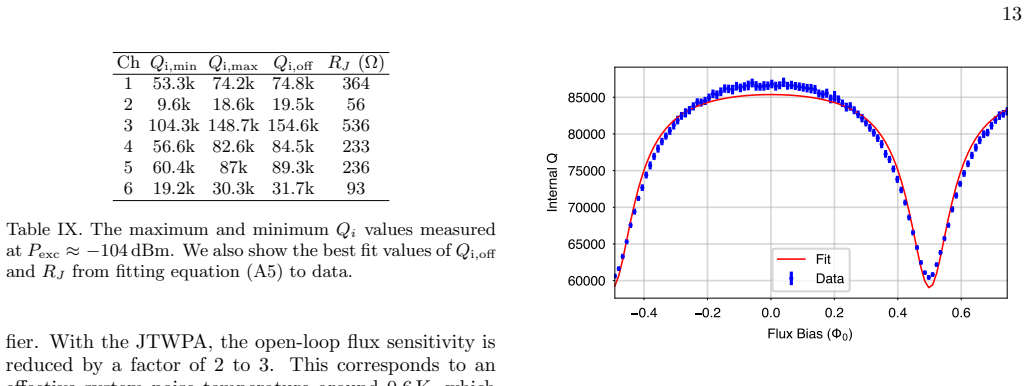
The coupling quality factorsQ c are approximately 1.4×10 4 across all channels, placing the device close to theQ i ≫Q c regime that is generally desirable. These Qi values are reduced relative to other resonators con- structed from high-quality superconductors, likely due to 7 the geometry near the termination and coupling to many potentially lossy compon...
2024
-
[2]
Armengaudet al., Journal of Cosmology and As- troparticle Physics2016, 019 (2016)
E. Armengaudet al., Journal of Cosmology and As- troparticle Physics2016, 019 (2016)
2016
-
[3]
Agneseet al., Physical Review Letters121, 051301 (2018)
R. Agneseet al., Physical Review Letters121, 051301 (2018)
2018
-
[4]
Angloheret al., Physical Review D107, 122003 (2023)
G. Angloheret al., Physical Review D107, 122003 (2023)
2023
-
[5]
Alloniet al., Physical Review D111, 103050 (2025)
D. Alloniet al., Physical Review D111, 103050 (2025)
2025
-
[6]
Angloheret al., The European Physical Journal C79, 1018 (2019)
G. Angloheret al., The European Physical Journal C79, 1018 (2019)
2019
-
[7]
Augieret al., Journal of Low Temperature Physics 212, 127 (2023)
C. Augieret al., Journal of Low Temperature Physics 212, 127 (2023)
2023
- [8]
-
[9]
The CUORE Collaboration, Nature604, 53 (2022)
2022
-
[10]
Agrawalet al., The European Physical Journal C85, 172 (2025)
A. Agrawalet al., The European Physical Journal C85, 172 (2025)
2025
-
[11]
CUPID Collaboration, The European Physical Journal C85, 737 (2025)
2025
-
[12]
Gastaldoet al., Journal of Low Temperature Physics 176, 876 (2014)
L. Gastaldoet al., Journal of Low Temperature Physics 176, 876 (2014)
2014
-
[13]
Faverzaniet al., Journal of Low Temperature Physics 184, 922 (2016)
M. Faverzaniet al., Journal of Low Temperature Physics 184, 922 (2016)
2016
-
[14]
McCammon, inCryogenic Particle Detection, Vol
D. McCammon, inCryogenic Particle Detection, Vol. 99, edited by C. E. Ascheron, H. J. K¨ olsch, W. Skolaut, and C. Enss (Springer Berlin Heidelberg, Berlin, Heidelberg,
-
[15]
K. D. Irwin, Applied Physics Letters66, 1998 (1995)
1998
-
[16]
Irwin and G
K. Irwin and G. Hilton, inCryogenic Particle Detection, Vol. 99, edited by C. E. Ascheron, H. J. K¨ olsch, W. Sko- laut, and C. Enss (Springer Berlin Heidelberg, Berlin, Heidelberg, 2005) pp. 63–150, series Title: Topics in Ap- plied Physics
2005
-
[17]
C. Enss, A. Fleischmann, K. Horst, J. Sch¨ onefeld, J. Soll- ner, J. S. Adams, Y. H. Huang, Y. H. Kim, and G. M. Seidel, Journal of Low Temperature Physics121, 137 (2000)
2000
-
[18]
Kempf, A
S. Kempf, A. Fleischmann, L. Gastaldo, and C. Enss, Journal of Low Temperature Physics193, 365 (2018)
2018
-
[19]
Haller, Infrared Physics & Technology35, 127 (1994)
E. Haller, Infrared Physics & Technology35, 127 (1994)
1994
-
[20]
P. K. Day, H. G. LeDuc, B. A. Mazin, A. Vayonakis, and J. Zmuidzinas, Nature425, 817 (2003)
2003
-
[21]
Zmuidzinas, Annual Review of Condensed Matter Physics3, 169 (2012)
J. Zmuidzinas, Annual Review of Condensed Matter Physics3, 169 (2012)
2012
-
[22]
Catelani and J
G. Catelani and J. P. Pekola, Materials for Quantum Technology2, 013001 (2022)
2022
-
[23]
Armatolet al., Physical Review D112, 112019 (2025)
A. Armatolet al., Physical Review D112, 112019 (2025)
2025
-
[24]
Augieret al., Nuclear Instruments and Methods in Physics Research Section A: Accelerators, Spectrome- ters, Detectors and Associated Equipment1057, 168765 (2023)
C. Augieret al., Nuclear Instruments and Methods in Physics Research Section A: Accelerators, Spectrome- ters, Detectors and Associated Equipment1057, 168765 (2023)
2023
-
[25]
D. A. Bennett, J. A. B. Mates, J. D. Gard, A. S. Hoover, M. W. Rabin, C. D. Reintsema, D. R. Schmidt, L. R. Vale, and J. N. Ullom, IEEE Transactions on Applied Superconductivity25, 1 (2015)
2015
-
[26]
J. A. B. Mateset al., Applied Physics Letters111, 062601 (2017)
2017
-
[27]
Beckeret al., Journal of Instrumentation14, P10035 (2019)
D. Beckeret al., Journal of Instrumentation14, P10035 (2019)
2019
-
[28]
Szyprytet al., IEEE Transactions on Applied Super- conductivity33, 1 (2023)
P. Szyprytet al., IEEE Transactions on Applied Super- conductivity33, 1 (2023)
2023
-
[29]
T. P. Satterthwaiteet al., inMillimeter, Submillimeter, and Far-Infrared Detectors and Instrumentation for As- tronomy XII, Vol. 13102, edited by J. Zmuidzinas and J.-R. Gao, International Society for Optics and Photon- ics (SPIE, 2024) p. 1310223
2024
-
[30]
Kempf, M
S. Kempf, M. Wegner, L. Deeg, A. Fleischmann, L. Gastaldo, F. Herrmann, D. Richter, and C. Enss, Su- perconductor Science and Technology30, 065002 (2017)
2017
- [31]
-
[32]
Mates,The Microwave SQUID Multiplexer, Ph.D
J. Mates,The Microwave SQUID Multiplexer, Ph.D. the- sis, University of Colorado (2011)
2011
-
[33]
Nakashima, F
Y. Nakashima, F. Hirayama, S. Kohjiro, H. Yamamori, S. Nagasawa, N. Y. Yamasaki, and K. Mitsuda, IEICE Electronics Express14, 20170271 (2017)
2017
-
[34]
M. Songet al., Design, fabrication and characteriza- tion of microwave multiplexing squid prototype (2026), arXiv:2603.29613 [physics.ins-det]
-
[35]
Melvilleet al., Applied Physics Letters117, 124004 (2020)
A. Melvilleet al., Applied Physics Letters117, 124004 (2020)
2020
- [36]
-
[37]
Steer,Microwave and RF Design: Volume 2: Trans- mission Lines(North Carolina State University Li- braries, Raleigh, North Carolina, 2019)
M. Steer,Microwave and RF Design: Volume 2: Trans- mission Lines(North Carolina State University Li- braries, Raleigh, North Carolina, 2019)
2019
-
[38]
Wegner, C
M. Wegner, C. Enss, and S. Kempf, Superconductor Sci- ence and Technology35, 075011 (2022)
2022
-
[39]
J. A. B. Mates, K. D. Irwin, L. R. Vale, G. C. Hilton, J. Gao, and K. W. Lehnert, Journal of Low Temperature Physics167, 707 (2012)
2012
-
[40]
Yuet al., Journal of Low Temperature Physics209, 589 (2022)
C. Yuet al., Journal of Low Temperature Physics209, 589 (2022)
2022
-
[41]
Schuster, M
C. Schuster, M. Wegner, and S. Kempf, Journal of Ap- plied Physics133, 044503 (2023)
2023
-
[42]
M. E. Garc´ ıa Redondoet al., Journal of Applied Physics 136, 114401 (2024)
2024
-
[43]
COMSOL Multiphysics ®, COMSOL AB, Stockholm, Sweden
-
[44]
Probst, F
S. Probst, F. B. Song, P. A. Bushev, A. V. Ustinov, and M. Weides, Review of Scientific Instruments86, 024706 17 (2015)
2015
-
[45]
Ambegaokar and A
V. Ambegaokar and A. Baratoff, Physical Review Letters 10, 486 (1963)
1963
-
[46]
J. Gao, J. Zmuidzinas, B. A. Mazin, H. G. LeDuc, and P. K. Day, Applied Physics Letters90, 102507 (2007)
2007
-
[47]
Kumar, J
S. Kumar, J. Gao, J. Zmuidzinas, B. A. Mazin, H. G. LeDuc, and P. K. Day, Applied Physics Letters92, 123503 (2008)
2008
-
[48]
F. C. Wellstood, C. Urbina, and J. Clarke, Applied Physics Letters50, 772 (1987)
1987
-
[49]
D. A. Roweret al., Physical Review Letters130, 220602 (2023)
2023
-
[50]
Malnou, J
M. Malnou, J. A. B. Mates, M. R. Vissers, L. R. Vale, D. R. Schmidt, D. A. Bennett, J. Gao, and J. N. Ullom, Applied Physics Letters122, 214001 (2023)
2023
-
[51]
Chen,Design, Fabrication and Optimization of a Novel TES-Based Detector for CEνNS Process, Ph.D
R. Chen,Design, Fabrication and Optimization of a Novel TES-Based Detector for CEνNS Process, Ph.D. thesis, Northwestern University (2025)
2025
-
[52]
Macklin, K
C. Macklin, K. O’Brien, D. Hover, M. E. Schwartz, V. Bolkhovsky, X. Zhang, W. D. Oliver, and I. Siddiqi, Science350, 307 (2015)
2015
-
[53]
J. A. B. Mates, D. T. Becker, D. A. Bennett, B. J. Dober, J. D. Gard, G. C. Hilton, D. S. Swetz, L. R. Vale, and J. N. Ullom, Applied Physics Letters115, 202601 (2019)
2019
-
[54]
Bartramet al., Review of Scientific Instruments94, 044703 (2023)
C. Bartramet al., Review of Scientific Instruments94, 044703 (2023)
2023
-
[55]
Malnou, M
M. Malnou, M. Vissers, J. Wheeler, J. Aumentado, J. Hubmayr, J. Ullom, and J. Gao, PRX Quantum2, 010302 (2021)
2021
-
[56]
Faramarzi, R
F. Faramarzi, R. Stephenson, S. Sypkens, B. H. Eom, H. LeDuc, and P. Day, APL Quantum1, 036107 (2024)
2024
-
[57]
Yuet al., Review of Scientific Instruments94, 014712 (2023)
C. Yuet al., Review of Scientific Instruments94, 014712 (2023)
2023
-
[58]
J. C. Grohet al., Applied Physics Letters127, 152602 (2025)
2025
-
[59]
Analog Devices, IP3 and Intermodulation Guide (2013)
2013
discussion (0)
Sign in with ORCID, Apple, or X to comment. Anyone can read and Pith papers without signing in.