A Digital Twin Platform Enabling Monolithic Crystal-Free Bluetooth Low Energy Single-Chip Sensor Motes
Pith reviewed 2026-06-30 14:16 UTC · model grok-4.3
The pith
A digital twin platform allows pre-silicon validation of crystal-free Bluetooth Low Energy sensor motes.
A machine-rendered reading of the paper's core claim, the machinery that carries it, and where it could break.
Core claim
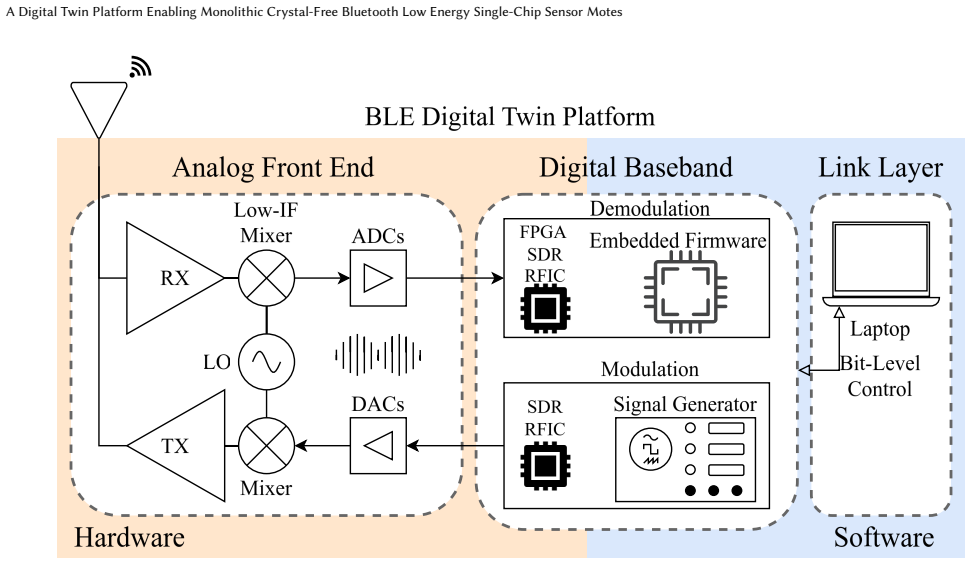
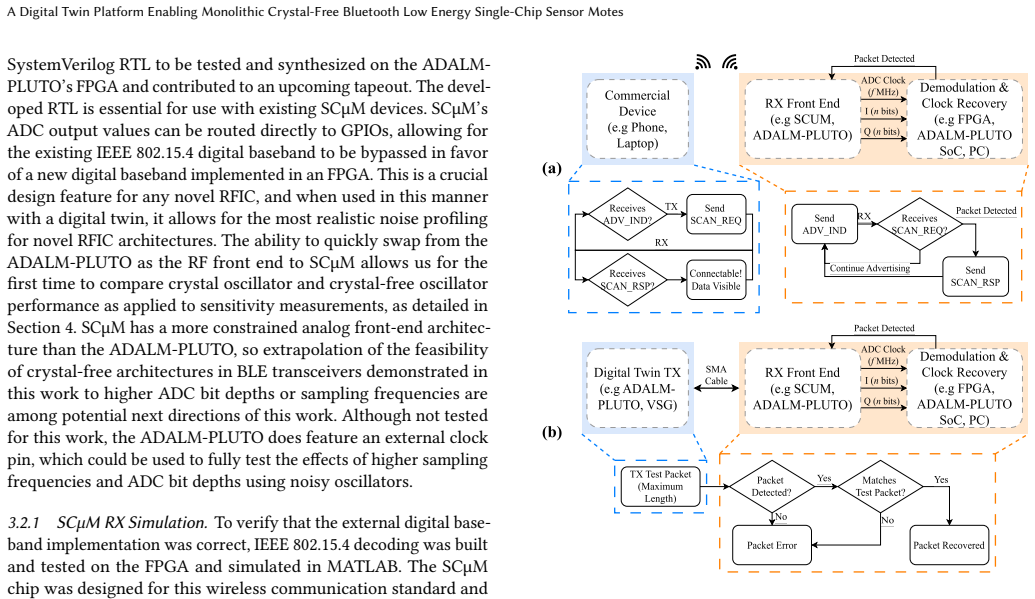
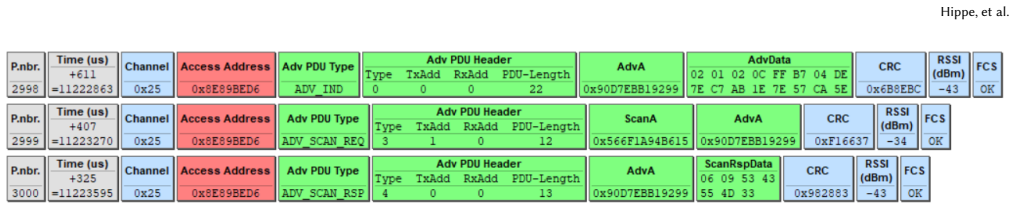
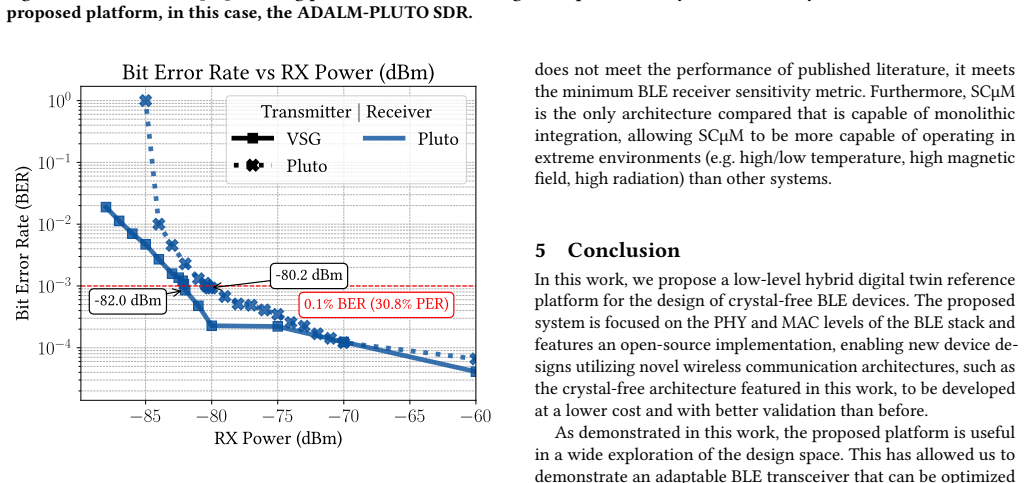
The authors present a digital twin platform for BLE with PHY control that supports multiple RF front ends and digital baseband implementations, including a commercially available SDR with synthesized RTL and embedded firmware along with an existing crystal-free SoC front end and FPGA digital baseband. These configurations communicate sensor data with commercially available BLE devices and achieve receiver sensitivities up to -82 dBm, exceeding the minimum BLE specification.
What carries the argument
The digital twin ecosystem with physical-layer control for novel device development and validation.
If this is right
- The platform supports multiple RF front ends and digital baseband implementations for flexible testing.
- It enables communication with commercial BLE devices for real-world validation.
- Receiver sensitivities exceed the minimum BLE specification.
- The system is extendable to other hardware and communication protocols.
Where Pith is reading between the lines
- Similar digital twins could support development of crystal-free devices using other wireless protocols.
- This approach may lower the cost barrier for custom sensor mote designs in large environmental monitoring deployments.
- Pre-silicon tools like this could be adapted to test power consumption or integration with additional sensors.
Load-bearing premise
The digital twin accurately models the RF front-end and baseband behavior of novel crystal-free implementations sufficiently for reliable pre-silicon validation.
What would settle it
Fabricate a crystal-free BLE mote guided by the digital twin predictions and measure whether its actual receiver sensitivity and communication performance with commercial devices match the reported results.
Figures
read the original abstract
Low-power wireless-capable systems-on-chips (SoCs) are critical for researching many of our current environmental issues. The scale at which these devices are needed for many applications necessitates innovation in their design to reduce the various capital and labor costs involved with operating an extensive sensor network. This can be difficult for devices with novel wireless architectures, as many emerging architectures lack commercially available development platforms. This makes pre-silicon validation challenging, and the impact of a failed tapeout is unacceptable when the cost is of primary concern for these devices. In this work, we propose a digital twin ecosystem for Bluetooth Low-Energy (BLE) with physical-layer (PHY) control intended for novel device development and demonstrated through use with crystal-free single-chip sensor motes. We present this system operating with multiple RF front ends and digital baseband implementations, including a commercially available Software Defined Radio (SDR) with synthesized RTL and embedded firmware, along with an existing crystal-free SoC front end and FPGA digital baseband. These configurations are shown to be capable of communicating sensor data with commercially available BLE devices and achieving receiver sensitivities up to -82 dBm, exceeding the minimum BLE specification. This approach is extendable to other hardware and communication protocols and promises to enable inexpensive, reusable validation and verification tools for novel wireless devices.
Editorial analysis
A structured set of objections, weighed in public.
Referee Report
Summary. The manuscript proposes a digital twin ecosystem for Bluetooth Low Energy (BLE) physical-layer control, intended to support pre-silicon validation of novel crystal-free single-chip sensor motes. It demonstrates operation across multiple hardware configurations—including a commercially available SDR with synthesized RTL and an existing crystal-free SoC front-end paired with FPGA digital baseband—showing interoperability with commercial BLE devices and receiver sensitivities reaching -82 dBm, which exceeds the BLE minimum specification. The approach is presented as extendable to other hardware and protocols.
Significance. If the digital twin's modeling fidelity for RF front-end and baseband behavior is established, the platform could meaningfully reduce tape-out risk and cost for innovative low-power wireless SoCs in large-scale environmental sensing applications. The emphasis on reusable, inexpensive validation tools for architectures lacking commercial development platforms addresses a genuine practical gap.
major comments (2)
- [Abstract] Abstract and introduction: the central claim is that the digital twin enables reliable pre-silicon validation for novel crystal-free BLE motes, yet all reported performance numbers (interoperability, -82 dBm sensitivity) are obtained from physical post-silicon configurations (SDR + FPGA or existing crystal-free SoC). No results are shown in which the twin itself generates sensitivity curves, BER data, or interoperability predictions for a new pre-silicon architecture prior to tape-out; this leaves the modeling accuracy required for the stated use-case unverified.
- [Demonstration sections (inferred from abstract)] The manuscript does not provide quantitative validation (e.g., measured vs. simulated BER, sensitivity curves, or timing diagrams) comparing digital-twin outputs against the physical hardware used in the demonstrations; without such side-by-side data the claim that the twin is sufficiently accurate for pre-silicon decisions cannot be assessed.
minor comments (1)
- [Abstract] Abstract: the phrase 'achieving receiver sensitivities up to -82 dBm' should be accompanied by the measurement conditions (packet length, modulation index, temperature, etc.) even in the abstract to allow immediate evaluation against the BLE spec.
Simulated Author's Rebuttal
We thank the referee for the constructive review and recommendation. We respond point-by-point to the major comments below.
read point-by-point responses
-
Referee: [Abstract] Abstract and introduction: the central claim is that the digital twin enables reliable pre-silicon validation for novel crystal-free BLE motes, yet all reported performance numbers (interoperability, -82 dBm sensitivity) are obtained from physical post-silicon configurations (SDR + FPGA or existing crystal-free SoC). No results are shown in which the twin itself generates sensitivity curves, BER data, or interoperability predictions for a new pre-silicon architecture prior to tape-out; this leaves the modeling accuracy required for the stated use-case unverified.
Authors: The manuscript demonstrates the digital twin ecosystem operating in real time with post-silicon hardware (SDR+RTL and crystal-free SoC+FPGA) to achieve the reported BLE interoperability and sensitivity. These configurations serve to establish that the twin can control PHY behavior across multiple front-ends. We agree that the manuscript does not contain explicit pre-tapeout sensitivity or BER predictions generated solely by the twin for a hypothetical new architecture, as no new silicon was fabricated. We will revise the abstract and introduction to distinguish the demonstrated post-silicon operation from the intended pre-silicon use case and add a brief discussion of how the existing modeling framework would be applied to a new design. revision: partial
-
Referee: [Demonstration sections (inferred from abstract)] The manuscript does not provide quantitative validation (e.g., measured vs. simulated BER, sensitivity curves, or timing diagrams) comparing digital-twin outputs against the physical hardware used in the demonstrations; without such side-by-side data the claim that the twin is sufficiently accurate for pre-silicon decisions cannot be assessed.
Authors: We acknowledge that the current manuscript does not include direct side-by-side quantitative comparisons (measured vs. twin-simulated BER, sensitivity curves, or timing diagrams) between the digital twin outputs and the physical hardware results. The reported metrics reflect end-to-end system performance. We will add such validation data and figures in the revised manuscript to allow assessment of modeling fidelity. revision: yes
Circularity Check
No circularity; empirical hardware results stand independently of modeling claims
full rationale
The manuscript presents an engineering platform demonstration using physical post-silicon hardware (SDR + FPGA, existing crystal-free SoC). Reported metrics such as -82 dBm sensitivity and BLE interoperability are obtained directly from these setups. No equations, fitted parameters, self-citations, or derivation steps appear that would reduce any central claim to its own inputs by construction. The work is therefore self-contained as an experimental report rather than a closed mathematical or parametric loop.
Axiom & Free-Parameter Ledger
Reference graph
Works this paper leans on
-
[1]
Hamed Ahmadi, Avishek Nag, Zaheer Khar, Kamran Sayrafian, and Susanto Rahardja. 2021. Networked Twins and Twins of Networks: An Overview on the Relationship Between Digital Twins and 6G.IEEE Communications Standards Magazine5, 4 (Dec. 2021), 154–160. https://doi.org/10.1109/MCOMSTD.0001. 2000041 Conference Name: IEEE Communications Standards Magazine
-
[2]
In: 2020 IEEE International Solid-State Circuits Conference - (ISSCC)
Abdullah Alghaihab, Xing Chen, Yao Shi, Daniel S. Truesdell, Benton H. Calhoun, and David D. Wentzloff. 2020. 30.7 A Crystal-Less BLE Transmitter with -86dBm Frequency-Hopping Back-Channel WRX and Over-the-Air Clock Recovery from a GFSK-Modulated BLE Packet. In2020 IEEE International Solid-State Circuits Conference - (ISSCC). 472–474. https://doi.org/10.1...
-
[3]
AMD. 2025. AMD Zynq™7000 SoCs. https://www.amd.com/en/products/ adaptive-socs-and-fpgas/soc/zynq-7000.html
2025
-
[4]
Analog Devices. 2025. ADALM-PLUTO Overview [Analog Devices Wiki]. https: //wiki.analog.com/university/tools/pluto
2025
-
[5]
Analog Devices. 2025. the libIIO documentation. https://analogdevicesinc. github.io/libiio/master/index.html
2025
-
[6]
Lina Bariah, Hikmet Sari, and Mérouane Debbah. 2023. Digital Twin-Empowered Communications: A New Frontier of Wireless Networks.IEEE Communications Magazine61, 12 (Dec. 2023), 24–36. https://doi.org/10.1109/MCOM.001.2300069 Conference Name: IEEE Communications Magazine
-
[7]
BlueKitchen. 2025. BlueKitchen – BlueKitchen GmbH | Dual-mode Bluetooth Stack – Available in Source Code. https://bluekitchen-gmbh.com/
2025
-
[8]
Burnett, Filip Maksimovic, Brad Wheeler, Osama Khan, Ali M
David C. Burnett, Filip Maksimovic, Brad Wheeler, Osama Khan, Ali M. Niknejad, and Kristofer S.J. Pister. 2021. Free-running 2.4GHz Ring Oscillator-Based FSK TX/RX for Ultra-Small IoT Motes. In2020 15th European Microwave Integrated Circuits Conference (EuMIC). 101–104. https://ieeexplore.ieee.org/document/ 9337291
2021
-
[9]
Tengfei Chang, Thomas Watteyne, Brad Wheeler, Filip Maksimovic, David C. Burnett, and Kris Pister. 2022. Surviving the Hair Dryer: Continuous Calibration of a Crystal-Free Mote-on-Chip.IEEE Internet of Things Journal9, 6 (March 2022), 4737–4747. https://doi.org/10.1109/JIOT.2021.3108077 Conference Name: IEEE Internet of Things Journal
-
[10]
A.N. D’Andrea, U. Mengali, and R. Reggiannini. 1990. A digital approach to clock recovery in generalized minimum shift keying.IEEE Transactions on Vehicular Technology39, 3 (Aug. 1990), 227–234. https://doi.org/10.1109/25. 131004 Conference Name: IEEE Transactions on Vehicular Technology
work page doi:10.1109/25 1990
-
[11]
Digilent. 2023. Digital Discovery - Digilent Reference. https://digilent. com/reference/test-and-measurement/digital-discovery/start?srsltid= AfmBOooOKOJVv8_tTRDpWYyrb7XqbbrQo-bQngJ2W0eDLuJAKq80LNYS
2023
-
[12]
Digilent. 2025. Analog Discovery 2: 100MS/s USB Oscilloscope, Logic Analyzer and Variable Power Supply. https://digilent.com/shop/analog-discovery-2- 100ms-s-usb-oscilloscope-logic-analyzer-and-variable-power-supply/
2025
-
[13]
Ali Hajimiri and Thomas H. Lee. 1999.The Design of Low Noise Oscillators(1999 ed.). Kluwer Academic Publishers
1999
-
[14]
Brandon P. Hippe and David C. Burnett. 2024. Digital Baseband Architecture and Simulated Low-IF FSK Receiver Performance. In2024 IEEE Asia Pacific Conference on Circuits and Systems (APCCAS). 437–441. https://doi.org/10.1109/ 9 Hippe, et al. APCCAS62602.2024.10808708 ISSN: 2768-3516
- [15]
-
[16]
Khan, Walid Saad, Dusit Niyato, Zhu Han, and Choong Seon Hong
Latif U. Khan, Walid Saad, Dusit Niyato, Zhu Han, and Choong Seon Hong. 2022. Digital-Twin-Enabled 6G: Vision, Architectural Trends, and Future Directions. IEEE Communications Magazine60, 1 (Jan. 2022), 74–80. https://doi.org/10.1109/ MCOM.001.21143 Conference Name: IEEE Communications Magazine
2022
-
[17]
Xingqin Lin, Lopamudra Kundu, Chris Dick, Emeka Obiodu, Todd Mostak, and Mike Flaxman. 2023. 6G Digital Twin Networks: From Theory to Practice.IEEE Communications Magazine61, 11 (Nov. 2023), 72–78. https://doi.org/10.1109/ MCOM.001.2200830 Conference Name: IEEE Communications Magazine
2023
-
[18]
Niknejad, and Kristofer S.J
Daniel Lovell, Titan Yuan, Yu-Chi Lin, Maithili Bapat, Rami Hijab, Julian Mar- avilla, Neelesh Ramachandran, Elisa Krause, Nagesh Patle, Stephen Chung, Yun- Chieh Lee, Yuqi He, Awani Khodkumbhe, Matthew Tran, Jero Wang, Daniel Endraws, Qiutong Jin, Kevin Lu, Shrey Aeron, Dang Le, Tarik Fawal, Rigoberto Gonzalez-Serrano, Borivoje Nikolić, Ali M. Niknejad, ...
-
[19]
In 2024 IEEE Workshop on Crystal-Free/-Less Radio and System-Based Research for IoT (CrystalFreeIoT)
SCuM-V23: Towards A Crystal-Free System-On-Chip For IoT In 16nm. In 2024 IEEE Workshop on Crystal-Free/-Less Radio and System-Based Research for IoT (CrystalFreeIoT). 18–23. https://doi.org/10.1109/CrystalFreeIoT62484.2024.00008
-
[20]
Filip Maksimovic, Brad Wheeler, David C. Burnett, Osama Khan, Sahar Mesri, Ioana Suciu, Lydia Lee, Alex Moreno, Arvind Sundararajan, Bob Zhou, Rachel Zoll, Andrew Ng, Tengfei Chang, Xavier Villajosana, Thomas Watteyne, Ali Niknejad, and Kristofer S. J. Pister. 2019. A Crystal-Free Single-Chip Micro Mote with Integrated 802.15.4 Compatible Transceiver, sub...
- [21]
-
[22]
Nguyen, Ramona Trestian, Duc To, and Mallik Tatipamula
Huan X. Nguyen, Ramona Trestian, Duc To, and Mallik Tatipamula. 2021. Digital Twin for 5G and Beyond.IEEE Communications Magazine59, 2 (Feb. 2021), 10–15. https://doi.org/10.1109/MCOM.001.2000343 Conference Name: IEEE Communications Magazine
-
[23]
Nordic Semiconductor. 2025. nRF Connect for Desktop. https://www.nordicsemi. com/Products/Development-tools/nRF-Connect-for-Desktop
2025
-
[24]
John Notor, A. L. Caviglia, and Gary B. Levy. 2003. CMOS RFIC ARCHI- TECTURES FOR IEEE 802.15.4 NETWORKS. https://api.semanticscholar.org/ CorpusID:5142660
2003
-
[25]
Masayoshi Oshiro, Tatsuhiko Maruyama, Takashi Tokairin, Yuki Tuda, Tong Wang, Naotaka Koide, Yosuke Ogasawara, Tuan Thanh Ta, Hiroshi Yoshida, and Kenichi Sami. 2016. A 3.2 mA-RX 3.5 mA-TX fully integrated SoC for Bluetooth Low Energy. In2016 IEEE Asian Solid-State Circuits Conference (A-SSCC). 1–4. https://doi.org/10.1109/ASSCC.2016.7844120
-
[26]
Manus Pengnoo, Michael Taynnan Barros, Lunchakorn Wuttisittikulkij, Bernard Butler, Alan Davy, and Sasitharan Balasubramaniam. 2020. Digital Twin for Metasurface Reflector Management in 6G Terahertz Communications.IEEE Access8 (2020), 114580–114596. https://doi.org/10.1109/ACCESS.2020.3003734 Conference Name: IEEE Access
-
[27]
PySDR. 2025. PySDR: A Guide to SDR and DSP using Python. https://pysdr.org/
2025
-
[28]
Haziq Rohail and David C. Burnett. 2024. A Tutorial on Frequency Stability Funda- mentals. In2024 IEEE Workshop on Crystal-Free/-Less Radio and System-Based Re- search for IoT (CrystalFreeIoT). 1–6. https://doi.org/10.1109/CrystalFreeIoT62484. 2024.00005
-
[29]
Pengg, Konstantinos Manetakis, Camilo A
Nicola Scolari, Franz X. Pengg, Konstantinos Manetakis, Camilo A. Salazar, Alexandre Vouilloz, Ernesto Pérez Serna, Anjana Dissanayake, Pascal Persechini, Vladimir Kopta, Erwan Le Roux, Francesco Chicco, Stefano Cillo, Nicola Gerber, Cédric Barbelenet, Fabio Epifano, Paulo A. Dal Fabbro, and Nicolas Raemy. 2024. 23.2 A 1mm2 Software-Defined Dual-Mode Blue...
-
[30]
Yi Shen, Boxuan Chang, Chien-Wei Tseng, Yunfan Wang, Qirui Zhang, Zichen Fan, Zhen Feng, Rahul Narashimha, Andrea Bejarano-Carbo, Hun-Seok Kim, and David Blaauw. 2025. A Crystal-Less Frequency-Modulation Transmitter IC with Joint Neural-Network-Driven Modulation and Coding for Low-Power Connectivity. In2025 IEEE International Solid-State Circuits Conferen...
-
[31]
Amir H. Masnadi Shirazi, Hossein Miri Lavasani, Mojtaba Sharifzadeh, Yashar Rajavi, Shahriar Mirabbasi, and Mazhareddin Taghivand. 2017. A 980uW 5.2dB- NF current-reused direct-conversion bluetooth-low-energy receiver in 40nm CMOS. In2017 IEEE Custom Integrated Circuits Conference (CICC). 1–4. https: //doi.org/10.1109/CICC.2017.7993647 ISSN: 2152-3630
-
[32]
Bluetooth SIG. 2024. Core Specification (amended). https://www.bluetooth. com/specifications/specs/core-specification-amended-4-2/
2024
-
[33]
Silicon Labs. 2025. Simplicity Connect Mobile App - Silicon Labs. https: //www.silabs.com/developer-tools/simplicity-connect-mobile-app
2025
-
[34]
de Sousa, João Costa Freire, and João Caldinhas Vaz
Marco Silva-Pereira, José T. de Sousa, João Costa Freire, and João Caldinhas Vaz
-
[35]
A 1.7-mW -92-dBm Sensitivity Low-IF Receiver in 0.13-um CMOS for Blue- tooth LE Applications.IEEE Transactions on Microwave Theory and Techniques 67, 1 (Jan. 2019), 332–346. https://doi.org/10.1109/TMTT.2018.2876224
-
[36]
Fengxiao Tang, Xuehan Chen, Tiago Koketsu Rodrigues, Ming Zhao, and Nei Kato. 2022. Survey on Digital Twin Edge Networks (DITEN) Toward 6G.IEEE Open Journal of the Communications Society3 (2022), 1360–1381. https://doi. org/10.1109/OJCOMS.2022.3197811 Conference Name: IEEE Open Journal of the Communications Society
-
[37]
Texas Instruments. 2025. CC2540 data sheet, product information and support | TI.com. https://www.ti.com/product/CC2540
2025
-
[38]
Khosravirad, Antonino Masaracchia, Octavia A
Dang Van Huynh, Saeed R. Khosravirad, Antonino Masaracchia, Octavia A. Dobre, and Trung Q. Duong. 2022. Edge Intelligence-Based Ultra-Reliable and Low-Latency Communications for Digital Twin-Enabled Metaverse.IEEE Wire- less Communications Letters11, 8 (Aug. 2022), 1733–1737. https://doi.org/10. 1109/LWC.2022.3179207 Conference Name: IEEE Wireless Communi...
-
[39]
Chen Wang, Yuyang Ding, Chunli Huang, Bo Zhou, Xukun Wang, and Ziyuan Chen. 2025. A High-Robust Low-IF Bluetooth Receiver With Noise Suppression and Offset Elimination Schemes.IEEE Microwave and Wireless Technology Letters (2025), 1–4. https://doi.org/10.1109/LMWT.2025.3552775
-
[40]
Yiwen Wu, Ke Zhang, and Yan Zhang. 2021. Digital Twin Networks: A Survey. IEEE Internet of Things Journal8, 18 (Sept. 2021), 13789–13804. https://doi.org/ 10.1109/JIOT.2021.3079510 Conference Name: IEEE Internet of Things Journal
-
[41]
Burnett, Lydia Lee, Thomas Watteyne, and Kristofer S.J
Titan Yuan, Filip Maksimovic, Brad Wheeler, David C. Burnett, Lydia Lee, Thomas Watteyne, and Kristofer S.J. Pister. 2022. A Temperature-Compensated BLE Beacon and 802.15.4-to-BLE Translator on a Crystal-Free Mote. In2021 51st European Microwave Conference (EuMC). 765–768. https://doi.org/10.23919/ EuMC50147.2022.9784300
-
[42]
Zixuan Zhang, Feng Wen, Zhongda Sun, Xinge Guo, Tianyiyi He, and Chengkuo Lee. 2022. Artificial Intelligence-Enabled Sensing Technologies in the 5G/Internet of Things Era: From Virtual Real- ity/Augmented Reality to the Digital Twin.Advanced Intelligent Systems 4, 7 (2022), 2100228. https://doi.org/10.1002/aisy.202100228 _eprint: https://onlinelibrary.wil...
-
[43]
Jiahao Zhao, Yining Zhang, Kunnong Zeng, Woogeun Rhee, and Zhihua Wang
-
[44]
IEEE Transactions on Circuits and Systems II: Express Briefs68, 4 (April 2021), 1143–1147
A 2.4-GHz Crystal-Less GFSK Receiver Using an Auxiliary Multiphase BBPLL for Digital Output Demodulation With Enhanced Frequency Scaling. IEEE Transactions on Circuits and Systems II: Express Briefs68, 4 (April 2021), 1143–1147. https://doi.org/10.1109/TCSII.2020.3032149 Conference Name: IEEE Transactions on Circuits and Systems II: Express Briefs. 10
discussion (0)
Sign in with ORCID, Apple, or X to comment. Anyone can read and Pith papers without signing in.