Framing Triangulations for Arbitrary Integer Flow Polytopes
Pith reviewed 2026-06-30 13:43 UTC · model grok-4.3
The pith
A theory of unimodular framing triangulations extends to arbitrary integer flow polytopes.
A machine-rendered reading of the paper's core claim, the machinery that carries it, and where it could break.
Core claim
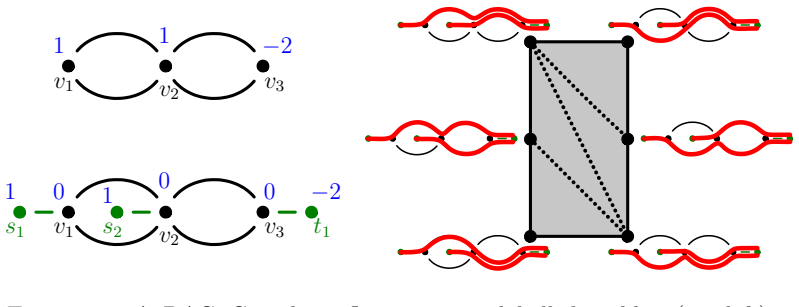
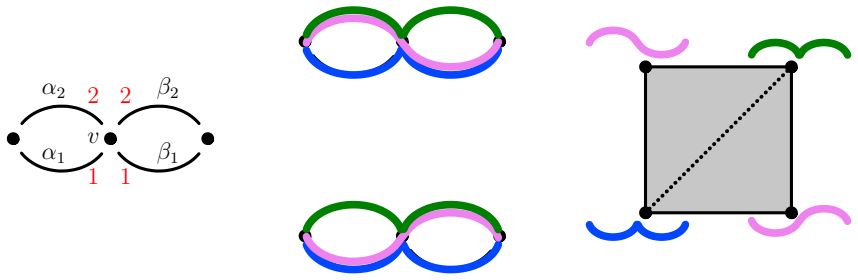
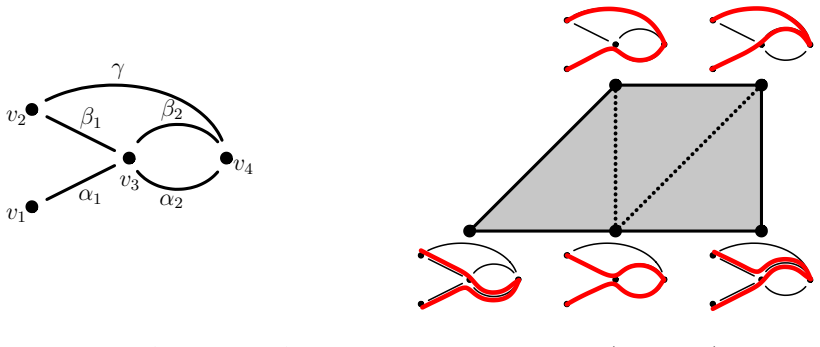
We introduce the first theory of (unimodular) framing triangulations for arbitrary integer flow polytopes. We will observe some pathologies in general examples which are impossible in the unit case, and propose in response a class of "well-ordered" framing triangulations which we expect to inherit key properties from the unit case while still containing all settings of framing triangulations existing in the literature.
What carries the argument
well-ordered framing triangulations, a proposed subclass of unimodular triangulations on integer flow polytopes that avoids pathologies while preserving combinatorial properties
If this is right
- Framing triangulations apply to every integer flow polytope, not merely unit ones.
- All previously described framing triangulation settings from the literature become special cases.
- Connections to Catalan and Cambrian combinatorics are expected to carry over to the general setting.
- Volume and h*-polynomial formulas from the unit case are expected to extend.
- Pathologies that arise without the well-ordered condition are excluded.
Where Pith is reading between the lines
- The two recent partial extensions to non-unit polytopes mentioned in the paper can now be checked directly for membership in the well-ordered class.
- Pathologies observed in unrestricted triangulations supply concrete test cases for determining exactly which combinatorial properties require the well-ordering condition.
- The construction may supply a uniform method for producing triangulations on flow polytopes that arise from networks with arbitrary integer capacities.
Load-bearing premise
Well-ordered framing triangulations can be defined in a way that inherits key properties from the unit case while containing all existing settings of framing triangulations in the literature.
What would settle it
A specific well-ordered framing triangulation on a non-unit integer flow polytope that either violates a volume or h*-polynomial formula inherited from the unit case or fails to include one of the two non-unit settings already described in the literature.
Figures
read the original abstract
Framing triangulations of unit flow polytopes have received a great deal of recent study with rich connections to various generalizations of Catalan and Cambrian combinatorics as well as volume and h*-polynomial formulas. This story has largely been restricted to unit flow polytopes, with only two recent works giving descriptions of framing triangulations on classes of non-unit flow polytopes. In this article we introduce the first theory of (unimodular) framing triangulations for arbitrary integer flow polytopes. We will observe some pathologies in general examples which are impossible in the unit case, and propose in response a class of "well-ordered" framing triangulations which we expect to inherit key properties from the unit case while still containing all settings of framing triangulations existing in the literature.
Editorial analysis
A structured set of objections, weighed in public.
Referee Report
Summary. The manuscript introduces the first theory of unimodular framing triangulations for arbitrary integer flow polytopes. It observes pathologies absent from the unit case and proposes a subclass of 'well-ordered' framing triangulations expected to inherit key properties from the unit case while containing all existing literature settings of framing triangulations.
Significance. If the well-ordered subclass can be shown to inherit the relevant combinatorial properties (e.g., connections to generalized Catalan/Cambrian structures and explicit volume/h*-polynomial formulas) and to subsume the two cited non-unit constructions, the work would provide a uniform framework extending recent results beyond unit flow polytopes. The proposal itself is a natural response to the observed pathologies, but its significance hinges on explicit verification of inheritance and containment rather than expectation alone.
major comments (1)
- [Abstract, final paragraph] Abstract (final paragraph): the central claim that well-ordered framing triangulations 'inherit key properties from the unit case while still containing all settings of framing triangulations existing in the literature' is presented as an expectation without an explicit definition, inclusion proof, or check against the two cited non-unit works. This assumption is load-bearing for the assertion that the new theory extends the unit-case results to arbitrary integer flow polytopes.
minor comments (1)
- [Abstract] The abstract states that pathologies will be observed in general examples but provides no concrete example or reference to a specific section or figure illustrating them; adding one brief, self-contained example would clarify the motivation for the well-ordered restriction.
Simulated Author's Rebuttal
We thank the referee for their careful reading and for identifying the load-bearing nature of the claims regarding well-ordered framing triangulations. We address the single major comment below and will revise the manuscript accordingly.
read point-by-point responses
-
Referee: [Abstract, final paragraph] Abstract (final paragraph): the central claim that well-ordered framing triangulations 'inherit key properties from the unit case while still containing all settings of framing triangulations existing in the literature' is presented as an expectation without an explicit definition, inclusion proof, or check against the two cited non-unit works. This assumption is load-bearing for the assertion that the new theory extends the unit-case results to arbitrary integer flow polytopes.
Authors: We agree that the abstract presents the inheritance of properties and the containment of literature examples as an expectation without supplying the supporting details. The manuscript defines well-ordered framing triangulations explicitly in Definition 3.5. Section 4 verifies containment by showing that both cited non-unit constructions satisfy the well-ordered condition. The inheritance of combinatorial properties (e.g., generalized Catalan/Cambrian connections and explicit volume/h*-formulas) remains conjectural, supported by the elimination of unit-case pathologies and explicit computations in low-dimensional cases, but without a general proof. We will revise the abstract to state clearly that the well-ordered class is defined to contain the known examples (with the proof referenced to the body) and that inheritance is conjectured; we will also add an explicit conjecture statement in the introduction and a short subsection summarizing the checks against the two non-unit works. This addresses the concern directly. revision: yes
Circularity Check
No circularity: new definition proposed without reduction to inputs
full rationale
The paper proposes a new definitional class of well-ordered framing triangulations for arbitrary integer flow polytopes, stating an expectation that this class will inherit unit-case properties and subsume prior literature examples. No equations, parameter fits, uniqueness theorems, or self-citations are invoked in a load-bearing way that would make any claimed result equivalent to its inputs by construction. The work is self-contained as an extension via definition rather than a derivation chain that loops back.
Axiom & Free-Parameter Ledger
Forward citations
Cited by 1 Pith paper
-
Locally anti-blocking $\mathbf{g}$-polytopes for flow polytopes
Combinatorial characterization of locally anti-blocking g-polytopes arising from amply framed DAG flow polytopes, including minimal faces, pulling triangulations, and coherence diagrams.
Reference graph
Works this paper leans on
-
[1]
Morales, GaYee Park, and Hugh Thomas
[ABD+26] Antoine Abram, Jose Bastidas, Benjamin Dequˆ ene, Alejandro H. Morales, GaYee Park, and Hugh Thomas. Flows on graphs with cycles, locally gentle algebras, and the mutoperhedron. 2026.arXiv:2601.08150. [BBB+24] Matias von Bell, Benjamin Braun, Kaitlin Bruegge, Derek Hanely, Zachery Peterson, Khrystyna Serhiyenko, and Martha Yip. Triangulations of ...
-
[2]
doi:10.4153/s0008414x19000397. [Ber25] Jonah Berggren. Flows on gentle algebras. 2025.arXiv:2507.12688. [Ber26] Jonah Berggren. Framing triangulations and framing posets of planar dags with nontrivial netflow vectors. 2026.arXiv:2507.12684. [BGDMCY23] Matias von Bell, Rafael S. Gonz´ alez D’Le´ on, Francisco A. Mayorga Cetina, and Martha Yip. A unifying f...
-
[3]
URL:http://projecteuclid.org/euclid.em/ 1046889594. [DHY25] Rafael S. Gonz´ alez D’Le´ on, Christopher R. H. Hanusa, and Martha Yip. Permutation flows I: Triangulations of flow polytopes (research announcement). 2025.arXiv:2512.04078. [DKK12] Vladimir I. Danilov, Alexander V. Karzanov, and Gleb A. Koshevoy. Coherent fans in the space of flows in framed gr...
-
[4]
Toric matrix Schubert varieties and their polytopes
[EM16] Laura Escobar and Karola M´ esz´ aros. Toric matrix Schubert varieties and their polytopes. Proc. Amer. Math. Soc., 144(12):5081–5096, 2016.doi:10.1090/proc/13152. [FRAdW71] Michael Florian, Maurice Rossin-Arthiat, and Dominique de Werra. A property of minimum concave cost flows in capacitated networks.INFOR—Canad. J. Operational Res. and Infor- ma...
-
[5]
Special issue on linear algebra methods in representation theory.doi:10.1016/S0024-3795(02)00406-8. [LMSD19] Ricky I. Liu, Karola M´ esz´ aros, and Avery St. Dizier. Gelfand-Tsetlin polytopes: a story of flow and order polytopes.SIAM J. Discrete Math., 33(4):2394–2415, 2019.doi:10.1137/ 19M1251242. 30 [MM15] Karola M´ esz´ aros and Alejandro H. Morales. F...
discussion (0)
Sign in with ORCID, Apple, or X to comment. Anyone can read and Pith papers without signing in.