On the Differential-Geometric Equivalence of Hellinger-Kantorovich and Cone-Wasserstein Spaces
Pith reviewed 2026-06-30 12:38 UTC · model grok-4.3
The pith
HK geometry on measures is locally isometric to Wasserstein geometry on their cone lifts along geodesics.
A machine-rendered reading of the paper's core claim, the machinery that carries it, and where it could break.
Core claim
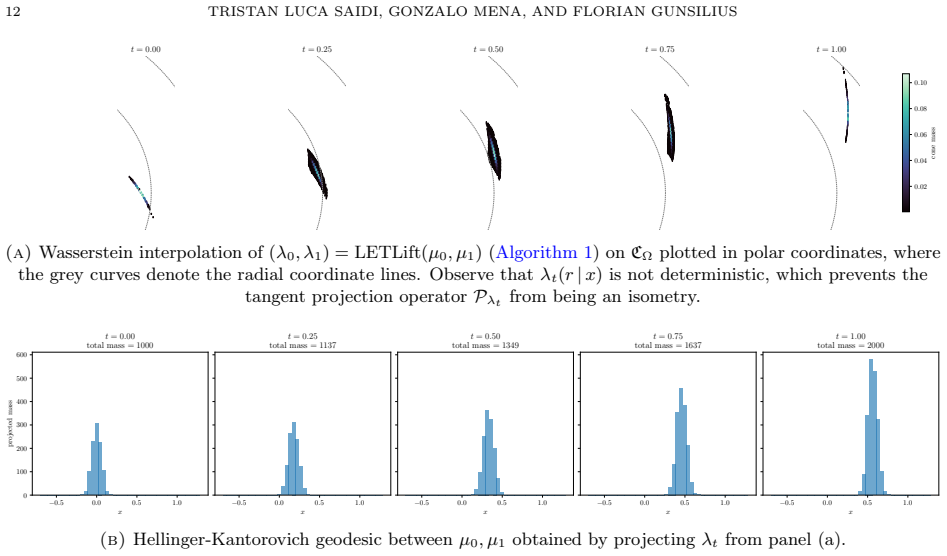
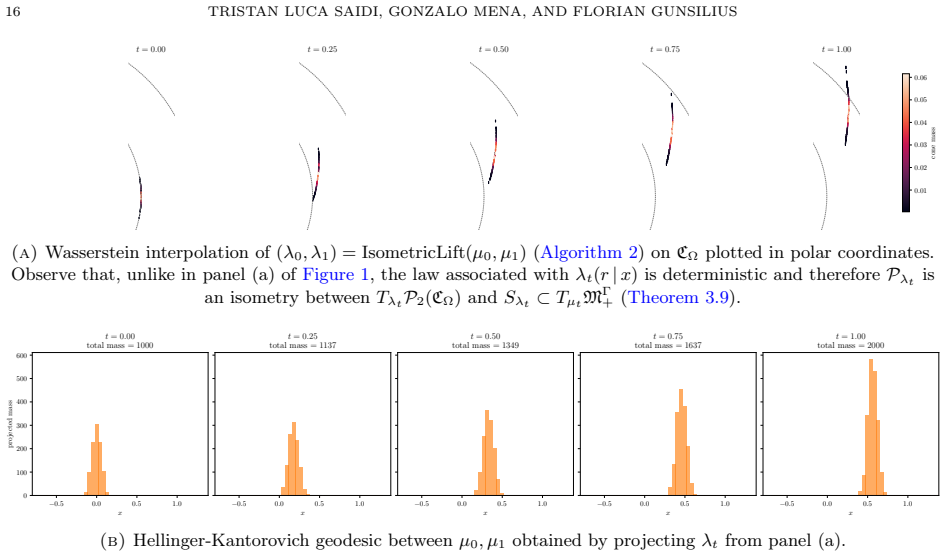
We show that the cone representation of the HK geometry via the Wasserstein metric preserves the local Riemannian geometry along a class of lifted geodesics. Specifically, we give a constructive procedure that produces a Wasserstein geodesic on the cone along which the HK Riemannian geometry is preserved pointwise, yielding an explicit isometry of tangent spaces between HK geodesics and their Wasserstein lifts. This connection makes many Wasserstein-geometric tools available for HK computations.
What carries the argument
The constructive lifting procedure that maps HK geodesics to cone Wasserstein geodesics while preserving pointwise Riemannian geometry and giving tangent space isometries.
If this is right
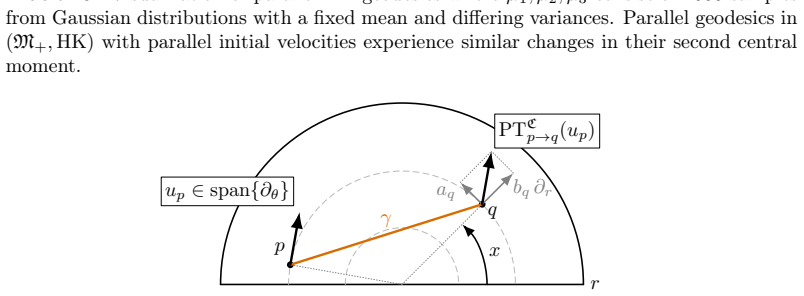
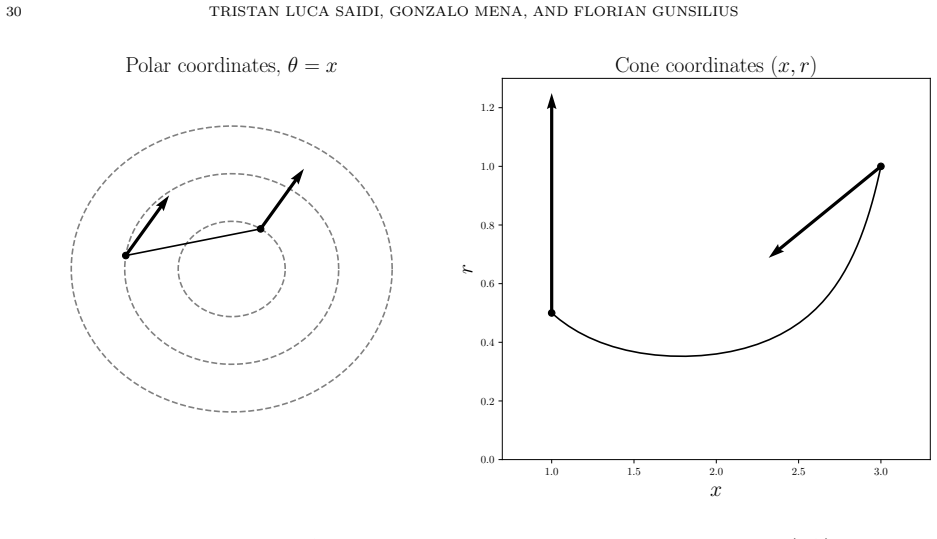
- Wasserstein parallel transport tools can approximate parallel transport on HK space by lifting to the cone.
- Closed-form covariant derivative and parallel transport expressions hold on Euclidean metric cones from warped product theory.
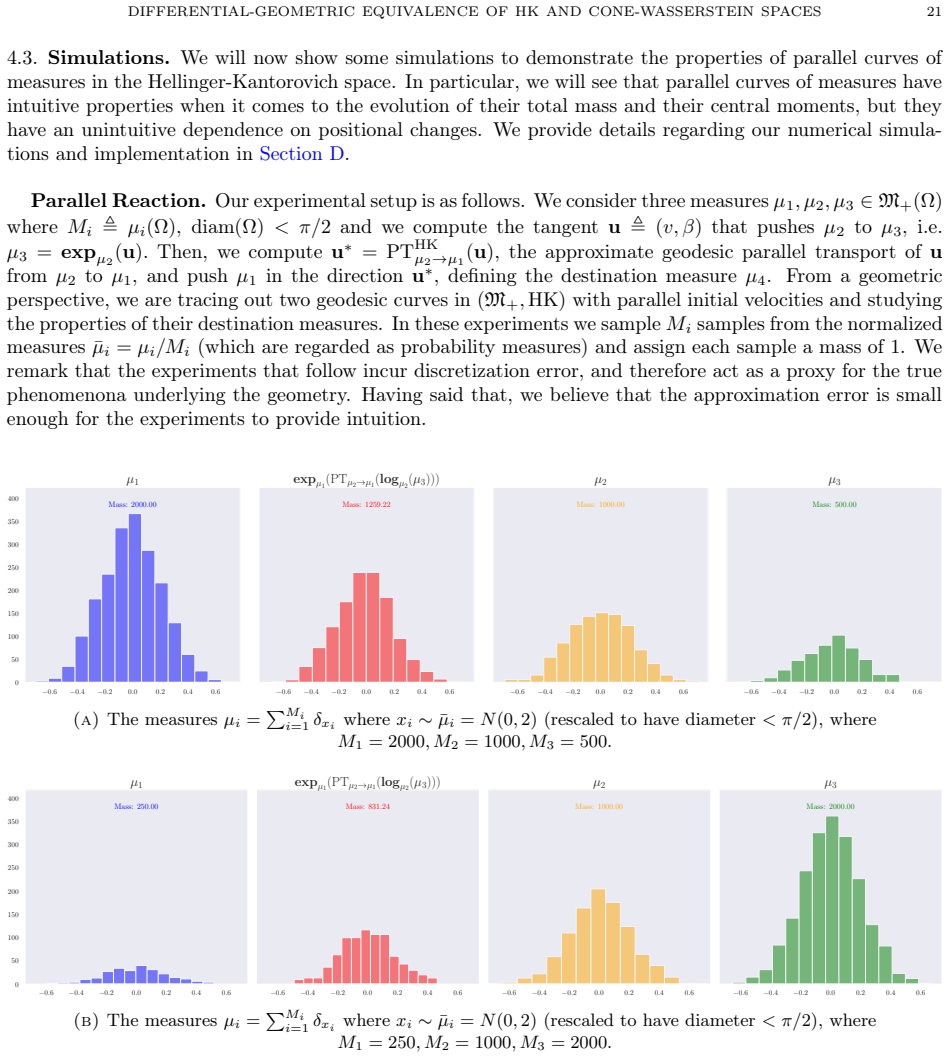
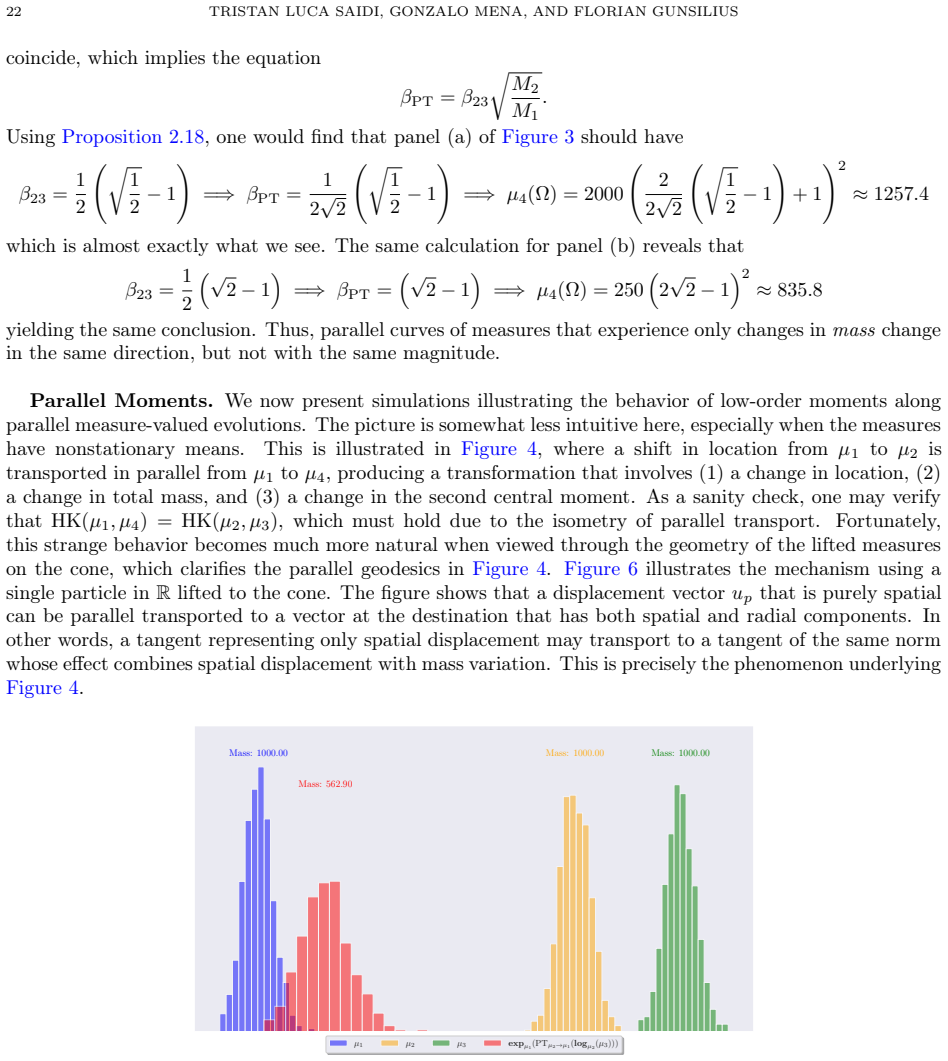
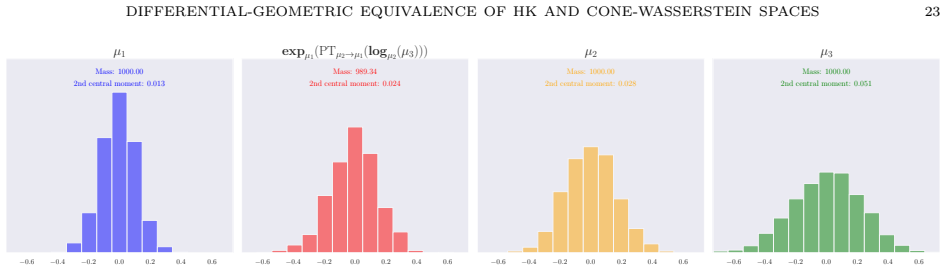
- Simulations reveal that HK geometry couples spatial and mass variations via the cone structure.
Where Pith is reading between the lines
- The approach may reduce the computational cost of HK-based methods in applications with varying total mass.
- Similar lifting techniques could connect other optimal transport variants to standard Wasserstein geometry.
- The observed coupling might influence how mass variation is modeled in data analysis tasks.
Load-bearing premise
The pointwise preservation and isometry apply only to a specific class of lifted geodesics.
What would settle it
Observing a mismatch in the inner products of tangent vectors under the HK metric versus the cone Wasserstein metric at a point on one of the lifted geodesics would disprove the claim.
Figures
read the original abstract
The Hellinger-Kantorovich (HK) space provides a natural geometry for nonnegative measures with varying total mass, but its differential-geometric structure is less well understood than that of the closely related Wasserstein space of probability measures. In this paper, we take a step toward resolving this issue. We show that the cone representation of the HK geometry via the Wasserstein metric preserves the local Riemannian geometry along a class of lifted geodesics. Specifically, we give a constructive procedure that produces a Wasserstein geodesic on the cone along which the HK Riemannian geometry is preserved pointwise, yielding an explicit isometry of tangent spaces between HK geodesics and their Wasserstein lifts. This connection makes many Wasserstein-geometric tools available for HK computations. Concretely, we use it to approximate parallel transport on HK space by lifting to the cone and applying recently developed Wasserstein parallel transport tools, circumventing the high-dimensional PDE arising from the HK covariant derivative. We also derive closed-form expressions for the covariant derivative and parallel transport on Euclidean metric cones, using the theory of warped-product manifolds. Finally, we present simulations illustrating the behavior of parallel geodesics in HK space, which reveal that the HK geometry couples spatial and mass variation through the geometry of the cone -- a feature with nontrivial implications for applied use of the framework.
Editorial analysis
A structured set of objections, weighed in public.
Referee Report
Summary. The manuscript claims that the cone representation of the Hellinger-Kantorovich (HK) geometry via the Wasserstein metric preserves the local Riemannian geometry along a class of lifted geodesics. It provides a constructive procedure to produce a Wasserstein geodesic on the cone that preserves the HK Riemannian geometry pointwise, resulting in an explicit isometry of tangent spaces. This is used to approximate parallel transport on HK space by lifting to the cone, and closed-form expressions for the covariant derivative and parallel transport on Euclidean metric cones are derived using warped-product manifold theory. Simulations of parallel geodesics in HK space are presented.
Significance. If the construction holds, the work provides a valuable bridge between HK and Wasserstein geometries, making Wasserstein tools available for HK computations and circumventing high-dimensional PDEs for parallel transport. The explicit isometry along the specified class, the closed-form expressions on cones via warped products, and the simulation insights into the coupling of spatial and mass variation are concrete strengths. The restriction to a specific class of lifted geodesics is stated clearly and avoids overclaiming global equivalence.
minor comments (3)
- [Abstract] The abstract and introduction refer to 'a class of lifted geodesics' without an immediate characterization of the class (e.g., via a defining property or equation); adding a one-sentence description would improve readability.
- [Section on warped-product manifolds] In the section deriving the closed-form covariant derivative on Euclidean metric cones, the warped-product formulas are invoked but the precise identification of the warping function with the cone metric is not written out; an explicit equation would aid verification.
- [Simulations section] The simulation figures show qualitative behavior of parallel geodesics but do not report quantitative error measures (e.g., deviation from the HK covariant derivative along the lift); including such metrics would strengthen the validation of the approximation procedure.
Simulated Author's Rebuttal
We thank the referee for the positive evaluation of the manuscript, the accurate summary of its contributions, and the recommendation of minor revision. The report correctly identifies the scope of the isometry result (restricted to the specified class of lifted geodesics) and the utility of the cone lift for approximating parallel transport.
Circularity Check
No significant circularity
full rationale
The paper presents a constructive geometric procedure that lifts HK geodesics to Wasserstein geodesics on the cone while preserving the Riemannian structure pointwise, yielding an explicit tangent-space isometry. This construction is derived from the cone representation and the theory of warped-product manifolds rather than from any fitted parameter, self-referential definition, or load-bearing self-citation. The abstract explicitly restricts the result to a specific class of lifted geodesics and does not claim global equivalence, so the central claim does not reduce to its own inputs by construction. No steps matching the enumerated circularity patterns are present.
Axiom & Free-Parameter Ledger
axioms (2)
- domain assumption The HK space admits a Riemannian structure compatible with the cone embedding via the Wasserstein metric.
- standard math Warped-product manifold theory applies directly to Euclidean metric cones.
Reference graph
Works this paper leans on
-
[1]
Ambrosio and N
L. Ambrosio and N. Gigli. A user’s guide to optimal transport. InModelling and Optimisation of Flows on Networks: Cetraro, Italy 2009, Editors: Benedetto Piccoli, Michel Rascle, pages 1–155. Springer,
2009
- [2]
-
[3]
J. Clancy and F. Suarez. Wasserstein-fisher-rao splines.arXiv preprint arXiv:2203.15728,
-
[4]
URLhttps://arxiv.org/abs/1505.07746. V. Laschos and A. Mielke. Geometric properties of cones with applications on the hellinger–kantorovich space, and a new distance on the space of probability measures.Journal of Functional Analysis, 276(11): 3529–3576,
work page internal anchor Pith review Pith/arXiv arXiv
-
[5]
URLhttps://arxiv.org/abs/2605.08705. T. L. Saidi, G. Mena, L. Wasserman, and F. Gunsilius. Wasserstein parallel transport for predicting the dynamics of statistical systems,
work page internal anchor Pith review Pith/arXiv arXiv
-
[6]
URLhttps://arxiv.org/abs/2603.23736. G. Schiebinger, J. Shu, M. Tabaka, B. Cleary, V. Subramanian, A. Solomon, J. Gould, S. Liu, S. Lin, P. Berube, et al. Optimal-transport analysis of single-cell gene expression identifies developmental trajec- tories in reprogramming.Cell, 176(4):928–943,
- [7]
discussion (0)
Sign in with ORCID, Apple, or X to comment. Anyone can read and Pith papers without signing in.