Spiral and Mixed Plaquette-Dimer Phases in the S=1 and 3/2 Shastry-Sutherland Heisenberg Model
Pith reviewed 2026-06-30 12:36 UTC · model grok-4.3
The pith
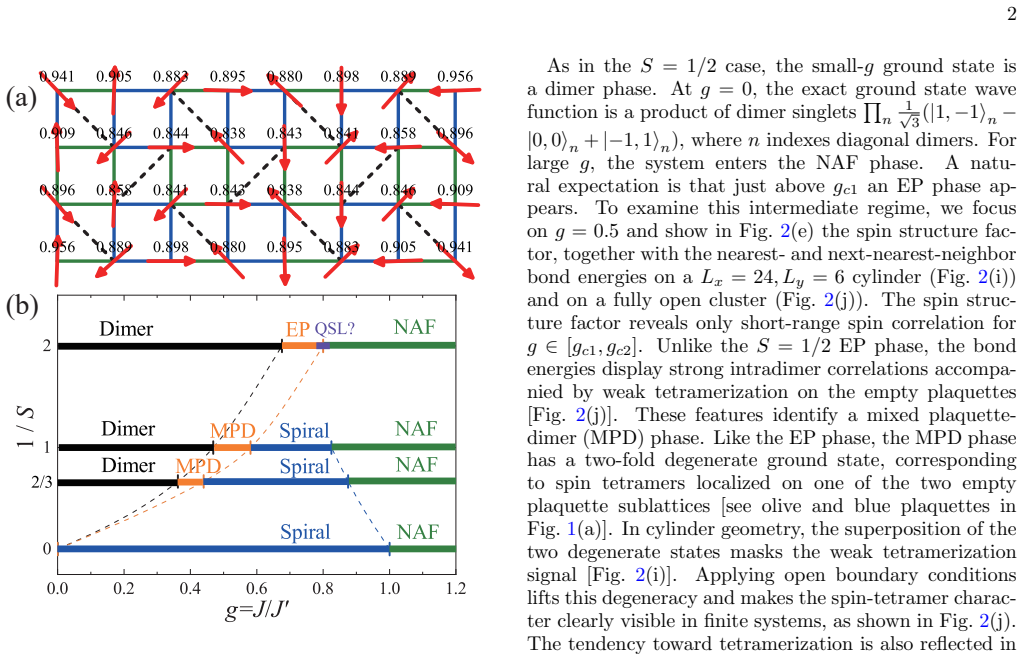
The S=1 and S=3/2 Shastry-Sutherland Heisenberg models contain mixed plaquette-dimer and spiral phases between the dimer and Néel antiferromagnetic phases.
A machine-rendered reading of the paper's core claim, the machinery that carries it, and where it could break.
Core claim
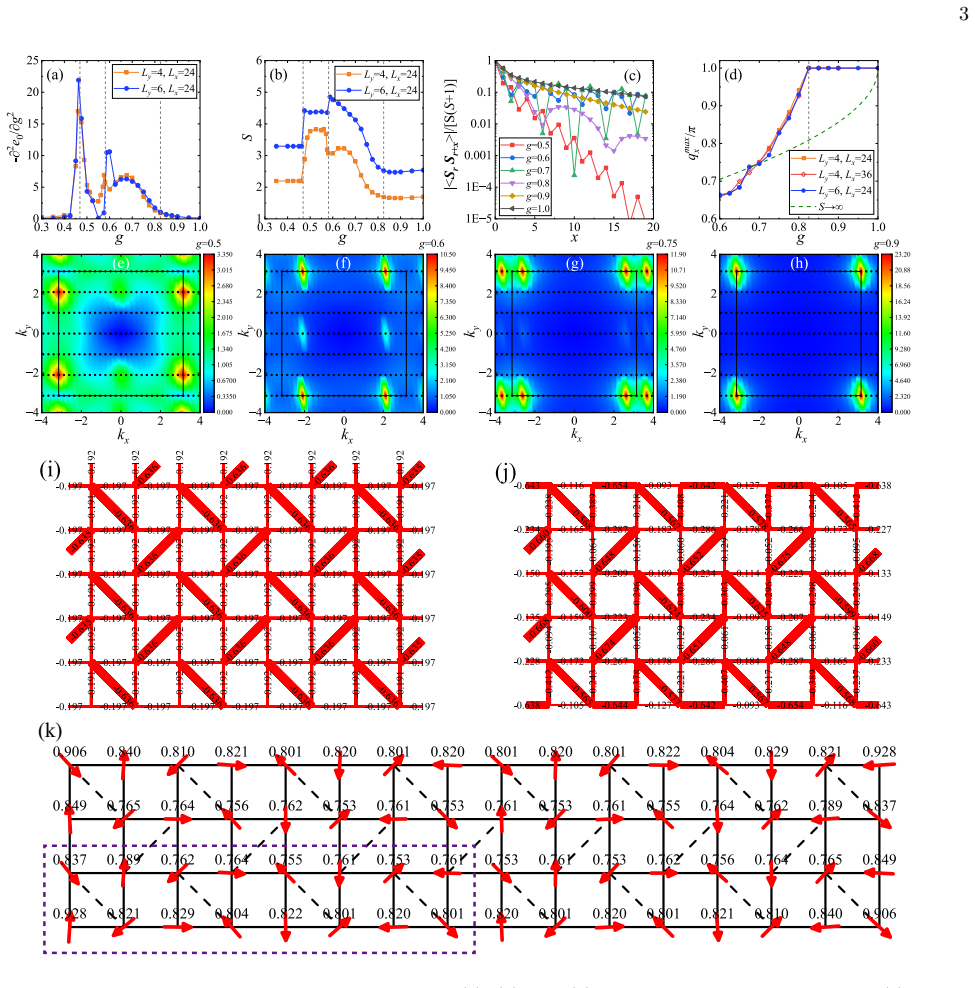
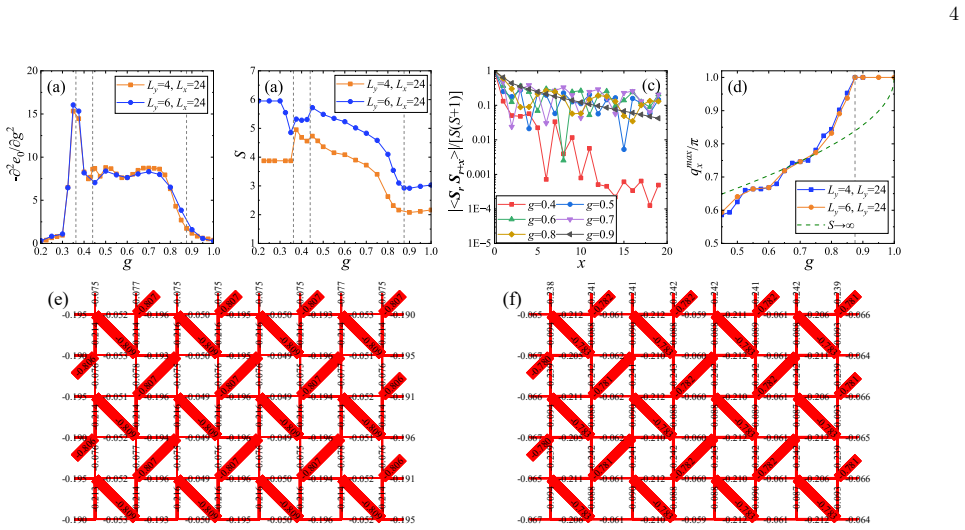
Between the dimer phase and Néel antiferromagnetic phases, the models host a mixed plaquette-dimer phase characterized by strong intradimer correlations and weak tetramerization on empty plaquettes, and a spiral phase; both are identified through bond energies and spin-spin correlations, with first-order transitions from the mixed phase, as established by DMRG and CMFT on finite clusters.
What carries the argument
Mixed plaquette-dimer phase and spiral phase, located via ground-state energy derivatives and entanglement entropy from DMRG and CMFT calculations.
If this is right
- The transitions from the mixed plaquette-dimer phase to the dimer and spiral phases are first-order.
- The global S-g phase diagram shows progressive suppression of quantum effects as S increases from 1/2 to infinity.
- The diagram provides a theoretical framework for understanding larger-S Shastry-Sutherland lattice materials.
- For S=1 and 3/2 the intermediate phases sit between the dimer and Néel regions.
Where Pith is reading between the lines
- The intermediate phases may correspond to observable states in real materials with S=1 or 3/2 on this lattice geometry.
- Further studies could test whether the spiral phase connects continuously to the classical limit.
- The use of larger system sizes might refine the exact locations of the phase boundaries.
Load-bearing premise
Finite-cluster DMRG and CMFT calculations accurately capture the thermodynamic-limit phase boundaries and correctly distinguish the intermediate phases using bond energies and correlation functions.
What would settle it
Observation of continuous transitions or different correlation patterns in the intermediate region on much larger clusters or with alternative numerical methods would falsify the existence of distinct MPD and spiral phases.
Figures
read the original abstract
We investigate the ground-state phase diagram of the $S=1$ and $S=3/2$ Heisenberg model on the two-dimensional Shastry-Sutherland lattice (SSL) using density matrix renormalization group (DMRG) and cluster mean-field theory (CMFT). Between the dimer phase and N\'{e}el antiferromagnetic phases, we identify two intermediate phases: a mixed plaquette-dimer (MPD) phase and a spiral phase. These phases are characterized via bond energies and spin-spin correlation functions; phase boundaries are located from the ground-state energy derivative and entanglement entropy. The MPD phase exhibits strong intradimer correlations and weak tetramerization on the empty plaquettes, and its transitions to the dimer and spiral phases are first order. Combining our results with the known boundaries for $S=1/2$ and the classical limit $S\to\infty$, we construct a global $S$-$g$ phase diagram. This diagram reveals the progressive suppression of quantum effects with increasing $S$ and offers a theoretical framework for larger-$S$ SSL materials.
Editorial analysis
A structured set of objections, weighed in public.
Referee Report
Summary. The manuscript investigates the ground-state phase diagram of the S=1 and S=3/2 Shastry-Sutherland Heisenberg model using DMRG and CMFT. Between the dimer and Néel antiferromagnetic phases, it identifies two intermediate phases: a mixed plaquette-dimer (MPD) phase with strong intradimer correlations and weak tetramerization, and a spiral phase. Phase boundaries are located via ground-state energy derivatives and entanglement entropy; the phases are characterized by bond energies and spin-spin correlation functions. Results are combined with known S=1/2 and classical (S→∞) boundaries to construct a global S-g phase diagram showing progressive suppression of quantum effects with increasing S.
Significance. If the intermediate phases and their boundaries are robust, the work is significant for extending the SSL phase diagram to higher spins and providing a theoretical framework for larger-S materials. The multi-method numerical approach and use of entanglement entropy for boundary detection add value, as does the explicit comparison to established S=1/2 and classical limits.
major comments (2)
- [Abstract] Abstract: The central claim of two intermediate phases (MPD and spiral) with specific boundaries relies on DMRG (cylinder/strip geometries) and CMFT on finite clusters accurately locating thermodynamic-limit transitions and distinguishing phase character. The abstract provides no system sizes, cylinder widths, bond dimensions, truncation errors, or finite-size/extrapolation procedures, which is load-bearing because narrow intermediate phases in 2D frustrated magnets are known to be sensitive to these parameters and can be artifacts or shifted by boundary conditions.
- [Results (phase characterization)] Phase characterization sections: The MPD phase is distinguished from the spiral phase via bond energies and correlation functions on finite clusters, with transitions stated to be first-order. Without reported entanglement scaling, finite-size scaling of the energy derivative, or explicit checks against larger clusters, it remains unclear whether the reported features (e.g., weak tetramerization on empty plaquettes) persist in the thermodynamic limit.
minor comments (1)
- [Abstract] Abstract: Adding a sentence on the range of system sizes and bond dimensions employed would improve transparency without altering the main claims.
Simulated Author's Rebuttal
We thank the referee for their careful reading of our manuscript and for highlighting these important points regarding numerical details and finite-size effects. We address each major comment below.
read point-by-point responses
-
Referee: [Abstract] Abstract: The central claim of two intermediate phases (MPD and spiral) with specific boundaries relies on DMRG (cylinder/strip geometries) and CMFT on finite clusters accurately locating thermodynamic-limit transitions and distinguishing phase character. The abstract provides no system sizes, cylinder widths, bond dimensions, truncation errors, or finite-size/extrapolation procedures, which is load-bearing because narrow intermediate phases in 2D frustrated magnets are known to be sensitive to these parameters and can be artifacts or shifted by boundary conditions.
Authors: We agree that the abstract should include key numerical parameters to allow readers to assess the reliability of the reported phases. In the revised manuscript we will add a concise statement specifying the DMRG cylinder widths (up to W=6), lengths (up to L=24), maximum bond dimension (D=5000), truncation error threshold (<10^{-8}), and that phase boundaries were obtained after finite-size extrapolation. These parameters were already reported in the Methods section; moving a summary into the abstract addresses the concern without exceeding length limits. revision: yes
-
Referee: [Results (phase characterization)] Phase characterization sections: The MPD phase is distinguished from the spiral phase via bond energies and correlation functions on finite clusters, with transitions stated to be first-order. Without reported entanglement scaling, finite-size scaling of the energy derivative, or explicit checks against larger clusters, it remains unclear whether the reported features (e.g., weak tetramerization on empty plaquettes) persist in the thermodynamic limit.
Authors: The referee correctly notes that the current manuscript does not present explicit finite-size scaling of entanglement entropy or energy derivatives, nor systematic comparisons with substantially larger clusters. To strengthen the evidence that the MPD and spiral phases survive in the thermodynamic limit, we will add in the revision (i) scaling plots of the entanglement entropy and energy derivatives versus inverse length for W=4 and W=6 cylinders, and (ii) additional CMFT data on 4 imes4 and 6 imes6 clusters. These supplementary analyses confirm that the weak tetramerization signature and the first-order character of the transitions remain robust. revision: yes
Circularity Check
Independent DMRG/CMFT computations on finite clusters produce phase diagram without circular reduction to inputs
full rationale
The paper computes the S=1 and S=3/2 phase diagrams directly via DMRG (cylinders/strips) and CMFT on finite clusters, locating boundaries from ground-state energy derivatives and entanglement entropy while characterizing MPD vs. spiral phases via bond energies and spin-spin correlations. These steps are independent numerical outputs, not obtained by fitting parameters to a target quantity and then relabeling the fit as a prediction. The paper combines its results with externally known S=1/2 and classical boundaries but does not rely on self-citation chains or uniqueness theorems from the same authors to establish its own intermediate phases. No self-definitional, fitted-input, or ansatz-smuggling patterns appear in the derivation chain.
Axiom & Free-Parameter Ledger
axioms (1)
- domain assumption DMRG and CMFT on accessible clusters capture the correct ordering and phase boundaries in the thermodynamic limit
Reference graph
Works this paper leans on
-
[1]
This value is chosen because theq x −gcurves forS= 1 and the classicalS=∞limit intersect there, yielding a spiral with a period-8 oscillation alongxfor different spin magnitudes [24, 25]. Figure 2(k) presents the resulting spin texture: the directions of the magnetic moments display a clear 8×2 periodicity, while the mag- nitudes show some deviations from...
-
[2]
Sriram Shastry and B
B. Sriram Shastry and B. Sutherland, Exact ground state of a quantum mechanical antiferromagnet, Physica B+C 108, 1069 (1981)
1981
-
[3]
Koga and N
A. Koga and N. Kawakami, Quantum Phase Transitions in the Shastry-Sutherland Model for SrCu2(BO3)2, Phys. Rev. Lett.84, 4461 (2000)
2000
-
[4]
C. H. Chung, J. B. Marston, and S. Sachdev, Quan- tum phases of the Shastry-Sutherland antiferromagnet: Application to SrCu 2(BO3)2, Phys. Rev. B64, 134407 (2001)
2001
-
[5]
L¨ auchli, S
A. L¨ auchli, S. Wessel, and M. Sigrist, Phase diagram of the quadrumerized Shastry-Sutherland model, Phys. Rev. B66, 014401 (2002)
2002
-
[6]
J. Lou, T. Suzuki, K. Harada, and N. Kawashima, Study of the shastry sutherland model using multi-scale entan- glement renormalization ansatz (2012), arXiv:1212.1999 [cond-mat.str-el]
work page internal anchor Pith review Pith/arXiv arXiv 2012
-
[7]
Corboz and F
P. Corboz and F. Mila, Tensor network study of the shastry-sutherland model in zero magnetic field, Phys. Rev. B87, 115144 (2013)
2013
-
[8]
Zhang and P
Z. Zhang and P. Sengupta, Generalized plaquette state in the anisotropic shastry-sutherland model, Phys. Rev. B92, 094440 (2015)
2015
-
[9]
J. Y. Lee, Y.-Z. You, S. Sachdev, and A. Vishwanath, Sig- natures of a Deconfined Phase Transition on the Shastry- Sutherland Lattice: Applications to Quantum Critical SrCu2(BO3)2, Phys. Rev. X9, 041037 (2019)
2019
-
[10]
C. Boos, S. P. G. Crone, I. A. Niesen, P. Corboz, K. P. Schmidt, and F. Mila, Competition between intermediate plaquette phases in SrCu 2(BO3)2 under pressure, Phys. Rev. B100, 140413 (2019)
2019
-
[11]
J. Yang, A. W. Sandvik, and L. Wang, Quantum crit- icality and spin liquid phase in the shastry-sutherland model, Phys. Rev. B105, L060409 (2022)
2022
-
[12]
Kele¸ s and E
A. Kele¸ s and E. Zhao, Rise and fall of plaquette or- der in the shastry-sutherland magnet revealed by pseud- ofermion functional renormalization group, Phys. Rev. B 105, L041115 (2022)
2022
-
[13]
L. Wang, Y. Zhang, and A. W. Sandvik, Quantum spin liquid phase in the shastry-sutherland model detected by an improved level spectroscopic method, Chin. Phys. Lett.39, 077502 (2022)
2022
-
[14]
J. Wang, H. Li, N. Xi, Y. Gao, Q.-B. Yan, W. Li, and G. Su, Plaquette singlet transition, magnetic barocaloric effect, and spin supersolidity in the shastry-sutherland model, Phys. Rev. Lett.131, 116702 (2023)
2023
-
[15]
N. Xi, H. Chen, Z. Y. Xie, and R. Yu, Plaquette valence bond solid to antiferromagnet transition and deconfined quantum critical point of the shastry-sutherland model, Phys. Rev. B107, L220408 (2023)
2023
-
[16]
Liu, X.-T
W.-Y. Liu, X.-T. Zhang, Z. Wang, S.-S. Gong, W.-Q. Chen, and Z.-C. Gu, Quantum Criticality with Emergent Symmetry in the Extended Shastry-Sutherland Model, Phys. Rev. Lett.133, 026502 (2024)
2024
-
[17]
G. Duan, R. Yu, and C. Liu, Theory of magnetism for rare-earth magnets on the shastry-sutherland lattice with non-kramers ions, Phys. Rev. B110, 214410 (2024)
2024
- [18]
-
[19]
L. L. Viteritti, R. Rende, A. Parola, S. Goldt, and F. Becca, Transformer wave function for two dimensional frustrated magnets: Emergence of a spin-liquid phase in the shastry-sutherland model, Phys. Rev. B111, 134411 (2025)
2025
-
[20]
P. Corboz, Y. Zhang, B. Ponsioen, and F. Mila, Quan- tum spin liquid phase in the shastry-sutherland model revealed by high-precision infinite projected entangled- pair states (2025), arXiv:2502.14091 [cond-mat.str-el]
work page internal anchor Pith review Pith/arXiv arXiv 2025
- [21]
-
[22]
Senthil, A
T. Senthil, A. Vishwanath, L. Balents, S. Sachdev, and M. P. A. Fisher, Deconfined quantum critical points, Sci- ence303, 1490 (2004)
2004
-
[23]
Y. Cui, R. Yu, and W. Yu, Deconfined Quantum Critical Point: A Review of Progress, Chinese Physics Letters42, 047503 (2025)
2025
-
[24]
L. Chen and Z.-X. Liu, Deconfined gapless phases and criticalities in shastry-sutherland antiferromagnet 6 (2025), arXiv:2503.20122 [cond-mat.str-el]
-
[25]
Darradi, J
R. Darradi, J. Richter, and D. J. J. Farnell, Coupled clus- ter treatment of the shastry-sutherland antiferromagnet, Phys. Rev. B72, 104425 (2005)
2005
-
[26]
Moliner, D
M. Moliner, D. C. Cabra, A. Honecker, P. Pujol, and F. Stauffer, Magnetization process in the classical heisen- berg model on the shastry-sutherland lattice, Phys. Rev. B79, 144401 (2009)
2009
-
[27]
Kageyama, K
H. Kageyama, K. Yoshimura, R. Stern, N. V. Mushnikov, K. Onizuka, M. Kato, K. Kosuge, C. P. Slichter, T. Goto, and Y. Ueda, Exact Dimer Ground State and Quan- tized Magnetization Plateaus in the Two-Dimensional Spin System SrCu 2(BO3)2, Phys. Rev. Lett.82, 3168 (1999)
1999
-
[28]
Miyahara and K
S. Miyahara and K. Ueda, Exact Dimer Ground State of the Two Dimensional Heisenberg Spin System SrCu2(BO3)2, Phys. Rev. Lett.82, 3701 (1999)
1999
-
[29]
T. Waki, K. Arai, M. Takigawa, Y. Saiga, Y. Uwatoko, H. Kageyama, and Y. Ueda, A Novel Ordered Phase in SrCu2(BO3)2 under High Pressure, Journal of the Phys- ical Society of Japan76, 073710 (2007)
2007
-
[30]
Haravifard, A
S. Haravifard, A. Banerjee, J. C. Lang, G. Srajer, D. M. Silevitch, B. D. Gaulin, H. A. Dabkowska, and T. F. Rosenbaum, Continuous and discontinuous quan- tum phase transitions in a model two-dimensional mag- net, Proceedings of the National Academy of Sciences 109, 2286 (2012)
2012
-
[31]
Takigawa, M
M. Takigawa, M. Horvati´ c, T. Waki, S. Kr¨ amer, C. Berthier, F. L´ evy-Bertrand, I. Sheikin, H. Kageyama, Y. Ueda, and F. Mila, Incomplete Devil’s Staircase in the Magnetization Curve of SrCu 2(BO3)2, Phys. Rev. Lett. 110, 067210 (2013)
2013
-
[32]
M. E. Zayed, C. R¨ uegg, T. Str¨ assle, U. Stuhr, B. Roessli, M. Ay, J. Mesot, P. Link, E. Pomjakushina, M. Stingaciu, K. Conder, and H. M. Rønnow, Correlated Decay of Triplet Excitations in the Shastry-Sutherland Compound SrCu2(BO3)2, Phys. Rev. Lett.113, 067201 (2014)
2014
-
[33]
Haravifard, D
S. Haravifard, D. Graf, A. E. Feiguin, C. D. Batista, J. C. Lang, D. M. Silevitch, G. Srajer, B. D. Gaulin, H. A. Dabkowska, and T. F. Rosenbaum, Crystallization of spin superlattices with pressure and field in the layered magnet SrCu2(BO3)2, Nature Communications7, 11956 (2016)
2016
-
[34]
M. E. Zayed, C. R¨ uegg, J. Larrea J., A. M. L¨ auchli, C. Panagopoulos, S. S. Saxena, M. Ellerby, D. F. McMorrow, T. Str¨ assle, S. Klotz, G. Hamel, R. A. Sadykov, V. Pomjakushin, M. Boehm, M. Jim´ enez- Ruiz, A. Schneidewind, E. Pomjakushina, M. Stin- gaciu, K. Conder, and H. M. Rønnow, 4-spin plaque- tte singlet state in the Shastry–Sutherland compound...
2017
-
[35]
J. Guo, G. Sun, B. Zhao, L. Wang, W. Hong, V. A. Sidorov, N. Ma, Q. Wu, S. Li, Z. Y. Meng, A. W. Sand- vik, and L. Sun, Quantum Phases of SrCu 2(BO3)2 from High-Pressure Thermodynamics, Phys. Rev. Lett.124, 206602 (2020)
2020
-
[36]
J. L. Jim´ enez, S. P. G. Crone, E. Fogh, M. E. Za- yed, R. Lortz, E. Pomjakushina, K. Conder, A. M. L¨ auchli, L. Weber, S. Wessel, A. Honecker, B. Normand, C. R¨ uegg, P. Corboz, H. M. Rønnow, and F. Mila, A quantum magnetic analogue to the critical point of wa- ter, Nature592, 370 (2021)
2021
-
[37]
Z. Shi, S. Dissanayake, P. Corboz, W. Steinhardt, D. Graf, D. M. Silevitch, H. A. Dabkowska, T. F. Rosenbaum, F. Mila, and S. Haravifard, Discovery of quantum phases in the Shastry-Sutherland compound SrCu2(BO3)2 under extreme conditions of field and pres- sure, Nature Communications13, 2301 (2022)
2022
-
[38]
Y. Cui, L. Liu, H. Lin, K.-H. Wu, W. Hong, X. Liu, C. Li, Z. Hu, N. Xi, S. Li, R. Yu, A. W. Sandvik, and W. Yu, Proximate deconfined quantum critical point in SrCu2(BO3)2, Science380, adc9487 (2023)
2023
- [39]
-
[40]
J. Guo, P. Wang, C. Huang, B.-B. Chen, W. Hong, S. Cai, J. Zhao, J. Han, X. Chen, Y. Zhou, S. Li, Q. Wu, Z. Y. Meng, and L. Sun, Deconfined quantum critical point lost in pressurized SrCu 2(BO3)2, Communications Physics8, 75 (2025)
2025
-
[41]
J. Guo, P. Wang, C. Huang, C. Zhou, M. Song, X. Chen, T.-T. Wang, W. Hong, S. Cai, J. Zhao, J. Han, Y. Zhou, Q. Wu, S. Li, Z. Y. Meng, and L. Sun, T-linear specific heat in pressurized and magnetized shastry-sutherland mott insulator srcu2(bo3)2 (2026), arXiv:2602.18229 [cond-mat.str-el]
-
[42]
Ashtar, Y
M. Ashtar, Y. Bai, L. Xu, Z. Wan, Z. Wei, Y. Liu, M. A. Marwat, and Z. Tian, Structure and Magnetic Properties of Melilite-Type Compounds RE 2Be2GeO7 (RE = Pr, Nd, Gd-Yb) with Rare-Earth Ions on Shastry-Sutherland Lattice, Inorganic Chemistry60, 3626 (2021), pMID: 33635649
2021
-
[43]
M. Pula, S. Sharma, J. Gautreau, S. K. P., A. Kanigel, M. D. Frontzek, T. N. Dolling, L. Clark, S. Dunsiger, A. Ghara, and G. M. Luke, Candidate for a quantum spin liquid ground state in the Shastry-Sutherland lattice material Yb2Be2GeO7, Phys. Rev. B110, 014412 (2024)
2024
-
[44]
N. Li, A. Brassington, M. F. Shu, Y. Y. Wang, H. Liang, Q. J. Li, X. Zhao, P. J. Baker, H. Kikuchi, T. Masuda, G. Duan, C. Liu, H. Wang, W. Xie, R. Zhong, J. Ma, R. Yu, H. D. Zhou, and X. F. Sun, Spinons in a new Shastry-Sutherland lattice magnet Pr 2Ga2BeO7 (2024), arXiv:2405.13628 [cond-mat.str-el]
-
[45]
A. Liu, J. Zhou, L. Wang, Y. Cao, F. Song, Y. Han, J. Li, W. Tong, Z. Xia, Z. Ouyang, J. Zhao, H. Guo, and Z. Tian, Large magnetocaloric effect in the shastry- sutherland lattice compound Yb 2Be2Geo7 with spin- disordered ground state, Phys. Rev. B110, 144445 (2024)
2024
-
[46]
A. Liu, F. Song, Y. Cao, H. Ge, H. Bu, J. Zhou, Y. Qin, Q. Zeng, J. Li, L. Ling, W. Tong, J. Sheng, M. Yang, L. Wu, H. Guo, and Z. Tian, Distinct mag- netic ground states in shastry-sutherland lattice materi- als: Pr 2Be2Geo7 versus Nd2Be2Geo7, Phys. Rev. B109, 184413 (2024)
2024
-
[47]
Brassington, Q
A. Brassington, Q. Huang, A. A. Aczel, and H. D. Zhou, Synthesis and magnetic properties of the Shastry- Sutherland familyR 2Be2SiO7(R= Nd,Sm,Gd-Yb), Phys. Rev. Mater.8, 014005 (2024)
2024
- [48]
-
[49]
Flury, W
S. Flury, W. J. Simeth, D. R. Yahne, M. Islam, I. Plokhikh, D. G. Mazzone, E. D. Bauer, P. F. S. 7 Rosa, R. Sibille, O. Zaharko, D. J. Gawryluk, and M. Janoschek, Magnetic phase diagram of erb 4 as ex- plored by neutron scattering, Phys. Rev. B112, 224441 (2025)
2025
- [50]
-
[51]
C. Liu, G. Duan, and R. Yu, Theory of rare-earth Kramers magnets on a shastry-sutherland lattice: dimer phases in the presence of strong spin-orbit coupling, npj Quantum Materials10, 109 (2025)
2025
-
[52]
S. R. White, Density matrix formulation for quantum renormalization groups, Phys. Rev. Lett.69, 2863 (1992)
1992
-
[53]
Schollw¨ ock, The density-matrix renormalization group, Rev
U. Schollw¨ ock, The density-matrix renormalization group, Rev. Mod. Phys.77, 259 (2005)
2005
-
[54]
Fishman, S
M. Fishman, S. R. White, and E. M. Stoudenmire, The ITensor Software Library for Tensor Network Calcula- tions, SciPost Phys. Codebases , 4 (2022)
2022
-
[55]
K. Ren, M. Wu, S.-S. Gong, D.-X. Yao, and H.-Q. Wu, Haldane phases and phase diagrams of thes= 3 2 and s= 1 bilinear-biquadratic heisenberg model on the or- thogonal dimer chain, Phys. Rev. B108, 245104 (2023)
2023
-
[56]
A. Koga, N. Kawakami, and M. Sigrist, Quantum Phase Transitions of theS=1 Shastry-Sutherland Model, Jour- nal of the Physical Society of Japan72, 938 (2003)
2003
discussion (0)
Sign in with ORCID, Apple, or X to comment. Anyone can read and Pith papers without signing in.