Shared hidden-factor information framework for multiple behavioral tasks
Pith reviewed 2026-06-30 12:48 UTC · model grok-4.3
The pith
A joint modeling framework called SHIFT uses shared subject-specific latent factors to link performance across multiple behavioral tasks.
A machine-rendered reading of the paper's core claim, the machinery that carries it, and where it could break.
Core claim
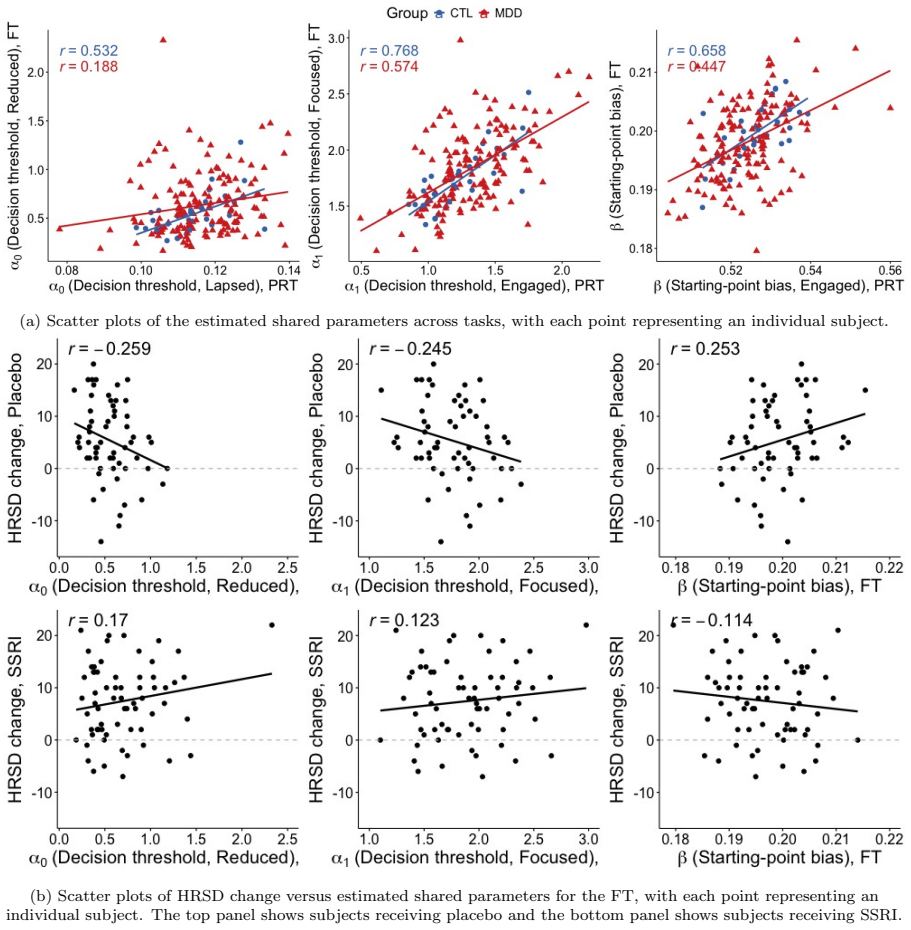
SHIFT models multiple behavioral tasks by introducing subject-specific latent factors that capture cross-task dependencies in decision-making, response times, and strategy use. These factors are estimated using an expectation-maximization algorithm with variational approximation that avoids high-dimensional integration while preserving temporal and between-task structure. The approach yields more accurate parameter estimates than single-task models in simulations and, when applied to Probabilistic Reward and Flanker tasks in MDD, identifies lower engagement and focus in patients along with shared parameters that show treatment-modulation patterns.
What carries the argument
Subject-specific latent factors that capture cross-task dependencies while accommodating individual heterogeneity.
If this is right
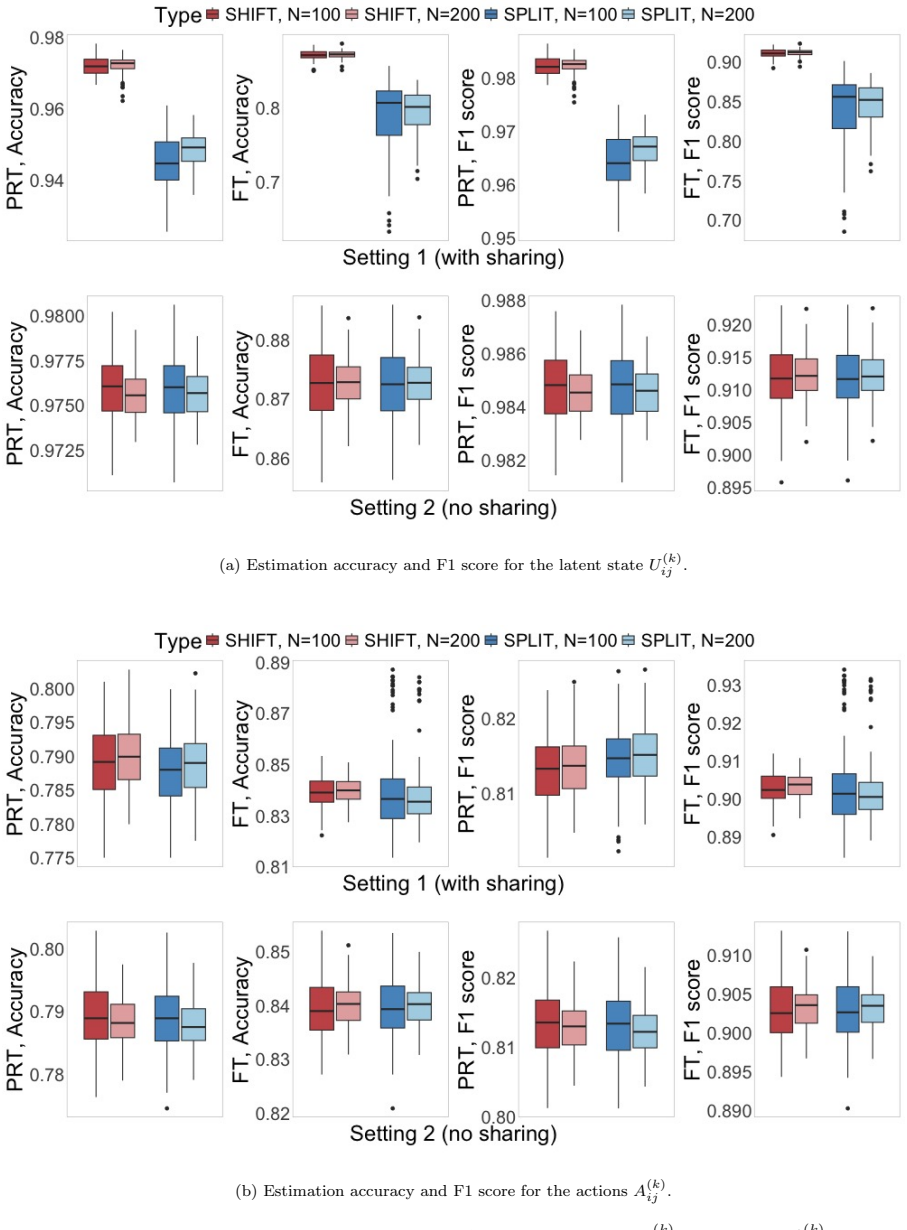
- Estimation accuracy and efficiency improve substantially relative to single-task analyses.
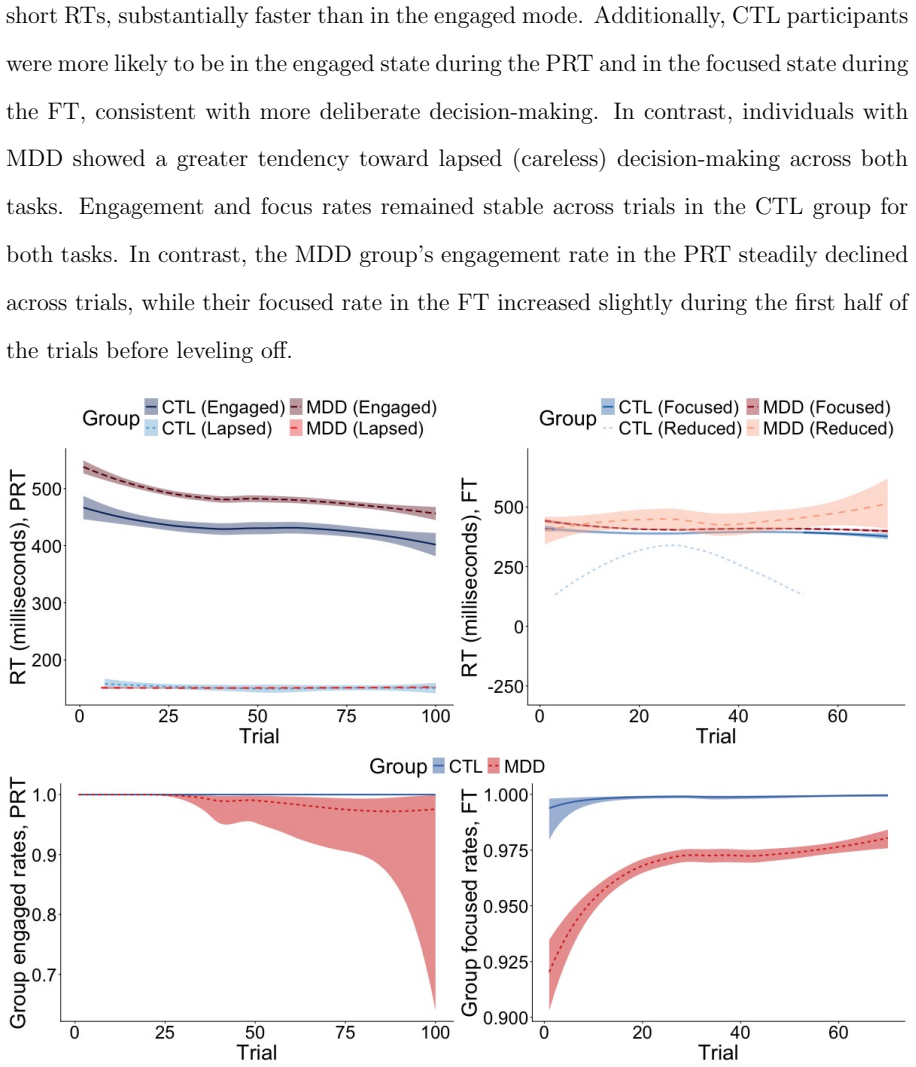
- MDD participants show lower engagement in the Probabilistic Reward Task and reduced focus in the Flanker Task compared to controls.
- Longer response times occur when individuals are engaged and focused.
- Shared parameters recovered by the model exhibit suggestive treatment-modulation patterns as exploratory behavioral markers.
Where Pith is reading between the lines
- Applying the framework to additional tasks could reveal broader cognitive networks in psychiatric conditions.
- The latent factors might serve as targets for interventions aimed at improving cross-task consistency.
- Validation in larger longitudinal studies would test whether the shared parameters reliably predict individual treatment outcomes.
Load-bearing premise
Subject-specific latent factors exist that meaningfully capture the cross-task dependencies in behavioral data.
What would settle it
A simulation study where tasks are generated with no shared latent structure would show that SHIFT either fails to improve estimates or introduces bias compared to separate models.
Figures
read the original abstract
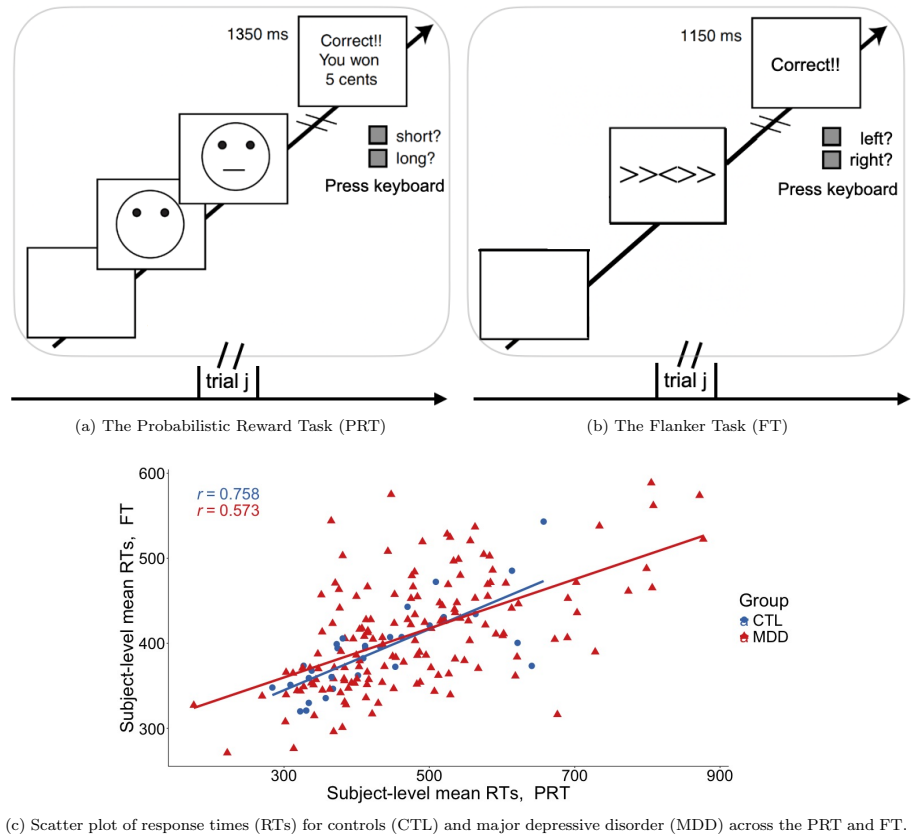
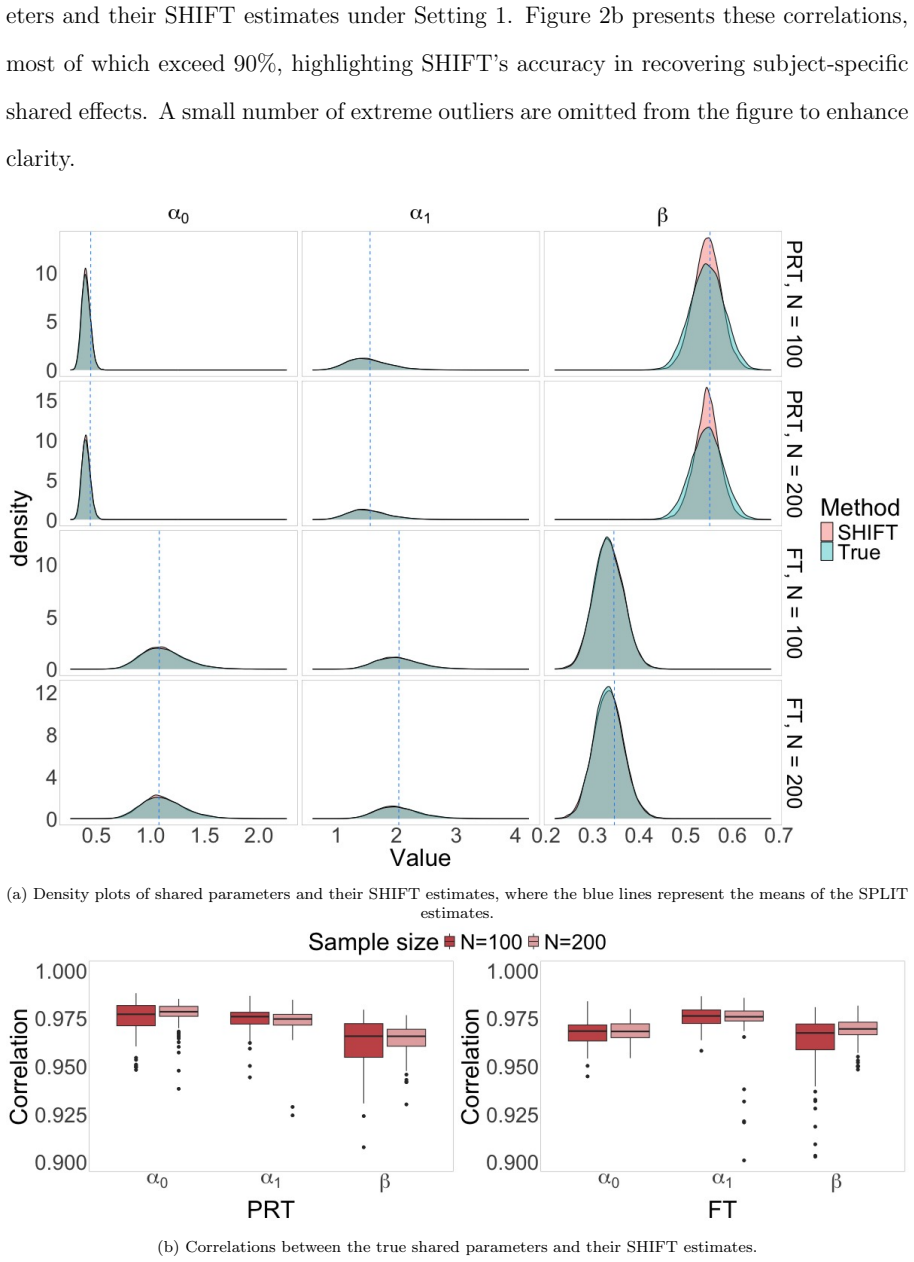
Understanding cognitive processes in major depressive disorder (MDD) often relies on behavioral tasks, which are typically analyzed separately, overlooking potential correlations and shared latent structure. To address this limitation, we propose the Shared Hidden-factor Information Framework for Multiple Behavioral Tasks (SHIFT), a joint modeling approach that leverages shared information across tasks, allowing each task to benefit from information learned by the others. SHIFT introduces subject-specific latent factors that capture cross-task dependencies while accommodating individual heterogeneity in decision-making, response times (RTs), and strategy switching. To address computational challenges without requiring high-dimensional integration, we develop an expectation-maximization with variational approximation algorithm that preserves both temporal structure and between-task dependencies. Through extensive simulation studies, we demonstrate that SHIFT substantially improves estimation accuracy and efficiency relative to single-task analyses. We then apply SHIFT to a study of MDD to jointly model the Probabilistic Reward Task (PRT) and the Flanker Task (FT). Results indicate that MDD participants show lower engagement in the PRT and reduced focus in the FT compared with healthy controls. Moreover, when individuals are engaged and focused, they exhibit longer RTs. Although observed RTs do not predict treatment response, the shared parameters recovered by SHIFT showed suggestive treatment-modulation patterns, indicating their potential as exploratory behavioral markers for therapeutic outcomes.
Editorial analysis
A structured set of objections, weighed in public.
Referee Report
Summary. The paper proposes SHIFT, a joint modeling framework for multiple behavioral tasks that introduces subject-specific latent factors to capture cross-task dependencies in decision-making, response times, and strategy switching. It develops an EM algorithm with variational approximation to avoid high-dimensional integration while claiming to preserve temporal and between-task structure, demonstrates improved estimation accuracy and efficiency via simulations relative to single-task analyses, and applies the method to MDD data from the Probabilistic Reward Task and Flanker Task, recovering shared parameters with suggestive treatment-modulation patterns.
Significance. If the variational approximation is reliable, the framework could meaningfully improve efficiency in analyzing correlated behavioral data by sharing information across tasks, with potential to identify exploratory markers for treatment response in MDD that separate analyses miss. The simulation-based evidence of gains and the real-data application to two standard tasks provide a concrete test case for the approach.
major comments (2)
- [Methods (EM-variational algorithm description)] The central claim that the variational approximation 'preserves both temporal structure and between-task dependencies' (as stated in the abstract and used to justify the EM algorithm) is load-bearing for all reported improvements, yet the manuscript provides no verification such as ELBO gap monitoring, comparison against exact marginals on toy models, or posterior predictive checks for RT distributions. Without these, the simulation gains and MDD shared-parameter patterns could be artifacts of under-approximation rather than genuine information sharing.
- [§4 (simulation studies)] §4 (simulation studies): the claim of 'substantially improves estimation accuracy and efficiency' is presented without reported quantitative metrics, error bars, replication counts, or exclusion criteria, which is required to evaluate whether the cross-task gains are robust or sensitive to the variational family choice.
minor comments (1)
- [Abstract] The abstract states that 'observed RTs do not predict treatment response' and that shared parameters show 'suggestive' patterns, but does not specify the statistical thresholds, multiple-comparison corrections, or effect-size criteria used for these conclusions.
Simulated Author's Rebuttal
We thank the referee for their detailed and constructive comments. We address each of the major comments below and have revised the manuscript to incorporate additional diagnostics and reporting as suggested.
read point-by-point responses
-
Referee: The central claim that the variational approximation 'preserves both temporal structure and between-task dependencies' (as stated in the abstract and used to justify the EM algorithm) is load-bearing for all reported improvements, yet the manuscript provides no verification such as ELBO gap monitoring, comparison against exact marginals on toy models, or posterior predictive checks for RT distributions. Without these, the simulation gains and MDD shared-parameter patterns could be artifacts of under-approximation rather than genuine information sharing.
Authors: The variational approximation in SHIFT is constructed to preserve the temporal and between-task dependencies by using a variational family that factors according to the model's conditional independence structure. We recognize that the original manuscript lacked explicit validation of this approximation. To address this, we have added ELBO monitoring, toy model comparisons with exact inference, and posterior predictive checks for RTs in the revised Methods and Results sections. These show that the approximation is reliable and the reported gains are due to information sharing rather than approximation artifacts. revision: yes
-
Referee: §4 (simulation studies): the claim of 'substantially improves estimation accuracy and efficiency' is presented without reported quantitative metrics, error bars, replication counts, or exclusion criteria, which is required to evaluate whether the cross-task gains are robust or sensitive to the variational family choice.
Authors: We agree that the simulation results would benefit from more comprehensive quantitative reporting. The revised manuscript now includes specific metrics (e.g., relative MSE reductions with 95% confidence intervals), error bars on all simulation figures, the number of replications (50 per setting), and exclusion criteria for non-convergent runs. We have also added a sensitivity analysis to different variational families, confirming the robustness of the improvements. revision: yes
Circularity Check
No significant circularity; new modeling framework validated empirically
full rationale
The paper introduces SHIFT as a new joint modeling approach with subject-specific latent factors and a variational EM algorithm. No equations, fitted parameters, or predictions are shown that reduce to inputs by construction. Simulations and real-data application provide independent empirical support rather than algebraic self-equivalence. No load-bearing self-citations or ansatzes imported from prior author work are evident in the derivation chain. The method is presented as a modeling choice whose performance is assessed externally.
Axiom & Free-Parameter Ledger
Reference graph
Works this paper leans on
-
[1]
Altman, R. M. (2007). Mixed hidden markov models: An extension of the hidden markov model to the longitudinal data setting.Journal of the American Statistical Association, 102(477):201–210. Ashwood, Z. C., Roy, N. A., Stone, I. R., Laboratory, I. B., Urai, A. E., Churchland, A. K., Pouget, A., and Pillow, J. W. (2022). Mice alternate between discrete stra...
work page internal anchor Pith review Pith/arXiv arXiv 2007
-
[2]
S., Quinn, K., Sanislow, C., and Wang, P
Insel, T., Cuthbert, B., Garvey, M., Heinssen, R., Pine, D. S., Quinn, K., Sanislow, C., and Wang, P. (2010). Research domain criteria (RDoC): Toward a new classifi- cation framework for research on mental disorders.American Journal of Psychiatry, 167(7):748–751. Institute for Health Metrics and Evaluation (2021). Global Burden of Disease (GBD) [online da...
2010
-
[3]
J¨ ackel, P. (2005). A note on multivariate Gauss-Hermite quadrature. Manuscript. Jordan, M. I., Ghahramani, Z., Jaakkola, T. S., and Saul, L. K. (1999). An introduction to variational methods for graphical models.Machine Learning, 37(2):183–233. Li, J.-J., Shi, C., Li, L., and Collins, A. G. (2024). Dynamic noise estimation: A gener- alized method for mo...
2005
-
[4]
An Overview of Multi-Task Learning in Deep Neural Networks
Article 102842. Lorist, M. M. and Jolij, J. (2012). Trial history effects in stroop task performance are independent of top-down control.PLoS One, 7(6):Article e39802. Neal, R. M. and Hinton, G. E. (1998). A view of the EM algorithm that justifies incre- mental, sparse, and other variants. InLearning in Graphical Models, pages 355–368. Springer. Passos, I...
work page internal anchor Pith review Pith/arXiv arXiv 2012
discussion (0)
Sign in with ORCID, Apple, or X to comment. Anyone can read and Pith papers without signing in.