Differentially Private Obfuscation of Power Grid Dynamics
Pith reviewed 2026-06-30 12:42 UTC · model grok-4.3
The pith
An algorithm adds noise to power grid parameters for differential privacy then optimizes the result to match original dynamics.
A machine-rendered reading of the paper's core claim, the machinery that carries it, and where it could break.
Core claim
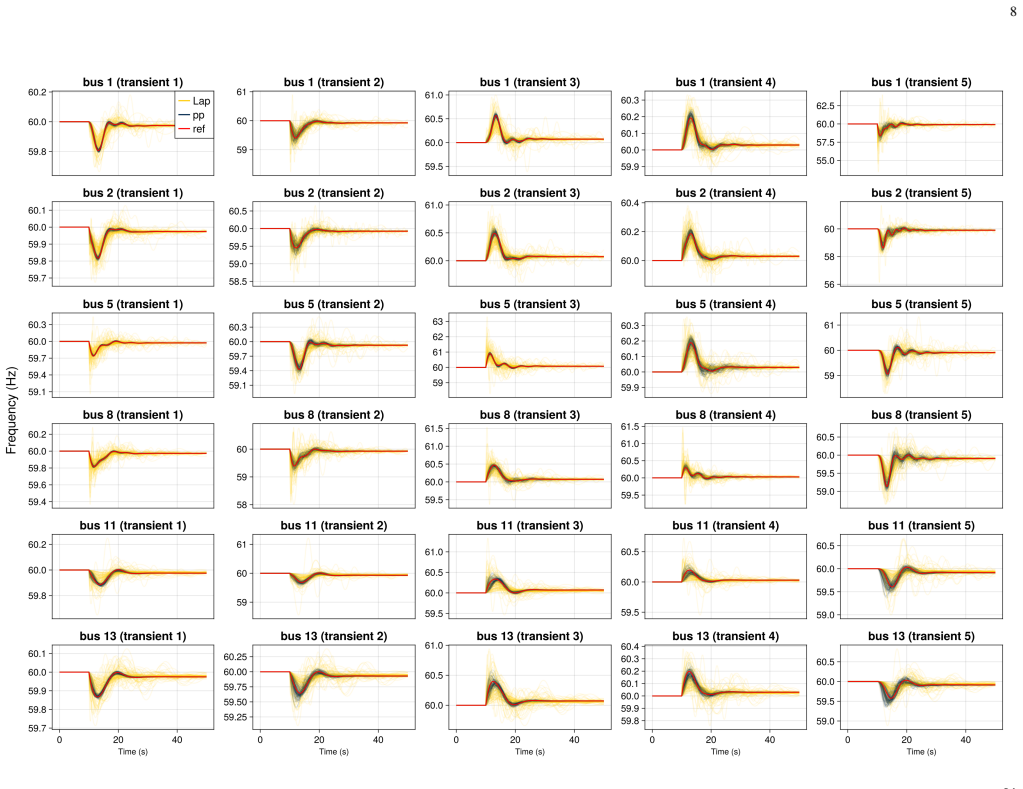
The algorithm applies privacy-preserving noise to obfuscate the original grid parameters, but then optimizes the perturbed parameters to ensure that the resulting model dynamics are statistically consistent with those observed in the source grid. Application to the frequency dynamics of the IEEE 30-bus system reveals the inherent privacy-fidelity trade-off: stricter privacy requirements degrade modeling fidelity, yet optimization significantly improves the quality of the synthesized models.
What carries the argument
Two-step procedure of differential-privacy noise injection on grid parameters followed by post-perturbation optimization that restores dynamic fidelity.
If this is right
- Stricter privacy budgets produce lower-fidelity synthetic models of grid frequency dynamics.
- The optimization step recovers measurable accuracy even under tighter privacy constraints.
- Synthetic models can be shared for disturbance analysis without exposing the source grid's transmission, generation, or load parameters.
- The approach is demonstrated on the IEEE 30-bus test system and directly quantifies the privacy-fidelity curve.
Where Pith is reading between the lines
- The same noise-plus-optimization pattern could be tested on voltage or transient stability models beyond frequency dynamics.
- If the privacy guarantee survives the optimization, the method might apply to other networked infrastructure such as gas or water systems.
- Utilities could use the reported trade-off curve to decide acceptable privacy levels when releasing planning models.
- Scaling experiments on larger test systems would show whether the optimization remains tractable as the number of parameters grows.
Load-bearing premise
Post-noise optimization of parameters can restore statistical consistency with the source grid dynamics while still satisfying the differential privacy guarantee on the original parameters.
What would settle it
A direct check whether the optimization step causes the released model to violate the original differential privacy bound on the parameters, or whether the optimized dynamics deviate from the source grid's observed frequency response by more than the statistical tolerance reported in the IEEE 30-bus experiments.
Figures




read the original abstract
Dynamic models of power systems are critical for analyzing grid response to disturbances and blackouts, but the release of real-world dynamic models is hindered by privacy and cybersecurity concerns, as such models carry sensitive information about transmission, generation, and load parameters. We develop an algorithm for synthesizing dynamic grid models from real-world power grids balancing two objectives: the privacy of the source grid, quantitatively measured using the notion of differential privacy, and the fidelity of the synthesized model. The algorithm applies privacy-preserving noise to obfuscate the original grid parameters, but then optimizes the perturbed parameters to ensure that the resulting model dynamics are statistically consistent with those observed in the source grid. Application to the frequency dynamics of the IEEE 30-bus system reveals the inherent privacy-fidelity trade-off: stricter privacy requirements degrade modeling fidelity, yet optimization significantly improves the quality of the synthesized models.
Editorial analysis
A structured set of objections, weighed in public.
Referee Report
Summary. The paper proposes a two-stage algorithm for synthesizing differentially private dynamic models of power grids. Calibrated noise is first added to the original parameters (e.g., inertia, damping, and line reactances) to satisfy (ε,δ)-differential privacy; the noisy parameters are then optimized so that the simulated frequency dynamics match empirical statistics (e.g., variance or autocorrelation) observed from the source grid. The method is applied to the frequency dynamics of the IEEE 30-bus system, where results illustrate the expected privacy-fidelity trade-off and claim that the post-optimization step materially improves model quality while the final model remains differentially private with respect to the original parameters.
Significance. If the differential privacy guarantee survives the optimization step, the work would provide a practical route to releasing dynamic models that retain statistical fidelity for stability and disturbance studies while protecting sensitive transmission and generation data. The explicit quantitative trade-off on a standard test case supplies a reproducible baseline that subsequent privacy-preserving modeling efforts could build upon.
major comments (2)
- [Algorithm description (likely §3 or §4)] Algorithm description (likely §3 or §4): the manuscript states that the final synthesized model satisfies the original (ε,δ) guarantee on the source-grid parameters, yet supplies no composition theorem, sensitivity analysis, or privacy-budget accounting for the second-stage optimization. Because the optimization loss compares simulated trajectories to measured frequency statistics drawn from the private source data, the post-processing step is not a priori DP-preserving; without an explicit argument that the optimization is either data-independent or itself (ε',δ')-DP with ε' folded into the total budget, the central privacy claim is unsupported.
- [Experimental section on IEEE 30-bus results] Experimental section on IEEE 30-bus results: the reported improvement in modeling fidelity after optimization is presented only qualitatively or via visual trajectory overlays; no quantitative metrics (e.g., mean-squared error on frequency nadir, Kullback-Leibler divergence on empirical distributions, or cross-validation error) are given, nor is any statistical test reported to establish that the improvement is significant relative to the added noise level. This weakens the claim that optimization "significantly improves" quality under privacy constraints.
minor comments (2)
- Notation for the privacy parameters (ε,δ) and the noise scale should be introduced once with explicit dependence on the sensitivity of the parameter vector; subsequent uses are occasionally ambiguous.
- The abstract and introduction both refer to "statistically consistent" dynamics without defining the precise statistic (e.g., power spectral density, moment matching) used in the loss; a short clarifying sentence would improve readability.
Simulated Author's Rebuttal
We thank the referee for the thorough review and for identifying these two key areas where the manuscript requires clarification and strengthening. We address each major comment below and will revise the manuscript to incorporate the suggested improvements.
read point-by-point responses
-
Referee: [Algorithm description (likely §3 or §4)] Algorithm description (likely §3 or §4): the manuscript states that the final synthesized model satisfies the original (ε,δ) guarantee on the source-grid parameters, yet supplies no composition theorem, sensitivity analysis, or privacy-budget accounting for the second-stage optimization. Because the optimization loss compares simulated trajectories to measured frequency statistics drawn from the private source data, the post-processing step is not a priori DP-preserving; without an explicit argument that the optimization is either data-independent or itself (ε',δ')-DP with ε' folded into the total budget, the central privacy claim is unsupported.
Authors: We agree that the current manuscript does not supply an explicit composition theorem or sensitivity analysis for the optimization stage. The referee correctly notes that the loss function depends on frequency statistics from the source data. In the revised version we will add a dedicated subsection (likely in §3) that provides (i) a formal statement of the overall mechanism as the composition of the initial noise addition and the subsequent optimization, (ii) a sensitivity bound for the optimization step with respect to the source statistics, and (iii) the resulting total (ε,δ) budget. If the statistics must themselves be treated as private, we will either make them differentially private or fold an additional privacy cost into the accounting; the revised text will make this choice explicit. revision: yes
-
Referee: [Experimental section on IEEE 30-bus results] Experimental section on IEEE 30-bus results: the reported improvement in modeling fidelity after optimization is presented only qualitatively or via visual trajectory overlays; no quantitative metrics (e.g., mean-squared error on frequency nadir, Kullback-Leibler divergence on empirical distributions, or cross-validation error) are given, nor is any statistical test reported to establish that the improvement is significant relative to the added noise level. This weakens the claim that optimization "significantly improves" quality under privacy constraints.
Authors: We accept that the experimental claims rest primarily on visual inspection. The revised manuscript will augment the IEEE 30-bus results with quantitative metrics: mean-squared error on frequency nadir and settling time, Kullback-Leibler divergence between the empirical distributions of key statistics before and after optimization, and cross-validation error across multiple disturbance scenarios. We will also report the results of paired statistical tests (e.g., Wilcoxon signed-rank) with p-values to establish that the observed improvements are significant relative to the noise level. revision: yes
Circularity Check
No circularity; explicit two-stage noise-then-optimize procedure is self-contained
full rationale
The paper describes an algorithm that first applies calibrated noise to grid parameters to achieve differential privacy, followed by a separate optimization step to match observed source-grid dynamics. This matches the reader's assessment of no circular reasoning. No self-definitional definitions, fitted inputs renamed as predictions, load-bearing self-citations, uniqueness theorems imported from authors, ansatz smuggling, or renaming of known results are present in the abstract or described procedure. The derivation chain does not reduce any claimed result to its inputs by construction; the optimization is an independent post-processing stage whose privacy accounting is asserted separately. The method is therefore self-contained against external benchmarks for the purpose of this circularity check.
Axiom & Free-Parameter Ledger
axioms (2)
- domain assumption Differential privacy supplies a quantifiable bound on information leakage about individual grid parameters
- domain assumption Frequency dynamics of a power grid can be summarized by statistical properties that are comparable across models
Reference graph
Works this paper leans on
-
[1]
Unified grid-forming/following inverter control,
S. Geng and I. A. Hiskens, “Unified grid-forming/following inverter control,”IEEE Open Access J. Power Energy, vol. 9, pp. 489–500, 2022
2022
-
[2]
Placement and implementation of grid-forming and grid-following virtual inertia and fast frequency response,
B. K. Poolla, D. Groß, and F. D ¨orfler, “Placement and implementation of grid-forming and grid-following virtual inertia and fast frequency response,”IEEE Trans. Power Syst., vol. 34, no. 4, pp. 3035–3046, 2019
2019
-
[3]
The unseen AI disruptions for power grids: LLM-induced transients,
Y . Li, M. Mughees, Y . Chen, and Y . R. Li, “The unseen ai disruptions for power grids: Llm-induced transients,”arXiv preprint arXiv:2409.11416, 2024
-
[4]
Connecting automatic generation control and economic dispatch from an optimization view,
N. Li, C. Zhao, and L. Chen, “Connecting automatic generation control and economic dispatch from an optimization view,”IEEE Transactions on Control of Network Systems, vol. 3, no. 3, pp. 254–264, 2016
2016
-
[5]
Optimal load-side control for frequency regulation in smart grids,
E. Mallada, C. Zhao, and S. Low, “Optimal load-side control for frequency regulation in smart grids,”IEEE Transactions on Automatic Control, vol. 62, no. 12, pp. 6294–6309, 2017
2017
-
[6]
Final report on the grid incident in spain and portugal on 28 april 2025,
ENTSO-E Expert Panel, “Final report on the grid incident in spain and portugal on 28 april 2025,” European Network of Transmission System Operators for Electricity (ENTSO-E), Tech. Rep., 2026
2025
-
[7]
Modeling and mitigating impact of false data injection attacks on automatic generation control,
R. Tanet al., “Modeling and mitigating impact of false data injection attacks on automatic generation control,”IEEE Transactions on Infor- mation Forensics and Security, vol. 12, no. 7, pp. 1609–1624, 2017
2017
-
[8]
Integrity data attacks in power market operations,
L. Xie, Y . Mo, and B. Sinopoli, “Integrity data attacks in power market operations,”IEEE T. Smart Grid, vol. 2, no. 4, pp. 659–666, 2011
2011
-
[9]
Kron reduction of graphs with applications to electrical networks,
F. Dorfler and F. Bullo, “Kron reduction of graphs with applications to electrical networks,”IEEE Transactions on Circuits and Systems I: Regular Papers, vol. 60, no. 1, pp. 150–163, 2012
2012
-
[10]
Graph-theoretic analysis of power systems,
T. Ishizaki, A. Chakrabortty, and J.-I. Imura, “Graph-theoretic analysis of power systems,”Proc. IEEE, vol. 106, no. 5, pp. 931–952, 2018
2018
-
[11]
Towards optimal kron-based reduction of networks (opti-kron) for the electric power grid,
S. Chevalier and M. R. Almassalkhi, “Towards optimal kron-based reduction of networks (opti-kron) for the electric power grid,” in61st Conference on Decision and Control. IEEE, 2022, pp. 5713–5718
2022
-
[12]
Optimal Kron-based Reduction of Networks (Opti-KRON) for Three-phase Distribution Feeders
O. Mokhtari, S. Chevalier, and M. Almassalkhi, “Optimal kron-based reduction of networks (opti-kron) for three-phase distribution feeders,” arXiv preprint arXiv:2510.19608, 2025
work page internal anchor Pith review Pith/arXiv arXiv 2025
-
[13]
Reverse kron reduction of three-phase radial network,
S. H. Low, “Reverse kron reduction of three-phase radial network,” in 2024 IEEE 63rd Conference on Decision and Control (CDC). IEEE, 2024, pp. 4615–4622
2024
-
[14]
Reverse kron reduction of multi-phase radial network,
——, “Reverse kron reduction of multi-phase radial network,”arXiv preprint arXiv:2403.17391, 2024
-
[15]
Learning distribution grid topologies: A tutorial,
D. Deka, V . Kekatos, and G. Cavraro, “Learning distribution grid topologies: A tutorial,”IEEE T. Smart Grid, vol. 15, no. 1, pp. 999– 1013, 2024
2024
-
[16]
The algorithmic foundations of differential privacy,
C. Dwork and A. Roth, “The algorithmic foundations of differential privacy,”Foundations and Trends® in Theoretical Computer Science, vol. 9, no. 3–4, pp. 211–407, 2014
2014
-
[17]
Differentially private synthetic voltage phasor release for distribution grids,
A. Campbellet al., “Differentially private synthetic voltage phasor release for distribution grids,” 2026
2026
-
[18]
Preserving privacy of smart meter data in a smart grid environment,
M. B. Goughet al., “Preserving privacy of smart meter data in a smart grid environment,”IEEE Transactions on Industrial Informatics, vol. 18, no. 1, pp. 707–718, 2021
2021
-
[19]
Solar photovoltaic systems metadata inference and differentially private publication,
N. Ravi, A. Scaglione, J. Giraldez, P. Pradhan, C. Moran, and S. Peisert, “Solar photovoltaic systems metadata inference and differentially private publication,”arXiv preprint arXiv:2304.03749, 2023
-
[20]
Differentially private algorithms for synthetic power system datasets,
V . Dvorkin and A. Botterud, “Differentially private algorithms for synthetic power system datasets,”IEEE Control Systems Letters, vol. 7, pp. 2053–2058, 2023
2053
-
[21]
Differentially private distributed optimal power flow,
V . Dvorkinet al., “Differentially private distributed optimal power flow,” in2020 59th IEEE Conference on Decision and Control (CDC), 2020, pp. 2092–2097
2020
-
[22]
Differentially private optimal power flow for distribution grids,
——, “Differentially private optimal power flow for distribution grids,” IEEE Trans. Power Syst., vol. 36, no. 3, pp. 2186–2196, 2021
2021
-
[23]
Differential privacy of network parameters from a system identification perspective,
A. Campbell, A. Scaglione, H. Liu, V . Elvira, S. Peisert, and D. Arnold, “Differential privacy of network parameters from a system identification perspective,” inICASSP 2026 - 2026 IEEE International Conference on Acoustics, Speech and Signal Processing (ICASSP), 2026, pp. 441–445
2026
-
[24]
Privacy-preserving convex optimization: When differential privacy meets stochastic programming,
V . Dvorkin, F. Fioretto, P. Van Hentenryck, P. Pinson, and J. Kazempour, “Privacy-preserving convex optimization: When differential privacy meets stochastic programming,” in2025 IEEE 64th Conference on Decision and Control (CDC). IEEE, 2025, pp. 8149–8156
2025
-
[25]
Differential privacy of aggregated dc optimal power flow data,
F. Zhou, J. Anderson, and S. H. Low, “Differential privacy of aggregated dc optimal power flow data,” in2019 American Control Conference (ACC), 2019, pp. 1307–1314
2019
-
[26]
Differential privacy for power grid obfuscation,
F. Fioretto, T. W. K. Mak, and P. Van Hentenryck, “Differential privacy for power grid obfuscation,”IEEE T. Smart Grid, vol. 11, no. 2, pp. 1356–1366, 2020
2020
-
[27]
Synthesizing grid data with cyber resilience and privacy guarantees,
S. Wu and V . Dvorkin, “Synthesizing grid data with cyber resilience and privacy guarantees,”IEEE Control Systems Letters, vol. 9, pp. 438–443, 2025
2025
-
[28]
Differential privacy for net- work identification,
V . Katewa, A. Chakrabortty, and V . Gupta, “Differential privacy for net- work identification,”IEEE Transactions on Control of Network Systems, vol. 7, no. 1, pp. 266–277, 2020
2020
-
[29]
Differential privacy for dynamical sensitive data,
F. Koufogiannis and G. J. Pappas, “Differential privacy for dynamical sensitive data,” in2017 IEEE 56th Annual Conference on Decision and Control (CDC), 2017, pp. 1118–1125
2017
-
[30]
Adjoint sensitivity analysis for differential-algebraic equations: The adjoint dae system and its numerical solution,
Y . Cao, S. Li, L. Petzold, and R. Serban, “Adjoint sensitivity analysis for differential-algebraic equations: The adjoint dae system and its numerical solution,”SIAM journal on scientific computing, vol. 24, no. 3, pp. 1076–1089, 2003
2003
-
[31]
Dynamic study model for the interconnected power system of continental europe in different simulation tools,
A. Semerow, S. H ¨ohn, M. Luther, W. Sattinger, H. Abildgaard, A. D. Garcia, and G. Giannuzzi, “Dynamic study model for the interconnected power system of continental europe in different simulation tools,” in 2015 IEEE Eindhoven PowerTech. IEEE, 2015, pp. 1–6
2015
-
[32]
Identification of physical parameters of a synchronous generator from online measurements,
M. Karrari and O. Malik, “Identification of physical parameters of a synchronous generator from online measurements,”IEEE transactions on energy conversion, vol. 19, no. 2, pp. 407–415, 2004
2004
-
[33]
Power system stabilizers design for intercon- nected power systems,
G. Gurrala and I. Sen, “Power system stabilizers design for intercon- nected power systems,”IEEE Trans. Power Syst., vol. 25, no. 2, pp. 1042–1051, 2010
2010
-
[34]
Modulated os- cillations of synchronous machine nonlinear dynamics with saturation,
D. Wu, P. V orobev, S. C. Chevalier, and K. Turitsyn, “Modulated os- cillations of synchronous machine nonlinear dynamics with saturation,” IEEE Trans. Power Syst., vol. 35, no. 4, pp. 2915–2925, 2020
2020
-
[35]
Distributed automatic load frequency control with optimality in power systems,
X. Chen, C. Zhao, and N. Li, “Distributed automatic load frequency control with optimality in power systems,”IEEE Transactions on Control of Network Systems, vol. 8, no. 1, pp. 307–318, 2020
2020
-
[36]
System inertia cost,
National Energy System Operator, “System inertia cost,” NESO Data Portal, 2024, accessed: 2024-12-18. [Online]. Available: https: //www.neso.energy/data-portal/system-inertia-cost
2024
-
[37]
Public plug-in electric vehicles+ grid data: Is a new cyberattack vector viable?
S. Acharya, Y . Dvorkin, and R. Karri, “Public plug-in electric vehicles+ grid data: Is a new cyberattack vector viable?”IEEE T. Smart Grid, vol. 11, no. 6, pp. 5099–5113, 2020
2020
-
[38]
A. R. Bergen and V . Vittal,Power Systems Analysis, 2nd ed. Upper Saddle River, NJ: Prentice Hall, 2000
2000
-
[39]
Local load redistribution attacks in power systems with incomplete network information,
X. Liu and Z. Li, “Local load redistribution attacks in power systems with incomplete network information,”IEEE T. Smart Grid, vol. 5, no. 4, pp. 1665–1676, Jul. 2014
2014
-
[40]
A review of false data injection attacks against modern power systems,
G. Lianget al., “A review of false data injection attacks against modern power systems,”IEEE T. Smart Grid, vol. 8, pp. 1630–1638, 2016
2016
-
[41]
Approximate gauss– newton methods for nonlinear least squares problems,
S. Gratton, A. S. Lawless, and N. K. Nichols, “Approximate gauss– newton methods for nonlinear least squares problems,”SIAM Journal on Optimization, vol. 18, no. 1, pp. 106–132, 2007
2007
discussion (0)
Sign in with ORCID, Apple, or X to comment. Anyone can read and Pith papers without signing in.