The Evolution of Cataclysmic Variables Under Various Magnetic Braking Prescriptions
Pith reviewed 2026-06-30 00:15 UTC · model grok-4.3
The pith
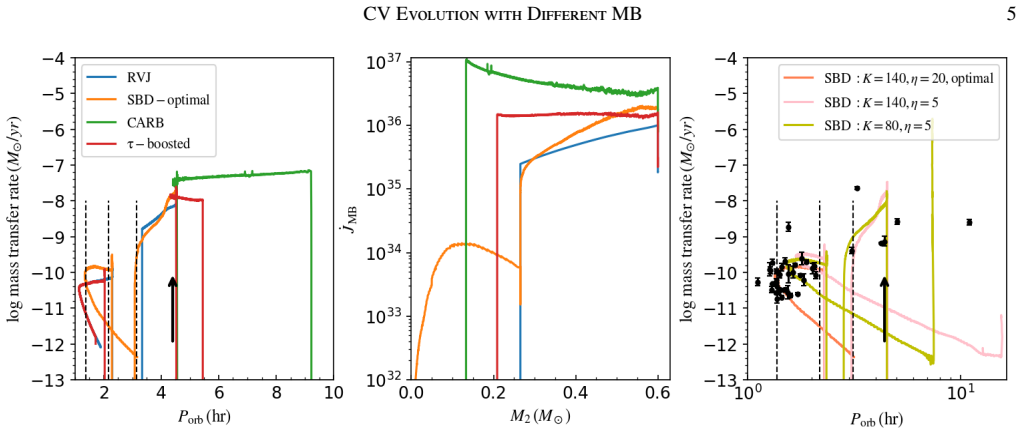
CARB and τ-boosted magnetic braking models are too strong to reproduce the observed period gap in cataclysmic variables.
A machine-rendered reading of the paper's core claim, the machinery that carries it, and where it could break.
Core claim
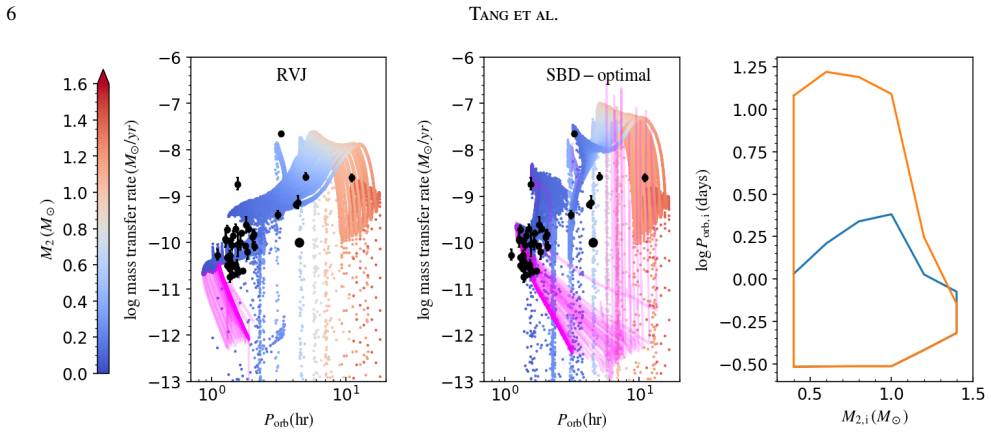
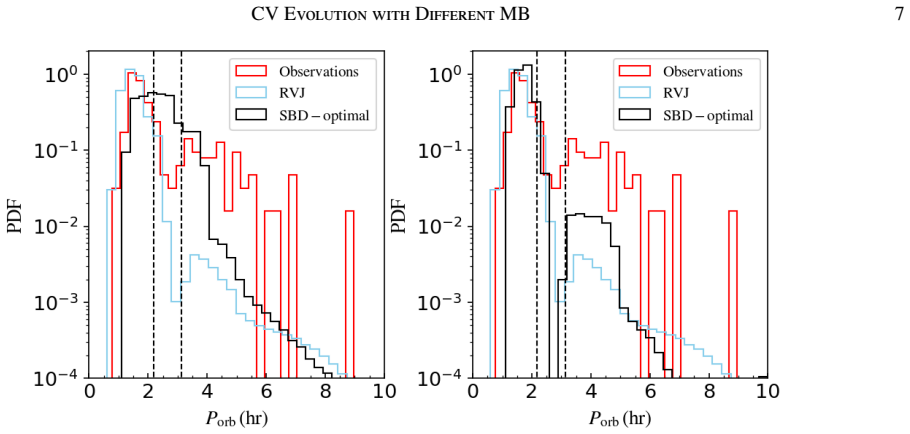
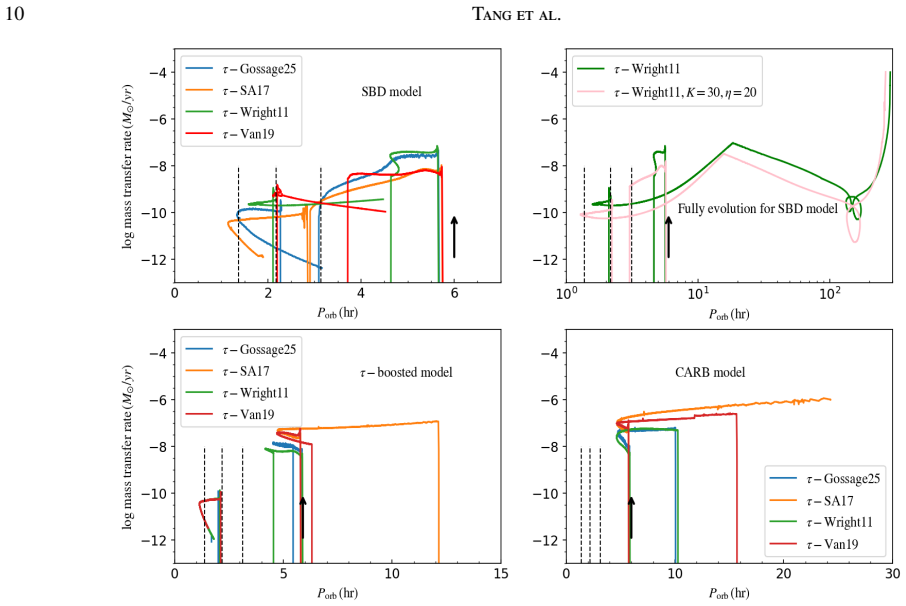
Both the CARB and τ-boosted magnetic braking models are too strong for cataclysmic variables and therefore fail to place the period gap at the observed orbital periods, while the SBD model yields better agreement on some observables but larger discrepancies on others.
What carries the argument
Magnetic braking prescriptions (standard, CARB, τ-boosted, SBD) acting on the orbital evolution of cataclysmic variables, tested against the location of the period gap.
If this is right
- The CARB and τ-boosted prescriptions should not be applied to population synthesis or evolutionary calculations of cataclysmic variables.
- The SBD model can be used in place of the standard prescription when some observational features must be matched, but additional adjustments are needed for full consistency.
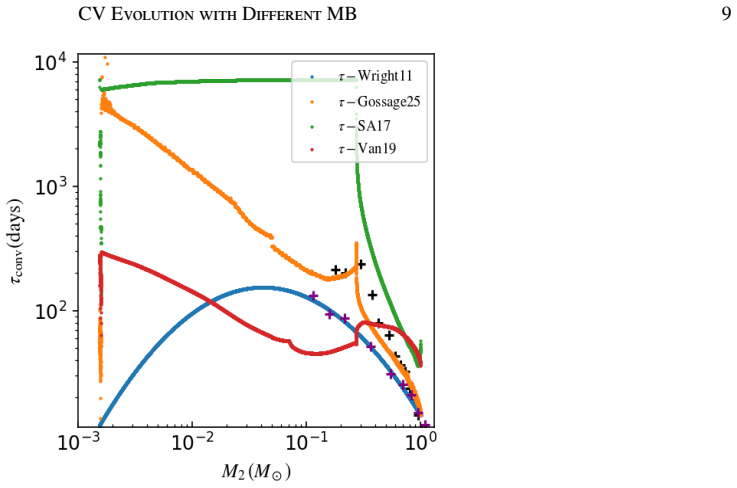
- Results for non-standard magnetic braking depend strongly on the adopted convective turnover timescale, so that choice must be specified and varied in future work.
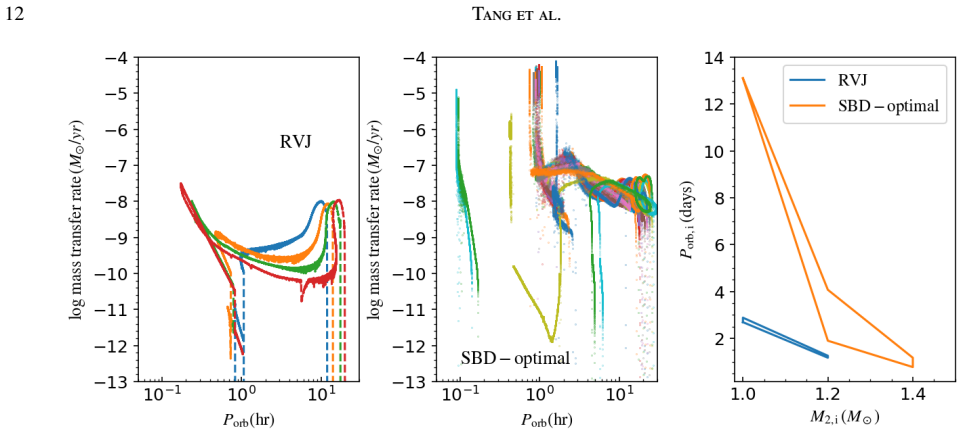
- The SBD model alters the predicted formation rate and properties of AM CVn systems relative to the standard model.
Where Pith is reading between the lines
- If the SBD model is adopted, population studies of detached white-dwarf plus main-sequence binaries may need re-calibration to match the same period gap data.
- Future tests could compare the models against the distribution of mass-transfer rates above the gap rather than relying solely on the gap location.
- The finding that different convective timescales matter suggests that stellar interior models should be coupled more tightly to binary evolution codes.
Load-bearing premise
The observed location of the period gap is the decisive test for the strength of magnetic braking in cataclysmic variable models.
What would settle it
A direct measurement showing that the period gap in cataclysmic variables occurs at the shorter orbital periods predicted by the CARB or τ-boosted models would falsify the claim that those prescriptions are too strong.
Figures
read the original abstract
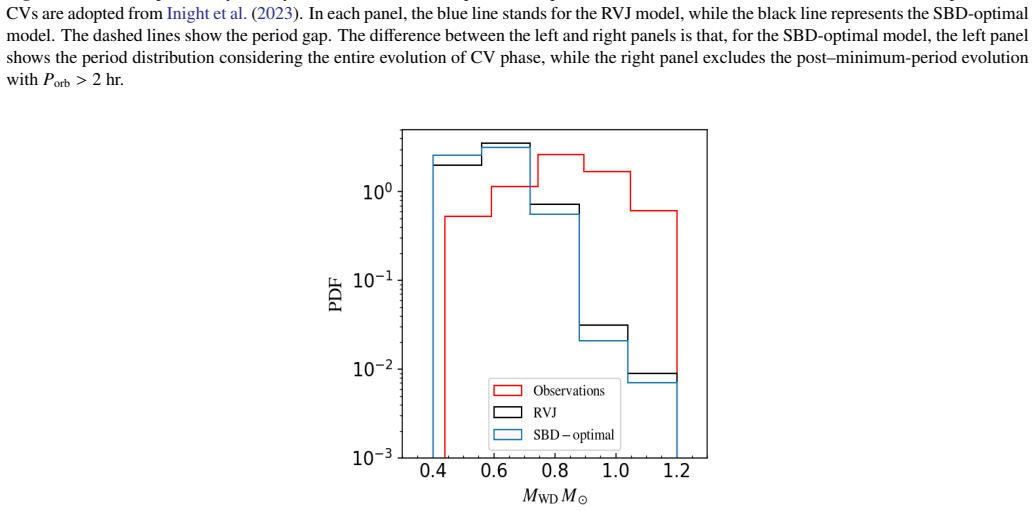
Recent studies revealed discrepancies between observations and the predictions of the standard magnetic braking (MB). Although alternative models have been broadly discussed in neutron star binaries, they have not been systematically tested in cataclysmic variables (CVs). In this work, we investigate the performance of four MB models in CVs: the standard MB, the Convection And Rotation Boosted (CARB) model, the $\tau$-boosted model, and the saturated, boosted, and disrupted (SBD) model. We find that both the CARB and $\tau$-boosted models appear too strong so that it fails to reproduce the location of the period gap in CVs, indicating that they are not appropriate for CVs. Furthermore, we present a comparison between the standard MB and the SBD models. Compared with the standard model, although the SBD model can better reproduce some observational features, it also exacerbates certain discrepancies between theory and observations. We also find that different prescriptions for the convective turnover timescale have a significant impact on the results in the non-standard MBs. Finally, we discuss the impact of the SBD model on the formation and evolution of AM CVn.
Editorial analysis
A structured set of objections, weighed in public.
Referee Report
Summary. The manuscript compares four magnetic braking (MB) prescriptions in cataclysmic variable (CV) binary evolution calculations: the standard model, the Convection And Rotation Boosted (CARB) model, the τ-boosted model, and the saturated, boosted, and disrupted (SBD) model. It concludes that both CARB and τ-boosted models are too strong across the relevant orbital-period range and therefore fail to reproduce the observed CV period gap, rendering them inappropriate for CVs. The SBD model is shown to improve reproduction of some observational features relative to the standard model while exacerbating others; different convective-turnover-time prescriptions are found to affect results in the non-standard models, and the SBD model’s implications for AM CVn formation are discussed.
Significance. If the evolutionary calculations and direct comparisons to the period gap hold, the work supplies a clear, observationally grounded test of alternative MB prescriptions in the CV context. The finding that boosted models (CARB, τ-boosted) fail the standard period-gap diagnostic is falsifiable and directly useful for model selection. The balanced evaluation of the SBD model’s trade-offs and the demonstrated sensitivity to convective-turnover timescale add practical value for future population synthesis.
minor comments (3)
- The abstract asserts that CARB and τ-boosted models 'fail to reproduce the location of the period gap' but does not report the actual predicted gap locations (in hours) produced by those models; adding these quantitative values would make the central claim more precise.
- A summary table listing the four MB prescriptions, their key functional forms, and the resulting period-gap locations (or lack thereof) would improve readability and allow direct comparison with the observational 2–3 h range.
- The manuscript should explicitly state whether the same initial binary parameters, mass-transfer rates, and numerical settings were used for all four prescriptions to confirm that differences arise solely from the MB formulation.
Simulated Author's Rebuttal
We thank the referee for their positive assessment of our manuscript and the recommendation for minor revision. The referee summary accurately captures the scope, methods, and conclusions of the work. No specific major comments were raised in the report.
Circularity Check
No significant circularity
full rationale
The paper's central claim rests on running binary evolution calculations with four distinct magnetic braking prescriptions and comparing the resulting period-gap locations directly to external observational data on CVs. No equations, fitted parameters, or self-citations are shown to reduce the reported outcomes to the inputs by construction; the period gap serves as an independent benchmark rather than a derived quantity. The abstract and provided context give no indication of self-definitional steps, renamed fits presented as predictions, or load-bearing self-citation chains.
Axiom & Free-Parameter Ledger
Reference graph
Works this paper leans on
-
[1]
doi:10.1086/343030 Barraza-Jorquera, J. A., Schreiber, M. R., & Belloni, D. 2025, A&A, 696, A92. doi:10.1051/0004-6361/202553757 Barraza-Jorquera, J. A., Schreiber, M. R., Littlefair, S., et al. 2026, arXiv:2603.14560. doi:10.48550/arXiv.2603.14560 Begari, T. & Maccarone, T. J. 2023, JAA VSO, 51, 2, 227. doi:10.48550/arXiv.2312.06007 Belloni, D., Schreibe...
work page internal anchor Pith review Pith/arXiv arXiv doi:10.1086/343030 2025
-
[2]
doi:10.1093/mnras/stab670 Deng, Z.-L., Li, X.-D., Gao, Z.-F., et al. 2021, ApJ, 909, 2, 174. doi:10.3847/1538-4357/abe0b2 Deng, Z.-L. & Li, X.-D. 2024, ApJ, 971, 1, 54. doi:10.3847/1538-4357/ad5fec Echeveste, M., Novarino, M. L., Benvenuto, O. G., et al. 2024, MNRAS, 530, 4, 4277. doi:10.1093/mnras/stae1115 El-Badry, K., Conroy, C., Fuller, J., et al. 202...
-
[3]
doi:10.1093/mnras/stac2945 Fan, Y .-N., Shao, Y ., & Chen, W.-C. 2024, ApJ, 976, 2, 210. doi:10.3847/1538-4357/ad8b48 Gossage, S., Kiman, R., Monsch, K., et al. 2025, ApJ, 988, 1, 102. doi:10.3847/1538-4357/adde4d 14 Tang et al. Green, M. J., van Roestel, J., & Wong, T. L. S. 2025, A&A, 700, A107. doi:10.1051/0004-6361/202554925 Hurley, J. R., Tout, C. A....
-
[4]
doi:10.1046/j.1365-8711.2002.05038.x Hurley, J. R., Pols, O. R., & Tout, C. A. 2000, MNRAS, 315, 3,
-
[5]
doi:10.1046/j.1365-8711.2000.03426.x Hussain, G. A. J. 2011, Evolution of Compact Binaries, 447, 143. doi:10.48550/arXiv.1202.5075 Inight, K., G¨ansicke, B. T., Schwope, A., et al. 2023, MNRAS, 525, 3, 3597. doi:10.1093/mnras/stad2409 Inight, K., G¨ansicke, B. T., Breedt, E., et al. 2023, MNRAS, 524, 4, 4867. doi:10.1093/mnras/stad2018 Istrate, A. G., Tau...
-
[6]
doi:10.1086/324074 Kroupa, P., Tout, C. A., & Gilmore, G. 1993, MNRAS, 262, 545. doi:10.1093/mnras/262.3.545 Landau, L. D. & Lifshitz, E. M. 1975, . Landin, N. R., Mendes, L. T. S., Vaz, L. P. R., et al. 2023, MNRAS, 519, 4, 5304. doi:10.1093/mnras/stac3823 Lee, Y ., Moon, D.-S., Kim, S. C., et al. 2024, ApJ, 964, 2, 186. doi:10.3847/1538-4357/ad25ff Ma, ...
-
[7]
doi:10.3847/2515-5172/ad9a64 Magaudda, E., Stelzer, B., Covey, K. R., et al. 2020, A&A, 638, A20. doi:10.1051/0004-6361/201937408 Matt, S. P., MacGregor, K. B., Pinsonneault, M. H., et al. 2012, ApJL, 754, 2, L26. doi:10.1088/2041-8205/754/2/L26 Matt, S. P., Brun, A. S., Baraffe, I., et al. 2015, ApJL, 799, 2, L23. doi:10.1088/2041-8205/799/2/L23 McAllist...
-
[8]
doi:10.3847/1538-4357/abc686 Pala, A. F., G¨ansicke, B. T., Townsley, D., et al. 2017, MNRAS, 466, 3, 2855. doi:10.1093/mnras/stw3293 Pala, A. F., G¨ansicke, B. T., Breedt, E., et al. 2020, MNRAS, 494, 3, 3799. doi:10.1093/mnras/staa764 Pala, A. F., G¨ansicke, B. T., Belloni, D., et al. 2022, MNRAS, 510, 4, 6110. doi:10.1093/mnras/stab3449 Patterson, J. 1...
-
[9]
doi:10.1086/378632 Podsiadlowski, P., Rappaport, S., & Pfahl, E. D. 2002, ApJ, 565, 2,
-
[10]
doi:10.1086/324686 Ramsay, G., Green, M. J., Marsh, T. R., et al. 2018, A&A, 620, A141. doi:10.1051/0004-6361/201834261 Rappaport, S., Verbunt, F., & Joss, P. C. 1983, ApJ, 275, 713. doi:10.1086/161569 Reimers, D. 1975, Memoires of the Societe Royale des Sciences de Liege, 8, 369. Reiners, A., Basri, G., & Browning, M. 2009, ApJ, 692, 1, 538. doi:10.1088/...
-
[11]
doi:10.1093/mnras/sty3489 Van, K. X. & Ivanova, N. 2019, ApJL, 886, 2, L31. doi:10.3847/2041-8213/ab571c Verbunt, F. & Zwaan, C. 1981, A&A, 100, L7. Wang, B., Li, X.-D., & Han, Z.-W. 2010, MNRAS, 401, 4, 2729. doi:10.1111/j.1365-2966.2009.15857.x Wei, N., Jiang, L., & Chen, W.-C. 2023, A&A, 679, A74. doi:10.1051/0004-6361/202346397 Wright, N. J., Drake, J...
-
[12]
doi:10.1088/0004-637X/743/1/48 Wright, N. J. & Drake, J. J. 2016, Nature, 535, 7613, 526. doi:10.1038/nature18638 Wu, C., Wang, B., Liu, D., et al. 2017, A&A, 604, A31. doi:10.1051/0004-6361/201630099 Xu, X.-J. & Li, X.-D. 2010, ApJ, 716, 1, 114. doi:10.1088/0004-637X/716/1/114 Xu, X.-T. & Li, X.-D. 2018, MNRAS, 480, 3, 3856. doi:10.1093/mnras/sty2146 Yan...
discussion (0)
Sign in with ORCID, Apple, or X to comment. Anyone can read and Pith papers without signing in.