Limiting Absorption Principle for the Helmholtz Equation with Sign-Changing Coefficients in Multilayer Spheres
Pith reviewed 2026-06-30 00:13 UTC · model grok-4.3
The pith
A bespoke T-coercivity operator restores coercivity for the Helmholtz equation with alternating sign coefficients in multilayer spheres, enabling the limiting absorption principle.
A machine-rendered reading of the paper's core claim, the machinery that carries it, and where it could break.
Core claim
By synthesizing a bespoke T-coercivity operator with a complex-wavenumber DtN map, the sesquilinear form regains coercivity on the chosen function space, which together with sharp a priori estimates yields the limiting absorption principle and well-posedness for the multilayer transmission problem; uniqueness is controlled by the optimal trace constant that encodes the layer radii.
What carries the argument
The bespoke T-coercivity operator that restores coercivity to the variational formulation despite sign-changing coefficients.
Load-bearing premise
A T-coercivity operator exists that makes the sesquilinear form coercive regardless of the specific layer radii and sign alternation pattern.
What would settle it
Existence of layer radii and sign pattern where the sesquilinear form remains non-coercive for every candidate T-operator, violating the a priori estimates.
Figures
read the original abstract
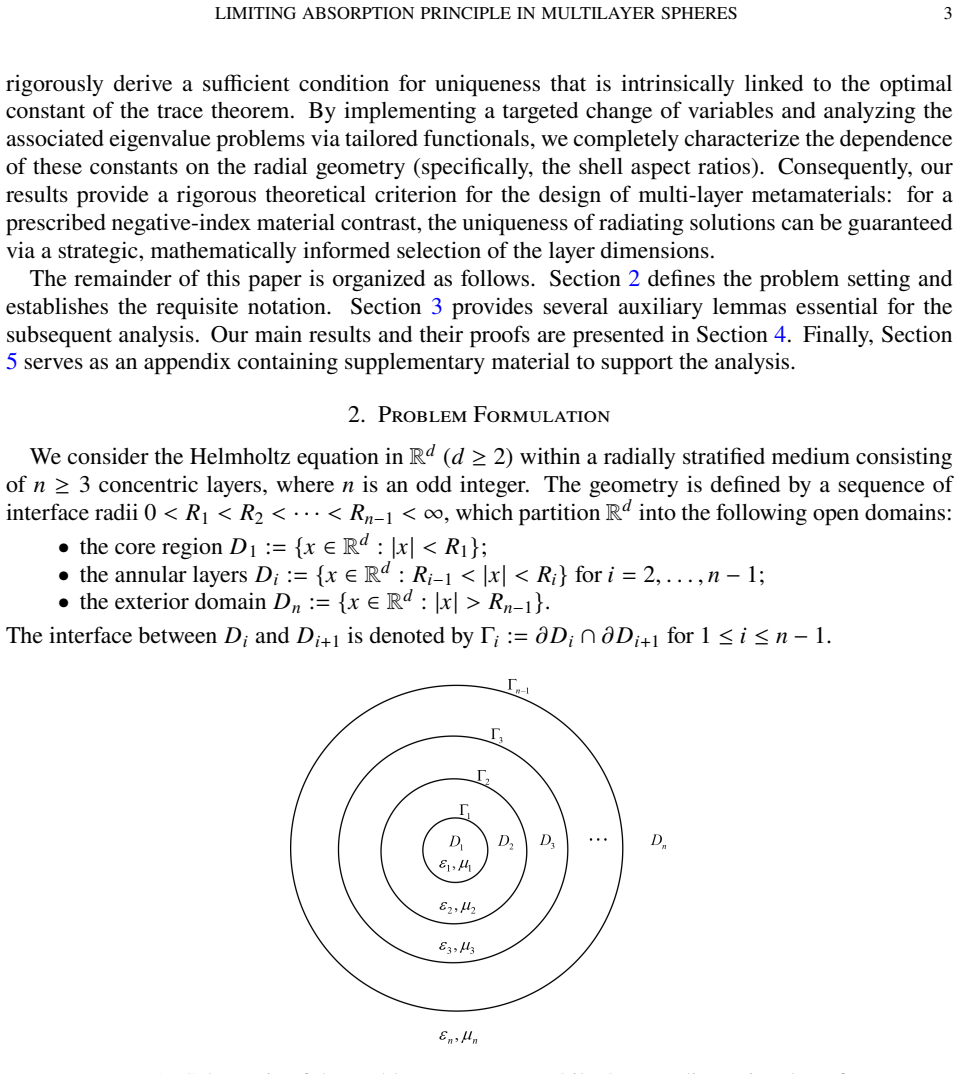
This paper investigates a multilayered Helmholtz model in $\mathbb{R}^d$ ($d \ge 2$) characterized by concentric layers of materials with alternating positive and negative refractive indices. To overcome the loss of coercivity induced by the sign-changing material parameters, we construct a bespoke $\mathbb T$-coercivity operator to restore the coercive structure of the problem. Furthermore, to address the inherent lack of compactness on unbounded domains, we integrate a complex-wavenumber Dirichlet-to-Neumann (DtN) operator into this framework. By combining this variational synthesis with sharp \textit{a priori} estimates, we rigorously establish the limiting absorption principle and prove the well-posedness of the corresponding transmission problem in appropriate function spaces. Crucially, we quantify the dependence of uniqueness on the domain geometry by explicitly analyzing the optimal trace constant, thereby providing a rigorous mathematical criterion for the design of multi-layer metamaterials.
Editorial analysis
A structured set of objections, weighed in public.
Referee Report
Summary. The paper claims to prove the limiting absorption principle for the Helmholtz equation with alternating sign-changing refractive indices in concentric multilayer spheres in R^d (d≥2). It constructs a bespoke T-coercivity operator to restore coercivity of the sesquilinear form, incorporates a complex-wavenumber DtN map to handle the unbounded domain, derives sharp a priori estimates, and analyzes the optimal trace constant to establish well-posedness of the transmission problem while quantifying geometry dependence for uniqueness.
Significance. If the central construction and estimates hold, the work supplies a variational criterion for well-posedness in sign-changing layered media that is directly relevant to metamaterial design; the explicit dependence on layer radii via the trace constant is a concrete strength that could guide practical choices of geometry.
major comments (2)
- [Abstract / variational synthesis paragraph] The load-bearing claim that a T-coercivity operator exists making the sesquilinear form coercive for arbitrary layer radii and any alternating sign pattern (abstract, variational synthesis paragraph) is asserted without visible bounds or construction details that would confirm independence from radii; this must be verified explicitly since it underpins both the LAP and the well-posedness result.
- [Section deriving a priori estimates and LAP] The combination of the T-coercivity framework with the complex-wavenumber DtN map to obtain the limiting absorption principle (abstract) requires confirmation that possible interface resonances are controlled by the a priori estimates; the abstract indicates sharp estimates are supplied, but their uniformity with respect to the sign pattern and radii needs explicit statement.
minor comments (2)
- Clarify the precise function space in which the transmission problem is posed and state the optimal trace constant explicitly (e.g., as a function of the radii) rather than only qualitatively.
- Add a short remark on how the construction reduces when all signs are positive, to highlight the novelty of the sign-changing case.
Simulated Author's Rebuttal
We thank the referee for the careful reading and constructive comments on our manuscript. We address the major comments point by point below.
read point-by-point responses
-
Referee: [Abstract / variational synthesis paragraph] The load-bearing claim that a T-coercivity operator exists making the sesquilinear form coercive for arbitrary layer radii and any alternating sign pattern (abstract, variational synthesis paragraph) is asserted without visible bounds or construction details that would confirm independence from radii; this must be verified explicitly since it underpins both the LAP and the well-posedness result.
Authors: The construction of the T-coercivity operator is given explicitly in the variational synthesis section, where the operator is defined and coercivity of the sesquilinear form is proved for arbitrary layer radii and any alternating sign pattern. The proof establishes existence of the operator without requiring additional bounds on the radii; the resulting coercivity constant depends on geometry via the trace constant (analyzed later in the paper) but the construction itself holds uniformly for any fixed radii. We will add a clarifying sentence in the abstract and introduction to make this explicit. revision: yes
-
Referee: [Section deriving a priori estimates and LAP] The combination of the T-coercivity framework with the complex-wavenumber DtN map to obtain the limiting absorption principle (abstract) requires confirmation that possible interface resonances are controlled by the a priori estimates; the abstract indicates sharp estimates are supplied, but their uniformity with respect to the sign pattern and radii needs explicit statement.
Authors: The a priori estimates derived in the relevant section combine the T-coercivity framework with the complex DtN map and control interface resonances through the resulting coercive structure. These estimates are uniform with respect to the sign pattern (as T-coercivity removes dependence on sign changes) while the dependence on radii is quantified explicitly via the optimal trace constant. We will revise the abstract and estimates section to include an explicit statement of these uniformity properties. revision: yes
Circularity Check
No significant circularity in the derivation chain
full rationale
The paper's central argument proceeds by explicitly constructing a bespoke T-coercivity operator to restore coercivity for alternating-sign coefficients, incorporating a complex-wavenumber DtN map to compactify the unbounded domain, and then deriving a priori estimates together with an explicit optimal trace constant to obtain the limiting absorption principle and well-posedness. None of these steps reduce by definition or construction to their own inputs; the constructions are independent of the final claims, no data-fitting or prediction-from-fit occurs, and no load-bearing self-citation or imported uniqueness theorem is invoked. The derivation therefore remains self-contained against external mathematical benchmarks.
Axiom & Free-Parameter Ledger
axioms (1)
- domain assumption A T-coercivity operator exists that restores coercivity for the sign-changing multilayer transmission problem on concentric spheres.
Reference graph
Works this paper leans on
-
[1]
S. Agmon. Spectral properties of Schr ¨odinger operators and scattering theory.Ann. Scuola Norm. Sup. Pisa Cl. Sci. (4), 2(2):151–218, 1975
1975
-
[2]
Al` u and N
A. Al` u and N. Engheta. Multifrequency optical invisibility cloak with layered plasmonic shells.Phys. Rev. Lett., 100:113901, Mar 2008
2008
-
[3]
Bonnet-Ben Dhia, L
A.-S. Bonnet-Ben Dhia, L. Chesnel, and P. Ciarlet, Jr.𝑇-coercivity for scalar interface problems between dielectrics and metamaterials.ESAIM Math. Model. Numer. Anal., 46(6):1363–1387, 2012. 26 WENJING ZHANG AND YIXIAN GAO
2012
-
[4]
Bonnet-Ben Dhia, L
A.-S. Bonnet-Ben Dhia, L. Chesnel, and P. Ciarlet, Jr.𝑇-coercivity for the Maxwell problem with sign-changing coefficients.Comm. Partial Differential Equations, 39(6):1007–1031, 2014
2014
-
[5]
A. S. Bonnet-Ben Dhia, P. Ciarlet, Jr., and C. M. Zw ¨olf. Time harmonic wave diffraction problems in materials with sign-shifting coefficients.J. Comput. Appl. Math., 234(6):1912–1919, 2010
1912
-
[6]
Brezis.Functional Analysis, Sobolev Spaces and Partial Differential Equations
H. Brezis.Functional Analysis, Sobolev Spaces and Partial Differential Equations. Universitext. Springer New York, 2010
2010
-
[7]
Cacciafesta, P
F. Cacciafesta, P. D’ Ancona, and R. Luc`a. A limiting absorption principle for the Helmholtz equation with variable coefficients.J. Spectr. Theory, 8(4):1349–1392, 2018
2018
-
[8]
Z. Chen, Y. Han, Z. Cui, and X. Shi. Scattering analysis of bessel beam by a multilayered sphere.Optics Communications, 340:5–10, 2015
2015
-
[9]
Colton and R
D. Colton and R. Kress.Inverse acoustic and electromagnetic scattering theory, volume 93 ofApplied Mathematical Sciences. Springer, New York, third edition, 2013
2013
-
[10]
Y. Deng, L. Kong, Y. Liu, and L. Zhu. Mathematical analysis of subwavelength resonant acoustic scattering in multi-layered high-contrast structures.Journal of Differential Equations, 462:114133, 2026
2026
-
[11]
D. M. `E˘ıdus. On the principle of limiting absorption.Mat. Sb. (N.S.), 57(99):13–44, 1962
1962
-
[12]
Farhat, S
M. Farhat, S. Guenneau, and S. Enoch. Ultrabroadband elastic cloaking in thin plates.Phys. Rev. Lett., 103:024301, 2009
2009
-
[13]
Dirichlet-to-Neumann operator for the Helmholtz problem with general wavenumbers on the $n$-sphere
B. Gr ¨aßle and S. A. Sauter. Dirichlet-to-neumann operator for the helmholtz problem with general wavenumbers on the𝑛-sphere, arXiv:2503.18837, 2025
work page internal anchor Pith review Pith/arXiv arXiv 2025
-
[14]
Hu and A
G. Hu and A. Kirsch. Direct and inverse time-harmonic scattering by dirichlet periodic curves with local perturba- tions.Science China Mathematics, pages 1–34, 2026
2026
-
[15]
B. R. Johnson. Light scattering by a multilayer sphere.Appl. Opt., 35(18):3286–3296, Jun 1996
1996
-
[16]
Kirsch and A
A. Kirsch and A. Lechleiter. The limiting absorption principle and a radiation condition for the scattering by a periodic layer.SIAM J. Math. Anal., 50(3):2536–2565, 2018
2018
-
[17]
G. W. Milton and N.-A. P. Nicorovici. On the cloaking effects associated with anomalous localized resonance. Proc. R. Soc. Lond. Ser. A Math. Phys. Eng. Sci., 462(2074):3027–3059, 2006
2074
-
[18]
H.-M. Nguyen. Limiting absorption principle and well-posedness for the Helmholtz equation with sign changing coefficients.J. Math. Pures Appl. (9), 106(2):342–374, 2016
2016
-
[19]
F. W. Olver, A. Olde Daalhuis, D. W. Lozier, B. I. Schneider, R. F. Boisvert, C. W. Clark, B. R. Miller, and B. Sounders. Nist digital library of mathematical functions (2017).Online version available at http://dlmf. nist. gov, 2022
2017
-
[20]
R. A. Shelby, D. R. Smith, and S. Schultz. Experimental verification of a negative index of refraction.science, 292(5514):77–79, 2001
2001
-
[21]
E. M. Stein and G. Weiss.Introduction to Fourier analysis on Euclidean spaces, volume 1. Princeton university press, 1971
1971
-
[22]
Stenger, M
N. Stenger, M. Wilhelm, and M. Wegener. Experiments on elastic cloaking in thin plates.Phys. Rev. Lett., 108:014301, Jan 2012
2012
-
[23]
A. G. Sve ˇsnikov. The principle of radiation.Doklady Akad. Nauk SSSR (N.S.), 73:917–920, 1950
1950
-
[24]
W. v. Ignatowsky. Reflexion elektromagnetisches wellen an einem draht.Annalen der Physik, 323(13):495–522, 1905
1905
-
[25]
V. G. Veselago. The electrodynamics of substances with simultaneously negative values of𝜖and𝜇.Soviet Phys. Uspekhi, 10(4):509–514, 1968
1968
-
[26]
G. N. Watson.A treatise on the theory of Bessel functions, volume 3. The University Press, 1922
1922
-
[27]
Z. Wu, J. Yin, and C. Wang.Elliptic and parabolic equations. World Scientific Publishing Company, 2003
2003
-
[28]
Zhang, Y
W. Zhang, Y. Chen, and Y. Gao. Limiting absorption principle of Helmholtz equation with sign changing coefficients under periodic structure.J. Differential Equations, 458:Paper No. 114037, 2026
2026
-
[29]
K. Zhu, J. Shao, S. Li, and Y. Huang. Analytical solutions to radiative absorption and scattering by the large multilayer concentric-sphere particle.International Communications in Heat and Mass Transfer, 117:104793, 2020. LIMITING ABSORPTION PRINCIPLE IN MULTILAYER SPHERES 27 School of Mathematics and Statistics, Northeast Normal University , Changchun, ...
2020
discussion (0)
Sign in with ORCID, Apple, or X to comment. Anyone can read and Pith papers without signing in.