Exascale Hybrid Numerical-AI Ensembles for Operational Flood-Season Forecasting in East Asia: 15-km Decadal Hindcasts and 1-km High-Resolution Capability
Reviewed by Pith T0 review T1 audit T2 compute T3 formal T4 kernel 2026-06-30 11:52 UTCgrok-4.3pith:RDZI53AVrecord.jsonopen to challenge →
The pith
A hybrid system fusing 174 numerical members with 1,600 AI members improves East Asia seasonal rainfall forecast scores from 71.8 to 75.9 while completing 1,774-member hindcasts in 14.6 hours.
A machine-rendered reading of the paper's core claim, the machinery that carries it, and where it could break.
Core claim
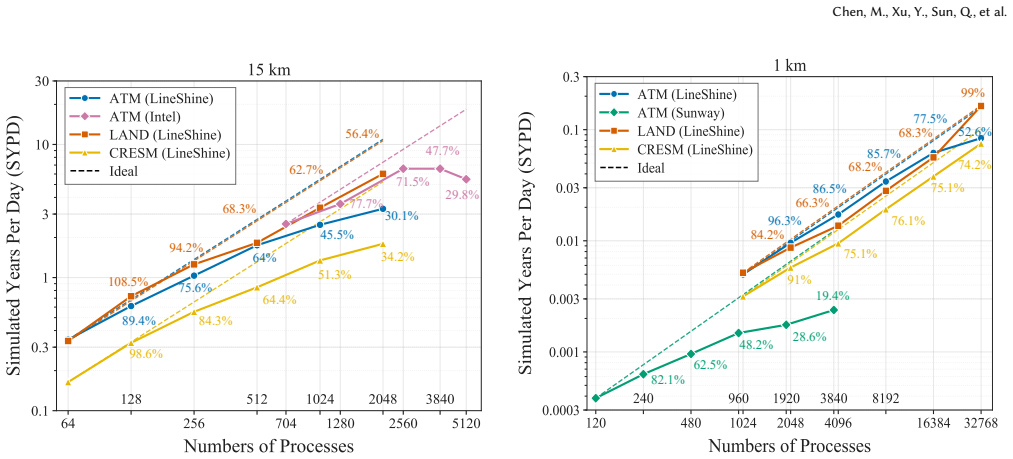
CAPES integrates a 15-km coupled regional model with atmosphere, land, and ocean components and a data-driven AI seasonal forecasting system. At 15 km the fused workflow combines 174 numerical members from varying start times, physics schemes, and parameter perturbations with 1,600 AI members generated from initial and physical perturbations. Using the full LineShine system, CAPES completes ten annual 1,774-member hindcasts for 2016 to 2025 within 14.6 hours, improving the mean prediction score from ECMWF's 71.8 to 75.9. The 1-km configuration further enables fine-scale typhoon simulation and establishes the feasibility of kilometer-scale fused ensemble forecasting on a one-week timescale.
What carries the argument
The CAPES fused workflow, which merges numerical ensemble members from varying start times, physics schemes, and parameter perturbations with AI members generated from initial and physical perturbations.
If this is right
- Ten annual 1,774-member hindcasts for 2016-2025 can be completed within 14.6 hours.
- Mean prediction score rises from ECMWF's 71.8 to 75.9.
- A 1-km configuration resolves fine-scale typhoon structure.
- Kilometer-scale fused ensemble forecasting becomes feasible on a one-week timescale.
Where Pith is reading between the lines
- If the AI members truly add independent skill, the same fusion approach could be tested on other regions limited by spring predictability barriers.
- The reported wall-clock time suggests the workflow could support real-time operational forecasts rather than hindcasts alone.
- Extending the 1-km configuration to longer leads might further reduce errors in localized convective extremes.
Load-bearing premise
The 1,600 AI members generated from initial and physical perturbations supply genuinely independent skill that is not already captured by the 174 numerical members or by the definition of the prediction score itself.
What would settle it
A side-by-side run in which the 1,600 AI members are removed and the ensemble score falls back to or below the numerical-only baseline of 71.8 would show that the reported gain depends on independent AI skill.
Figures




read the original abstract
Seasonal forecasting of summer rainfall in East Asia remains a grand challenge, as predictability at 3 to 6 month lead times is constrained by the spring predictability barrier, weak large-scale signals, and localized nonlinear convective extremes. We address this challenge with CAPES, which integrates a kilometer-resolution coupled regional model with atmosphere, land, and ocean components and a data-driven AI seasonal forecasting system. At 15 km resolution, the fused workflow combines 174 numerical members from varying start times, physics schemes, and parameter perturbations with 1,600 AI members generated from initial and physical perturbations. Using the full LineShine system, CAPES completes ten annual 1,774-member hindcasts for 2016 to 2025 within 14.6 hours, improving the mean prediction score from ECMWF's 71.8 to 75.9 and delivering a major gain in operational forecasting capability. The 1-km configuration further enables fine-scale typhoon simulation and establishes the feasibility of kilometer-scale fused ensemble forecasting on a one-week timescale.
Editorial analysis
A structured set of objections, weighed in public.
Referee Report
Summary. The manuscript presents CAPES, a hybrid numerical-AI ensemble forecasting system for summer rainfall and flood-season prediction in East Asia. It integrates a 15-km coupled regional model (atmosphere-land-ocean) with a data-driven AI component, generating 1,774-member ensembles (174 numerical members from start-time, physics, and parameter perturbations plus 1,600 AI members from initial and physical perturbations). The work claims that ten annual hindcasts (2016–2025) can be completed in 14.6 hours on the LineShine exascale system, raising the mean prediction score from ECMWF’s 71.8 to 75.9, while also demonstrating 1-km resolution capability for typhoon simulation.
Significance. If the reported 4.1-point score improvement is shown to arise from genuinely additive skill in the AI members rather than ensemble size or score definition, the hybrid approach could represent a meaningful advance for operational seasonal forecasting at 3–6 month leads. The reported wall-clock performance for 1,774-member decadal hindcasts on exascale hardware is a concrete engineering achievement. However, the absence of a defined prediction score, validation protocol, error bars, or ablation controls in the abstract prevents any assessment of whether these results are robust or load-bearing.
major comments (2)
- [Abstract] Abstract: the central claim of an improvement from 71.8 to 75.9 is stated without any definition of the prediction score, without error bars, without a description of the validation procedure, and without any indication of whether the score was computed on independent test data or after tuning of the AI component. This information is required to evaluate whether the delta is meaningful.
- [Abstract] Abstract: no ablation (numerical-only ensemble vs. full 1,774-member hybrid), no per-member or per-component skill decomposition, and no test of score sensitivity to ensemble size are provided. Without these controls it is impossible to attribute the reported gain to independent information supplied by the 1,600 AI members rather than to simply increasing the number of members or to an implicit bias in the score aggregation.
Simulated Author's Rebuttal
We thank the referee for the constructive comments highlighting the need for greater clarity and controls in the abstract. We address each point below and will make the requested revisions to strengthen the manuscript.
read point-by-point responses
-
Referee: [Abstract] Abstract: the central claim of an improvement from 71.8 to 75.9 is stated without any definition of the prediction score, without error bars, without a description of the validation procedure, and without any indication of whether the score was computed on independent test data or after tuning of the AI component. This information is required to evaluate whether the delta is meaningful.
Authors: We agree the abstract is overly concise. The prediction score refers to the mean seasonal rainfall prediction score (anomaly correlation for East Asian summer rainfall). The 10 hindcasts (2016-2025) serve as the validation set and are independent of AI training data. We will revise the abstract to define the score, note that error bars are computed from interannual spread across the hindcasts, and clarify the independent validation protocol. The full manuscript already details the AI training procedure. revision: yes
-
Referee: [Abstract] Abstract: no ablation (numerical-only ensemble vs. full 1,774-member hybrid), no per-member or per-component skill decomposition, and no test of score sensitivity to ensemble size are provided. Without these controls it is impossible to attribute the reported gain to independent information supplied by the 1,600 AI members rather than to simply increasing the number of members or to an implicit bias in the score aggregation.
Authors: We acknowledge that the current manuscript does not include explicit ablations or ensemble-size sensitivity tests in the abstract or main text. While the hybrid is compared to ECMWF, a direct numerical-only (174-member) versus full hybrid comparison and size-sensitivity analysis are absent. We will add these controls in a revised version, including a skill decomposition and ensemble-size sensitivity plot, to demonstrate the additive contribution of the AI members. revision: yes
Circularity Check
No circularity detected; empirical ensemble performance reported without self-referential definitions or fitted predictions
full rationale
The abstract reports a computational result: a hybrid 1,774-member ensemble improves a mean prediction score from ECMWF's 71.8 to 75.9. No equations, score definitions, derivations, or self-citations appear in the provided text. The central claim is an observed outcome of running the LineShine system on hindcasts, not a mathematical step that reduces to its own inputs by construction. Without any load-bearing derivation chain or parameter-fitting presented as prediction, the paper is self-contained against external benchmarks and receives the default non-finding.
Axiom & Free-Parameter Ledger
Reference graph
Works this paper leans on
-
[1]
Anna Allen, Stratis Markou, Will Tebbutt, James Requeima, Wessel P Bruinsma, Tom R Andersson, Nicholas D Herzog, Michael nd Lane, et al. 2025. End-to-end data-driven weather prediction. Nature 641, 8065 (2025), 1172–1179
2025
-
[2]
Peter Bauer, Alan Thorpe, and Gilbert Brunet. 2015. The quiet revolution of numerical weather prediction. Nature 525, 7567 (2015), 47–55
2015
-
[3]
Kaifeng Bi, Lingxi Xie, et al. 2023. Accurate medium-range global weather fore- casting with 3D neural networks. Nature 619, 7970 (2023), 533–538
2023
-
[4]
Noah D Brenowitz, Yair Cohen, Jaideep Pathak, Ankur Mahesh, Boris Bonev, Thorsten Kurth, Dale R Durran, et al. 2025. A practical probabilistic benchmark for ai weather models. Geophysical Research Letters 52, 7 (2025), e2024GL113656
2025
-
[5]
Dake Chen, Stephen E Zebiak, et al. 1995. An improved procedure for EI Niño forecasting: Implications for predictability. Science 269, 5231 (1995), 1699–1702
1995
-
[6]
Dickinson, et al
Yongjiu Dai, Xubin Zeng, Robert E. Dickinson, et al. 2003. The Common Land Model. Bulletin of the American Meteorological Society 84, 8 (2003), 1013–1024
2003
-
[7]
Catherine O de Burgh-Day and Tennessee Leeuwenburg. 2023. Machine learn- ing for numerical weather and climate modelling: a review. Geoscientific Model Development 16, 22 (2023), 6433–6477
2023
-
[8]
G. T. Diro, W. J. Merryfield, H. Lin, W.-S. Lee, R. Muncaster, et al. 2024.The Cana- dian Seasonal to Interannual Prediction System Version 3.0 (CanSIPSv3.0) . Techni- cal Note. Canadian Centre for Meteorological and Environmental Prediction
2024
- [9]
-
[10]
Kristina Fröhlich, Mikhail Dobrynin, Katharina Isensee, Claudia Gessner, An- dreas Paxian, Holger Pohlmann, Helmuth Haak, Sebastian Brune, et al. 2020. The German Climate Forecast System: GCFS. ESS Open Archive 2020, 0324 (2020)
2020
-
[11]
Oliver Fuhrer, Tarun Chadha, Torsten Hoefler, Grzegorz Kwasniewski, Xavier Lapillonne, David Leutwyler, Daniel Lüthi, et al. 2018. Near-global climate sim- ulation at 1 km resolution: establishing a performance baseline on 4888 GPUs with COSMO 5.0. Geoscientific Model Development 11, 4 (2018), 1665–1681
2018
-
[12]
Yukiko Hirabayashi, Roobavannan Mahendran, Sujan Koirala, et al. 2013. Global flood risk under climate change. Nature climate change 3, 9 (2013), 816–821
2013
-
[13]
Cathy Hohenegger, Peter Korn, Leonidas Linardakis, René Redler, Reiner Schnur, Panagiotis Adamidis, Jiawei Bao, et al. 2023. ICON-Sapphire: simulat- ing the components of the Earth system and their interactions at kilometer and subkilometer scales. Geoscientific Model Development 16, 2 (2023), 779–811
2023
-
[14]
Stephanie J Johnson, Timothy N Stockdale, Laura Ferranti, Magdalena A Bal- maseda, Franco Molteni, et al. 2019. SEAS5: the new ECMWF seasonal forecast system. Geoscientific Model Development 12, 3 (2019), 1087–1117
2019
-
[15]
Diederik P Kingma and Max Welling. 2013. Auto-encoding variational bayes. arXiv preprint arXiv:1312.6114 (2013)
work page internal anchor Pith review Pith/arXiv arXiv 2013
-
[16]
Daniel Klocke, Claudia Frauen, Jan Frederik Engels, Dmitry Alexeev, René Redler, Reiner Schnur, Helmuth Haak, Luis Kornblueh, et al. 2025. Comput- ing the Full Earth System at 1km Resolution. In Proceedings of the International Conference for High Performance Computing, Networking, Storage and Analysis . Association for Computing Machinery, New York, NY, ...
2025
-
[17]
Chihiro Kodama, Yohei Yamada, Akira T Noda, Kazuyoshi Kikuchi, Yoshiyuki Kajikawa, et al. 2015. A 20-year climatology of a NICAM AMIP-type simulation. Journal of the Meteorological Society of Japan. Ser. II 93, 4 (2015), 393–424
2015
-
[18]
Randal D Koster, Paul A Dirmeyer, Zhichang Guo, Gordon Bonan, Edmond Chan, Peter Cox, CT Gordon, et al. 2004. Regions of strong coupling between soil moisture and precipitation. Science 305, 5687 (2004), 1138–1140
2004
-
[19]
Y. Kubo, K. Ochi, J. Chiba, T. Yoshida, T. Takakura, R. Sekiguchi, Y. Adachi, M. Deushi, and S. Hirahara. 2025. Upgrade of the JMA Sub-Seasonal and Seasonal Ensemble Prediction System (JMA/MRI-CPS4). WGNE Research Activities in Earth System Modelling 55 (2025), 1–14
2025
-
[20]
Remi Lam, Alvaro Sanchez-Gonzalez, Matthew Willson, Peter Wirnsberger, Meire Fortunato, Ferran Alet, Suman Ravuri, et al. 2023. Learning skillful medium-range global weather forecasting. Science 382, 6677 (2023), 1416–1421
2023
-
[21]
Choi, Feng Zhang, Ligang Chen, et al
Xin-Zhong Liang, Min Xu, Xing Yuan, Tiejun Ling, Hyun I. Choi, Feng Zhang, Ligang Chen, et al. 2012. Regional Climate–Weather Research and Forecasting Model. Bulletin of the American Meteorological Society 93, 9 (2012), 1363–1387
2012
-
[22]
Gerald A Meehl, Lisa Goddard, James Murphy, Ronald J Stouffer, George Boer, Gokhan Danabasoglu, Keith Dixon, et al. 2009. Decadal prediction: can it be skillful? Bulletin of the American Meteorological Society 90, 10 (2009), 1467–1486
2009
-
[23]
Ministry of Emergency Management of the People’s Republic of China. 2021. China Flood and Drought Disaster Bulletin 2020. https://www.mem.gov.cn/ in Chinese
2021
-
[24]
Tim N Palmer. 2014. More reliable forecasts with less precise computations: a fast-track route to cloud-resolved weather and climate simulators? Philosophi- cal Transactions of the Royal Society A: Mathematical, Physical and Engineering Sciences 372, 2018 (2014)
2014
-
[25]
William Peebles and Saining Xie. 2023. Scalable diffusion models with trans- formers. In Proceedings of the IEEE/CVF international conference on computer vi- sion. 4195–4205
2023
-
[26]
Ilan Price, Alvaro Sanchez-Gonzalez, Ferran Alet, et al. 2025. Probabilistic weather forecasting with machine learning. Nature 637, 8044 (2025), 84–90
2025
-
[27]
Colin Raymond, Radley M Horton, et al. 2020. Understanding and managing connected extreme events. Nature climate change 10, 7 (2020), 611–621
2020
-
[28]
Suranjana Saha, Shrinivas Moorthi, Xingren Wu, et al. 2014. The NCEP climate forecast system version 2. Journal of climate 27, 6 (2014), 2185–2208
2014
-
[29]
A Sanna, A Borrelli, P Athanasiadis, et al. 2017. The CMCC seasonal prediction system. CMCC Research Paper 285 (2017)
2017
-
[30]
Hans Segura et al. 2025. nextGEMS: entering the era of kilometer-scale Earth system modeling. Geoscientific Model Development 18, 20 (2025), 7735–7761
2025
-
[31]
Damien Specq, Laurent Dorel, Jonathan Beuvier, Constantin Ardilouze, and Lau- riane Batté. 2024. Documentation of the Météo-France seasonal forecasting system
2024
-
[32]
Ph. D. Dissertation. Centre National de Recherches Météorologiques
-
[33]
Bjorn Stevens, Masaki Satoh, Ludovic Auger, et al. 2019. DYAMOND: the DY- namics of the Atmospheric general circulation Modeled On Non-hydrostatic Domains. Progress in Earth and Planetary Science 6, 1 (2019), 61
2019
-
[34]
Mark Taylor, Peter M Caldwell, et al. 2023. The simple cloud-resolving e3sm atmosphere model running on the frontier exascale system. In Proceedings of the international conference for high performance computing, networking, storage and analysis. Association for Computing Machinery, New York, NY, USA, 1–11
2023
-
[35]
Robin Wedd, Oscar Alves, Catherine de Burgh-Day, et al. 2022. ACCESS-S2: the upgraded Bureau of Meteorology multi-week to seasonal prediction system. Journal of Southern Hemisphere Earth Systems Science 72, 3 (12 2022), 218–242
2022
-
[36]
Nils P Wedi, Inna Polichtchouk, Peter Dueben, Valentine G Anantharaj, et al
-
[37]
Journal of Advances in Modeling Earth Systems 12, 11 (2020), e2020MS002192
A baseline for global weather and climate simulations at 1 km resolution. Journal of Advances in Modeling Earth Systems 12, 11 (2020), e2020MS002192
2020
-
[38]
Prince Xavier, Martin Willett, Tim Graham, et al. 2023. Assessment of the Met Office Global Coupled model version 5 (GC5) configurations. (2023)
2023
-
[39]
Kai Xu et al. 2025. Kilometer-scale AI-powered and performance-portable earth system model (AP3ESM) to achieve year-scale simulation speed on heteroge- neous supercomputers. In Proceedings of the International Conference for High Performance Computing, Networking, Storage and Analysis . 111–124
2025
-
[40]
Zhen-Qiang Zhou, Shang-Ping Xie, and Renhe Zhang. 2021. Historic Yangtze flooding of 2020 tied to extreme Indian Ocean conditions. Proceedings of the National Academy of Sciences 118, 12 (2021), e2022255118
2021
-
[41]
Jakob Zscheischler, Seth Westra, Bart JJM Van Den Hurk, et al. 2018. Future climate risk from compound events. Nature climate change 8, 6 (2018), 469–477
2018
discussion (0)
Sign in with ORCID, Apple, or X to comment. Anyone can read and Pith papers without signing in.