Basis-Canonical Projectivization for Smooth Complete Toric Varieties
Pith reviewed 2026-06-29 23:51 UTC · model grok-4.3
The pith
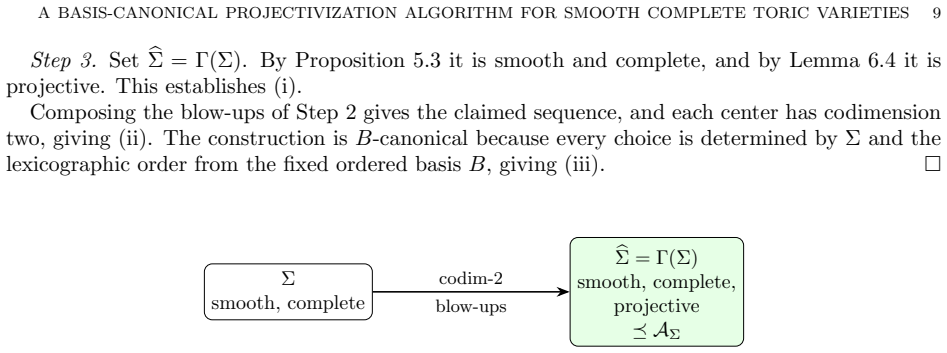
Every smooth complete toric fan admits a basis-canonical refinement to a smooth complete projective fan obtained by star subdivisions of two-dimensional cones.
A machine-rendered reading of the paper's core claim, the machinery that carries it, and where it could break.
Core claim
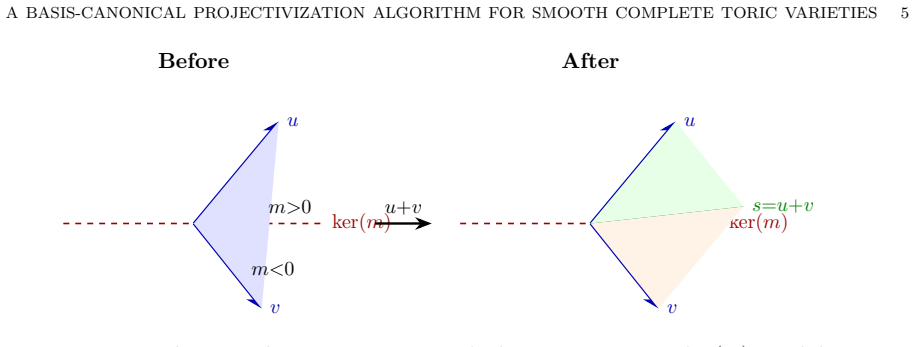
After fixing an ordered lattice basis, every smooth complete fan Σ admits a basis-canonical refinement wΣ=Γ(Σ) that is smooth, complete, projective, and obtained from Σ by star subdivisions of two-dimensional cones. Equivalently, X_wΣ → X_Σ is a finite sequence of ordinary toric blow-ups along smooth invariant centers of codimension two. The algorithm first constructs a projective wall-arrangement fan by extending the spans of the codimension-one cones of Σ to central hyperplanes, then sign-adapts Σ to this arrangement by repeatedly subdividing bad two-cones of maximal weight. A lexicographic badness profile gives termination, while projectivity follows from a wall-bend sandwich argument com
What carries the argument
The basis-canonical refinement Γ(Σ), built by first forming the projective wall-arrangement fan from the codimension-one cones and then performing sign-adaptation through repeated star subdivision of maximal-weight bad two-cones.
If this is right
- The morphism X_wΣ → X_Σ is realized by a finite sequence of ordinary toric blow-ups along smooth invariant codimension-two centers.
- The construction works uniformly for smooth complete fans in every dimension n ≥ 2.
- No additional projectivizing refinement is needed once the wall-adaptation step is complete.
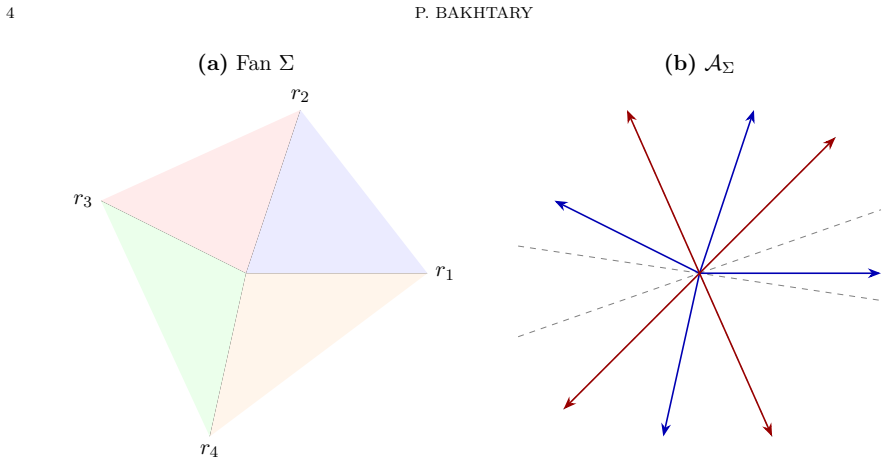
- The algorithm produces a deterministic length that can be compared with the minimal ordinary invariant projectivization length on specific examples such as Oda's non-projective threefold.
Where Pith is reading between the lines
- Different ordered bases may produce refinements of different lengths or with different combinatorial properties for the same starting fan.
- The method supplies a uniform, basis-relative projective model that can be used to compare projectivity data across families of smooth complete toric varieties.
- One could examine whether the final support function obtained from the sandwich argument yields new bounds on the Picard number or on the number of rays needed for projectivity.
Load-bearing premise
The wall-arrangement fan obtained by extending codimension-one cones to central hyperplanes is projective, and the lexicographic badness profile ensures that repeated subdivision of maximal-weight bad two-cones terminates with a fan whose projectivity follows from the wall-bend sandwich argument.
What would settle it
A smooth complete fan Σ such that the constructed wΣ is not projective, requires subdivisions of cones of dimension other than two, or such that the subdivision process fails to terminate under the given lexicographic badness ordering.
Figures
read the original abstract
We give an explicit projectivization algorithm for smooth complete toric varieties in arbitrary dimension $n\ge 2$. After fixing an ordered lattice basis, every smooth complete fan~$\Sig$ admits a basis-canonical refinement~$\wSig=\Gam(\Sig)$ that is smooth, complete, projective, and obtained from~$\Sig$ by star subdivisions of two-dimensional cones. Equivalently, $X_{\wSig}\to X_\Sig$ is a finite sequence of ordinary toric blow-ups along smooth invariant centers of codimension two. The algorithm first constructs a projective wall-arrangement fan by extending the spans of the codimension-one cones of~$\Sig$ to central hyperplanes. It then sign-adapts~$\Sig$ to this arrangement by repeatedly subdividing bad two-cones of maximal weight. A lexicographic badness profile gives termination, while projectivity follows from a wall-bend sandwich argument combining a support function pulled back from the arrangement with a relatively ample perturbation. The construction is canonical relative to the chosen ordered basis and requires no additional projectivizing refinement after wall-adaptation. We illustrate the procedure on Oda's non-projective threefold and compare its deterministic length with a separate threefold whose minimal ordinary invariant projectivization length is exactly two.
Editorial analysis
A structured set of objections, weighed in public.
Referee Report
Summary. The paper claims that, after fixing an ordered lattice basis, every smooth complete fan Σ in dimension n≥2 admits a basis-canonical refinement wΣ=Γ(Σ) obtained by star subdivisions of two-dimensional cones; the resulting fan is smooth, complete, and projective. The algorithm constructs a projective wall-arrangement fan by extending spans of codimension-one cones to central hyperplanes, then sign-adapts Σ by repeatedly subdividing maximal-weight bad two-cones; termination follows from a lexicographic badness profile and projectivity from a wall-bend sandwich argument that pulls back a support function from the arrangement and adds a relatively ample perturbation. The construction is illustrated on Oda’s non-projective threefold and compared with another example whose minimal projectivization length is two.
Significance. If the central claims hold, the result supplies an explicit, deterministic, and basis-canonical projectivization procedure for smooth complete toric varieties that requires only ordinary codimension-two blow-ups and no further refinement. This would be a concrete algorithmic contribution to toric geometry, where the existence of projective refinements is known but explicit constructions are rare; the use of an ordered basis to make the output canonical and the comparison with Oda’s example are strengths.
major comments (2)
- [wall-arrangement fan construction] Construction of the wall-arrangement fan (abstract and the section describing the initial step): the manuscript asserts without a separate general argument that extending the spans of the codimension-one cones of an arbitrary smooth complete Σ to central hyperplanes always produces a projective fan admitting a strictly convex support function. This projectivity is load-bearing for the subsequent sign-adaptation and wall-bend sandwich argument; if it fails for some choice of ordered basis, the pull-back support function cannot be used to establish projectivity of Γ(Σ).
- [projectivity proof] Wall-bend sandwich argument (the paragraph following the sign-adaptation procedure): the combination of the pulled-back support function with a relatively ample perturbation is claimed to prove projectivity of the final fan, but the manuscript provides no explicit verification that the perturbation remains strictly convex after all subdivisions or that the sandwich inequality holds uniformly for every smooth complete Σ.
minor comments (2)
- The abstract states that the refinement is obtained solely by star subdivisions of two-dimensional cones; the manuscript should clarify whether this remains true after the sign-adaptation steps or whether higher-dimensional cones are ever subdivided.
- Notation for the refined fan (wΣ versus Γ(Σ)) is used interchangeably; a single consistent symbol would improve readability.
Simulated Author's Rebuttal
We thank the referee for the careful reading and constructive comments on our manuscript. The two major comments correctly identify places where the projectivity arguments would benefit from additional explicit general lemmas and verifications. We respond point by point below and will incorporate the suggested clarifications.
read point-by-point responses
-
Referee: [wall-arrangement fan construction] Construction of the wall-arrangement fan (abstract and the section describing the initial step): the manuscript asserts without a separate general argument that extending the spans of the codimension-one cones of an arbitrary smooth complete Σ to central hyperplanes always produces a projective fan admitting a strictly convex support function. This projectivity is load-bearing for the subsequent sign-adaptation and wall-bend sandwich argument; if it fails for some choice of ordered basis, the pull-back support function cannot be used to establish projectivity of Γ(Σ).
Authors: We agree that the projectivity of the wall-arrangement fan is asserted in the construction without a standalone general lemma. In the revised manuscript we will insert a new lemma immediately following the definition of the wall-arrangement fan. The lemma will prove that, for any smooth complete fan Σ and any ordered lattice basis, the fan obtained by extending the spans of its codimension-one cones to central hyperplanes is always projective and admits a strictly convex support function; the argument uses the fact that the resulting fan is the normal fan of a polytope whose facets are determined by the basis vectors and the completeness of Σ. This will make the load-bearing step fully rigorous. revision: yes
-
Referee: [projectivity proof] Wall-bend sandwich argument (the paragraph following the sign-adaptation procedure): the combination of the pulled-back support function with a relatively ample perturbation is claimed to prove projectivity of the final fan, but the manuscript provides no explicit verification that the perturbation remains strictly convex after all subdivisions or that the sandwich inequality holds uniformly for every smooth complete Σ.
Authors: The referee is correct that the manuscript does not supply an explicit uniform verification that the perturbation stays strictly convex after every star subdivision or that the sandwich inequality holds for arbitrary smooth complete Σ. In the revision we will expand the paragraph after the sign-adaptation procedure with a detailed argument: the perturbation is chosen sufficiently small relative to the wall-arrangement support function so that strict convexity is preserved under each codimension-two star subdivision (by the standard toric criterion for convexity under blow-ups), and the sandwich inequality is verified uniformly by comparing the values of the pulled-back function on the original rays versus the new rays introduced during adaptation, using the lexicographic decrease in the badness profile to bound the number of steps. This uniform proof will be added. revision: yes
Circularity Check
No circularity; constructive algorithm with independent support-function argument
full rationale
The paper describes an explicit algorithm: construct the wall-arrangement fan by extending codim-1 cones, sign-adapt via repeated star subdivisions of bad 2-cones using a lexicographic profile for termination, then obtain projectivity of the final fan via the wall-bend sandwich (pullback support function plus perturbation). No step reduces a claimed output to an input by definition, fitted parameter, or self-citation chain. The initial projectivity assertion for the arrangement fan is presented as part of the construction rather than derived from the final result, and the sandwich argument is external to the subdivision sequence itself. The derivation is therefore self-contained and does not exhibit any of the enumerated circularity patterns.
Axiom & Free-Parameter Ledger
Reference graph
Works this paper leans on
-
[1]
Abramovich, K
D. Abramovich, K. Karu, K. Matsuki, and J. W lodarczyk, Torification and factorization of birational maps, J. Amer. Math. Soc.15(2002), no. 3, 531–572
2002
-
[2]
Abramovich, K
D. Abramovich, K. Matsuki, and S. Rashid, A note on the factorization theorem of toric birational maps after Morelli and its toroidal extension,Tohoku Math. J. (2)51(1999), no. 4, 489–537
1999
-
[3]
K. A. Adiprasito and I. Pak, All triangulations have a common stellar subdivision,Invent. Math.(2026), doi:10.1007/s00222-026-01423-7; see alsoarXiv:2404.05930
-
[4]
Bonavero, Sur des vari´ et´ es toriques non projectives,Bull
L. Bonavero, Sur des vari´ et´ es toriques non projectives,Bull. Soc. Math. France128(2000), no. 3, 407–431
2000
-
[5]
D. A. Cox, J. B. Little, and H. K. Schenck,Toric Varieties, Graduate Studies in Mathematics, vol. 124, Amer. Math. Soc., Providence, RI, 2011
2011
-
[6]
V. I. Danilov, The geometry of toric varieties,Russian Math. Surveys33(1978), no. 2, 97–154
1978
-
[7]
O. Fujino and H. Sato, On non-projective complete toric varieties,Exp. Math.(2025), doi:10.1080/10586458. 2025.2536032
-
[8]
Morelli, The birational geometry of toric varieties,J
R. Morelli, The birational geometry of toric varieties,J. Algebraic Geom.5(1996), no. 4, 751–782
1996
-
[9]
Oda,Convex Bodies and Algebraic Geometry, Ergeb
T. Oda,Convex Bodies and Algebraic Geometry, Ergeb. Math. Grenzgeb., vol. 15, Springer, Berlin, 1988
1988
-
[10]
T. Peternell, Rational curves in Moishezon 3-folds, in:Complex Analysis and Algebraic Geometry, Lecture Notes in Math., vol. 1194, Springer, Berlin, 1986, pp. 133–144, doi:10.1007/BFb0077000
-
[11]
Rossi, On a conjecture of Fujino and Sato, arXiv preprintarXiv:2602.22947[math.AG], 2026
M. Rossi, On a conjecture of Fujino and Sato, arXiv preprintarXiv:2602.22947[math.AG], 2026
-
[12]
W lodarczyk, Toroidal varieties and the weak factorization theorem,Invent
J. W lodarczyk, Toroidal varieties and the weak factorization theorem,Invent. Math.154(2003), no. 2, 223–331
2003
-
[13]
G. M. Ziegler,Lectures on Polytopes, Grad. Texts in Math., vol. 152, Springer, New York, 1995. Independent Email address:pbakhtary@gmail.com
1995
discussion (0)
Sign in with ORCID, Apple, or X to comment. Anyone can read and Pith papers without signing in.