DateSAT: A Framework for Solving Date and Period Constraints
Pith reviewed 2026-06-29 23:38 UTC · model grok-4.3
The pith
Date and period constraints reduce to integer SMT problems for automated solving.
A machine-rendered reading of the paper's core claim, the machinery that carries it, and where it could break.
Core claim
The paper claims that satisfiability constraints involving dates and periods can be decided by formalizing their semantics and applying five reduction strategies that convert them into integer-based SMT formulas, which can then be solved using backends like Z3. This is demonstrated through a curated dataset of 450 constraints and performance evaluation.
What carries the argument
Five reduction strategies that map date and period operations to integer constraints while maintaining equivalence in satisfiability.
If this is right
- Program analysis tools gain the ability to reason symbolically about operations on dates and periods.
- Verification of software containing calendar logic becomes possible without ad-hoc encodings.
- Automated checking of date-based rules in legal or contractual documents becomes feasible.
- Empirical tests on 450 synthesized and mined constraints show the reductions can be solved by current SMT backends.
Where Pith is reading between the lines
- Similar reduction techniques could apply to related domains such as recurring schedules or fiscal periods.
- The approach might combine with domain-specific date solvers to improve performance on large instances.
- Integration into broader verification frameworks would allow date constraints to appear alongside other program properties.
Load-bearing premise
The five reduction strategies correctly preserve satisfiability and unsatisfiability with respect to the formalized semantics of date and period arithmetic.
What would settle it
A concrete date constraint where direct evaluation against the date semantics yields satisfiability different from the result after applying any of the five reductions to an SMT solver.
Figures
read the original abstract
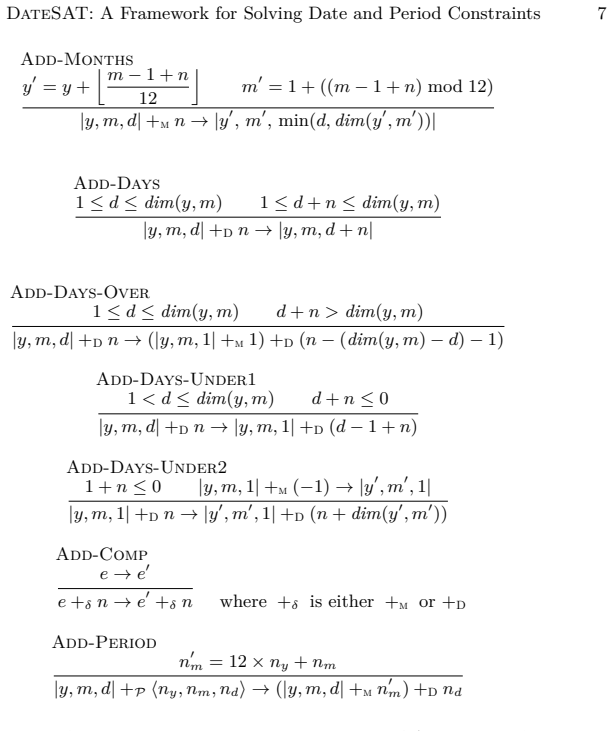
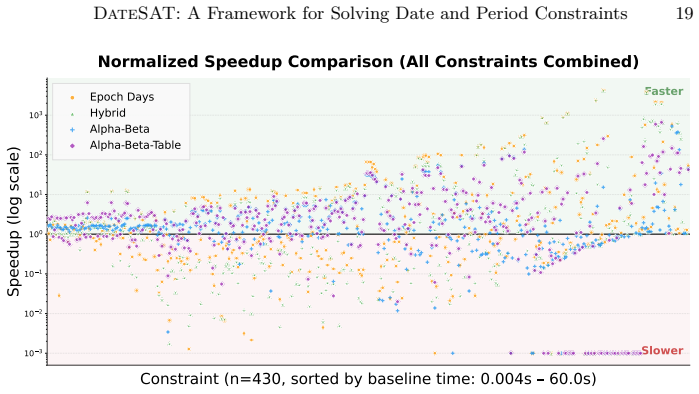
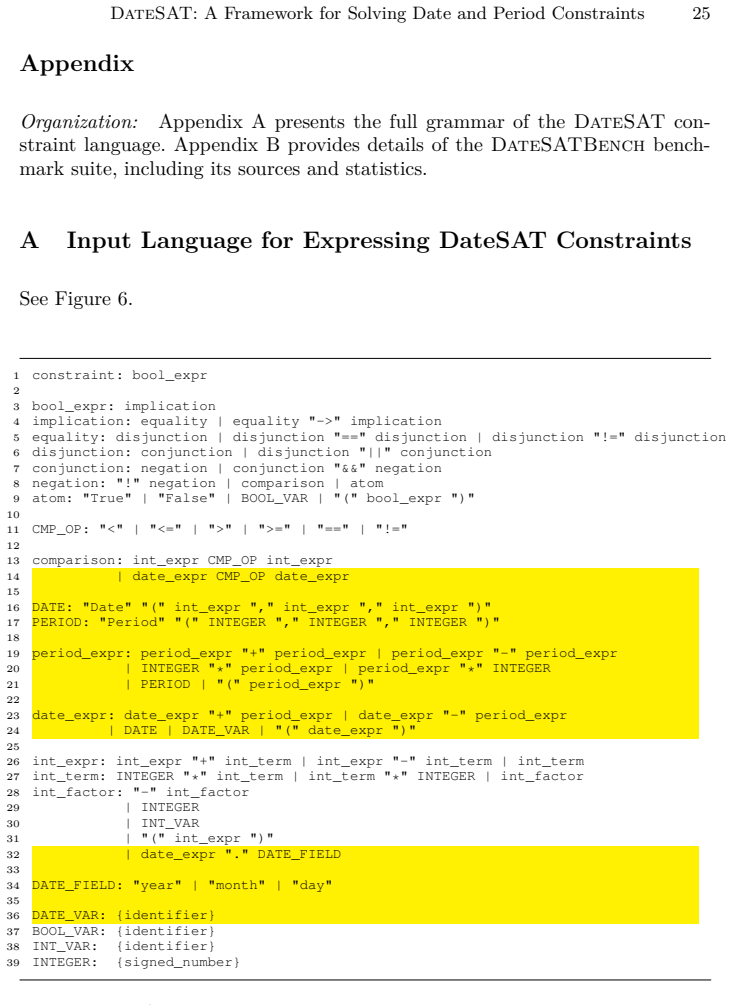
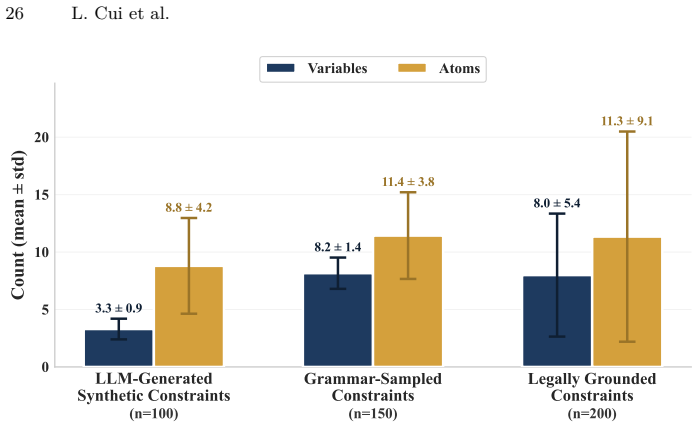
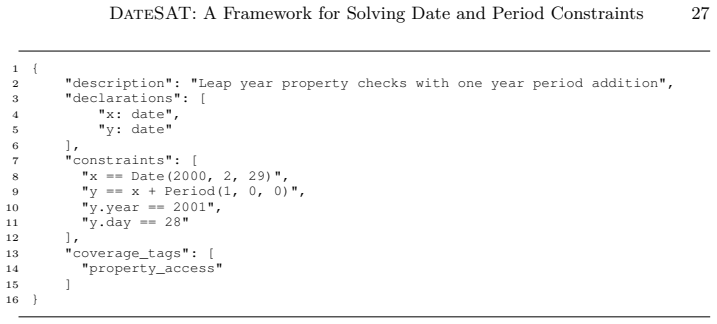
Dates and calendar periods (i.e., days, months, years) appear frequently in tasks involving analysis of software, data, and documents. Prior research has shown that computer logic involving dates and calendrical calculations is error-prone due to tricky rules (e.g., irregularly sized months), ambiguities (e.g., scheduling one month from "Jan 31st"), and edge cases (e.g., leap years). However, existing program analysis and verification tools do not provide native support for dates, making it hard to reason about operations involving calendrical arithmetic symbolically. This paper presents DateSAT, the first framework for expressing and solving satisfiability constraints involving dates and calendar periods. The paper first formalizes an input language and the semantics of date and period arithmetic. The paper then presents five separate strategies for solving DateSAT constraints based on reductions to SMT formulas involving integers, which we have implemented using Z3 as a backend. We curate a dataset of 450 DateSAT constraints synthesized using LLM prompting, grammar-based sampling, and mining legal documents, and then present an empirical evaluation of DateSAT solver performance.
Editorial analysis
A structured set of objections, weighed in public.
Referee Report
Summary. The paper introduces DateSAT, the first framework for expressing and solving satisfiability constraints involving dates and calendar periods. It formalizes an input language and the semantics of date and period arithmetic, presents five reduction strategies to SMT formulas over integers implemented using Z3, and evaluates the approach on a dataset of 450 DateSAT constraints synthesized using LLM prompting, grammar-based sampling, and mining legal documents.
Significance. If the reductions are sound, DateSAT would address a practical gap in program analysis and verification tools by enabling symbolic reasoning about calendrical constraints, which are prone to errors due to irregular month lengths, leap years, and ambiguities. The implementation with Z3 and the curated dataset provide a basis for empirical assessment of performance.
major comments (2)
- [Reductions section] Reductions section (following the semantics formalization): No formal proof, machine-checked verification, or exhaustive case analysis is provided showing that the five reduction strategies preserve satisfiability and unsatisfiability with respect to the formalized semantics. This is load-bearing for the central claim that DateSAT correctly solves the constraints, especially given potential failures on edge cases such as month-length variations, leap years, and ambiguous additions like "Jan 31 + 1 month".
- [Empirical evaluation section] Empirical evaluation section: Performance results on the 450-instance dataset cannot substitute for a soundness argument, as they provide no evidence that every model of the SMT formula corresponds to a model of the original DateSAT constraint (and vice versa).
minor comments (1)
- [Abstract] Abstract and introduction: The claim of being "the first framework" would be strengthened by explicit discussion of related work on date arithmetic in SMT solvers or constraint programming.
Simulated Author's Rebuttal
We thank the referee for the constructive feedback highlighting the importance of soundness for the reduction strategies. We address each major comment below and commit to revisions that strengthen the manuscript without altering its core contributions.
read point-by-point responses
-
Referee: [Reductions section] Reductions section (following the semantics formalization): No formal proof, machine-checked verification, or exhaustive case analysis is provided showing that the five reduction strategies preserve satisfiability and unsatisfiability with respect to the formalized semantics. This is load-bearing for the central claim that DateSAT correctly solves the constraints, especially given potential failures on edge cases such as month-length variations, leap years, and ambiguous additions like "Jan 31 + 1 month".
Authors: We agree that the current manuscript lacks an explicit formal proof of soundness for the five reduction strategies. The reductions were constructed to be semantics-preserving by design, but we recognize that informal presentation is insufficient for the central claim. We will add a dedicated subsection after the semantics formalization that provides rigorous proofs for each strategy, including explicit handling of edge cases such as leap years, variable month lengths, and ambiguous period additions. These proofs will establish both satisfiability and unsatisfiability preservation. revision: yes
-
Referee: [Empirical evaluation section] Empirical evaluation section: Performance results on the 450-instance dataset cannot substitute for a soundness argument, as they provide no evidence that every model of the SMT formula corresponds to a model of the original DateSAT constraint (and vice versa).
Authors: We concur that the empirical results on the 450-instance dataset serve only to evaluate performance and scalability and cannot substitute for a soundness argument. We will revise the evaluation section to explicitly state its scope and purpose, removing any phrasing that could be read as implying empirical validation of correctness. The soundness proofs added in response to the first comment will directly address the correspondence between models of the SMT formulas and the original DateSAT constraints. revision: yes
Circularity Check
No significant circularity detected in derivation chain
full rationale
The paper formalizes an input language and semantics for dates and periods, then presents five reduction strategies to integer SMT (implemented in Z3) along with empirical results on a 450-instance dataset. No equations, fitted parameters, self-citations, or ansatzes are quoted that would reduce any claimed result to its own inputs by construction. The reductions are presented as a new engineering contribution whose correctness is asserted with respect to the defined semantics; this does not constitute a self-definitional or fitted-input circularity under the specified patterns. The derivation chain is therefore self-contained.
Axiom & Free-Parameter Ledger
Reference graph
Works this paper leans on
-
[1]
com/news/claude-sonnet-4-5(2025), retrieved Jan 26, 2026
Anthropic: Introducing Claude Sonnet 4.5.https://www.anthropic. com/news/claude-sonnet-4-5(2025), retrieved Jan 26, 2026
2025
-
[2]
Azure, M.: Summary of Windows Azure service disruption on Feb 29th, 2012.https://azure.microsoft.com/en-us/blog/summary- of-windows-azure-service-disruption-on-feb-29th-2012/ (2012), retrieved Apr 26, 2026
2012
-
[3]
Baptiste, P., Le Pape, C., Nuijten, W.: Constraint-based scheduling: ap- plying constraint programming to scheduling problems, vol. 39. Springer Science & Business Media (2001)
2001
-
[4]
In: Proceedings of the 8th international workshop on satisfiability modulo theories (Edinburgh, UK)
Barrett, C., Stump, A., Tinelli, C., et al.: The SMT-LIB standard: Ver- sion 2.0. In: Proceedings of the 8th international workshop on satisfiability modulo theories (Edinburgh, UK). vol. 13, p. 14 (2010)
2010
-
[5]
In: Handbook of model checking, pp
Barrett, C., Tinelli, C.: Satisfiability modulo theories. In: Handbook of model checking, pp. 305–343. Springer (2018)
2018
-
[6]
In: 2017 Formal Methods in Computer Aided Design (FM- CAD)
Berzish, M., Ganesh, V., Zheng, Y.: Z3str3: A string solver with theory- aware heuristics. In: 2017 Formal Methods in Computer Aided Design (FM- CAD). pp. 55–59. IEEE (2017)
2017
- [7]
-
[8]
Fordham Intell
Cheian, D.: I see dead patents: How bugs in the patent system keep expired patents alive. Fordham Intell. Prop. Media & Ent. LJ33, 1 (2022)
2022
-
[9]
In: 44th IARCS Annual Conference on Foundations of Software Technology and Theoretical Computer Science (FSTTCS 2024)
Chistikov, D.: An introduction to the theory of linear integer arithmetic. In: 44th IARCS Annual Conference on Foundations of Software Technology and Theoretical Computer Science (FSTTCS 2024). vol. 323, p. 1. Schloss Dagstuhl—Leibniz-Zentrum für Informatik (2024)
2024
-
[10]
Creative Commons: CC-BY 4.0 license (2013),https:// creativecommons.org/licenses/by/4.0/
2013
-
[11]
In: Proceedings of theTheoryandPracticeofSoftware,14thInternationalConferenceonTools and Algorithms for the Construction and Analysis of Systems
De Moura, L., Bjørner, N.: Z3: an efficient SMT solver. In: Proceedings of theTheoryandPracticeofSoftware,14thInternationalConferenceonTools and Algorithms for the Construction and Analysis of Systems. p. 337–340. TACAS’08/ETAPS’08, Springer-Verlag, Berlin, Heidelberg (2008)
2008
-
[12]
DeepMind, G.: Gemini 3: Our most intelligent AI model that brings any idea to life.https://deepmind.google/models/gemini/(2025), re- trieved Jan 26, 2026
2025
-
[13]
In: International Sympo- sium on Formal Techniques in Real-Time and Fault-Tolerant Systems
Dutertre, B., Sorea, M.: Modeling and verification of a fault-tolerant real- time startup protocol using calendar automata. In: International Sympo- sium on Formal Techniques in Real-Time and Fault-Tolerant Systems. pp. 199–214. Springer (2004)
2004
-
[14]
Fatemi, B., Kazemi, M., Tsitsulin, A., Malkan, K., Yim, J., Palowitch, J., Seo, S., Halcrow, J., Perozzi, B.: Test of time: A benchmark for evaluating LLMs on temporal reasoning. arXiv preprint arXiv:2406.09170 (2024) DateSAT: A Framework for Solving Date and Period Constraints 23
-
[15]
PRIMETIME : Limits of LLMs in Temporal Primitives
Gaere, E., Wangenheim, F.: DATETIME: A new benchmark to measure LLM translation and reasoning capabilities. arXiv preprint arXiv:2504.16155 (2025)
work page internal anchor Pith review Pith/arXiv arXiv 2025
-
[16]
Goebel, R., Kano, Y., Kim, M.Y., Rabelo, J., Satoh, K., Yoshioka, M.: Summary of the competition on legal information, extraction/entailment (COLIEE)2023.In:ProceedingsoftheNineteenthInternationalConference on Artificial Intelligence and Law. pp. 472–480 (2023)
2023
-
[17]
In: European Symposium on Programming
Goutagny, P., Fromherz, A., Monat, R.: CUTECat: Concolic execution for computational law. In: European Symposium on Programming. pp. 31–61. Springer (2025)
2025
-
[18]
Advances in Neural Information Processing Systems36(2024)
Guha,N.,Nyarko,J.,Ho,D.,Ré,C.,Chilton,A.,Chohlas-Wood,A.,Peters, A., Waldon, B., Rockmore, D., Zambrano, D., et al.: Legalbench: A collab- oratively built benchmark for measuring legal reasoning in large language models. Advances in Neural Information Processing Systems36(2024)
2024
-
[19]
In: Proceedings of the eighteenth international symposium on Software testing and analysis
Kiezun, A., Ganesh, V., Guo, P.J., Hooimeijer, P., Ernst, M.D.: Hampi: a solver for string constraints. In: Proceedings of the eighteenth international symposium on Software testing and analysis. pp. 105–116 (2009)
2009
-
[20]
Proceedings of the ACM on Programming Languages 7(OOPSLA1), 286–315 (2023)
Lattuada, A., Hance, T., Cho, C., Brun, M., Subasinghe, I., Zhou, Y., How- ell, J., Parno, B., Hawblitzel, C.: Verus: Verifying Rust programs using linear ghost types. Proceedings of the ACM on Programming Languages 7(OOPSLA1), 286–315 (2023)
2023
-
[21]
In: International Conference on Computer Aided Verification
Liang, T., Reynolds, A., Tinelli, C., Barrett, C., Deters, M.: A dpll (t) the- ory solver for a theory of strings and regular expressions. In: International Conference on Computer Aided Verification. pp. 646–662. Springer (2014)
2014
-
[22]
MacIver, D., Hatfield-Dodds, Z., Contributors, M.: Hypothesis: A new approach to property-based testing. Journal of Open Source Software 4(43), 1891 (11 2019).https://doi.org/10.21105/joss.01891, http://dx.doi.org/10.21105/joss.01891
-
[23]
In: European Symposium on Programming
Monat, R., Fromherz, A., Merigoux, D.: Formalizing date arithmetic and statically detecting ambiguities for the law. In: European Symposium on Programming. pp. 421–450. Springer (2024)
2024
-
[24]
Mora, F., Berzish, M., Kulczynski, M., Nowotka, D., Ganesh, V.: Z3str4: A multi-armedstringsolver.In:InternationalSymposiumonFormalMethods. pp. 389–406. Springer (2021)
2021
-
[25]
Philosophical Transactions of the Royal Society A382(2270), 20230159 (2024)
Nay, J.J., Karamardian, D., Lawsky, S.B., Tao, W., Bhat, M., Jain, R., Lee, A.T., Choi, J.H., Kasai, J.: Large language models as tax attorneys: a case study in legal capabilities emergence. Philosophical Transactions of the Royal Society A382(2270), 20230159 (2024)
2024
-
[26]
Code of Laws of the United States of America26(121) (2018)
Office, G.P.: Internal Revenue Code. Code of Laws of the United States of America26(121) (2018)
2018
-
[27]
OpenAI: Introducing GPT-5.2.https://openai.com/index/ introducing-gpt-5-2/(2025), retrieved Jan 26, 2026
2025
-
[28]
In: Proceedings of the 2024 ACM SIGPLAN International Sym- posium on New Ideas, New Paradigms, and Reflections on Programming and Software
Padhye, R.: Software engineering methods for AI-driven deductive legal reasoning. In: Proceedings of the 2024 ACM SIGPLAN International Sym- posium on New Ideas, New Paradigms, and Reflections on Programming and Software. pp. 85–95 (2024) 24 L. Cui et al
2024
-
[29]
Pierce, R.: Birthday puzzle.https://www.mathsisfun.com/ puzzles/birthday.html(2012), retrieved Jan 10, 2026
2012
-
[30]
Presburger, M.: Über die vollständigkeit eines gewissen systems der arith- metik ganzer zahlen, in welchem die addition als einzige operation hervor- tritt.In:ComptesRendusduICongrèsdesMathématiciensdesPaysSlaves, Warszawa. pp. 92–101. Skład Główny (1929)
1929
-
[31]
https://www.reuters.com/world/asia-pacific/leap-year- glitch-shuts-some-new-zealand-fuel-pumps-2024-02-29/ (Feb 2024)
Reuters: ’leap year glitch’ shuts some new zealand fuel pumps. https://www.reuters.com/world/asia-pacific/leap-year- glitch-shuts-some-new-zealand-fuel-pumps-2024-02-29/ (Feb 2024)
2024
-
[32]
In: 2010 IEEE Symposium on Security and Privacy
Saxena, P., Akhawe, D., Hanna, S., Mao, F., McCamant, S., Song, D.: A symbolic execution framework for javascript. In: 2010 IEEE Symposium on Security and Privacy. pp. 513–528. IEEE (2010)
2010
-
[33]
In: 2025 IEEE/ACM 22nd International Conference on Mining Software Repositories (MSR)
Tiwari, S., Chen, S., Joukov, A., Vandervelde, P., Li, A., Padhye, R.: It’s about time: An empirical study of date and time bugs in open-source python software. In: 2025 IEEE/ACM 22nd International Conference on Mining Software Repositories (MSR). pp. 39–51 (2025).https://doi.org/10. 1109/MSR66628.2025.00020
-
[34]
In: Proceedings of the 2014 ACM SIGSAC Conference on Computer and Communications Security
Trinh, M.T., Chu, D.H., Jaffar, J.: S3: A symbolic string solver for vul- nerability detection in web applications. In: Proceedings of the 2014 ACM SIGSAC Conference on Computer and Communications Security. pp. 1232– 1243 (2014)
2014
-
[35]
Computers & Operations Research142, 105731 (2022)
Xiong, H., Shi, S., Ren, D., Hu, J.: A survey of job shop scheduling problem: The types and models. Computers & Operations Research142, 105731 (2022)
2022
-
[36]
In: Proceedings of the eighteenth international conference on artificial in- telligence and law
Yoshioka, M., Aoki, Y., Suzuki, Y.: BERT-based ensemble methods with data augmentation for legal textual entailment in COLIEE statute law task. In: Proceedings of the eighteenth international conference on artificial in- telligence and law. pp. 278–284 (2021)
2021
-
[37]
Zamudio Amaya, J.A., Smytzek, M., Zeller, A.: Fandango: Evolv- ing language-based testing. Proc. ACM Softw. Eng.2(ISSTA) (Jun 2025).https://doi.org/10.1145/3728915,https://doi.org/ 10.1145/3728915
-
[38]
Zheng, Y., Ganesh, V., Subramanian, S., Tripp, O., Berzish, M., Dolby, J., Zhang, X.: Z3str2: an efficient solver for strings, regular expressions, and lengthconstraints.FormalMethodsinSystemDesign50(2),249–288(2017)
2017
-
[39]
->" implication 5equality: disjunction | disjunction
Zheng, Y., Zhang, X., Ganesh, V.: Z3-str: A z3-based string solver for web application analysis. In: Proceedings of the 2013 9th Joint Meeting on Foun- dations of Software Engineering. pp. 114–124 (2013) DateSAT: A Framework for Solving Date and Period Constraints 25 Appendix Organization:Appendix A presents the full grammar of theDateSATcon- straint lang...
2013
discussion (0)
Sign in with ORCID, Apple, or X to comment. Anyone can read and Pith papers without signing in.