On the Hersch-Weinberger inequality in higher dimensions
Pith reviewed 2026-06-29 23:31 UTC · model grok-4.3
The pith
A concentric spherical shell maximizes the first Robin eigenvalue among domains with two boundary components under volume and perimeter constraints.
A machine-rendered reading of the paper's core claim, the machinery that carries it, and where it could break.
Core claim
A concentric spherical shell maximizes the first eigenvalue of the Robin Laplacian over a class of domains with two connected boundary components under perimeter and volume constraints, and under an additional convexity assumption when N ≥ 3. The proof relies on the gradient flow of the first eigenfunction together with several approximation procedures; the effectless cut is shown to possess basic topological properties but need not be a hypersurface.
What carries the argument
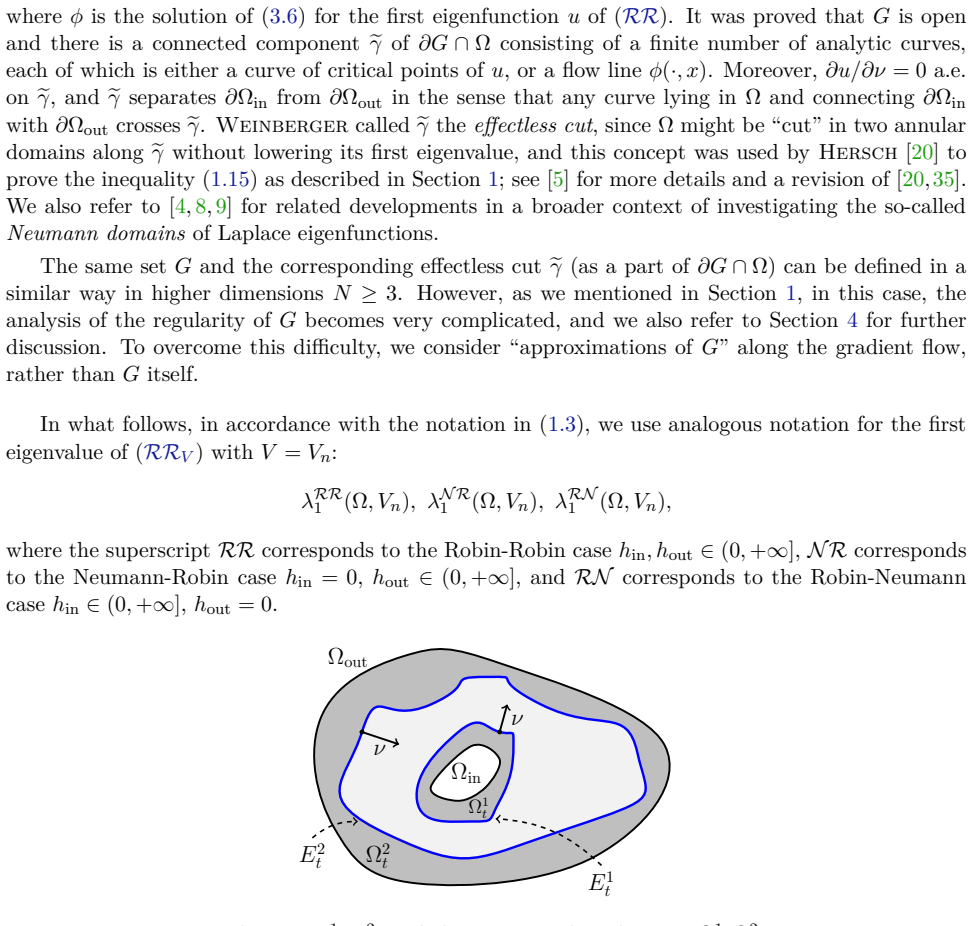
Gradient flow of the first eigenfunction, which generates the flow lines used to compare eigenvalues and to approximate the maximizer.
If this is right
- The maximality result extends to a wider class of domains with two boundary components.
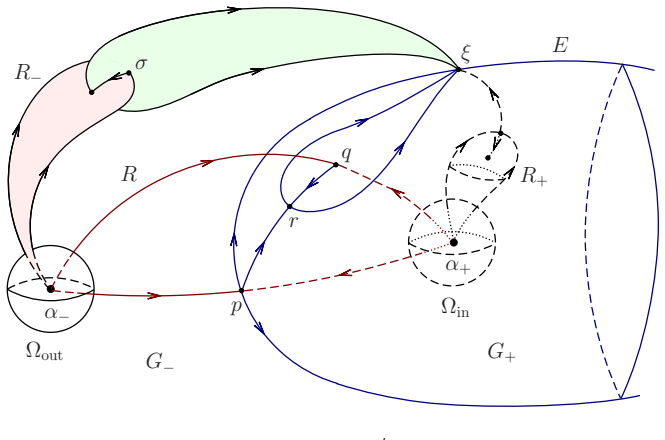
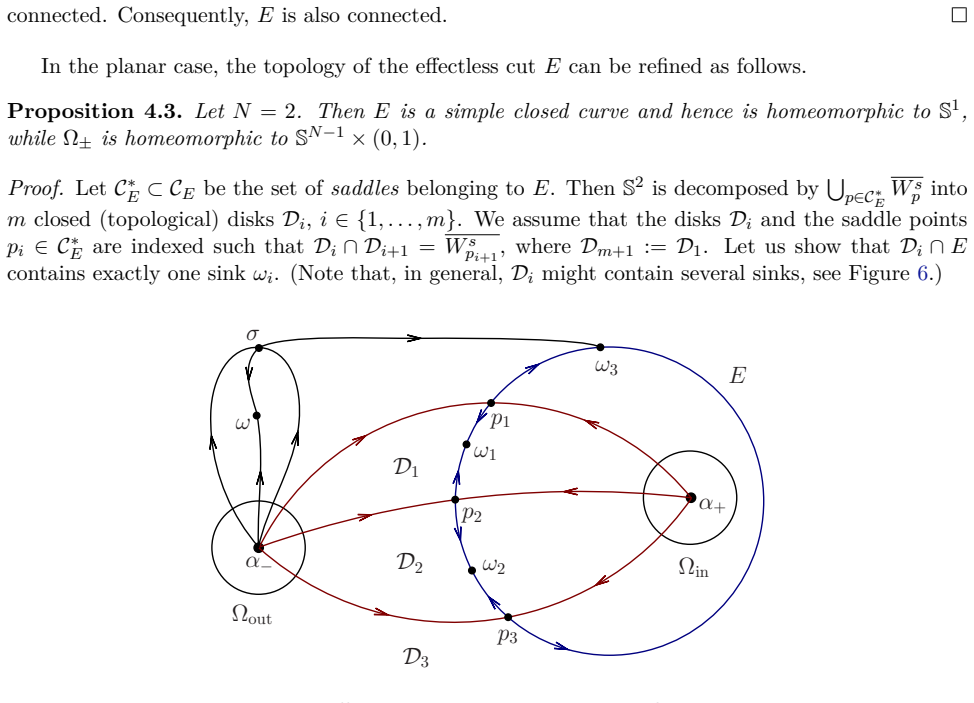
- The effectless cut associated with the gradient flow is not necessarily a hypersurface.
- The gradient-flow method replaces the earlier effectless-cut construction and works in all dimensions.
Where Pith is reading between the lines
- Gradient-flow techniques developed here could be tested on other Robin-type optimization problems with disconnected boundaries.
- Numerical schemes that follow eigenfunction gradient flows might locate candidate maximizers in domains where convexity fails.
- The topological description of the effectless cut suggests examining whether similar objects arise for higher eigenvalues or different boundary conditions.
Load-bearing premise
The domain boundary consists of exactly two connected components, the domain is convex when the dimension is at least three, and the first eigenfunction is sufficiently regular for its gradient flow to be analyzed.
What would settle it
A non-convex or non-concentric domain with two boundary components that achieves a strictly larger first Robin eigenvalue than the concentric shell while preserving the same volume and perimeter would falsify the maximality claim.
Figures
read the original abstract
We investigate a reverse Faber-Krahn type inequality for the Robin Laplacian in a bounded smooth domain $\Omega \subset \mathbb{R}^N$ whose boundary has two connected components. We prove that a concentric spherical shell maximizes the first eigenvalue over a class of such domains under perimeter and volume constraints, and under an additional convexity assumption when $N \geq 3$. This result generalizes to a wider class, and extends to higher dimensions, the inequality of Hersch [20], whose approach was substantially based on a construction of the so-called effectless cut by Weinberger [35], so that we call it the Hersch-Weinberger inequality. Our method is based on the analysis of the gradient flow of the first eigenfunction and several approximation procedures, without relying on the effectless cut itself. The effectless cut being a complicated object related to the attractor of the gradient flow, we describe its most fundamental topological properties. In particular, we show that it does not necessarily have to be a hypersurface.
Editorial analysis
A structured set of objections, weighed in public.
Referee Report
Summary. The manuscript proves that, among bounded smooth domains Ω ⊂ R^N with exactly two connected boundary components, the concentric spherical shell maximizes the first Robin eigenvalue λ1 under fixed volume and perimeter constraints (with an additional convexity assumption imposed when N ≥ 3). The argument proceeds by analyzing the gradient flow of a positive first eigenfunction, combined with several approximation procedures that avoid direct use of the effectless cut; the paper also establishes basic topological properties of the effectless cut, showing in particular that it need not be a hypersurface.
Significance. If the approximation arguments are fully rigorous, the result supplies a direct gradient-flow proof of a higher-dimensional Hersch-Weinberger inequality for Robin eigenvalues on domains with prescribed topology, thereby extending the classical two-dimensional case and furnishing new information on the attractor of the flow. The explicit description of the effectless cut’s topological features is a secondary but useful contribution.
major comments (3)
- [gradient-flow approximation section (post-Theorem 1.1)] The central approximation scheme (gradient flow followed by passage to the limit) must simultaneously preserve convexity (when N ≥ 3), connectedness of each boundary component, and the strict inequality λ1(Ω) < λ1(shell). The manuscript notes that the flow can develop critical points whose stable manifolds are not hypersurfaces, yet the argument that these phenomena do not violate the three listed properties in the limit is not supplied with sufficient detail or an independent check (e.g., an explicit non-radial convex annulus computation).
- [convexity handling paragraph] The convexity assumption is invoked to preclude focal points, but the paper does not verify that the approximating sequence remains inside the convex class while the flow is applied; without this, the comparison with the concentric shell cannot be closed.
- [eigenfunction regularity subsection] The claim that the first eigenfunction remains sufficiently regular for the flow analysis to be justified throughout the approximation is stated but not accompanied by uniform estimates that survive the limit while keeping the two boundary components distinct.
minor comments (2)
- [preliminaries] Notation for the Robin parameter and the two boundary components should be introduced once and used consistently; several passages switch between Γ1, Γ2 and ∂Ω± without explicit cross-reference.
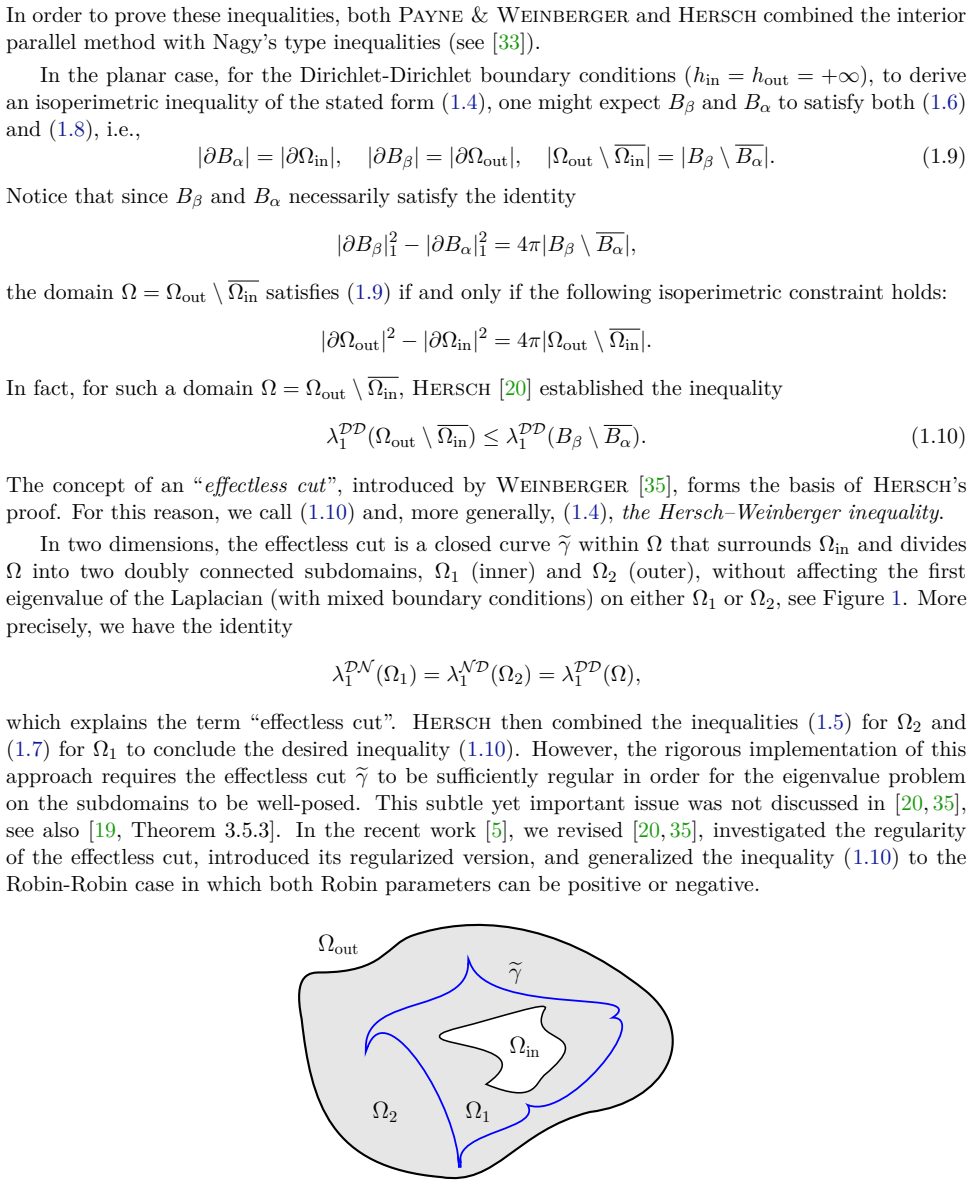
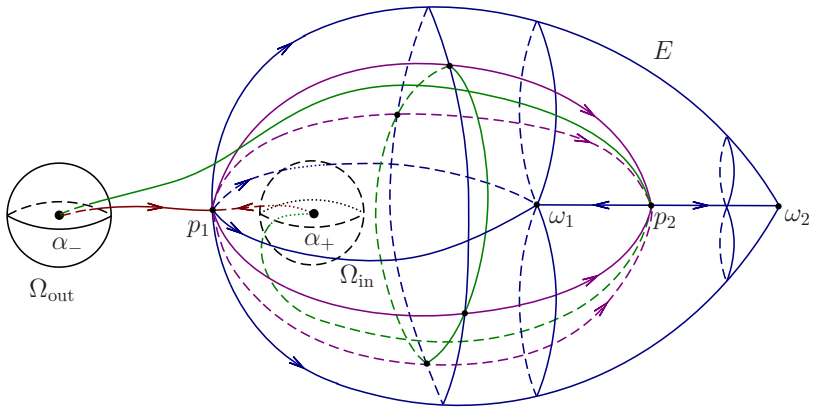
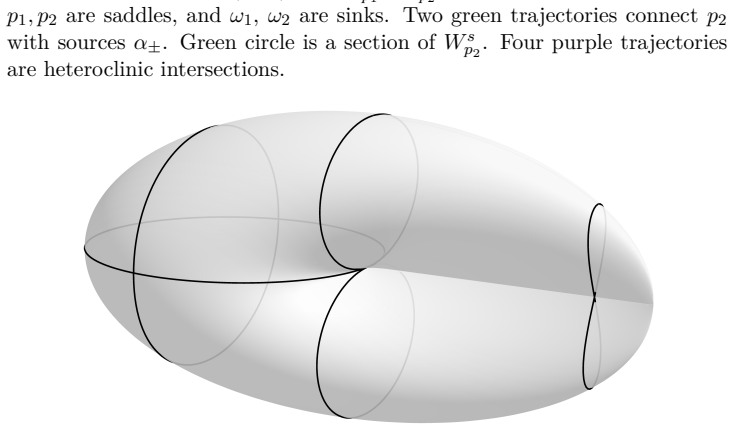
- [effectless-cut topology paragraph] The statement that the effectless cut “does not necessarily have to be a hypersurface” would benefit from a concrete low-dimensional example or figure illustrating the topology that arises.
Simulated Author's Rebuttal
We thank the referee for the thorough report and constructive suggestions. The comments correctly identify points where the approximation arguments need expanded justification. We will revise the manuscript to supply the missing details on limit preservation, convexity maintenance, and uniform estimates, thereby strengthening the rigor of the gradient-flow approach without altering the main results.
read point-by-point responses
-
Referee: [gradient-flow approximation section (post-Theorem 1.1)] The central approximation scheme (gradient flow followed by passage to the limit) must simultaneously preserve convexity (when N ≥ 3), connectedness of each boundary component, and the strict inequality λ1(Ω) < λ1(shell). The manuscript notes that the flow can develop critical points whose stable manifolds are not hypersurfaces, yet the argument that these phenomena do not violate the three listed properties in the limit is not supplied with sufficient detail or an independent check (e.g., an explicit non-radial convex annulus computation).
Authors: We agree that additional detail on the passage to the limit is warranted. In the revision we will insert a dedicated paragraph (or short subsection) after Theorem 1.1 that invokes the C^1-continuity of λ1 with respect to domain variation together with the strict inequality λ1(Ω) < λ1(shell) to show that connectedness of the two boundary components and the strict inequality are preserved; convexity is handled separately in the next comment. We maintain that an explicit non-radial convex annulus computation is not required for the general argument, as the topological properties of the effectless cut already control the possible singularities of the stable manifolds; we will clarify this distinction rather than add the suggested computation. revision: partial
-
Referee: [convexity handling paragraph] The convexity assumption is invoked to preclude focal points, but the paper does not verify that the approximating sequence remains inside the convex class while the flow is applied; without this, the comparison with the concentric shell cannot be closed.
Authors: We will expand the convexity-handling paragraph to include a short verification: the initial approximating domains are obtained by mollification of a smooth convex domain and therefore remain convex; standard comparison principles for the mean-curvature flow (or the specific gradient flow of the eigenfunction) preserve convexity when the initial datum is convex and the Robin parameter is positive. This keeps the entire approximating sequence inside the convex class, allowing the comparison with the concentric shell to close. revision: yes
-
Referee: [eigenfunction regularity subsection] The claim that the first eigenfunction remains sufficiently regular for the flow analysis to be justified throughout the approximation is stated but not accompanied by uniform estimates that survive the limit while keeping the two boundary components distinct.
Authors: We will add uniform Schauder estimates (derived from the standard elliptic theory for the Robin problem) that are independent of the approximation parameter. These estimates guarantee that the first eigenfunction stays in C^{2,α} up to the boundary uniformly, which in turn ensures that the two boundary components remain separated in the limit by the strict inequality λ1(Ω) < λ1(shell). The estimates will be collected in a short appendix for clarity. revision: yes
Circularity Check
No circularity: derivation via independent gradient-flow analysis
full rationale
The paper derives the maximizer property for the concentric shell by direct analysis of the gradient flow of the first Robin eigenfunction together with approximation procedures that preserve the two-component boundary and convexity constraints. No step reduces a claimed prediction to a fitted input by construction, nor does any load-bearing premise rest on a self-citation chain. The cited Hersch and Weinberger results are external prior work; the present argument explicitly avoids relying on the effectless-cut construction. The derivation is therefore self-contained against external benchmarks.
Axiom & Free-Parameter Ledger
axioms (2)
- standard math The first eigenfunction of the Robin Laplacian exists and is sufficiently regular for the gradient flow to be well-defined on the space of admissible domains.
- domain assumption The domain is bounded and smooth with boundary consisting of exactly two connected components.
Reference graph
Works this paper leans on
-
[1]
J. H. Albert. Generic properties of eigenfunctions of elliptic partial differential operators. Trans. Amer. Math. Soc., 238:341–354, 1978. doi:10.2307/1997812. 8, 24
-
[2]
V. Amato, N. Gavitone, and F. de Giovanni. On the Effectless Cut Method for Laplacian Eigenvalues in any dimensions. arXiv:2604.00976, 2026. doi:10.48550/arXiv.2604.00976. 4, 7 24
-
[3]
T. V. Anoop and K. Ashok Kumar. On reverse Faber-Krahn inequalities. J. Math. Anal. Appl., 485(1):123766, 20, 2020. doi:10.1016/j.jmaa.2019.123766. 3, 4
-
[4]
T. V. Anoop, V. Bobkov, and M. Ghosh. Neumann domains of planar analytic eigenfunctions. arXiv:2410.07811, 2024. doi:10.48550/arXiv.2410.07811. 12, 15
-
[5]
T. V. Anoop, V. Bobkov, and M. Ghosh. Reverse Faber-Krahn inequality for planar doubly connected domains. arXiv:2410.07811, 2025. doi:10.48550/arXiv.2509.17480. 3, 4, 5, 9, 11, 12, 14, 15, 18, 24
-
[6]
T. V. Anoop, V. Bobkov, and S. Sasi. On the strict monotonicity of the first eigenvalue of the p-Laplacian on annuli. Trans. Amer. Math. Soc., 370(10):7181–7199, 2018. doi:10.1090/tran/
-
[7]
T. V. Anoop and M. Ghosh. Reverse Faber-Krahn inequalities for Zaremba problems. Topol. Methods Nonlinear Anal., 64(1):257–278, 2024. doi:10.12775/TMNA.2023.055. 3, 4, 6, 14, 24
-
[8]
R. Band, G. Cox, and S. K. Egger. Defining the spectral position of a Neumann domain. Anal. PDE, 16(9):2147–2171, 2023. doi:10.2140/apde.2023.16.2147. 12, 18
-
[9]
R. Band and D. Fajman. Topological properties of Neumann domains. Ann. Henri Poincaré, 17(9):2379–2407, 2016. doi:10.1007/s00023-016-0468-7 . 12
-
[10]
Banyaga and D
A. Banyaga and D. Hurtubise. Lectures on Morse homology, volume 29 of Kluwer Texts in the Mathematical Sciences. Kluwer Academic Publishers Group, Dordrecht, 2004. doi:10.1007/ 978-1-4020-2696-6 . 23
2004
-
[11]
D. Bucur, P. Freitas, and J. Kennedy. The Robin problem. In Shape optimization and spectral theory, pages 78–119. De Gruyter Open, Warsaw, 2017. doi:10.1515/9783110550887-004. 8
-
[12]
F. Della Pietra, C. Nitsch, and C. Trombetti. An optimal insulation problem. Math. Ann., 382(1-2):745–759, 2022. doi:10.1007/s00208-020-02058-6 . 7
-
[13]
Della Pietra and G
F. Della Pietra and G. Piscitelli. An optimal bound for nonlinear eigenvalues and tor- sional rigidity on domains with holes. Milan J. Math., 88(2):373–384, 2020. doi:10.1007/ s00032-020-00320-9 . 4, 14, 24
2020
-
[14]
N. Gavitone and G. Piscitelli. A sharp bound for the first Robin-Dirichlet eigenvalue. J. Optim. Theory Appl., 203(1):745–766, 2024. doi:10.1007/s10957-024-02531-1 . 4
-
[15]
Gilbarg and N
D. Gilbarg and N. S. Trudinger. Elliptic partial differential equations of second order. Classics in Mathematics. Springer-Verlag, Berlin, 2001. Reprint of the 1998 edition. 2
2001
-
[16]
V. Z. Grines, T. V. Medvedev, and O. V. Pochinka. Dynamical systems on 2- and 3-manifolds, volume 46 of Developments in Mathematics. Springer, Cham, 2016. doi: 10.1007/978-3-319-44847-3 . 17, 20
-
[17]
V. Z. Grines, E. V. Zhuzhoma, V. S. Medvedev, and O. V. Pochinka. Global attractor and repeller of Morse–Smale diffeomorphisms. Proceedings of the Steklov Institute of Mathematics, 271(1):103–124, 2010. doi:10.1134/S0081543810040097. 18, 19, 20
-
[18]
E. M. Harrell, II, P. Kröger, and K. Kurata. On the placement of an obstacle or a well so as to optimize the fundamental eigenvalue. SIAM J. Math. Anal., 33(1):240–259, 2001. doi: 10.1137/S0036141099357574. 4
-
[19]
A. Henrot. Extremum problems for eigenvalues of elliptic operators. Springer, 2006. doi: 10.1007/3-7643-7706-2 . 3
-
[20]
J. Hersch. The method of interior parallels applied to polygonal or multiply connected mem- branes. Pacific J. Math., 13:1229–1238, 1963. URL: http://projecteuclid.org/euclid.pjm/ 1103034558. 1, 2, 3, 4, 5, 12
1963
-
[21]
D. Hug and W. Weil. Lectures on convex geometry, volume 286 of Graduate Texts in Mathematics. Springer, Cham, [2020] ©2020. doi:10.1007/978-3-030-50180-8 . 5, 6
-
[22]
J. Jost. Riemannian geometry and geometric analysis. Universitext. Springer-Verlag, Berlin, fourth edition, 2005. doi:10.1007/978-3-319-61860-9 . 11
-
[23]
S. Kesavan. On two functionals connected to the Laplacian in a class of doubly connected domains. Proc. Roy. Soc. Edinburgh Sect. A, 133(3):617–624, 2003. doi:10.1017/S0308210500002560. 4 25
-
[24]
A. Lemmens. A local Jordan-Brouwer separation theorem. arXiv preprint arXiv:1810.13221,
work page internal anchor Pith review Pith/arXiv arXiv
-
[25]
URL: https://doi.org/10.48550/arXiv.1810.13221. 20
work page internal anchor Pith review Pith/arXiv arXiv doi:10.48550/arxiv.1810.13221
-
[26]
G. M. Lieberman. Boundary regularity for solutions of degenerate elliptic equations. Nonlinear Analysis: Theory, Methods & Applications, 12(11):1203–1219, 1988. doi:10.1016/ 0362-546X(88)90053-3. 14
1988
-
[27]
G. Paoli, G. Piscitelli, and L. Trani. Sharp estimates for the first p-Laplacian eigenvalue and for the p-torsional rigidity on convex sets with holes. ESAIM Control Optim. Calc. Var., 26:Paper No. 111, 15, 2020. doi:10.1051/cocv/2020033. 3, 4, 14
-
[28]
L. E. Payne and H. F. Weinberger. Some isoperimetric inequalities for membrane frequencies and torsional rigidity. J. Math. Anal. Appl., 2:210–216, 1961. doi:10.1016/0022-247X(61)90031-2. 2, 4, 14
-
[29]
L. Perko. Differential equations and dynamical systems, volume 7 of Texts in Applied Mathematics. Springer-Verlag, New York, third edition, 2001. doi:10.1007/ 978-1-4613-0003-8 . 15
2001
-
[30]
Robinson
C. Robinson. Dynamical systems: stability, symbolic dynamics, and chaos. CRC Press, 1998. 17
1998
-
[31]
L. A. Santaló. Integral geometry and geometric probability. Addison-Wesley Publishing Com- pany, 1976. 6
1976
-
[32]
Schneider
R. Schneider. Convex bodies: the Brunn-Minkowski theory, volume 151 of Encyclopedia of Mathematics and its Applications. Cambridge University Press, Cambridge, expanded edition,
-
[33]
doi:10.1017/CBO9780511526282. 4, 5, 6
-
[34]
S. Smale. Differentiable dynamical systems. Bull. Amer. Math. Soc., 73:747–817, 1967. doi: 10.1090/S0002-9904-1967-11798-1 . 17
-
[35]
Sz.-Nagy
B. Sz.-Nagy. Über Parallelmengen nichtkonvexer ebener Bereiche. Acta Sci. Math. (Szeged), 20:36–47, 1959. 3
1959
-
[36]
K. Uhlenbeck. Generic properties of eigenfunctions. Amer. J. Math., 98(4):1059–1078, 1976. doi:10.2307/2374041. 8, 24
-
[37]
H. F. Weinberger. An effectless cutting of a vibrating membrane. Pacific J. Math., 13:1239–1240,
-
[38]
URL: http://projecteuclid.org/euclid.pjm/1103034559. 1, 3, 4, 5, 11, 12, 18 26 (T. V. Anoop) Department of Mathematics, Indian Institute of Technology Madras Chennai 36, India 0000-0002-2470-9140 E-mail address : anoop@iitm.ac.in (V. Bobkov) Institute of Mathematics, Ufa Federal Research Centre, RAS Chernyshevsky str. 112, 450008 Ufa, Russia 0000-0002-442...
discussion (0)
Sign in with ORCID, Apple, or X to comment. Anyone can read and Pith papers without signing in.