Local network evolution rules drive shortest path multiplicity
Pith reviewed 2026-07-02 23:14 UTC · model grok-4.3
The pith
Local network evolution rules cause shortest path multiplicity to increase faster with network size than random rewiring predicts.
A machine-rendered reading of the paper's core claim, the machinery that carries it, and where it could break.
Core claim
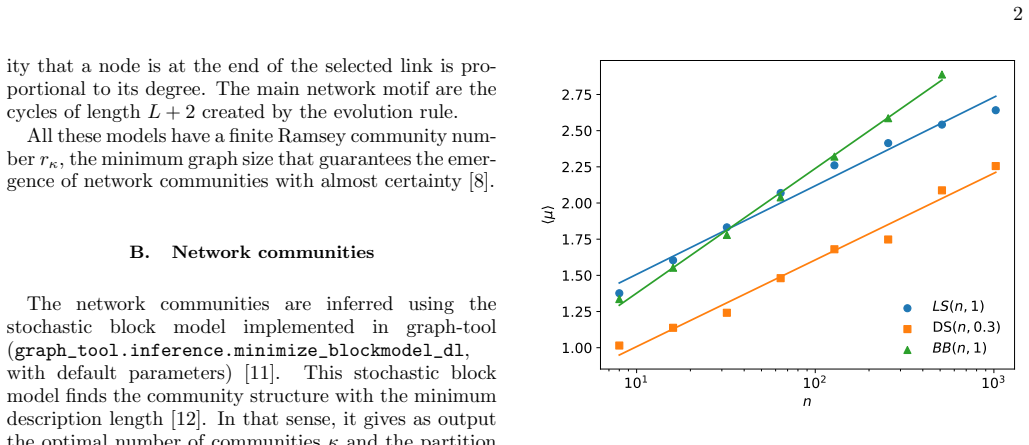
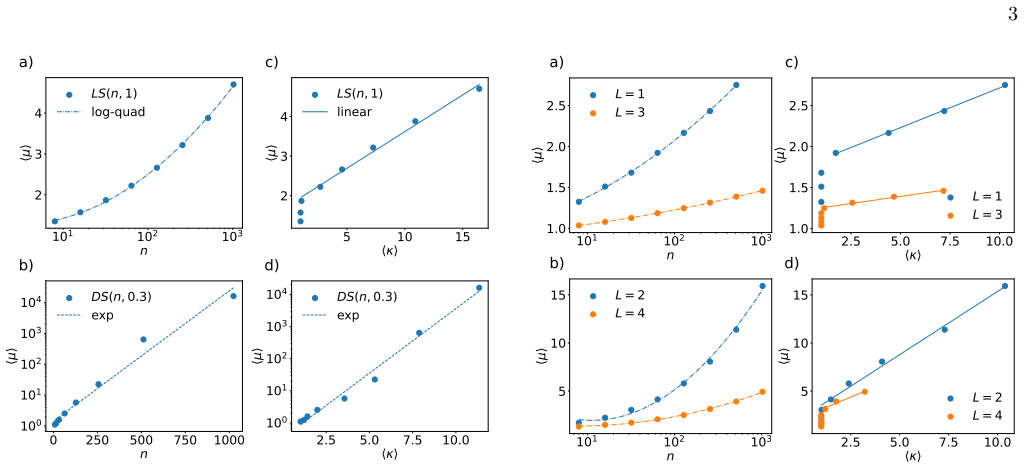
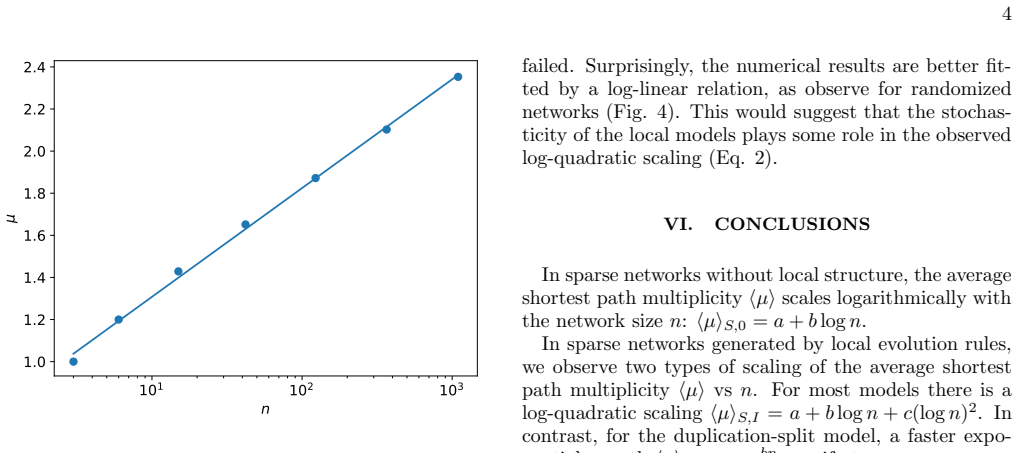
For networks generated by local rules, ⟨μ⟩ increases with the network size and it does so faster than what is observed in their randomized versions. Furthermore, the number of communities increases with the network size and the correlation with ⟨μ⟩ follows. For random graphs with arbitrary degree distributions p_k, ⟨μ⟩∼⟨k(k−1)⟩/(⟨k⟩e), growing with the network size when p_k∼k^{−γ} and γ≤3.
What carries the argument
Shortest path multiplicity μ (the average number of shortest paths between node pairs), generated by local evolution rules that also produce communities.
If this is right
- ⟨μ⟩ increases with network size under local evolution rules.
- The increase in ⟨μ⟩ is faster than the increase seen after degree-preserving randomization.
- The number of communities grows with network size.
- ⟨μ⟩ correlates positively with the number of communities.
- For random graphs with power-law exponent γ≤3, ⟨μ⟩ itself grows with network size.
Where Pith is reading between the lines
- If local attachment dominates real network formation then larger networks should reliably display higher multiplicity.
- Interventions that break local attachment could reduce both multiplicity and community count in growing networks.
- Multiplicity could function as a simple scalar indicator of emerging community structure without needing explicit community detection.
- The result supplies a baseline expectation for multiplicity in any network whose growth is dominated by local rules rather than global optimization.
Load-bearing premise
The particular local evolution rules used in the simulations represent the mechanisms that operate in real complex networks, and randomizing edges while preserving the degree distribution removes exactly the effects of those local rules.
What would settle it
A real network in which average shortest path multiplicity does not increase with size or does not exceed the value found after degree-preserving randomization would falsify the claim.
Figures
read the original abstract
The shortest path multiplicity, here denoted by $\mu$, is an important metric of complex networks. For real networks $\mu$ is high and it correlates with the network community structure. Since local network evolution induces network communities, it is possible that a high shortest path multiplicity is the natural expectation of local evolution rules. Here I demonstrate, by means of numerical simulations, that this is indeed the case. For random graphs with arbitrary degree distributions $p_k$, $\langle\mu\rangle\sim \langle k(k-1)\rangle / (\langle k\rangle e)$, growing with the network size when $p_k\sim k^{-\gamma}$ and $\gamma\leq3$. For networks generated by local rules, $\langle\mu\rangle$ increases with the network size and it does so faster than what is observed in their randomized versions. Furthermore, the number of communities increases with the network size and the correlation with $\langle \mu\rangle$ follows.
Editorial analysis
A structured set of objections, weighed in public.
Referee Report
Summary. The paper claims that shortest path multiplicity μ is naturally high in networks due to local evolution rules that also induce communities. For random graphs with arbitrary degree distribution p_k, it states ⟨μ⟩ ∼ ⟨k(k-1)⟩ / (⟨k⟩ e), which grows with network size for p_k ~ k^{-γ} when γ ≤ 3. Numerical simulations are presented to show that networks generated by local rules exhibit faster growth of ⟨μ⟩ with size than degree-preserving randomized versions, with the number of communities also increasing and correlating with ⟨μ⟩.
Significance. If the simulation results are robust, the work would establish a direct mechanistic link between local network evolution, community structure, and shortest-path multiplicity, providing a baseline expectation for μ in real networks without invoking additional global mechanisms.
major comments (2)
- [Abstract] Abstract: The scaling formula ⟨μ⟩ ∼ ⟨k(k-1)⟩ / (⟨k⟩ e) for random graphs is presented as a key theoretical expectation but without derivation, proof sketch, or reference to an equation or section where it is obtained. This baseline is load-bearing for the claim that local-rule networks grow faster.
- [Simulation results] Simulation results: The central claim that local-rule networks show faster ⟨μ⟩ growth than randomized counterparts rests on numerical simulations, yet no details are supplied on the specific local evolution rules, network sizes simulated, number of realizations, statistical controls, error analysis, or the precise randomization procedure (e.g., configuration model or other degree-sequence preservation method). These omissions prevent verification of the scaling statements and the attribution to local structure.
Simulated Author's Rebuttal
Thank you for the referee's thoughtful review of our manuscript on local network evolution rules and shortest path multiplicity. We address each major comment point by point below.
read point-by-point responses
-
Referee: [Abstract] Abstract: The scaling formula ⟨μ⟩ ∼ ⟨k(k-1)⟩ / (⟨k⟩ e) for random graphs is presented as a key theoretical expectation but without derivation, proof sketch, or reference to an equation or section where it is obtained. This baseline is load-bearing for the claim that local-rule networks grow faster.
Authors: We agree that the abstract presents the scaling formula without a derivation, proof sketch, or reference to an equation or section. The manuscript does not include an explicit derivation of this expression. In the revised version, we will add a brief derivation or proof sketch in the main text (based on the configuration model approximation) and include a reference to the relevant section or equation in the abstract. revision: yes
-
Referee: [Simulation results] Simulation results: The central claim that local-rule networks show faster ⟨μ⟩ growth than randomized counterparts rests on numerical simulations, yet no details are supplied on the specific local evolution rules, network sizes simulated, number of realizations, statistical controls, error analysis, or the precise randomization procedure (e.g., configuration model or other degree-sequence preservation method). These omissions prevent verification of the scaling statements and the attribution to local structure.
Authors: We acknowledge that the simulation details are not sufficiently described in the current manuscript. In the revision, we will expand the relevant sections to specify the local evolution rules employed, the network sizes used in the simulations, the number of realizations performed, any statistical controls and error analysis applied, and the precise method for generating the randomized counterparts (such as the configuration model). revision: yes
Circularity Check
No significant circularity; derivation relies on independent theory and external benchmarks
full rationale
The paper states an independent closed-form expression for ⟨μ⟩ in random graphs with arbitrary degree distribution p_k and then reports separate numerical simulations comparing locally evolved networks against their degree-sequence randomized counterparts. The randomization step and the random-graph formula are not derived from the local-rule results; they function as external references. No load-bearing self-citations, self-definitional steps, or fitted quantities renamed as predictions appear in the provided text. The central claim therefore rests on simulation evidence that is not tautological with its inputs.
Axiom & Free-Parameter Ledger
axioms (2)
- domain assumption Local network evolution induces network communities
- domain assumption Random graphs with the same degree distribution form an appropriate null model for isolating local-structure effects
Reference graph
Works this paper leans on
-
[1]
For this model⟨µ⟩ increases faster than linear with increasing logn
model: node addition, link creation to a randomly chosen existing node, local search stopping at 1 step, and link addition to the reached node. For this model⟨µ⟩ increases faster than linear with increasing logn. A fit to the log-quadratic law ⟨µ⟩S,I =a+blogn+c(logn) 2,(2) is consistent with the data points for the range of network sizes tested (Fig. 2a, ...
-
[2]
In contrast, the duplication rule create cycles of length 4
There is only one shortest path between the nodes in a 3-nodes cycle. In contrast, the duplication rule create cycles of length 4. Each node in a 4-cycle has two shortest paths to the opposite node two steps away. The duplication rule boosts the shortest path multiplicity. 101 102 103 n 1.0 1.5 2.0 2.5 a) L = 1 L = 3 2.5 5.0 7.5 10.0 1.0 1.5 2.0 2.5 c) L ...
-
[3]
Y. Deng, J. Wu, X. Lu, P. Holme, D. Li, Z. Di, G. Chen, and J. Kurths, Nature Communications17, 2283 (2026)
2026
-
[4]
Vazquez, Phys
A. Vazquez, Phys. Rev. E67, 056104 (2003)
2003
-
[5]
J. M. Kleinberg, R. Kumar, P. Raghavan, S. Ra- jagopalan, and A. S. Tomkins, inComputing and Com- binatorics, Lecture Notes in Computer Science, edited by T. Asano, H. Imai, D. T. Lee, S.-i. Nakano, and T. Tokuyama (Springer, Berlin, Heidelberg, 1999) pp. 1– 17
1999
-
[6]
Vazquez, Europh
A. Vazquez, Europh. Lett.54, 430 (2001)
2001
-
[7]
E. M. Jin, M. Girvan, and M. E. J. Newman, Phys. Rev. E64, 046132 (2001)
2001
-
[8]
V´ azquez, A
A. V´ azquez, A. Flammini, A. Maritan, and A. Vespig- nani, Complexus1, 38 (2003)
2003
-
[9]
Pastor-Satorras, E
R. Pastor-Satorras, E. Smith, and R. V. Sol´ e, J. Theor. Biol.222, 199 (2003)
2003
-
[10]
Vazquez, Phys
A. Vazquez, Phys. Rev. E111, 064314 (2025)
2025
-
[11]
Bianconi, R
G. Bianconi, R. K. Darst, J. Iacovacci, and S. Fortunato, Phys. Rev. E90, 042806 (2014)
2014
-
[12]
S. N. Dorogovtsev, J. F. F. Mendes, and A. N. Samukhin, Phys. Rev. E63, 062101 (2001)
2001
-
[13]
T. P. Peixoto, figshare (2014), 10.6084/m9.figshare.1164194
-
[14]
Network reconstruction via the minimum description length principle,
T. P. Peixoto, “Network reconstruction via the minimum description length principle,” (2024), arXiv:2405.01015 [stat.ML]
-
[15]
The MapE- quation software package,
D. Edler, A. Holmgren, and M. Rosvall, “The MapE- quation software package,”https://mapequation.org (2025)
2025
-
[16]
Park and M
J. Park and M. E. J. Newman, Phys. Rev. E70, 066117 (2004)
2004
-
[17]
Y. Dong, Y. Deng, and J. Wu, Chaos, Solitons & Fractals 193, 116124 (2025)
2025
-
[18]
S. N. Dorogovtsev, A. V. Goltsev, and J. F. F. Mendes, Phys. Rev. E65, 066122 (2002)
2002
discussion (0)
Sign in with ORCID, Apple, or X to comment. Anyone can read and Pith papers without signing in.