A Unified [CII] Morpho-Kinematic Corpus for 31 Star-Forming Galaxies at z = 4.26-5.68: The High-z Kinematic Corpus Z1
Pith reviewed 2026-06-29 22:05 UTC · model grok-4.3
The pith
A new dataset of high-redshift [C II] observations yields negative omega values for eight galaxies, unlike the positive values seen locally.
A machine-rendered reading of the paper's core claim, the machinery that carries it, and where it could break.
Core claim
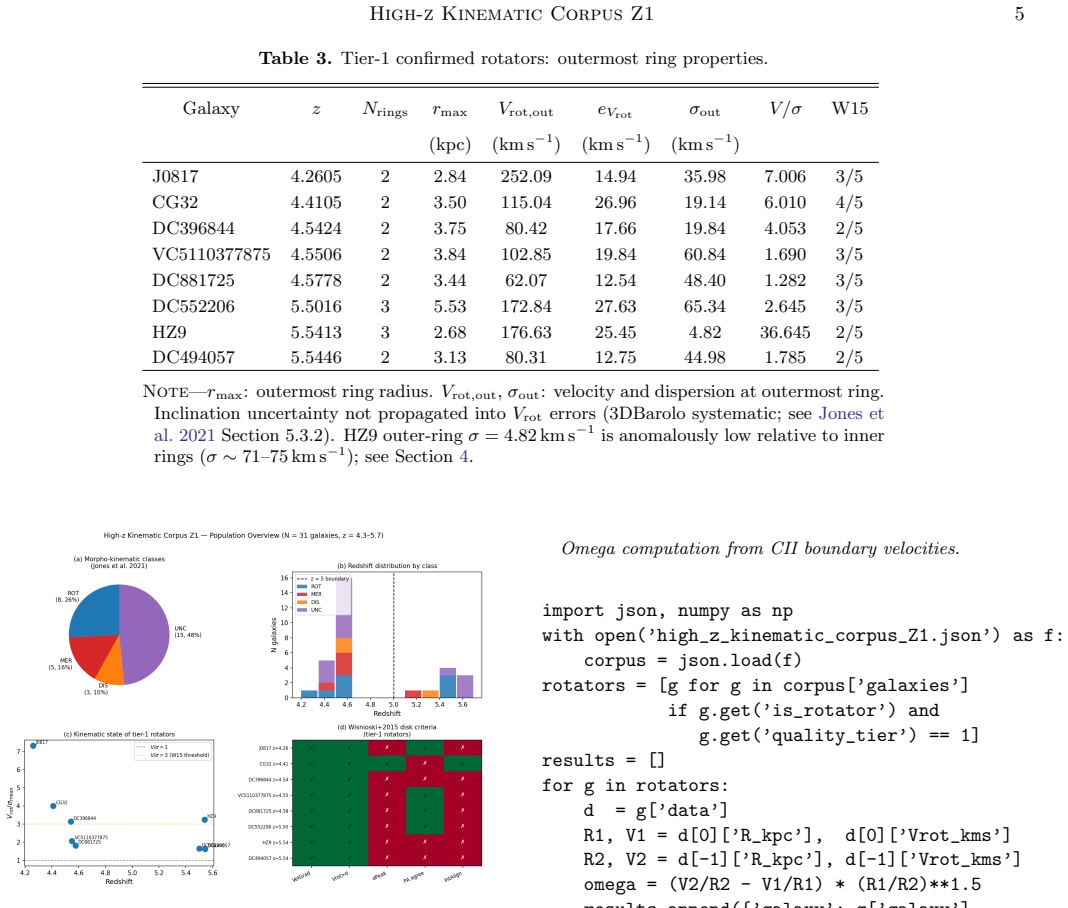
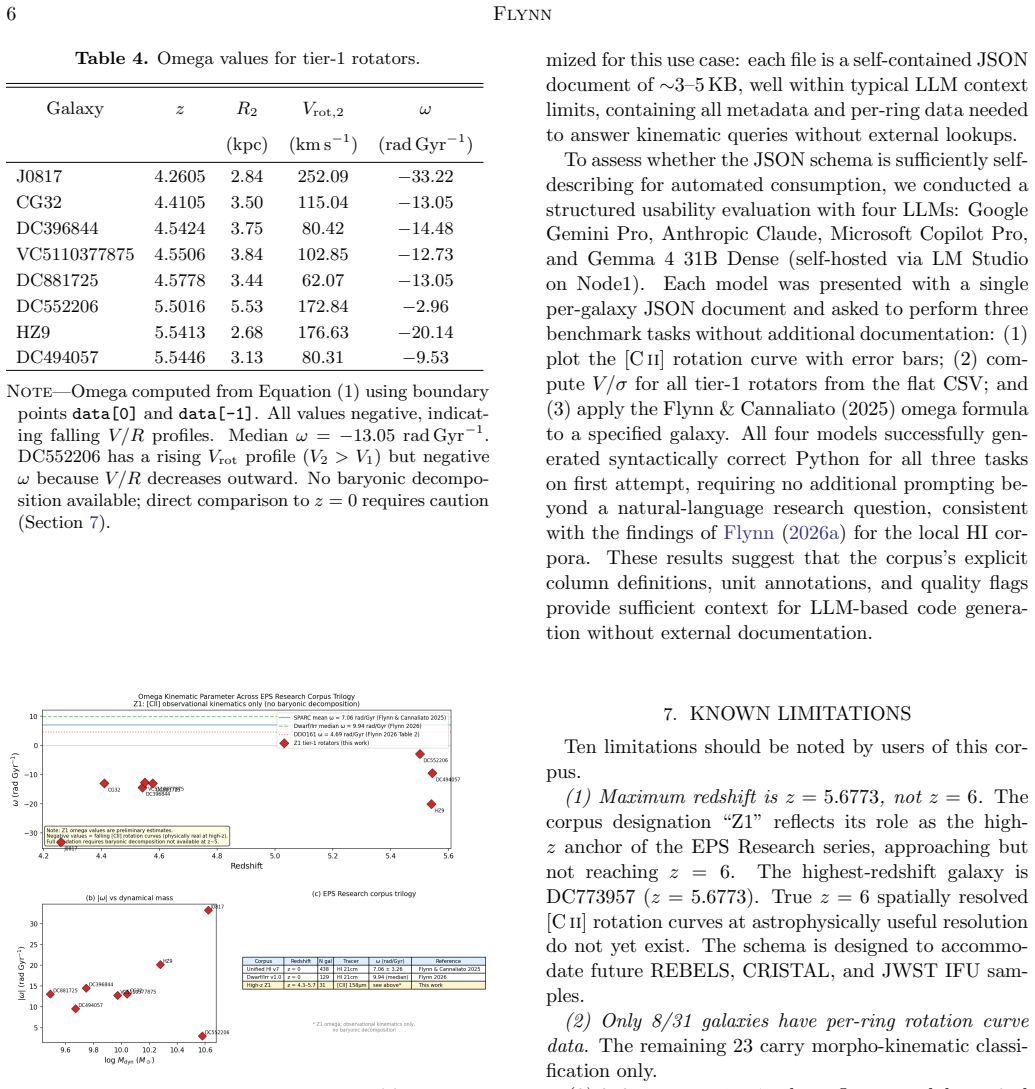
The High-z Kinematic Corpus Z1 supplies structured ALMA [C II] morpho-kinematic data for 31 galaxies at z = 4.26-5.68, of which eight tier-1 rotators produce negative omega values (median -13.05 rad/Gyr) from per-ring rotation curves, in direct contrast to the positive omega values measured at z = 0.
What carries the argument
The omega kinematic formula applied to quality tier 1 per-ring rotation curves and velocity dispersions extracted by 3DBarolo tilted-ring fits on the [C II] data.
If this is right
- Negative omega at these redshifts aligns with the transition from centrally concentrated high-z systems to extended rotating disks at lower redshift.
- The corpus supports direct population statistics and cross-corpus application of the omega correction across redshift.
- The released formats enable single-galaxy rotation curve analysis and corpus-level filtering for future kinematic studies.
- The data set provides a reference catalog for galaxies approaching the epoch of reionization.
Where Pith is reading between the lines
- If the negative omega trend persists in larger samples, it may reflect systematic differences in how angular momentum is distributed in early galaxies.
- Higher-resolution follow-up observations could test whether the tier-1 rotation curve quality remains stable under improved spatial sampling.
- Linking the corpus to hydrodynamic simulations would allow direct comparison of observed omega evolution with predicted assembly histories.
Load-bearing premise
The eight galaxies possess reliable per-ring rotation curves and dynamical masses from the 3DBarolo tilted-ring fits, and the morpho-kinematic classifications correctly isolate the full sample of 31 galaxies.
What would settle it
A re-reduction of the same ALMA [C II] cubes that returns positive omega values for the eight tier-1 galaxies would remove the reported sign difference with local samples.
Figures
read the original abstract
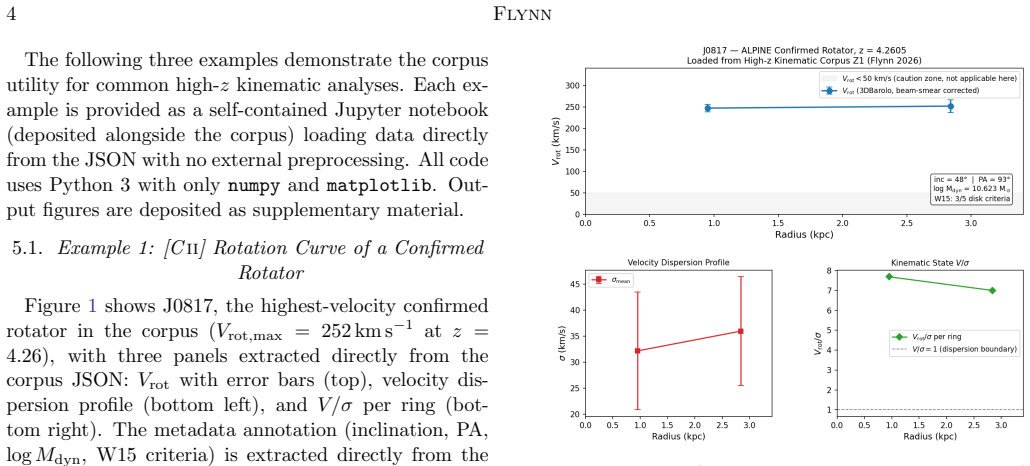
We present the High-z Kinematic Corpus Z1, a structured machine-readable dataset of ALMA [C ii] 158 um morpho-kinematic data for 31 star-forming main-sequence galaxies at z = 4.26-5.68 drawn from the ALPINE survey (Jones et al. 2021; Le Fevre et al. 2020). The corpus is the fourth entry in the EPS Research RAG Astrophysics Corpus Series, extending coverage from Milky Way globular clusters and local HI rotation curves (Flynn 2026a,b,c) to the epoch approaching cosmic reionization. Eight confirmed rotators carry quality tier 1 per-ring rotation curves from 3DBarolo tilted-ring fits (Di Teodoro & Fraternali 2015), with 2-3 rings per galaxy, Vrot and sigma per ring, and dynamical mass estimates; the remaining 23 galaxies carry morpho-kinematic classification only (quality tier 2). All entries include stellar mass (Faisst et al. 2020), star formation rate, Wisnioski et al. (2015) disk criteria, and geometric parameters. The corpus is distributed as a single structured JSON file with nested per-ring kinematic data, a flat CSV for catalog-level filtering, a RAG-ready JSONL archive (one galaxy per line), and a per-galaxy ZIP archive. Three worked Jupyter notebook examples demonstrate single-galaxy [C ii] rotation curve analysis, corpus-level population statistics, and cross-corpus application of the Flynn & Cannaliato (2025) omega kinematic correction. Applying the omega formula to all 8 tier-1 rotators yields negative values (median -13.05 rad/Gyr), contrasting with positive values at z = 0 (+7.06 rad/Gyr for SPARC spirals; +9.94 rad/Gyr for local dwarfs), consistent with the known evolution from centrally concentrated high-z systems to extended rotating disks. The corpus is publicly available at Zenodo (DOI: 10.5281/zenodo.20369285) under CC BY 4.0.
Editorial analysis
A structured set of objections, weighed in public.
Referee Report
Summary. The manuscript presents the High-z Kinematic Corpus Z1, a structured machine-readable dataset compiling ALMA [C II] 158 μm morpho-kinematic data for 31 star-forming main-sequence galaxies at z = 4.26-5.68 from the ALPINE survey. Eight galaxies are classified as quality tier 1 with per-ring rotation curves (Vrot, σ, dynamical masses) from 3DBarolo tilted-ring fits (2-3 rings each); the remaining 23 receive morpho-kinematic classifications only (tier 2). All entries include stellar masses, SFRs, Wisnioski et al. (2015) disk criteria, and geometric parameters. The corpus is released as a nested JSON file, flat CSV, RAG-ready JSONL, and per-galaxy ZIP archives, accompanied by three Jupyter notebook examples. The paper applies the Flynn & Cannaliato (2025) ω kinematic correction to the tier-1 sample, reporting negative values (median −13.05 rad/Gyr) in contrast to positive local values.
Significance. If the compilation faithfully reproduces the source ALPINE data and 3DBarolo outputs, the corpus supplies a valuable, publicly accessible resource for high-redshift galaxy kinematics extending the authors’ prior series to z ≈ 5. The provision of multiple machine-readable formats plus worked Jupyter notebooks is a clear strength that directly supports reproducibility and community reuse.
minor comments (2)
- [Abstract] Abstract: the phrase 'the omega formula' is used without a parenthetical citation or one-sentence definition; adding '(Flynn & Cannaliato 2025)' would make the highlighted result immediately traceable.
- The manuscript would benefit from a concise table (or JSON schema excerpt) listing the eight tier-1 galaxies together with their ring counts, quality flags, and basic derived quantities for quick reference.
Simulated Author's Rebuttal
We thank the referee for their positive review of the manuscript and their recommendation to accept. The report contains no major comments requiring response.
Circularity Check
No significant circularity identified
full rationale
This is a data-release paper whose central deliverable is a structured corpus compiled from the ALPINE survey using established pipelines (3DBarolo, Wisnioski criteria). The application of the Flynn & Cannaliato (2025) omega formula is presented as an example in Jupyter notebooks, not as a load-bearing derivation or prediction for the corpus itself. No self-definitional steps, fitted inputs called predictions, or uniqueness theorems are invoked in a way that reduces the main claim to its inputs. The paper is self-contained as a compilation and distribution effort.
Axiom & Free-Parameter Ledger
Forward citations
Cited by 1 Pith paper
-
The EPS Research Astro-RAG Platform: A Unified Open-Science Infrastructure for Cross-Epoch Astrophysical Kinematic Analysis, LLM-Assisted Research Workflows, and Educational Outreach
Releases four cross-epoch kinematic corpora and reports a sign reversal in boundary-point angular velocity omega from positive at z=0 to negative at z~5 using a prior framework.
Reference graph
Works this paper leans on
-
[1]
arXiv , Author =:2002.00962 , Journal =
Béthermin, M., Fudamoto, Y., Ginolfi, M., et al.\ 2020, , 643, A2. doi:10.1051/0004-6361/202037649
-
[2]
Di Teodoro, E.M., & Fraternali, F.\ 2015, , 451, 3021. doi:10.1093/mnras/stv1213
-
[3]
Faisst, A.L., Schaerer, D., Lemaux, B.C., et al.\ 2020, , 247, 61. doi:10.3847/1538-4365/ab7a3c
-
[4]
doi:10.3389/fspas.2025.1680387
Flynn, D.C., & Cannaliato, J.\ 2025, Frontiers in Astronomy and Space Sciences, 12. doi:10.3389/fspas.2025.1680387
-
[5]
Flynn, D.C.\ 2026a, Astronomy and Computing (submitted; preprint arXiv:2604.13489). Zenodo. doi:10.5281/zenodo.19563417
work page internal anchor Pith review Pith/arXiv arXiv doi:10.5281/zenodo.19563417
-
[6]
Flynn, D.C.\ 2026b, Dwarf/Irregular Galaxy HI Rotation Curve Corpus v1.0. Zenodo. doi:10.5281/zenodo.20320362
-
[7]
Flynn, D.C.\ 2026c, Milky Way Globular Cluster Corpus v1.3.1. Zenodo. doi:10.5281/zenodo.19907765
-
[8]
Jones, G.C., Vergani, D., Romano, M., et al.\ 2021, , 507, 3540. doi:10.1093/mnras/stab2703
-
[9]
Survey strategy, observations, and sample properties of 118 star-forming galaxies at 4 < z < 6
Le F\` e vre, O., Béthermin, M., Faisst, A., et al.\ 2020, , 643, A1. doi:10.1051/0004-6361/201936965
-
[10]
doi:10.1088/0004-637X/799/2/209
Wisnioski, E., F\" o rster Schreiber, N.M., Wuyts, S., et al.\ 2015, , 799, 209. doi:10.1088/0004-637X/799/2/209
discussion (0)
Sign in with ORCID, Apple, or X to comment. Anyone can read and Pith papers without signing in.